


Read this first. Mold questions in a home are health questions, and this article does not attempt to answer health questions. What follows is about moisture, which is the condition growth depends on, and about what published federal guidance says regarding moisture control in a basement. It does not diagnose anything in your house, it does not quantify health risk, and it does not describe remediation procedures. If you have a specific concern about existing growth in your home, have it assessed by a qualified professional rather than working from a general article. It supports our services and sits under our wet basement guide.
In This Guide
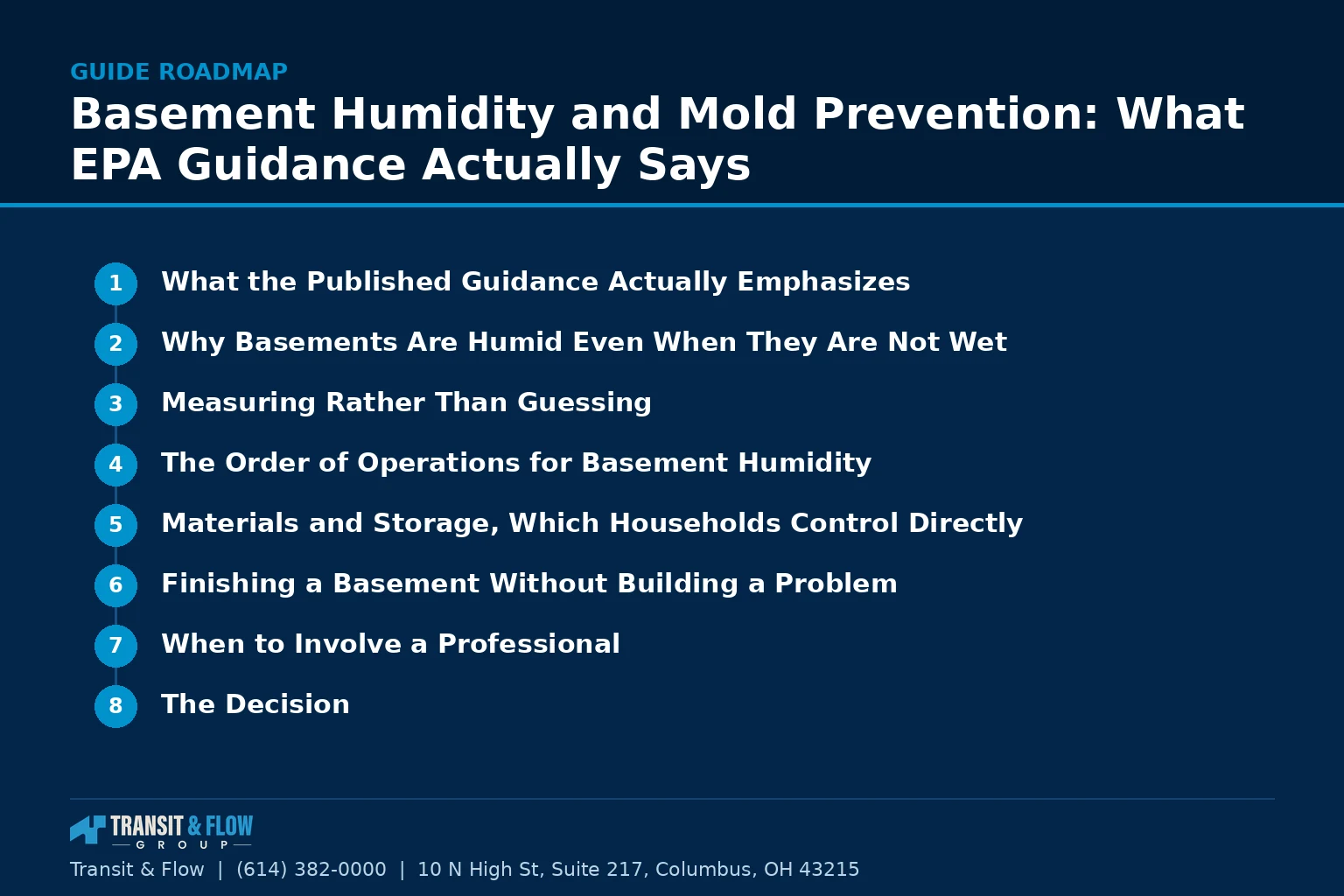
- What the Published Guidance Actually Emphasizes
- Why Basements Are Humid Even When They Are Not Wet
- Measuring Rather Than Guessing
- The Order of Operations for Basement Humidity
- Materials and Storage, Which Households Control Directly
- Finishing a Basement Without Building a Problem
- When to Involve a Professional
- On Cost
- Glossary
- The Decision
- Where Transit & Flow Group Fits
- Frequently Asked Questions
Transit & Flow Group coordinates projects and partners with properly licensed and insured specialty contractors when licensing is required.
What the Published Guidance Actually Emphasizes
The consistent theme across the United States Environmental Protection Agency’s published material on this subject is moisture. Guidance directs attention to controlling water and humidity, to acting promptly when water intrusion occurs, and to fixing the source of moisture rather than treating the surface. It is written around the idea that moisture is the variable a building owner can control, and that controlling it is the durable approach.
Two points in that guidance are worth stating carefully because they are frequently misrepresented in the marketplace. The first is the emphasis on timeliness: published guidance addresses drying wet materials promptly rather than allowing them to remain wet. The second is the emphasis on cause: guidance directs that the underlying water problem be corrected, because addressing a surface without correcting the source is understood to be temporary.
What that means for a Central Ohio basement is that everything in our wet basement guide about identifying and correcting the water source is the substantive work here. Humidity control is the second half of the problem, and it is the half this article covers.
Why Basements Are Humid Even When They Are Not Wet
A basement can have no liquid water at all and still hold high humidity, and understanding why is what separates a useful response from an expensive guess. There are three independent sources.
- Summer condensation. Warm humid outdoor air enters a cool basement, meets masonry and slab at ground temperature, and the moisture in that air condenses on the cool surfaces. This is why opening basement windows in July, which feels like the obvious remedy, frequently makes conditions worse rather than better.
- Vapor movement through the slab and walls. Concrete and masonry are permeable, and moisture moves through them from the soil as vapor without ever appearing as liquid. In a house without an under slab vapor barrier, which describes a great deal of older Central Ohio stock, this is continuous rather than seasonal.
- Interior generation. Laundry, showers, cooking, unvented appliances, and stored damp material all add moisture to the air, and in a basement with limited air exchange that moisture accumulates.
These behave differently through the year and they call for different responses, which is why measurement matters more than impression here. A basement that is humid in July and fine in March is describing condensation. A basement that is humid year round is describing vapor movement or interior generation.
Measuring Rather Than Guessing
An inexpensive hygrometer changes this from a subject of opinion into a subject of data, and it is the single most useful purchase a household can make in this category.
- Place a hygrometer in the basement, away from any obvious source, and leave it in a fixed position.
- Place a second one upstairs. The comparison between floors is more informative than either reading alone.
- Record readings on a schedule across a full year, so seasonal behavior becomes visible rather than remembered.
- Note outdoor conditions alongside each reading, because the relationship between indoor and outdoor humidity is what identifies the mechanism.
- Note anything that changed, including a dehumidifier being run, a window being opened, or drainage work being completed.
Published guidance on indoor humidity generally points toward keeping indoor relative humidity in a moderate range rather than allowing it to run high, and a household with a year of readings will know immediately whether their basement sits inside that range or outside it. That is a far stronger position than reacting to a musty impression on a humid afternoon.

The Order of Operations for Basement Humidity
As with liquid water, there is a correct sequence, and it runs from removing sources to managing what remains. Running a dehumidifier against an uncorrected source is an ongoing utility cost with no endpoint.
- Correct liquid water entry first, through gutters, discharge, grading, and drainage. Nothing downstream holds while water is still arriving.
- Eliminate interior sources. Confirm the dryer vents to the exterior and that the duct is intact, that bathroom and kitchen exhaust terminate outside rather than into the basement or an attic, and that no unvented combustion appliance is adding moisture.
- Insulate cold surfaces that condense, including cold water piping, which drips onto whatever sits below it all summer.
- Stop bringing humid summer air into a cool basement. Close basement windows during humid weather rather than opening them.
- Address vapor movement where it is the identified mechanism, which is a design question about the assembly rather than an appliance question.
- Then, and only then, size a dehumidifier for what remains, with a drain rather than a reservoir so it runs continuously without attention.
- Continue measuring, so you can see whether each step actually moved the number.
Materials and Storage, Which Households Control Directly
Some of the most effective moves in a basement have nothing to do with equipment. They are choices about what is put in the space and how.
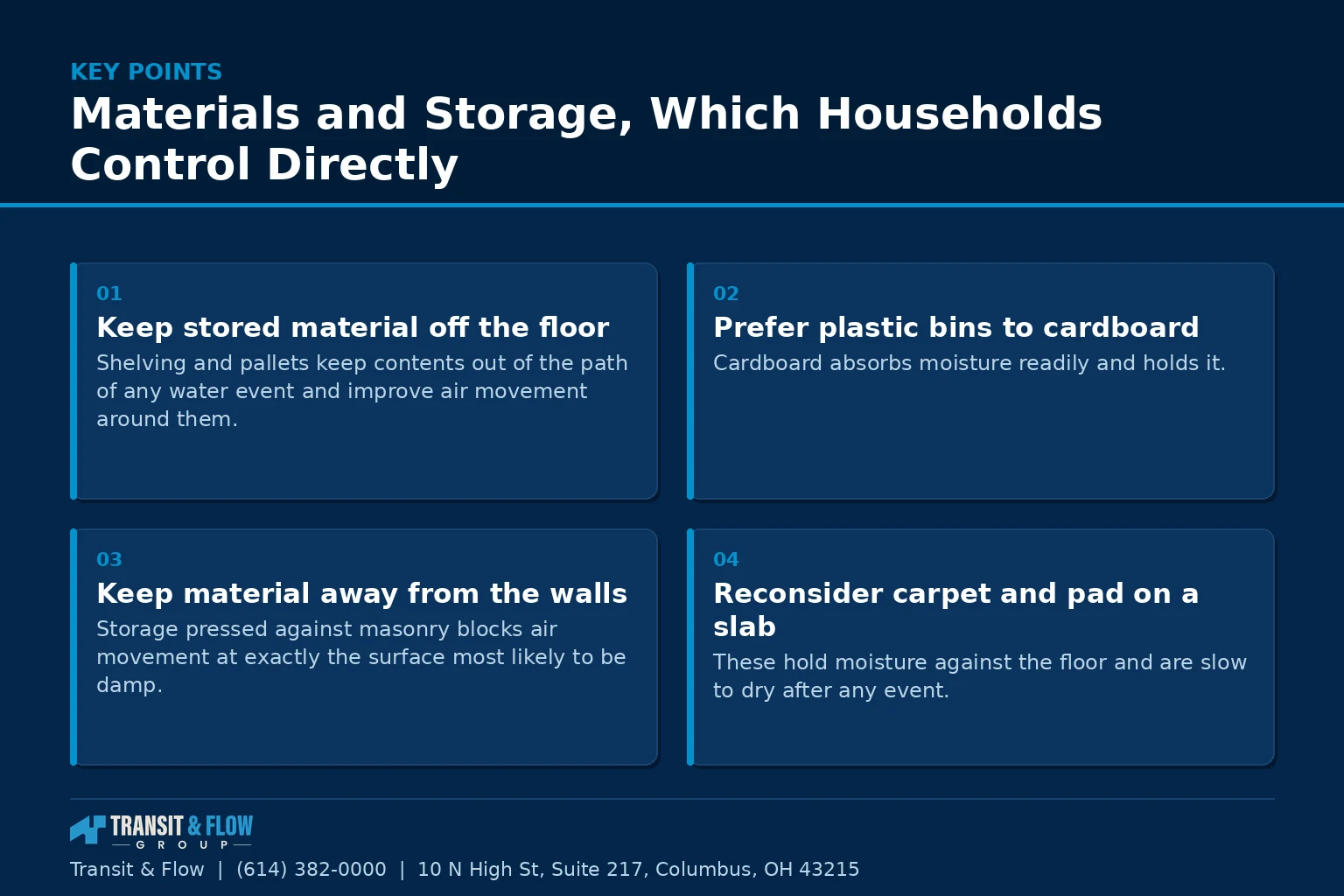
- Keep stored material off the floor. Shelving and pallets keep contents out of the path of any water event and improve air movement around them.
- Prefer plastic bins to cardboard. Cardboard absorbs moisture readily and holds it. This single substitution is one of the highest value changes available in an unfinished basement.
- Keep material away from the walls. Storage pressed against masonry blocks air movement at exactly the surface most likely to be damp.
- Reconsider carpet and pad on a slab. These hold moisture against the floor and are slow to dry after any event.
- Avoid storing anything irreplaceable below grade. Documents, photographs, and heirlooms belong above grade regardless of how dry the basement currently is.
- Leave clearance for inspection. Perimeter walls that cannot be seen cannot be monitored, and early observation is what keeps a small event small.
Finishing a Basement Without Building a Problem
Finishing changes the calculus, because a finished assembly conceals the wall and slows the discovery of any event. The general principle in published moisture guidance applies with particular force here: do not enclose a moisture problem. Correct the water first, verify it across seasons, and only then build.
The design questions that follow, including how the wall assembly handles vapor, what insulation is appropriate below grade, and what flooring tolerates an event, are genuine design questions rather than product preferences, and they are worth answering with a professional before framing begins. A basement finished over an uncorrected moisture condition produces exactly the outcome the guidance warns about, at a cost that includes the finish work as well as the original problem.
When to Involve a Professional
Some circumstances are outside what a household should be managing from general information. Visible growth of any meaningful extent, a persistent odor with no identified source, material that has been wet and stayed wet, any water event involving sewage or floodwater, or any situation where someone in the household has a specific health concern connected to the space. In each of these the right move is assessment by a qualified professional who examines the actual conditions.
That referral is not a formality and it is not hedging. Health questions require professional judgment applied to the specific circumstances of the specific people involved, and a general article is the wrong instrument for it. What this article can do is describe the moisture conditions that a household can control, which is what the published guidance itself emphasizes.
On Cost
This article contains no dollar figures on purpose. Moisture control spans everything from a hygrometer to a full drainage correction, and any figure published here would be applied to circumstances it does not fit. The relevant framing is sequencing rather than price. Measurement costs almost nothing and tells you which of the three mechanisms you are dealing with, and knowing that before spending is worth more than any single purchase in this category.
Glossary
- Relative humidity. The amount of water vapor in air expressed as a percentage of the maximum that air can hold at its current temperature.
- Dew point. The temperature at which air becomes saturated and moisture condenses onto a surface.
- Condensation. Water forming on a surface cooler than the dew point of the surrounding air.
- Vapor drive. The movement of water vapor through an assembly, driven by differences in vapor pressure across it.
- Vapor barrier or retarder. A material limiting the passage of water vapor through an assembly.
- Hygrometer. An instrument measuring relative humidity.
- Capillary action. Movement of liquid moisture through porous material against gravity.
- Efflorescence. Mineral deposit left on masonry as water moves through it and evaporates, evidence of moisture movement.
- Air exchange. The rate at which air in a space is replaced, which affects how much generated moisture accumulates.
The Decision
Option A is managing basement humidity with a dehumidifier and treating the number it produces as the measure of success. Option B is measuring across a full year, identifying which of the three mechanisms is operating, correcting sources in order, and then sizing a dehumidifier for the remainder with a permanent drain. My recommendation is Option B. Option A is not wrong so much as incomplete, and its weakness is that it never reveals whether the underlying condition is improving or worsening behind a machine that runs continuously. The households who resolve this durably are the ones who know their numbers by season, because that knowledge tells them whether they have a water problem, an air problem, or a vapor problem, and those three have entirely different remedies. For the water sequence, see our wet basement guide, and for the exterior work that removes most of the source, our article on grading and downspouts.
Where Transit & Flow Group Fits
Transit & Flow Group coordinates home services across Columbus and Central Ohio and partners with properly licensed and insured specialty contractors when licensing is required. Our standard on basement moisture is that liquid water sources are identified and corrected before humidity equipment is discussed, that exhaust terminations are verified to discharge outside the building, that measurement across seasons is recommended before spending, and that any concern about existing growth or about health is referred to a qualified professional for assessment rather than addressed within a construction proposal. To have basement moisture sources evaluated in that order, contact us.
Frequently Asked Questions
Why is my basement humid when there is no water in it?
There are three independent mechanisms and they behave differently through the year. Summer condensation happens when warm humid outdoor air enters a cool basement and its moisture condenses on masonry and slab sitting at ground temperature. Vapor movement through the slab and walls is continuous rather than seasonal, because concrete and masonry are permeable and moisture moves through them from the soil without ever appearing as liquid, which describes a great deal of older Central Ohio housing stock. Interior generation comes from laundry, showers, cooking, unvented appliances, and stored damp material accumulating in a space with limited air exchange. A basement humid in July and fine in March is describing condensation, while one humid year round is describing vapor movement or interior generation.
Does opening the basement windows in summer help?
It generally makes conditions worse rather than better, even though it feels like the obvious remedy. Bringing warm humid outdoor air into a cool basement puts that moisture in contact with surfaces at ground temperature, which is precisely the condensation mechanism. Closing basement windows during humid weather is the step that belongs in the sequence. Insulating cold surfaces that condense, including cold water piping that drips onto whatever sits below it all summer, belongs there as well.
How should basement humidity actually be measured?
An inexpensive hygrometer turns this from a matter of opinion into a matter of data, and it is the single most useful purchase in this category. Place one in the basement away from any obvious source and leave it in a fixed position, then place a second one upstairs, because the comparison between floors is more informative than either reading alone. Record readings on a schedule across a full year so seasonal behavior becomes visible rather than remembered, and note outdoor conditions alongside each reading, since the relationship between indoor and outdoor humidity is what identifies the mechanism. Note anything that changed as well, including a dehumidifier running, a window opened, or drainage work completed. Published guidance points toward keeping indoor relative humidity in a moderate range rather than allowing it to run high, and a year of readings tells you where you sit.
What is the right order of operations for basement humidity?
Correct liquid water entry first through gutters, discharge, grading, and drainage, because nothing downstream holds while water is still arriving. Then eliminate interior sources by confirming the dryer vents to the exterior with an intact duct and that bathroom and kitchen exhaust terminate outside rather than into the basement or attic. Insulate cold surfaces that condense, stop bringing humid summer air into the space, and address vapor movement where that is the identified mechanism, which is a design question about the assembly rather than an appliance question. Only then size a dehumidifier for what remains, with a drain rather than a reservoir so it runs continuously without attention. Keep measuring so you can see whether each step actually moved the number. Running a dehumidifier against an uncorrected source is an ongoing utility cost with no endpoint.
What storage choices make a difference in a basement?
Some of the most effective moves have nothing to do with equipment. Keep stored material off the floor on shelving or pallets so contents are out of the path of any water event and air can move around them, and prefer plastic bins to cardboard, since cardboard absorbs moisture readily and holds it. Keep material away from the walls, because storage pressed against masonry blocks air movement at exactly the surface most likely to be damp. Reconsider carpet and pad on a slab, and keep anything irreplaceable above grade regardless of how dry the basement currently is. Leave clearance to see the perimeter walls, because walls that cannot be seen cannot be monitored.
When should a professional be involved?
Mold questions in a home are health questions, and anyone with a concern about existing growth should have it assessed by a qualified professional rather than working from a general article. That applies to visible growth of any meaningful extent, a persistent odor with no identified source, material that has been wet and stayed wet, any water event involving sewage or floodwater, and any situation where someone in the household has a specific health concern connected to the space. The referral is not a formality, because those judgments have to be applied to the actual conditions and the actual people involved. What a general article can usefully cover is the moisture side, which is what the published guidance itself emphasizes.
Sources
- United States Environmental Protection Agency, mold and moisture guidance
- United States Environmental Protection Agency, indoor air quality resources
- United States Department of Energy, moisture control guidance
- City of Columbus, Get a Permit, permit and inspection process
About This Guide
Written and edited by Micheal Parker, founder of Transit & Flow Group. Published February 24, 2027. This guide is checked against the agency and code sources listed above, and it is revised when those sources change.
General contractor of record. Micheal Parker holds City of Columbus General Contractor Registration G12064, issued by the Columbus Department of Building and Zoning Services under Transit & Flow LLC and valid through June 30, 2027. Trade work that falls outside the scope of that registration is performed by licensed trade partners, and the responsible license holder is identified before work begins.
Reviewed by Micheal Parker, City of Columbus registered general contractor, registration G12064. This guide covers a permit, structural, or life safety subject. It is written as evaluation guidance only. Every determination in it routes to the authority having jurisdiction and to a professional licensed in the applicable trade, and no statement here substitutes for that review.
Transit & Flow Group, home and commercial services for Columbus and the surrounding Central Ohio communities. Phone (614) 382-0000. Email solutions@transitflowgroup.com. 10 N High St, Suite 217, Columbus, OH 43215. Contact our team or review the communities we serve.
