

A sump pump has to discharge somewhere the water is legally allowed to go and physically will not come back. In most Central Ohio jurisdictions that means daylight discharge to a graded area, a storm sewer connection where the sewer authority permits one, or an engineered infiltration structure. It almost never means the sanitary sewer, the floor drain, or the laundry tub, and it never means a pipe that ends near your own foundation wall.
In This Guide
- Two Tests Every Discharge Has to Pass
- Why the Sanitary Sewer Is Off Limits
- Sanitary, Storm, and the Older Neighborhood Complication
- Discharging to Grade, and the Direction Problem
- The Recirculation Loop
- Freezing Lines and the Winter Failure
- Discharging Onto a Neighbor’s Property
- Drywells, Infiltration, and the Soil That Limits Them
- Check Valves, Cycling, and Pump Life
- Backup Power as a Resilience Decision
- How to Evaluate an Installation You Already Have
- The Decision
- Where Transit & Flow Group Fits
- Frequently Asked Questions
Here is what most Central Ohio property owners get wrong. They treat discharge as the last six feet of a plumbing job. It is actually the part of the system that decides whether the pump works at all, and it answers to two authorities: the sewer authority that says where the water may legally go, and the grade and soil that decide where it actually goes. Bad installations usually fail both tests.
Two Tests Every Discharge Has to Pass
The regulatory test is jurisdiction specific and easy to resolve. Your sewer authority and the adopted code, administered through your building department, define what receiving points are permitted for clear water from a sump. That answer is available by phone.
The engineering test is the one nobody asks about. Water leaving the pipe has to travel away under gravity, across ground that keeps falling away, into soil or a conveyance that can accept it during the same storm filling the sump. Central Ohio’s flat terrain and dense clay subsoils make that harder than it sounds. A discharge that satisfies the code and then puddles against the foundation has moved the leak twenty feet and added a pump to the utility bill.
Why the Sanitary Sewer Is Off Limits
Sanitary sewers are sized for wastewater, a flow that is predictable in volume and has to be biologically processed before it reaches a stream. Groundwater and roof runoff are clear water. They need no treatment, and every gallon displaces capacity the system needs for what does.
The failure mode is regional, not individual. In a heavy rain, thousands of sump pumps and downspouts illegally tied to the sanitary system run at once, and flow reaches the treatment plant at many multiples of design volume. The plant cannot hold residence time, so partially treated flow can reach the stream. The collection system surcharges, and sewage backs up through the lowest fixture in the line, frequently a basement floor drain.
Sewer authorities across Central Ohio run smoke and dye testing and issue correction orders. A sanitary connection is a defect that transfers with the property, and correction lands on whoever owns the house when it is found. Enforcement and any associated charges are set by your sewer authority.
Sanitary, Storm, and the Older Neighborhood Complication
A separated system runs two independent networks in the street. The sanitary sewer carries wastewater to treatment. The storm sewer carries rainwater and clear water to a stream or detention basin, largely untreated. Sump discharge belongs to the second category, which is why a storm connection can be legitimate where the authority permits one.
Older parts of Columbus and several inner ring communities were built before that separation was standard, and some were served by combined sewers carrying both in one pipe. The legacy shows up three ways. There may be no storm sewer in your street. Your foundation drain may have been legally tied to the sanitary system under the rules in force when the house was built. And a pipe leaving your basement may not go where anyone assumes.
A house in Clintonville, Bexley, or Grandview Heights may carry a connection that predates current rules, and some communities run programs to redirect them. Trace the line, then ask the sewer authority what governs your address, because the answer changes across a street.
Discharging to Grade, and the Direction Problem
Daylight discharge to the yard is the most common permitted arrangement and the easiest to do badly. Your jurisdiction’s requirement will address separation from the foundation, separation from the property line, and discharge onto a public walk or street where ice is a hazard. Get those figures from the authority having jurisdiction, not from a rule of thumb.
What the code will not tell you is where water goes after it lands. On a typical Central Ohio subdivision lot the grade falls away from the house briefly, then flattens into a swale running between houses to the street or a rear easement. Water released short of that swale runs back along the path of least resistance, the backfill trench around your own foundation.
- Find the low point first. Discharge must reach ground that keeps falling away, not ground that merely starts lower than the outlet.
- Respect the drainage swale. Lots are graded to move water a designed direction, and cutting across it floods a neighbor or ponds in place.
- Keep it off hard surfaces. Driveways and public walks turn discharge into a winter liability and often violate the local requirement.
- Watch the outlet detail. An open pipe end erodes a hole, the hole holds water, and that water freezes and blocks the line.
- Confirm the pipe is continuous. Buried lines separate at joints and crush under traffic, and water reappears mid yard.
- Separate it from the downspouts. Roof runoff and sump discharge in one undersized line means both back up in the same storm.
The Recirculation Loop
This is the most common engineering failure in residential sump installations. The pump discharges near the house, and water infiltrates the loose backfill around the foundation, far more permeable than the undisturbed clay beyond it, descends the trench, reaches the footing drain, enters the sump, and is pumped out again.
The symptom is a pump cycling on a short, regular interval long after the rain stopped. Owners read that as a high water table or a failing pump. It is a closed loop the installation created, adding tens of thousands of useless cycles a year. Central Ohio’s clay makes it worse, since native soil accepts water slowly. The fix is distance, positive grade, and often a buried line carrying water past the disturbed zone before releasing it.
Freezing Lines and the Winter Failure
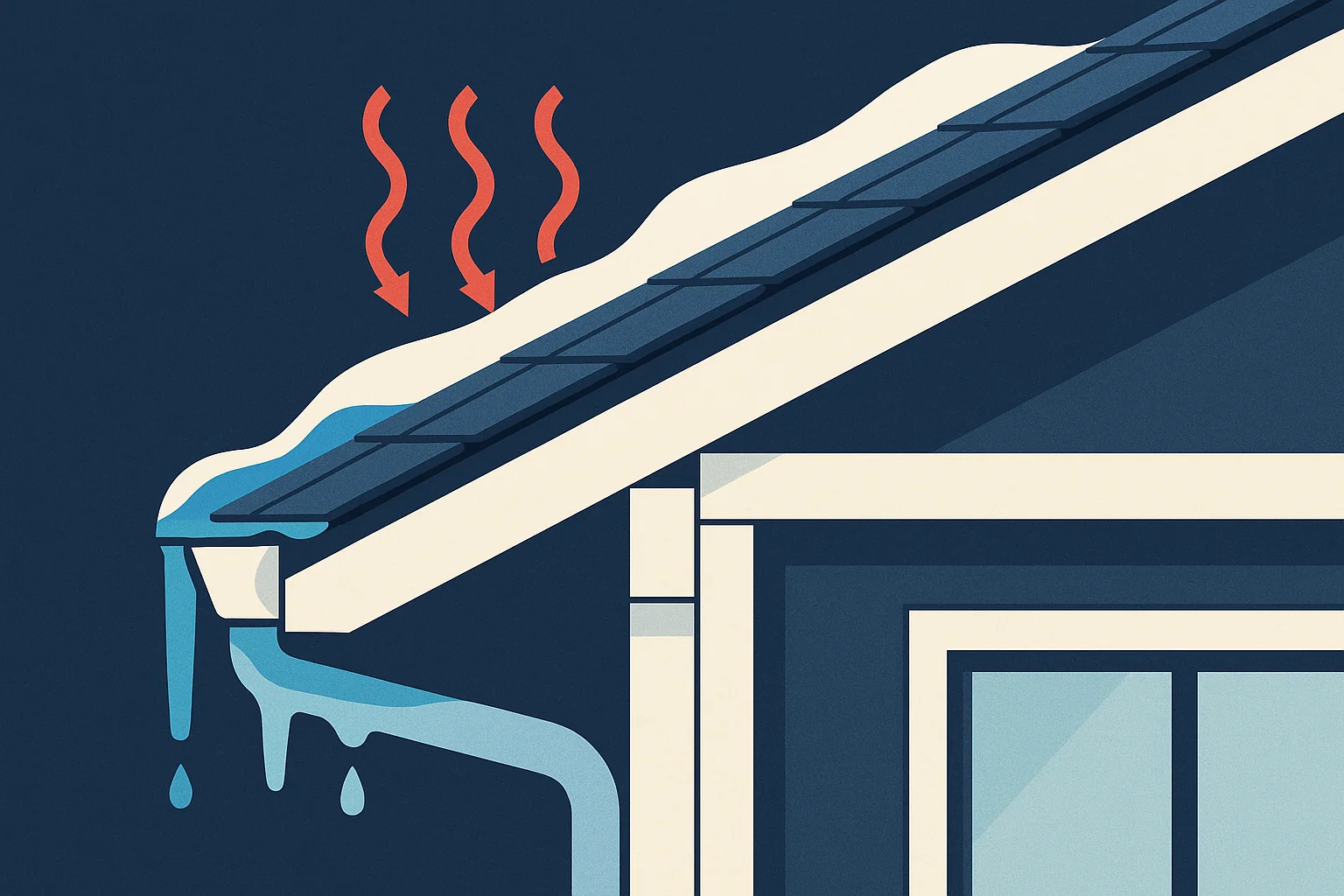
An Ohio winter presents a specific problem. Groundwater keeps moving during thaw cycles, so the pump still runs, but the line sits in air well below freezing. Any low spot holding residual water freezes, and each cycle adds ice until the line plugs.
What follows depends on the pump. Some stall against the blockage and burn out. Others run against no flow and overheat. Either way the basement floods during the February thaw, when the ground is saturated and the frost layer forces meltwater sideways.
- Continuous fall on the exposed run. Any sag holds water, and held water is where ice starts.
- No long runs above ground. Surface pipe crossing a yard freezes solid before buried pipe does.
- Bury the run below frost where possible. Buried line stays warmer and drains, though it still needs a freeze tolerant termination.
- Provide a relief fitting outside. A designed escape point keeps the pump from dead heading, though placement matters because it puts water near the house.
- Keep the outlet clear of snow. A discharge point under plowed snow is blocked.
- Test it in January, not April. Pour a bucket into the pit during a cold snap and confirm water reaches the outlet.
Discharging Onto a Neighbor’s Property
Ohio drainage disputes between neighbors generally turn on whether a discharge is a reasonable use of the property or an unreasonable concentration of water onto someone else’s land. Runoff routed to a property line, dumped into a shared swale beyond its design volume, or aimed at a downhill lot produces claims.
Two things distinguish sump discharge from ordinary runoff, and both work against you. It is concentrated at a single point, and it is continuous, running long after the storm passed while the neighbor’s yard tries to dry out. That turns an annoyance into a documented pattern with photographs. Keep discharge on your own property until it reaches the drainage path the subdivision was designed around.
Drywells, Infiltration, and the Soil That Limits Them
A drywell is a buried gravel or chambered void that receives discharge and lets it infiltrate. Where it works the water goes underground and never crosses a property line. It can be the right answer on a lot with nowhere else to send water.
The constraint is the soil, and in Central Ohio the soil usually is the constraint. Much of the region sits on glacial till with high clay content and low infiltration rates. A drywell in tight clay does not infiltrate, it stores, and once full it backs up the line or surfaces. In a multi day spring rain, exactly when the pump runs hardest, that storage is consumed early.
- Infiltration rate of the native soil. Measured on site, not assumed from a survey map.
- Seasonal high water table. A structure sitting in saturated ground has no capacity when you need it.
- Distance from the foundation. A drywell too close is a recirculation loop with a gravel pit attached.
- Distance from a septic system. On unsewered lots this is a county health department question.
- Sizing against sustained flow. The design case is a long saturating rain, not one downpour.
- A defined overflow path. Every infiltration structure eventually fills, and where water goes then should be a decision.
- Local approval. Some jurisdictions restrict or review infiltration structures, so confirm before digging.
Check Valves, Cycling, and Pump Life
The check valve sits above the pump and stops the column of water in the pipe from draining back into the pit at shutoff. Without one, that backflow refills the pit, retriggers the float, and the pump short cycles, running several times to move one pit of water.
Cycling predicts pump life. Motors fail on starts far more than on run hours, so an installation cycling twice as often gets about half the service life. Recirculation, a failed check valve, an undersized pit, and a float set for shallow travel all drive the same outcome. Valves fail quietly, holding partly open and producing slow backflow that owners blame on groundwater.
Backup Power as a Resilience Decision
The storms that produce the highest groundwater in Central Ohio are the storms that knock out power. Summer wind events and winter ice take down distribution lines while the ground is saturated. A pump without backup is offline during the hours it matters most, and that correlation is the whole argument.
Battery backup adds a second pump on its own float, powered by a maintained battery, with a charger and an alarm. Runtime depends on battery capacity and pump load, and the honest framing is hours, not days. Water powered backups use municipal supply pressure to drive an ejector and run indefinitely without electricity, but they consume treated water, need adequate pressure, and are restricted by some water authorities. A whole house generator solves it completely at larger cost and its own permitting.
The backup discharge has to be as sound as the primary. A backup plumbed into the same frozen line provides nothing.
How to Evaluate an Installation You Already Have
Work this in order, because each step changes what the next means.
- Trace the line end to end. Follow it from the pit to daylight and watch water leave the pipe. A line disappearing into a wall or floor is itself the finding.
- Rule out a sanitary connection. If discharge enters a floor drain, laundry tub, standpipe, or a pipe joining the building drain, call your sewer authority first.
- Watch a full cycle in the rain. Note where water lands and whether it stops within sight of the house.
- Time the cycles after the rain ends. Regular cycling a day or two later is the signature of recirculation.
- Test the check valve. Listen for water returning to the pit after the pump stops.
- Inspect the outlet. Look for erosion, a scoured basin, ice residue, crushed pipe, or a clogged screen.
- Map the winter route. Identify every above ground foot of pipe and every low spot that holds water.
- Walk the property line. Determine whether your discharge reaches a neighbor’s lot and how concentrated it arrives.
- Verify the backup and alarm. Unplug the primary, add water, and confirm the backup starts and the alarm sounds.
- Call the sewer authority once. Confirm what discharge points are permitted at your address and whether a redirection program applies.
The Decision
Option A. Treat the discharge as plumbing. Confirm the pump runs, extend the pipe past the flower bed, and deal with the rest when a problem appears.
Option B. Treat the discharge as a drainage design with a regulatory constraint. Establish with the sewer authority what receiving points are permitted, determine where your lot actually drains, route the line there with continuous fall and a freeze tolerant termination, and add backup power sized to the outage risk.
Recommendation: Option B, and the regulatory call comes first because it can eliminate options before you spend anything. The asymmetry settles it. Option A costs an afternoon and works most of the year. Its failure modes are a flooded basement in a February thaw, a correction order that transfers with the property, and a neighbor dispute with a documented history. Two moves capture most of the value. Get the water past the backfill zone to ground that keeps falling away, because that single change ends recirculation, extends pump life, and solves most of the winter problem at once. And confirm the receiving point with the authority having jurisdiction before anyone trenches.
Where Transit & Flow Group Fits
We coordinate residential drainage work across Central Ohio, and sump discharge is scoped as a drainage route rather than a length of pipe. That means confirming the permitted receiving point before design, reading the lot grade, and specifying a route that survives a February freeze. If you have a discharge you suspect is wrong, start a conversation with our team. You can also review our drainage and site water services, our guidance on foundation drainage in Central Ohio, our article on downspouts, extensions, and grading, and our overview of diagnosing basement water.
Transit & Flow Group coordinates projects and partners with properly licensed and insured specialty contractors when licensing is required, and work is performed under the appropriate permits.
Frequently Asked Questions
Can I connect my sump pump to the sanitary sewer
Connecting clear water sources such as sump pumps and downspouts to the sanitary sewer is prohibited in Ohio communities, because during storms that clear water overwhelms the collection and treatment system and contributes to backups and overflows.
What is the difference between a sanitary sewer and a storm sewer
The sanitary sewer carries wastewater to treatment. The storm sewer carries surface water to a waterway. Older Central Ohio neighborhoods sometimes have configurations that make this less obvious than it should be, which is why confirming with the sewer authority matters.
Where should sump water discharge
Far enough from the foundation, and in a direction that carries it away, so it does not simply return to the drain tile and cycle. The specific requirement is set by the local sewer authority and the adopted code, so confirm before installing or relocating a line.
Why does my sump pump run constantly
A short cycling or constantly running pump often means the discharged water is returning to the foundation. That recirculation loop is the most common reason a homeowner concludes the pump is undersized when the discharge location is the actual problem.
What happens to the discharge line in winter
A line that holds water can freeze, which blocks discharge exactly when the pump needs to run and can fail the pump or flood the basement. Discharge line design for freezing conditions is a real detail in an Ohio installation, not an afterthought.
Can I discharge sump water onto my neighbor’s property
Directing concentrated water onto adjoining property creates a liability exposure and a neighbor dispute, and local requirements commonly address it. Water must have a destination that works legally as well as physically, and that is part of the design.
Sources
- Ohio Environmental Protection Agency, wastewater treatment and stormwater program information
- United States Environmental Protection Agency, infiltration and runoff management practices
- International Code Council, adopted Ohio code documents
- Ohio Utilities Protection Service, underground utility location before excavation
- National Weather Service, Wilmington Ohio, regional precipitation and winter weather data
About This Guide
Written and edited by Micheal Parker, founder of Transit & Flow Group. Published July 20, 2027. This guide is checked against the agency and code sources listed above, and it is revised when those sources change.
General contractor of record. Micheal Parker holds City of Columbus General Contractor Registration G12064, issued by the Columbus Department of Building and Zoning Services under Transit & Flow LLC and valid through June 30, 2027. Trade work that falls outside the scope of that registration is performed by licensed trade partners, and the responsible license holder is identified before work begins.
Transit & Flow Group, home and commercial services for Columbus and the surrounding Central Ohio communities. Phone (614) 382-0000. Email solutions@transitflowgroup.com. 10 N High St, Suite 217, Columbus, OH 43215. Contact our team or review the communities we serve.
