


Read this first. This article is written to help a household decide when to call a licensed structural engineer, and nothing more than that. It does not diagnose foundations, it does not classify any crack in your house, and it does not describe repair procedures. Structural questions are answered by a licensed professional engineer who examines the actual building, and no article, photograph comparison, or contractor’s opinion at the curb substitutes for that. If any of the observations described below apply to your house, the correct next step is an engineer, not a repair estimate. It supports our concrete work and sits under our wet basement guide.
In This Guide
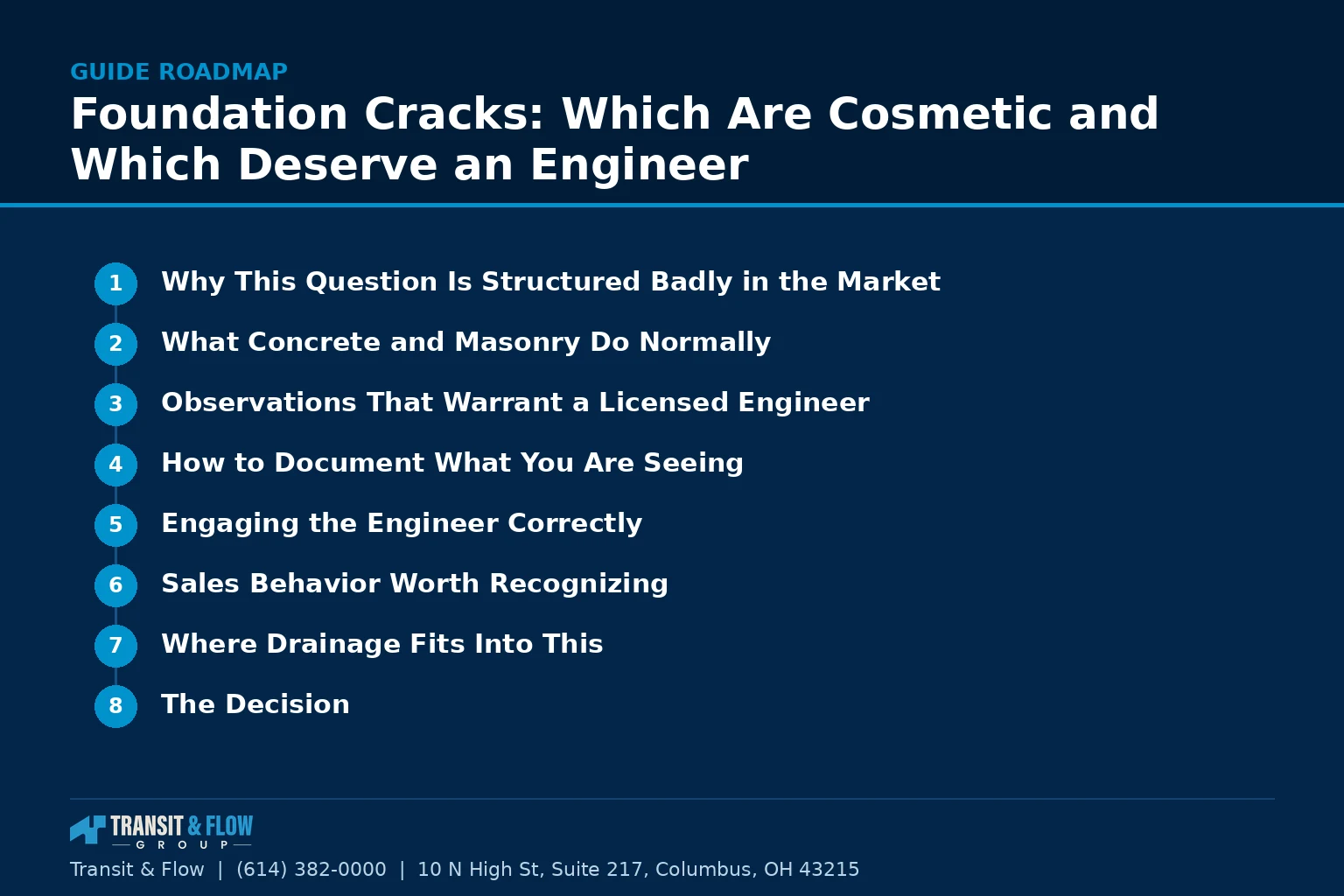
- Why This Question Is Structured Badly in the Market
- What Concrete and Masonry Do Normally
- Observations That Warrant a Licensed Engineer
- How to Document What You Are Seeing
- Engaging the Engineer Correctly
- Sales Behavior Worth Recognizing
- Where Drainage Fits Into This
- On Cost
- Glossary
- The Decision
- Where Transit & Flow Group Fits
- Frequently Asked Questions
Transit & Flow Group coordinates projects and partners with properly licensed and insured specialty contractors when licensing is required.
Why This Question Is Structured Badly in the Market
In most home improvement categories, the party who evaluates the problem and the party who fixes it being the same company is a convenience. In structural work it is a conflict, and it is the central reason households make poor decisions here. A company that sells foundation repair is being asked to judge whether foundation repair is necessary, and even in complete good faith that is a difficult position to occupy well.
The correction is straightforward and it is the single most valuable thing in this article. Separate the evaluation from the repair. A licensed professional engineer, engaged directly by the household, paid for the opinion rather than the work, and with no financial interest in the outcome, produces a report. That report then becomes the specification that contractors bid against. The household ends up comparing like to like, and the question of whether the work is needed at all has been answered by someone who does not benefit from the answer.
The cost of that report is small relative to any structural repair, and in the substantial number of cases where the engineer concludes that monitoring is the right course rather than intervention, it is the least expensive money a homeowner will ever spend.
What Concrete and Masonry Do Normally
Some context makes the rest of this easier to hold. Concrete shrinks as it cures, and shrinkage produces cracking. That is a material property rather than a defect, and it is why a poured foundation wall in a house of any age commonly shows fine vertical cracking that has been there since the first year and has never changed. Masonry moves seasonally with temperature and with the moisture content of the soil around it, and Central Ohio’s clay rich soils expand and contract more than sandier soils do, which means Central Ohio houses move more than houses elsewhere.
So the presence of a crack is not information by itself. The information is in the pattern, the width, the direction, the location, whether it is changing, and what else in the house is doing at the same time. Those are the things an engineer evaluates together, and that is exactly why isolated observations are not diagnoses.
Observations That Warrant a Licensed Engineer
The following are observations, not conclusions. Any one of them is a reason to have the building looked at by a professional engineer. None of them tells you what is wrong, and none of them tells you what the remedy is.
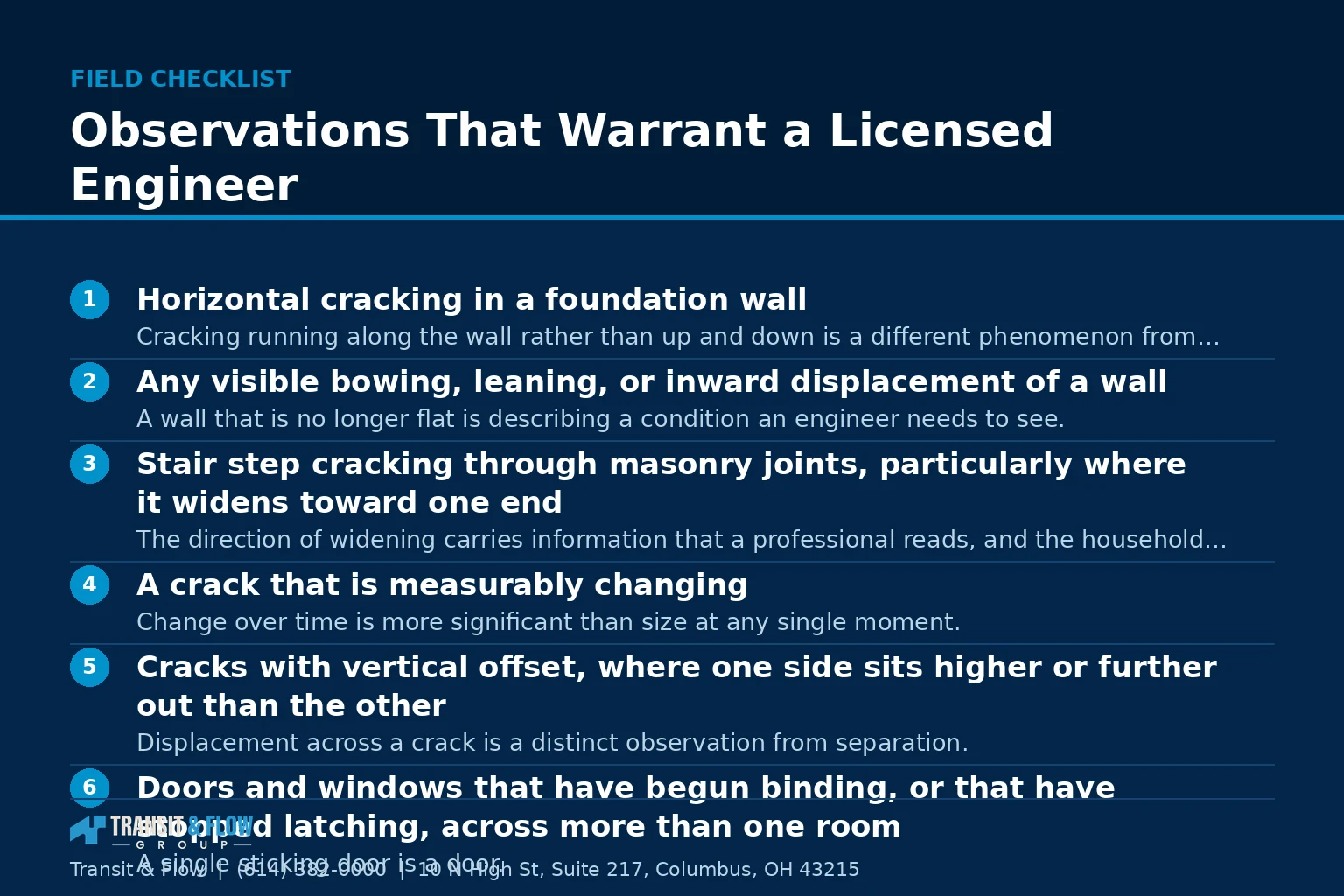
- Horizontal cracking in a foundation wall. Cracking running along the wall rather than up and down is a different phenomenon from vertical shrinkage cracking, and it warrants professional evaluation regardless of width.
- Any visible bowing, leaning, or inward displacement of a wall. A wall that is no longer flat is describing a condition an engineer needs to see.
- Stair step cracking through masonry joints, particularly where it widens toward one end. The direction of widening carries information that a professional reads, and the household does not need to interpret it, only to report it.
- A crack that is measurably changing. Change over time is more significant than size at any single moment. A crack that has been identical for fifteen years and a crack that has moved this season are different situations.
- Cracks with vertical offset, where one side sits higher or further out than the other. Displacement across a crack is a distinct observation from separation.
- Doors and windows that have begun binding, or that have stopped latching, across more than one room. A single sticking door is a door. A pattern across the house is a building.
- Sloping or bouncing floors, or a visible separation where a floor meets a wall.
- New cracking in drywall at the corners of door and window openings, recurring after repair. Cracking that returns after being patched is reporting movement rather than finish failure.
- Separation at the chimney, the porch, or an attached structure pulling away from the house.
- Any crack accompanied by active water entry, particularly where soil is visible or washing through. This combines a structural question with a drainage question and both need answering.
- Any observation that appeared or accelerated after nearby excavation, a new structure, a tree removal, a significant drainage change, or a prolonged drought or wet period.
Conversely, hairline vertical cracking in a poured wall, unchanged over years, with no water entry, no displacement, and nothing else in the house behaving oddly, is the most ordinary observation in residential construction. It is still reasonable to have it looked at during any inspection, and it is not a reason to accept an urgent repair proposal.
How to Document What You Are Seeing
Documentation is the household’s actual job here, and it makes the engineer’s work faster and better. It is also the only way to answer the question that matters most, which is whether anything is changing.
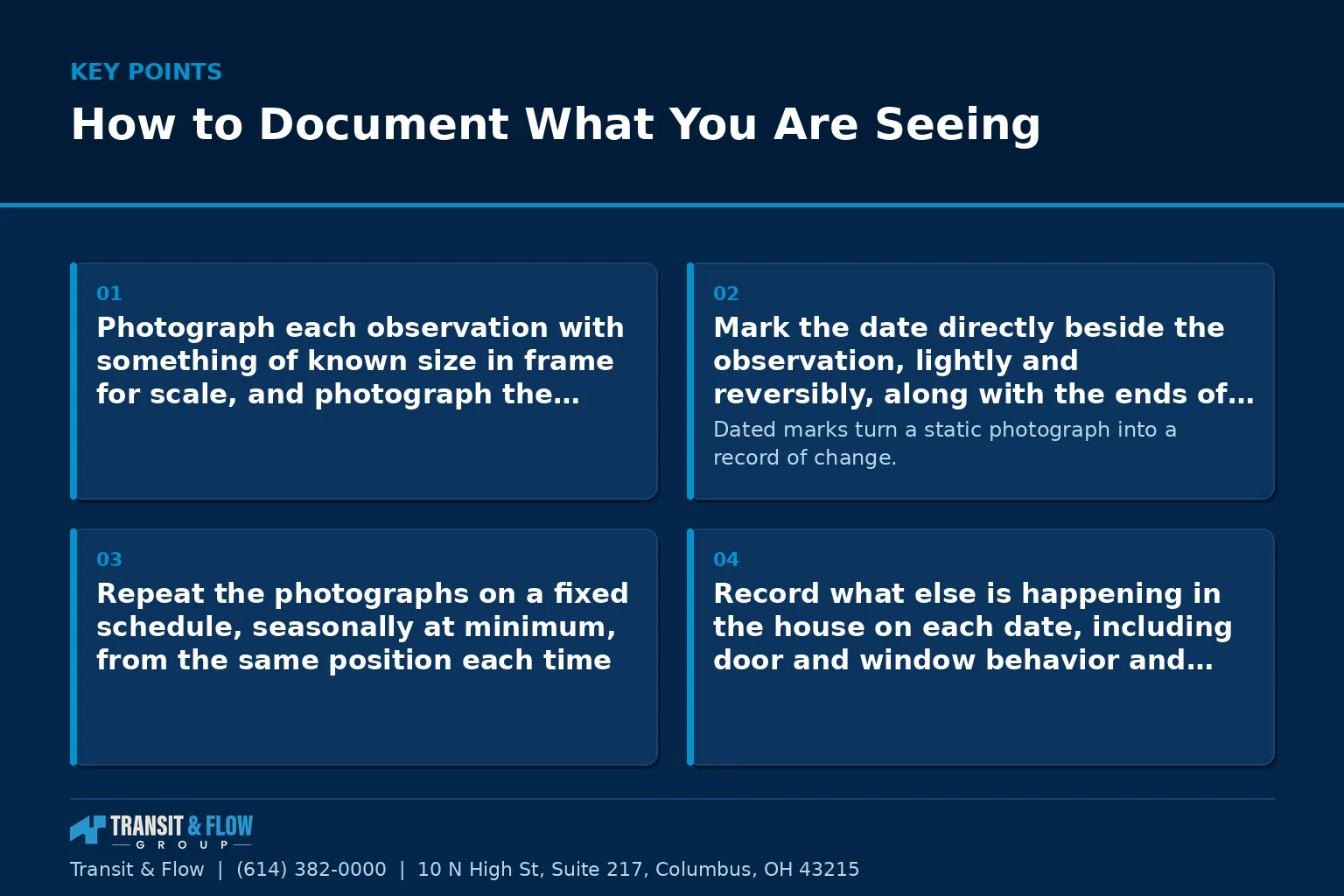
- Photograph each observation with something of known size in frame for scale, and photograph the whole wall as well as the detail, so location is clear.
- Mark the date directly beside the observation, lightly and reversibly, along with the ends of the crack. Dated marks turn a static photograph into a record of change.
- Repeat the photographs on a fixed schedule, seasonally at minimum, from the same position each time.
- Record what else is happening in the house on each date, including door and window behavior and any water entry.
- Record recent site changes, including drainage work, excavation, tree removal or planting, and unusually wet or dry stretches.
- Collect any prior inspection reports, disclosure documents, and previous repair records for the property.
- Bring all of it to the engineer at the first visit. An engineer with two years of dated photographs can say things an engineer seeing the wall once cannot.
Engaging the Engineer Correctly
- Engage a licensed professional engineer directly, as your client relationship. Not through the repair contractor, and not an engineer the contractor introduces and pays. Who holds the engagement determines who the report serves.
- Confirm the engineer holds a current Ohio professional engineer license. Licensure is verifiable, and it should be verified.
- Confirm they carry no financial interest in any repair method or contractor. Ask directly. The answer should be immediate and unambiguous.
- Ask for a written report with a stamped opinion, not a verbal impression. The written report is what contractors bid against and what a future buyer’s inspector will read.
- Ask whether monitoring is an acceptable course. Monitoring is a legitimate professional recommendation and it is frequently the correct one. A process that never produces that answer should raise a question.
- Ask what the report will specify. A useful report identifies the condition, states the probable mechanism, and defines the performance the repair must achieve, leaving the means to the contractor within those bounds.
- Ask about a follow up visit after any repair. Engineer verification that the installed work matches the specification is worth more than any contractor warranty.
Sales Behavior Worth Recognizing
This category attracts high pressure selling because the subject is frightening and the household has no independent way to check the claim. A few patterns are worth naming plainly.
Urgency applied to a condition that has existed for years. A price that expires at the end of the visit. A diagnosis delivered without measurement or documentation. A single recommended method applied to every house the company visits, which describes a product line rather than an assessment. An unwillingness to have the finding reviewed by an independent engineer, which is the clearest signal available. And free inspections that reliably discover expensive problems, which is not evidence of dishonesty in any individual case but is a structure that produces predictable outcomes across many.
The household’s protection against all of it is the same single move. No structural repair is purchased without an independent engineer’s written report first. That rule costs very little, it is easy to hold, and it removes essentially all of the exposure in this category.
Where Drainage Fits Into This
Foundation movement in Central Ohio is frequently connected to water, because clay soils change volume with moisture content and because saturated soil exerts pressure that dry soil does not. That connection cuts both ways. It means drainage correction is often part of a properly specified structural remedy, and it means drainage correction alone is sometimes what an engineer recommends.
What it does not mean is that a household should attempt to reason from water to structure on its own. The engineer establishes the relationship for the specific building. What the household can usefully do in the meantime is stop delivering unnecessary water to the foundation, because that is beneficial under every possible diagnosis and harmful under none. The sequence for doing that is in our wet basement guide.
On Cost
This article contains no dollar figures on purpose. Structural work spans a range so wide that any published number would mislead, and in this category specifically a number would be used as a benchmark against a proposal that may not be necessary at all. The only cost comparison worth making is between an engineer’s report and any structural repair proposal, and that ratio is dramatic enough that the report is never the expensive decision.
Glossary
- Professional engineer. An engineer licensed by the state to practice and to stamp engineering documents, holding professional responsibility for the opinion.
- Shrinkage cracking. Cracking arising as concrete cures and loses volume, a material property rather than a structural finding in itself.
- Differential settlement. Unequal downward movement between parts of a structure, as distinct from uniform settlement.
- Lateral load. Horizontal force applied to a wall, such as pressure from soil or from water in saturated soil.
- Displacement. Movement of one side of a crack relative to the other, in or out or up or down, as distinct from simple separation.
- Monitoring. A documented program of measurement over time to establish whether a condition is active or dormant, which is a legitimate professional recommendation.
- Stamped report. A written engineering opinion bearing the engineer’s seal, which carries professional accountability.
- Performance specification. A specification stating what the repair must achieve rather than dictating the exact method, allowing qualified contractors to propose means.
- Expansive soil. Soil that changes volume significantly with moisture content, characteristic of the clay rich soils common across Central Ohio.
The Decision
Option A is having a foundation repair company evaluate the condition and propose the remedy in the same visit. Option B is engaging an independent licensed professional engineer first, obtaining a stamped written report, and then taking that report to contractors as the basis for competitive proposals. My recommendation is Option B without any qualification, and it is the strongest recommendation in this entire library. Option A is not necessarily dishonest, but it asks one party to answer a question they are paid to answer in one direction, and it leaves the household with no way to evaluate the answer. Option B costs a fraction of any repair, it frequently concludes that monitoring is sufficient, and when repair genuinely is required it produces comparable bids against a defined standard and an independent party to verify the finished work. For the drainage sequence that reduces water load on a foundation regardless of diagnosis, see our wet basement guide, and for how scope changes should be documented once work begins, our article on change orders.
Where Transit & Flow Group Fits
Transit & Flow Group coordinates concrete and site work across Columbus and Central Ohio and partners with properly licensed and insured specialty contractors when licensing is required. Our standard on any observation that may be structural is that we refer the household to an independent licensed professional engineer before any repair scope is discussed or priced, that we do not evaluate structural conditions ourselves, and that where an engineer’s report specifies drainage or site work within our scope, we bid to that specification and support engineer verification of the completed work. To discuss drainage and site work around a foundation, contact us.
Frequently Asked Questions
Why should the company that evaluates a foundation crack not also be the company that repairs it?
In most home improvement categories the evaluator and the installer being one company is a convenience, but in structural work it is a conflict. A company that sells foundation repair is being asked to judge whether foundation repair is necessary, and even in complete good faith that is a difficult position to occupy well. The correction is to separate the evaluation from the repair by engaging a licensed professional engineer directly, paid for the opinion rather than the work. That report then becomes the specification contractors bid against, so the household compares like to like and the question of whether the work is needed at all was answered by someone with no interest in the answer.
Does a crack in my foundation wall mean something is wrong with the house?
The presence of a crack is not information by itself. Concrete shrinks as it cures and shrinkage produces cracking, which is a material property rather than a defect, and masonry moves seasonally with temperature and with the moisture content of the soil around it. Central Ohio’s clay rich soils change volume more than sandier soils do, so houses here move more than houses elsewhere. The information is in the pattern, the width, the direction, the location, whether it is changing, and what the rest of the house is doing at the same time, and those are things a licensed professional engineer evaluates together during an examination of the actual building.
Which observations mean I should call a licensed professional engineer?
The article lists observations rather than conclusions, and any one of them is a reason to have the building looked at. They include horizontal cracking in a foundation wall, visible bowing or leaning or inward displacement, stair step cracking through masonry joints, a crack that is measurably changing, cracks with vertical offset, doors and windows binding across more than one room, sloping or bouncing floors, drywall cracking at opening corners that recurs after repair, separation at a chimney or porch, any crack with active water entry, and anything that appeared after nearby excavation, tree removal, a drainage change, or a prolonged wet or dry stretch. None of these tells you what is wrong and none tells you what the remedy is. Report what you see and let the engineer interpret it.
What should I document before the engineer visits?
Documentation is the household’s actual job, and it is the only way to answer whether anything is changing. Photograph each observation with something of known size in frame for scale, and photograph the whole wall as well as the detail so location is clear. Mark the date beside the observation, lightly and reversibly, and repeat the photographs on a fixed schedule from the same position, seasonally at minimum. Record what else is happening in the house on each date and any recent site changes, collect prior inspection reports and repair records, and bring all of it to the first visit, because an engineer with two years of dated photographs can say things an engineer seeing the wall once cannot.
How do I engage a structural engineer the right way?
Engage a licensed professional engineer directly, as your own client relationship, rather than through a repair contractor or an engineer the contractor introduces and pays, because who holds the engagement determines who the report serves. Confirm the engineer holds a current Ohio professional engineer license, which is verifiable through the state board and should be verified. Ask directly whether they carry any financial interest in a repair method or contractor, and ask for a written report with a stamped opinion rather than a verbal impression. Ask what the report will specify and whether a follow up visit after any repair is available, since engineer verification that the installed work matches the specification is worth more than a contractor warranty.
Is it acceptable for an engineer to recommend monitoring instead of repair?
Monitoring is a legitimate professional recommendation and it is frequently the correct one. It means a documented program of measurement over time to establish whether a condition is active or dormant, and a process that never produces that answer should raise a question. In the substantial number of cases where an engineer concludes that monitoring is the right course rather than intervention, the report is the least expensive money a homeowner will ever spend. The protective rule to hold is simple, which is that no structural repair is purchased without an independent engineer’s written report first, particularly where urgency is being applied to a condition that has existed for years.
Sources
- Ohio State Board of Registration for Professional Engineers and Surveyors, license verification
- City of Columbus, Get a Permit, permit and inspection process
- Ohio Construction Industry Licensing Board, trade licensing verification
- Ohio Attorney General, consumer protection guidance on home improvement contracts
About This Guide
Written and edited by Micheal Parker, founder of Transit & Flow Group. Published February 19, 2027. This guide is checked against the agency and code sources listed above, and it is revised when those sources change.
General contractor of record. Micheal Parker holds City of Columbus General Contractor Registration G12064, issued by the Columbus Department of Building and Zoning Services under Transit & Flow LLC and valid through June 30, 2027. Trade work that falls outside the scope of that registration is performed by licensed trade partners, and the responsible license holder is identified before work begins.
Reviewed by Micheal Parker, City of Columbus registered general contractor, registration G12064. This guide covers a permit, structural, or life safety subject. It is written as evaluation guidance only. Every determination in it routes to the authority having jurisdiction and to a professional licensed in the applicable trade, and no statement here substitutes for that review.
Transit & Flow Group, home and commercial services for Columbus and the surrounding Central Ohio communities. Phone (614) 382-0000. Email solutions@transitflowgroup.com. 10 N High St, Suite 217, Columbus, OH 43215. Contact our team or review the communities we serve.
