


Two roofing estimates for the same house can differ by thousands of dollars and still both be fair, because they are quoting different roofs: different scopes, different components, different assumptions about what happens when the tear-off reveals surprises. The skill worth learning is not haggling. It is reading. This guide is a course in reading a roofing estimate line by line, spot what is missing, and force a true apples-to-apples comparison. It deliberately contains no price figures, because every roof is priced individually and any number quoted before yours is measured belongs to someone else’s roof. For the full project, start with our complete roof replacement guide.
In This Guide
- The Anatomy of a Complete Estimate
- What Missing Lines Actually Mean
- Forcing an Apples-to-Apples Comparison
- The Details That Reveal the Estimate Behind the Estimate
- Red Flags Worth Walking Away From
- How the Same Line Reads in Two Estimates
- Estimate Vocabulary Worth Knowing
- Estimates the Way They Should Be
- Frequently Asked Questions
Transit & Flow Group coordinates projects and partners with properly licensed and insured specialty contractors when licensing is required, and the estimates we present follow the structure described here, because an estimate you can interrogate is an estimate you can trust.
The Anatomy of a Complete Estimate
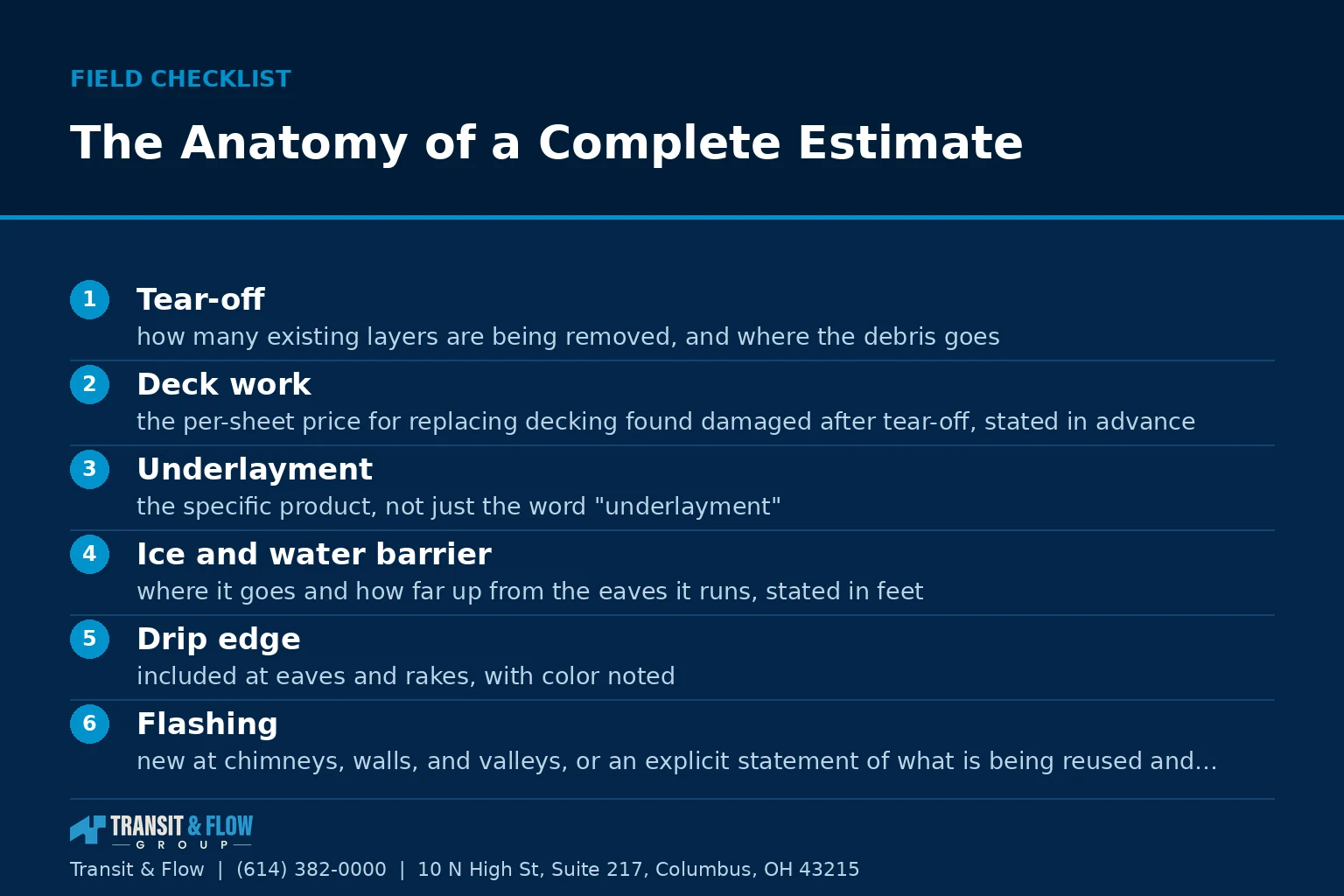
A complete roofing estimate identifies the property and the measured roof size in squares, then specifies every component of the system by name and, where it matters, by brand and product line. The Insurance Institute for Business and Home Safety’s research on roof performance is a catalog of reasons the details below the shingle decide how a roof survives wind and hail, and a serious estimate reads like it knows that.
- Tear-off: how many existing layers are being removed, and where the debris goes
- Deck work: the per-sheet price for replacing decking found damaged after tear-off, stated in advance
- Underlayment: the specific product, not just the word “underlayment”
- Ice and water barrier: where it goes and how far up from the eaves it runs, stated in feet
- Drip edge: included at eaves and rakes, with color noted
- Flashing: new at chimneys, walls, and valleys, or an explicit statement of what is being reused and why
- Ventilation: the intake and exhaust plan, as calculated pieces, not a vague “ridge vent included”
- Shingles: manufacturer, product line, and wind rating
- Permit: who pulls it and who pays for it
- Site protection and cleanup: landscaping protection, dumpster placement, and the magnetic nail sweep
- Warranties: manufacturer material warranty and contractor workmanship warranty, each with its term in years
- Payment schedule: deposit, milestones, and final payment tied to your walkthrough
What Missing Lines Actually Mean
An estimate that says “install new roof, workmanship guaranteed” in three lines is not simpler. It is unpriced scope, and unpriced scope becomes either a corner cut silently or a change order priced under pressure, after your old roof is already in the dumpster and your leverage went with it. The most expensive words in roofing are the ones that were never written down.
Watch especially for the deck. Nobody can see the deck until tear-off, so nobody can promise its condition. What a fair estimate does is price the unknown in advance: a stated cost per sheet of replacement decking, and a commitment to photograph damaged sections before replacing them. An estimate silent on the deck has not removed the risk. It has just moved the negotiation to the worst possible day.
Forcing an Apples-to-Apples Comparison
Take each estimate and fill in the same grid: the twelve components above, one row each, with what the estimate actually says. Leave a blank wherever the estimate is silent. When the grid is done, the comparison usually explains itself. The lower number is quoting fewer components, thinner coverage at the eaves, reused flashing, or a ventilation plan that consists of the word “vent.” Sometimes the lower number survives the grid intact, and then it is simply the better offer. The grid is how you find out which situation you are in.
Then normalize the warranties. A long workmanship warranty from a company two years old is a different instrument than a shorter one from a contractor with decades in the same service area. Ask each bidder the same two questions: what specifically voids this warranty, and who honors it if your company closes. The answers separate marketing from underwriting.
The Details That Reveal the Estimate Behind the Estimate
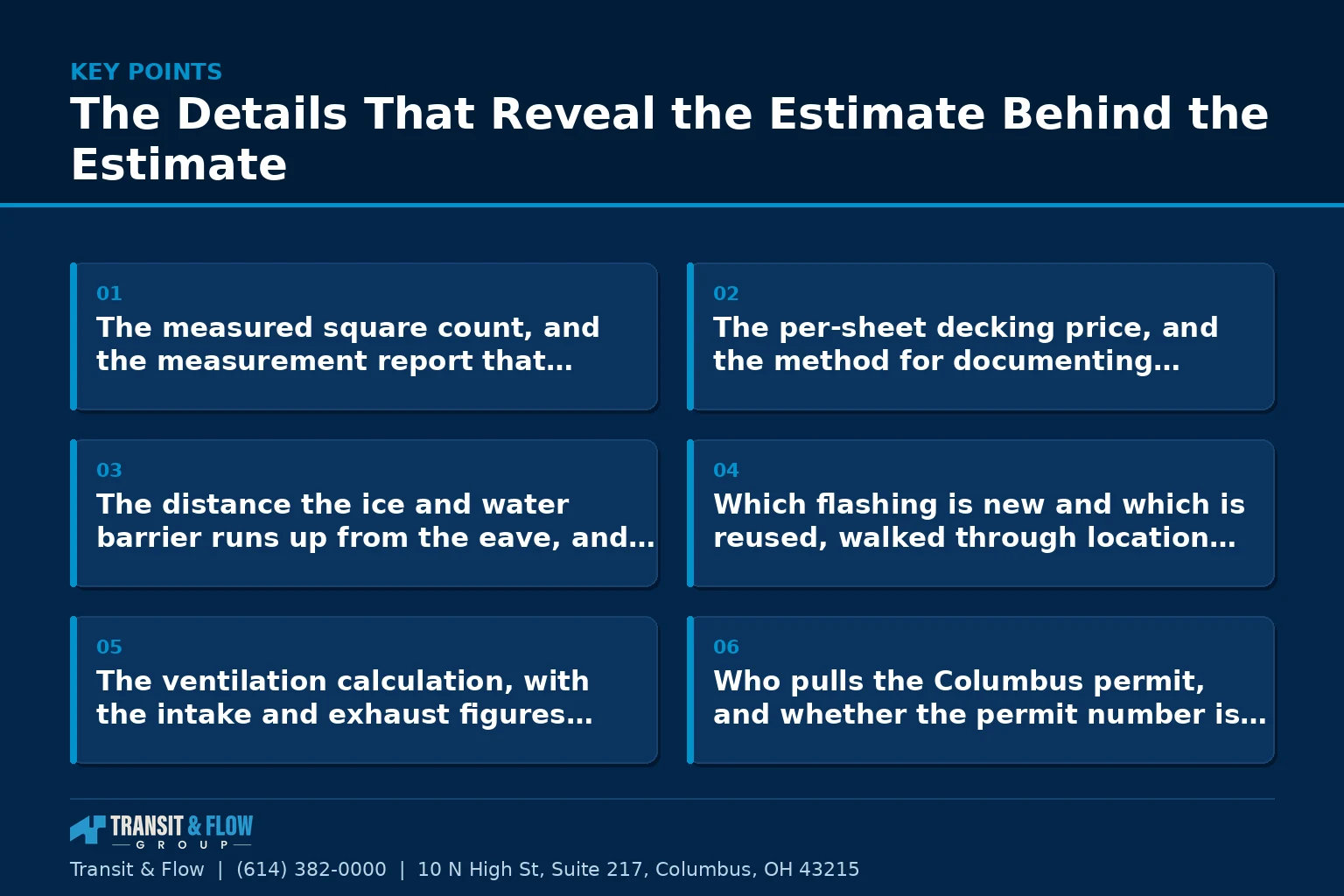
- The measured square count, and the measurement report that backs it.
- The per-sheet decking price, and the method for documenting damaged decking before it is replaced.
- The distance the ice and water barrier runs up from the eave, and the reasoning behind that distance on this roof.
- Which flashing is new and which is reused, walked through location by location.
- The ventilation calculation, with the intake and exhaust figures stated rather than implied.
- Who pulls the Columbus permit, and whether the permit number is in hand before tear-off begins.
- The payment schedule, and the work that is complete before each payment comes due.
Permit rules are local and current requirements should be verified with the City of Columbus permit office or your own jurisdiction’s building department. A bidder fluent in your jurisdiction’s process is showing you operational competence before the contract is signed.
Red Flags Worth Walking Away From
- A large payment demanded before any material is delivered or work begins
- Pressure to sign today to hold a price that expires tonight
- An offer to handle things without a permit to save time
- Refusal to put the deck price, the barrier coverage, or the flashing plan in writing
- No physical measurement of your actual roof before the number was produced
None of these are quirks of style. Each one moves risk from the contractor’s side of the table to yours, and if your roof is aging rather than storm-damaged, the decision sequence in our repair-or-replace framework belongs before any estimate at all.
How the Same Line Reads in Two Estimates
The gap between a complete estimate and a thin one is rarely a matter of honesty. It is a matter of what got written down. Put the same line side by side and the difference becomes obvious.
| Line item | Complete estimate states | Thin estimate states | What the gap costs you |
|---|---|---|---|
| Tear-off | Layer count removed and where debris goes | Remove old roof | A second layer discovered on site becomes a change order |
| Deck work | A stated unit price for replacement sheets plus a documentation commitment | Silent | The price is set after your leverage is gone |
| Underlayment | Named product and product line | Underlayment included | You cannot verify what was installed once it is covered |
| Flashing | New or reused, stated location by location | Flash as needed | Reused flashing at the oldest penetrations on the roof |
| Ventilation | Intake and exhaust stated as a calculated plan | Ridge vent included | An exhaust only system that starves for intake air |
| Warranties | Material and workmanship terms, each in years | Workmanship guaranteed | No instrument to point to when something fails |
Estimate Vocabulary Worth Knowing
An estimate is a technical document written for people who read them every day. These are the terms that carry the most weight.
- Square. The unit of roof area used for takeoffs and pricing. Every serious estimate states a measured square count.
- Measurement report. The aerial or field document behind the square count. Ask which one was used and request a copy.
- Decking. The structural sheathing under the roof system. Its condition cannot be known until tear-off, which is why the unit price belongs in the estimate.
- Underlayment. The water resisting layer between deck and shingle. Products differ substantially, so the product line matters.
- Ice and water barrier. A self adhering membrane applied in the areas most exposed to standing water and ice, with coverage defined by the adopted code and the manufacturer’s published instructions.
- Drip edge. The metal edge trim at eaves and rakes. Its presence, locations, and color all belong in writing.
- Flashing. The metal transitions at chimneys, walls, and valleys. Whether it is new or reused is one of the largest hidden differences between bids.
- Intake and exhaust. The two halves of attic ventilation. A plan that names only one half is incomplete by definition.
- Change order. A written revision to scope and price after signing. Fair projects have few, and they are documented before work proceeds.
- Workmanship warranty. The contractor’s own coverage on installation, distinct from the manufacturer’s material warranty.
- Exclusion. Work the estimate explicitly does not cover. Exclusions are useful and honest, and they are far better than silence.
- Punch walkthrough. The final joint inspection tying the last payment to work you have actually seen and accepted.
Estimates the Way They Should Be
Transit & Flow Group presents line-item roofing estimates built exactly to the anatomy above, walks you through every row before you sign, and manages the vetted specialty contractor performing the work through closeout. If you are holding estimates you cannot compare, bring them to us. We will put them in the grid with you, including ours.
Frequently Asked Questions
Why can two roofing estimates for the same house differ so much?
Because they are usually quoting different roofs. One may include full tear-off of every existing layer, new flashing at every penetration, a named underlayment, and a calculated ventilation plan, while the other assumes reused flashing and thinner coverage at the eaves. Differences in assumptions about what the tear-off will reveal widen the gap further. The gap is a scope difference far more often than it is a discount, which is why reading the line items matters more than negotiating the total.
What should a complete roofing estimate actually contain?
It should identify the property and the measured roof size in squares, then name every component of the system, including brand and product line where that matters. Expect distinct lines for tear-off, deck replacement pricing, underlayment, ice and water barrier, drip edge, flashing, ventilation, shingles, the permit, site protection and cleanup, warranties with their terms, and a payment schedule. Anything the estimate leaves silent is scope that has not been priced. The absence of a line is the information.
What does it mean if an estimate says nothing about the roof deck?
Nobody can see the deck until the old roof is off, so no contractor can honestly promise its condition in advance. A fair estimate handles that by pricing the unknown ahead of time, with a stated cost per sheet of replacement decking and a commitment to photograph damaged sections before they are replaced. An estimate that is silent on the deck has not removed that risk, it has only postponed the conversation. That conversation then happens after your old roof is in the dumpster, which is the point of lowest leverage.
How do I compare estimates that are formatted completely differently?
Build one grid and force every estimate into it. Put the standard components down the left side, one row each, and record what each estimate actually says in its column, leaving the cell blank wherever the estimate is silent. Once the grid is filled, the comparison generally explains itself, because the lower number is usually quoting fewer components or thinner coverage. Sometimes a lower number survives the grid intact, and in that case it is simply the better offer.
How should a workmanship warranty be evaluated?
Normalize the warranties before you compare them, because the term length alone tells you very little. A long workmanship warranty from a company two years old is a different instrument than a shorter one from a contractor with decades in the same service area. Put the same two points to every bidder: what specifically voids the warranty, and who honors it if the company closes. The answers tend to separate marketing language from anything actually backed.
What are the red flags worth walking away from?
A large payment demanded before any material is delivered or work begins, pressure to sign today to hold a price that expires tonight, and an offer to handle the job without a permit are the clearest ones. Refusal to put the deck price, the barrier coverage, or the flashing plan in writing belongs on the same list, as does producing a number without ever physically measuring the roof. None of these are quirks of style. Each one shifts risk from the contractor’s side of the table to yours. Permit requirements are local, so verify them with the City of Columbus permit office or your own jurisdiction’s building department.
Sources
- Insurance Institute for Business and Home Safety, roof system research
- National Roofing Contractors Association, installation standards referenced by warranties
- City of Columbus Building and Zoning Services, permit process
About This Guide
Written and edited by Micheal Parker, founder of Transit & Flow Group. Published August 23, 2026. This guide is checked against the agency and code sources listed above, and it is revised when those sources change.
General contractor of record. Micheal Parker holds City of Columbus General Contractor Registration G12064, issued by the Columbus Department of Building and Zoning Services under Transit & Flow LLC and valid through June 30, 2027. Trade work that falls outside the scope of that registration is performed by licensed trade partners, and the responsible license holder is identified before work begins.
Transit & Flow Group, home and commercial services for Columbus and the surrounding Central Ohio communities. Phone (614) 382-0000. Email solutions@transitflowgroup.com. 10 N. High St., Suite 217, Columbus, OH 43215. Contact our team or review the communities we serve.
