
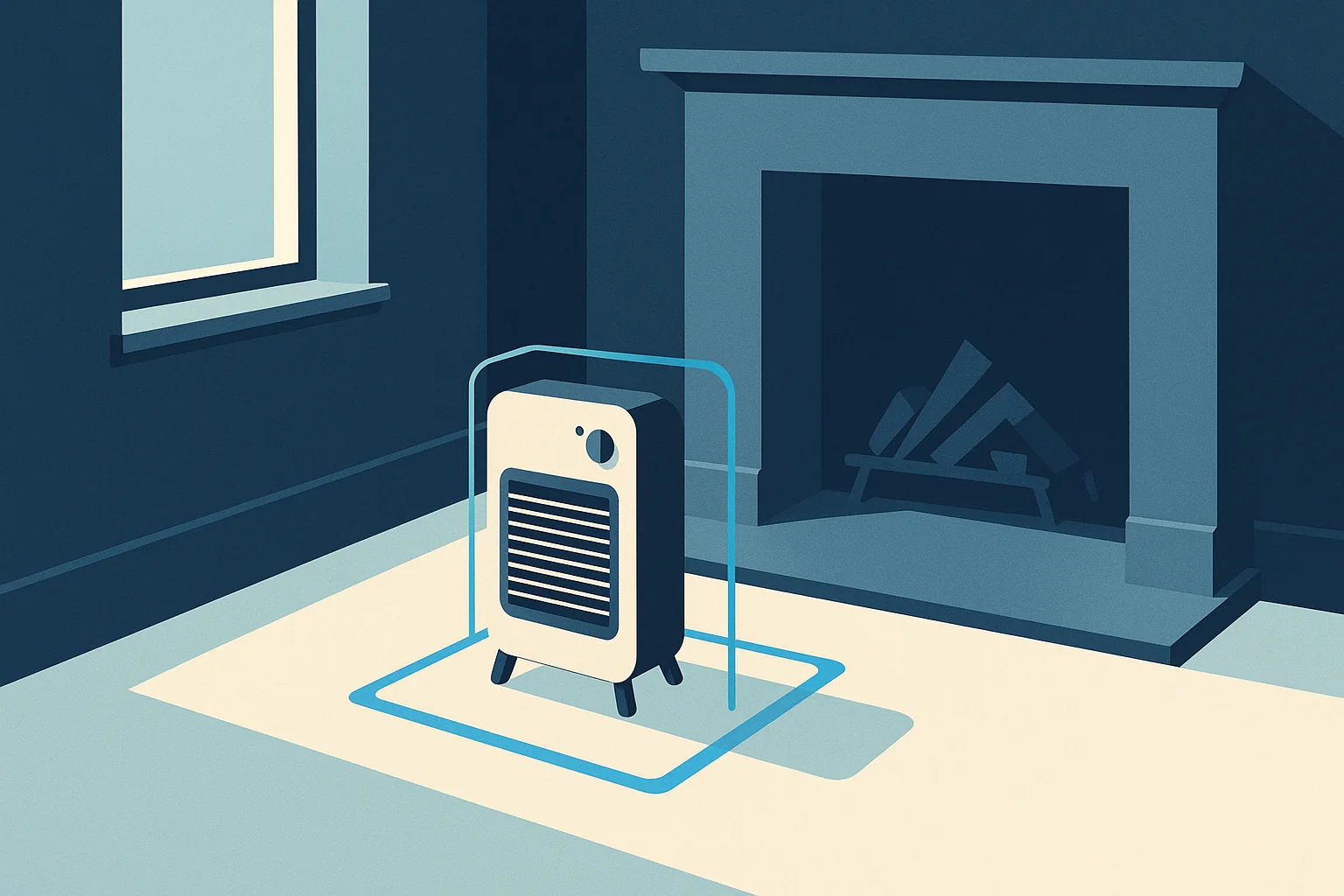

Supplemental heat is where Central Ohio homes get into trouble in January. Space heaters and fireplaces are the two systems most likely to be used casually and the two most associated with residential fire and carbon monoxide incidents during heating season. This is a checklist article, written to be worked through once in early winter. It supports our electrical and heating work.
In This Guide
- Why Supplemental Heat Carries Outsized Risk
- The Space Heater Checklist
- The Fireplace and Chimney Checklist
- Detection, Which Is the Part Everyone Skips
- Where Transit & Flow Group Fits
- Frequently Asked Questions
Transit & Flow Group coordinates projects and partners with properly licensed and insured specialty contractors when licensing is required.
Read this first. If a carbon monoxide alarm sounds, get everyone outside immediately, call from outside, and call emergency services if anyone has a headache, nausea, dizziness, or confusion. Do not open windows first and do not silence the alarm and go back to bed. If you smell gas, leave the building and call from outside. Never use a device intended for outdoor use indoors, including a grill, a camp stove, a generator, or an unvented construction heater. That category of misuse is the one that kills people during outages.
Why Supplemental Heat Carries Outsized Risk
Central heating systems are installed under permit, inspected, vented by design, and serviced on a schedule. Supplemental heat is none of those things. A space heater is bought at a store, plugged into whatever outlet is nearest, and placed wherever it is convenient, usually in a room being used at the time. A fireplace is a combustion appliance that is used a handful of times a year and inspected less often than that.
The risk profile follows directly. The heater problems are electrical load and proximity to combustibles. The fireplace problems are the flue and the combustion byproducts. They are different failures and they need different checklists.
The Space Heater Checklist
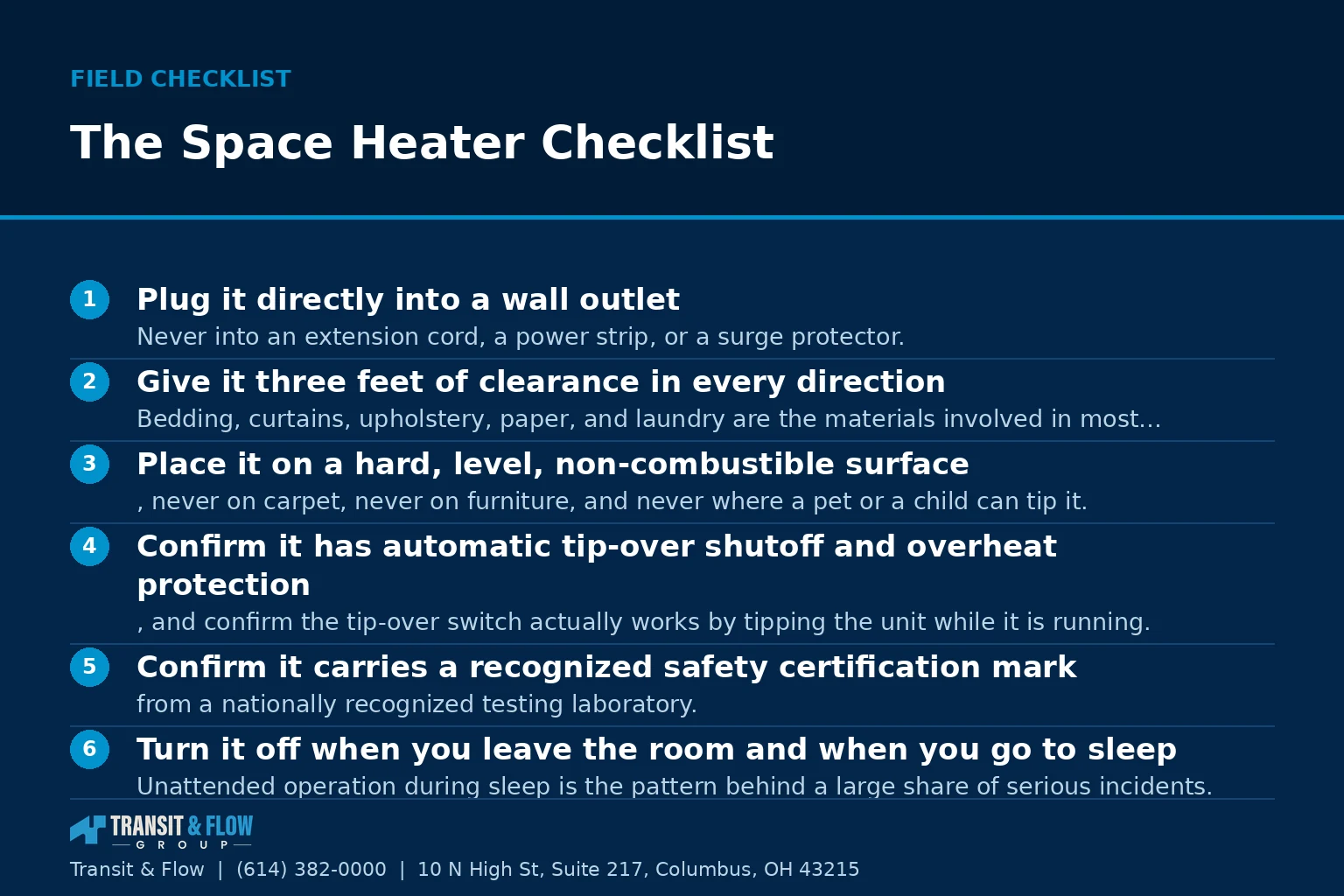
- Plug it directly into a wall outlet. Never into an extension cord, a power strip, or a surge protector. This is the single most consequential rule on the list, because these devices draw near the limit of a standard circuit for hours at a time and the cord or strip becomes the failure point.
- Give it three feet of clearance in every direction. Bedding, curtains, upholstery, paper, and laundry are the materials involved in most incidents.
- Place it on a hard, level, non-combustible surface, never on carpet, never on furniture, and never where a pet or a child can tip it.
- Confirm it has automatic tip-over shutoff and overheat protection, and confirm the tip-over switch actually works by tipping the unit while it is running.
- Confirm it carries a recognized safety certification mark from a nationally recognized testing laboratory.
- Turn it off when you leave the room and when you go to sleep. Unattended operation during sleep is the pattern behind a large share of serious incidents.
- Inspect the cord and the plug each season. Cracking, discoloration, stiffness, or a plug that feels warm in the outlet means the unit and possibly the receptacle are done.
- Feel the outlet after twenty minutes of operation. A warm faceplate is a wiring or receptacle problem, not a heater problem, and it needs a licensed electrician.
- Do not run two heaters on the same circuit, and be aware that bedroom and living room outlets frequently share one.
- Retire units older than roughly a decade, since protective features and construction standards have moved meaningfully.
Two points deserve emphasis. First, if you are using a space heater every day in the same room, the real problem is a heating or distribution deficiency and the heater is a symptom. Our article on ductwork problems covers the most common cause of a single cold room. Second, if the circuit trips when the heater runs, do not reset it repeatedly and do not move to a larger breaker. That is a capacity question covered in our guidance on overloaded panels.
The Fireplace and Chimney Checklist
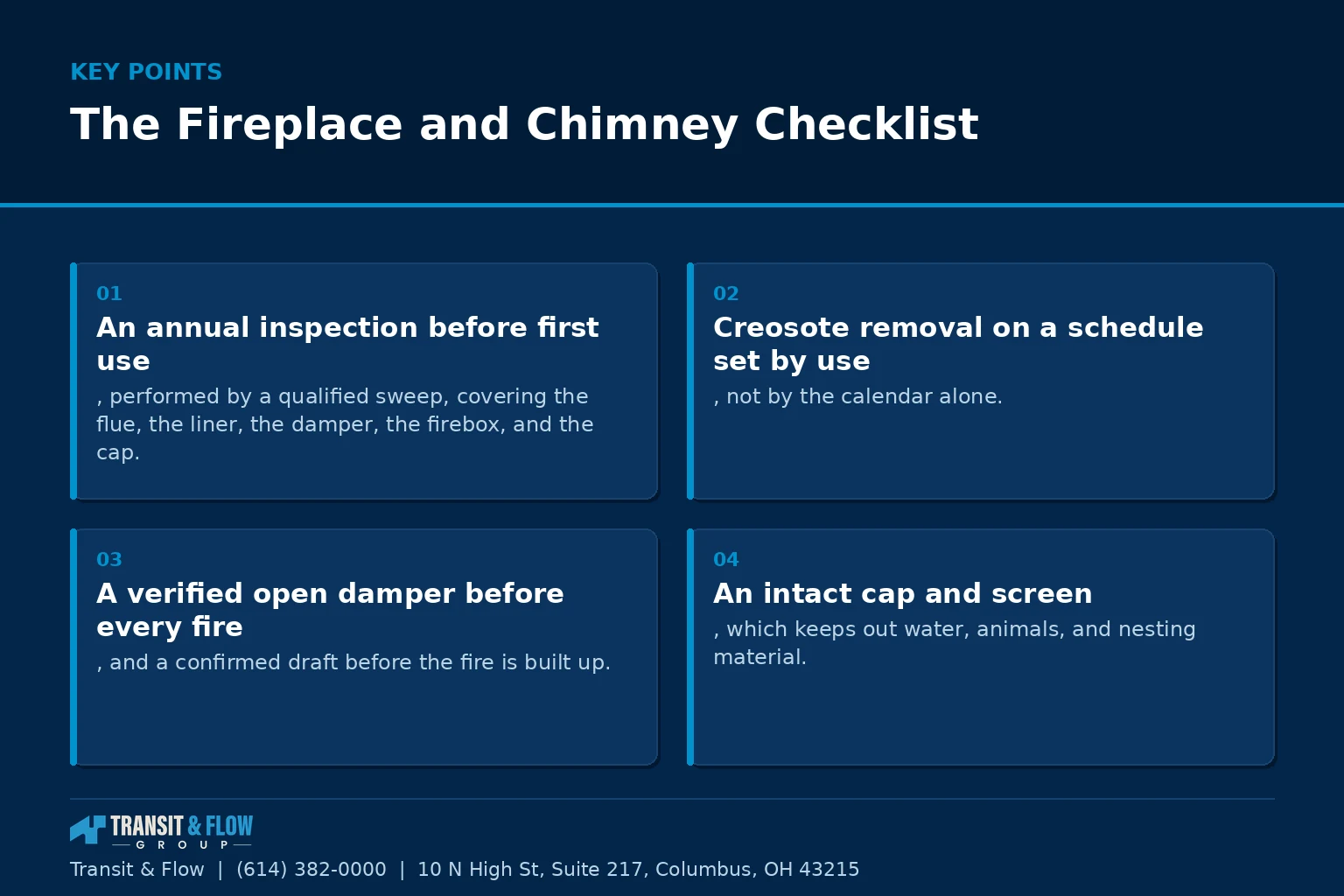
- An annual inspection before first use, performed by a qualified sweep, covering the flue, the liner, the damper, the firebox, and the cap.
- Creosote removal on a schedule set by use, not by the calendar alone. Creosote is the fuel in a chimney fire and it accumulates faster with slow, cool, smoldering fires.
- A verified open damper before every fire, and a confirmed draft before the fire is built up.
- An intact cap and screen, which keeps out water, animals, and nesting material. A blocked flue is the most common cause of a fireplace filling a room with smoke.
- A sound liner. Cracks and gaps in a masonry liner allow heat and combustion gases into framing cavities, and this is not visible from inside the firebox.
- Seasoned wood only. Wet or green wood burns cool, produces far more creosote, and smokes. No treated lumber, no painted wood, no construction debris, no accelerants.
- A hearth extension and a screen or glass door, with a metal container for ash that lives outside on a non-combustible surface. Ash holds live embers far longer than people expect.
- Nothing combustible on or near the mantel, especially during the holidays when stockings and greenery accumulate there.
- Attention to competing exhaust. A kitchen hood, bath fans, or a dryer can pull hard enough to reverse a marginal fireplace draft, which is the same backdrafting mechanism described in our article on carbon monoxide safety.
- For gas logs and gas inserts, an annual service covering the venting, the ignition system, and the gas connection, on the same footing as any other gas appliance.
Detection, Which Is the Part Everyone Skips
- Smoke alarms on every level and in every sleeping room, tested monthly.
- Carbon monoxide alarms on every level, including near sleeping areas, in any home with combustion appliances or an attached garage.
- Awareness that detectors expire. Sensors have a service life measured in years, and a powered detector past its sensor life is not a detector. Check the manufacture date printed on the back of every unit in the house this winter.
- Interconnection where possible, so an alarm in the basement is heard in a bedroom on the second floor.
- A practiced exit plan, including a meeting point outside, which takes ten minutes to establish and is the only part of this list that works when everything else has failed.
On cost: this article contains no dollar figures on purpose. Chimney inspection, liner repair, gas appliance service, and electrical corrections vary with the specific condition found, access, the age and construction of the chimney, and whether permits are required. Any published range would be wrong for most readers. Get the inspection findings in writing, then price the specific correction.
Option A is running through this checklist yourself in early winter and calling for the items that need a trade. Option B is booking a combustion appliance and chimney inspection as a standing annual item, on the calendar, at the same time each year. My recommendation is Option B, with Option A performed alongside it. The reason is that the two highest-consequence items on this page, flue condition and detector sensor life, are both invisible and both degrade silently on a multi-year timeline that a once-in-a-while inspection does not catch. Putting it on the calendar removes the decision from a season when you are already busy.
Where Transit & Flow Group Fits
Transit & Flow Group coordinates electrical and heating work across Columbus and Central Ohio and partners with properly licensed and insured specialty contractors when licensing is required. Our standard is that a daily space heater in a room is treated as a heating deficiency to be diagnosed rather than a preference to be accommodated, and that combustion readings and detector sensor dates are recorded in writing when we service a gas appliance. To get a heating deficiency or an electrical capacity question assessed, request an assessment.
Frequently Asked Questions
Can a space heater be plugged into an extension cord or a power strip?
No, and this is the most consequential item on the space heater checklist above. These units draw near the limit of a standard circuit for hours at a time, and an extension cord, a power strip, or a surge protector becomes the failure point long before the heater does. Plug the unit directly into a wall receptacle, and do not run two heaters on the same circuit, keeping in mind that bedroom and living room outlets frequently share one. If the circuit trips, do not reset it repeatedly and do not move to a larger breaker, because that is a capacity question for a licensed electrician.
The outlet feels warm after the heater has been running. Does that matter?
Yes, and it is worth treating as a wiring or receptacle issue rather than a heater issue. A warm faceplate, a plug that feels warm in the outlet, or a cord that has become cracked, discolored, or stiff all point at the fixed wiring and the device rather than at the appliance you bought. Stop using that receptacle and have a licensed electrician evaluate it under the adopted code. Seasonal inspection of the cord and plug is on the checklist for exactly this reason.
Is it a problem if a space heater runs in the same room every day?
It is a signal rather than a solution. Daily supplemental heat in one room usually means a heating or distribution deficiency somewhere in the house, and the heater is treating a symptom while the underlying condition stays in place. Ductwork and distribution problems are the most common cause of a single cold room. Having that diagnosed is a better use of the winter than accommodating it with a device that carries its own risk profile.
How often should a fireplace or chimney be inspected?
Annually, before the first fire of the season, by a qualified sweep, and the inspection should cover the flue, the liner, the damper, the firebox, and the cap. Creosote removal follows how the fireplace is actually used rather than the calendar alone, because slow, cool, smoldering fires build deposits faster. Liner condition in particular is not visible from inside the firebox, which is why an inspection rather than a look is what this calls for. Gas logs and gas inserts need the same annual footing, covering venting, ignition, and the gas connection.
Do smoke and carbon monoxide alarms expire?
They do, and this is the item most households skip. Sensors have a service life measured in years, and a powered detector past its sensor life is not functioning as a detector even though the light is on. Check the manufacture date printed on the back of every unit in the house, follow the manufacturer’s published replacement interval, and test the alarms monthly. Alarms belong on every level and in every sleeping room, with carbon monoxide coverage in any home that has combustion appliances or an attached garage.
What should I do the moment a carbon monoxide alarm sounds?
Get everyone outside immediately and call from outside. Call emergency services if anyone has a headache, nausea, dizziness, or confusion. Do not open windows first and do not silence the alarm and go back to sleep, because both responses discard the information the alarm just gave you. The same rule applies to a gas odor, and no device intended for outdoor use, including a grill, a camp stove, a generator, or an unvented construction heater, belongs inside the building under any circumstance.
Sources
- U.S. Consumer Product Safety Commission, portable heater and fuel-burning appliance safety
- Ohio Construction Industry Licensing Board, electrical and HVAC trade licensing
- City of Columbus, Get a Permit, electrical and mechanical permit channels
About This Guide
Written and edited by Micheal Parker, founder of Transit & Flow Group. Published December 9, 2026. This guide is checked against the agency and code sources listed above, and it is revised when those sources change.
General contractor of record. Micheal Parker holds City of Columbus General Contractor Registration G12064, issued by the Columbus Department of Building and Zoning Services under Transit & Flow LLC and valid through June 30, 2027. Trade work that falls outside the scope of that registration is performed by licensed trade partners, and the responsible license holder is identified before work begins.
Transit & Flow Group, home and commercial services for Columbus and the surrounding Central Ohio communities. Phone (614) 382-0000. Email solutions@transitflowgroup.com. 10 N. High St., Suite 217, Columbus, OH 43215. Contact our team or review the communities we serve.
