


When July humidity settles over Central Ohio, your air conditioner starts working overtime, and so does your electric bill. As a construction manager who has commissioned and serviced cooling systems across Columbus and its suburbs, I can tell you that the summer HVAC efficiency Central Ohio homeowners rely on rarely comes from buying a bigger unit. It is about maintenance, airflow, and a handful of smart habits that keep a well-built system running the way it was designed to. This guide walks through what actually moves the needle on comfort and cost.
In This Guide
- Why Central Ohio Summers Punish Your AC
- Filters and Coils: The Cheapest Efficiency Wins
- Thermostat Strategy That Lowers Cooling Costs in Columbus
- Summer HVAC Efficiency Central Ohio Homeowners Can Count On
- Insulation and Sealing: Efficiency Beyond the Equipment
- Tune-Up or Replace? Making the Honest Call
- The Payback of Getting It Right
- What Goes Wrong and Why
- Cooling Terms Worth Knowing
- Frequently Asked Questions
- Sources
- Related Transit & Flow Services
Why Central Ohio Summers Punish Your AC
Columbus does not just get hot, it gets humid. When outdoor dew points climb into the 70s through July and August, your air conditioner has two jobs: dropping the temperature and pulling moisture out of the air. That second job is invisible on the thermostat but very real on the compressor. A system that is dirty, low on refrigerant, or fighting leaky ductwork has to run longer cycles to hit the same setpoint, which drives up runtime and wear. Homes across Dublin, Westerville, Hilliard, and Gahanna share the same challenge, and older housing stock in Upper Arlington and Worthington often adds tired ductwork to the mix. Understanding that moisture load is the first step toward real air conditioner efficiency.
Filters and Coils: The Cheapest Efficiency Wins
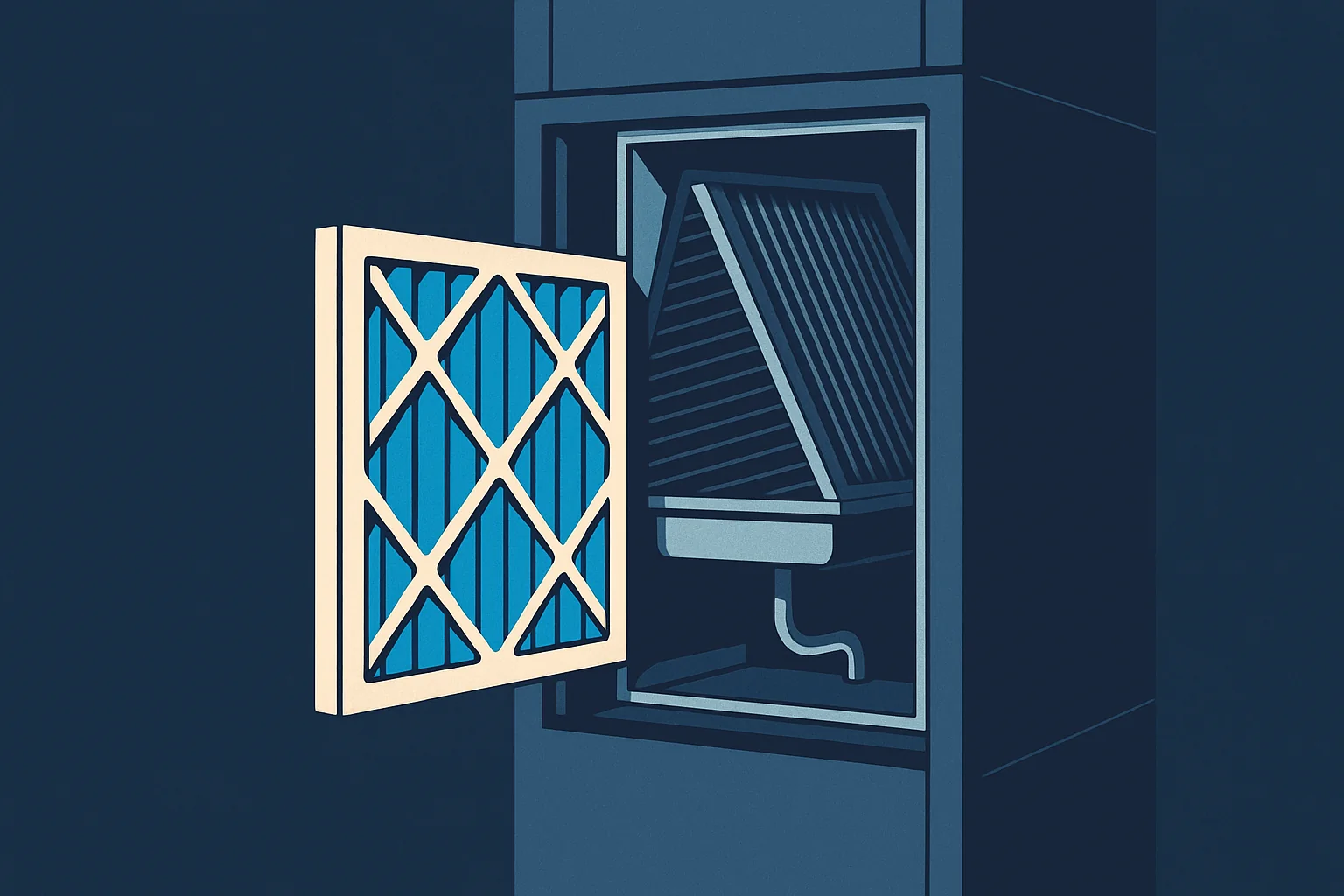
Nothing steals capacity faster than a clogged filter or a caked evaporator coil. A dirty filter restricts airflow, which lowers efficiency and can freeze the coil on a humid afternoon. I tell every homeowner to check filters monthly during cooling season and replace them every 30 to 90 days depending on pets and household traffic. The outdoor condenser coil matters just as much. When it is choked with cottonwood, grass clippings, and dust, the system cannot reject heat, and pressures climb. A gentle rinse and a two-foot clearance around the unit protect both comfort and the compressor.
- Replace or clean filters every 30 to 90 days through summer.
- Keep shrubs, mulch, and debris at least two feet from the condenser.
- Rinse the outdoor coil fins carefully with a garden hose, never a pressure washer.
- Watch for ice on the refrigerant lines, a sign to shut the system off and call a technician.
Thermostat Strategy That Lowers Cooling Costs in Columbus
Small thermostat habits add up fast. Setting the thermostat a few degrees higher when you are away, and letting it recover before you get home, reduces total runtime without sacrificing comfort. A programmable or smart thermostat automates that pattern and can trim a meaningful slice off a summer bill. Resist the urge to crank the setpoint way down to cool faster, because your AC cools at one steady rate regardless, and overshooting just wastes energy. Running the fan on “auto” rather than “on” also helps in humid weather, since a constantly running blower can re-evaporate moisture off the coil and back into your home. These moves are among the easiest ways to lower cooling costs in Columbus.
Summer HVAC Efficiency Central Ohio Homeowners Can Count On
Here is where professional service earns its keep. Refrigerant charge, static pressure, and airflow are not things a homeowner can eyeball. A system that is even slightly undercharged loses efficiency and dehumidification, and an overcharged one strains the compressor. During a proper AC tune up in Central Ohio, our technicians verify charge against manufacturer targets, measure temperature split across the coil, test capacitors and contactors, check the condensate drain, and confirm airflow is within spec. Duct leakage is the quiet culprit in many Grove City and Pickerington homes, where conditioned air escapes into attics and crawlspaces before it ever reaches a bedroom. Sealing and balancing that ductwork restores capacity you already paid for, and it is central to the summer HVAC efficiency Central Ohio homes need to hold steady through August.
Insulation and Sealing: Efficiency Beyond the Equipment
The best air conditioner in New Albany or Powell still struggles if the house leaks heat. Attic insulation, sealed rim joists, weatherstripped doors, and caulked window gaps all reduce the cooling load your system carries. Air sealing is especially valuable in Central Ohio’s older neighborhoods, where decades of settling have opened gaps you cannot see. When we improve the building envelope alongside the mechanical system, homeowners often find they can raise the thermostat a degree or two and still feel more comfortable, because the temperature holds steady instead of drifting. That combined approach is the heart of true summer HVAC efficiency, and it protects your investment year round. For more seasonal maintenance ideas, browse our related guides.

Tune-Up or Replace? Making the Honest Call
Not every struggling system needs replacement, and not every old one is worth saving. If your unit is under roughly 12 years old, holds charge, and only needs cleaning and minor parts, a tune-up is almost always the smart, economical choice. Once a system is pushing 15 years, leaking refrigerant repeatedly, or running on the phased-out R-22 refrigerant, the math shifts. A modern high-efficiency unit can cut cooling energy use substantially, and the comfort improvement from better dehumidification is dramatic. We give straight answers, not scare tactics. If a repair buys you three good summers, we will tell you. If replacement is genuinely the better long-term value, we will show you the numbers so you can decide with confidence.
The Payback of Getting It Right
Efficiency is not an abstraction, it is money that stays in your account. A clean, correctly charged, well-sealed system can lower cooling costs across Columbus homes while extending equipment life and reducing the odds of a breakdown on the hottest day of the year. That reliability matters just as much as the savings. Investing a modest amount in an AC tune up in Central Ohio each spring routinely prevents far larger emergency repair bills in July. Whether you are in Columbus proper or anywhere across our service areas, the fundamentals of summer HVAC efficiency Central Ohio residents value hold: maintain the system, seal the home, and let the equipment do the job it was built to do.
What Goes Wrong and Why
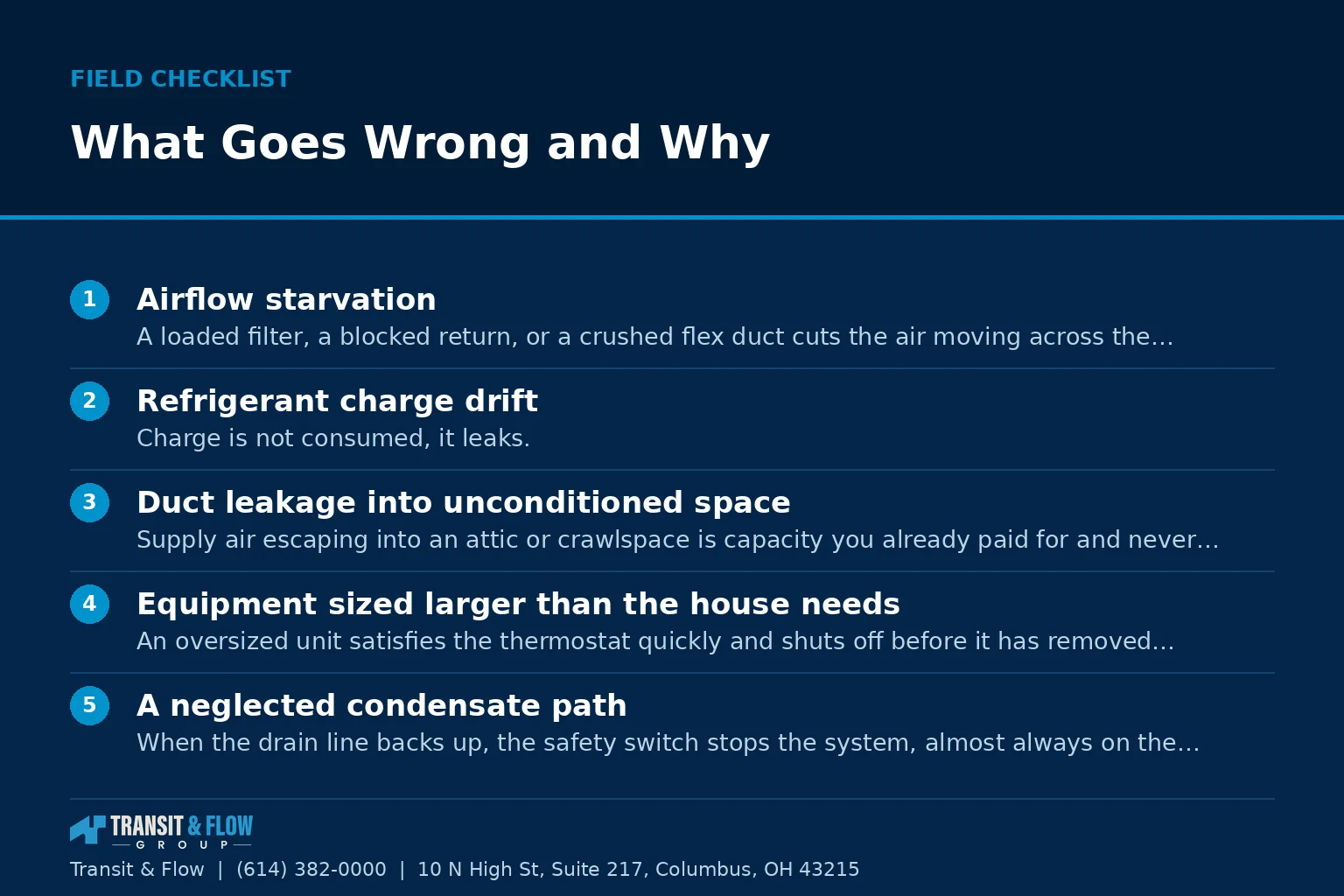
Most summer cooling complaints in Central Ohio trace back to a short list of causes, and almost none of them are a compressor quitting without warning. The pattern is a gradual loss of capacity that nobody notices until the first stretch of high dew points exposes it.
- Airflow starvation. A loaded filter, a blocked return, or a crushed flex duct cuts the air moving across the evaporator coil. The system runs longer for less cooling, and on a humid afternoon the coil can ice over.
- Refrigerant charge drift. Charge is not consumed, it leaks. A slow leak shows first as weak dehumidification, then as long run cycles, then as a system that simply cannot hold setpoint in August.
- Duct leakage into unconditioned space. Supply air escaping into an attic or crawlspace is capacity you already paid for and never received. The rooms farthest from the air handler feel it first.
- Equipment sized larger than the house needs. An oversized unit satisfies the thermostat quickly and shuts off before it has removed much moisture, so the house reads cool on the display and still feels clammy.
- A neglected condensate path. When the drain line backs up, the safety switch stops the system, almost always on the hottest afternoon of the season.
Cooling Terms Worth Knowing
Technicians work from a specific vocabulary, and understanding it makes the conversation about your system far more useful.
- Latent load. The share of the cooling job spent removing moisture rather than lowering temperature. Central Ohio summers are latent heavy.
- Sensible load. The share spent lowering air temperature, which is the only part the thermostat actually reads.
- Dew point. The temperature at which air becomes saturated. It describes muggy conditions more honestly than relative humidity does.
- Temperature split. The difference between the air entering the return and the air leaving the supply, used as a fast check on how the system is performing.
- Static pressure. The resistance the blower works against in the duct system. A high reading points to restriction somewhere in the path.
- Superheat and subcooling. Refrigerant measurements a technician compares against the manufacturer’s published targets to judge whether the charge is correct.
- Evaporator coil. The indoor coil where refrigerant absorbs heat and moisture condenses out of the airstream.
- Condenser coil. The outdoor coil where that absorbed heat is released into the surrounding air.
- Condensate drain. The line carrying water pulled from the air to a drain or pump, protected by a safety switch that shuts the system down if it backs up.
- Building envelope. The insulated, air sealed boundary between conditioned space and outdoors. Improving it lowers the load the equipment has to carry all season.
Ready to stop overpaying to stay cool this summer? Transit & Flow makes it simple to get a fast, accurate price. Get an instant estimate on the Transit & Flow homepage, or call our team to schedule your service. Our licensed trade partners deliver premium, operationally excellent air conditioner efficiency work across Central Ohio, and we treat your comfort like it is our own.
Transit & Flow Group coordinates projects and partners with properly licensed and insured specialty contractors when licensing is required, and work is performed under the appropriate permits.
Frequently Asked Questions
How often should I change the air filter during a Central Ohio cooling season?
Check it monthly once the system is running daily, and plan on replacement every 30 to 90 days. Pets, high household traffic, and construction dust all push you toward the shorter end of that window. A restricted filter lowers airflow, which costs efficiency and can freeze the evaporator coil on a humid afternoon. It is the cheapest maintenance step available and the one most often skipped.
Why does Columbus humidity make my air conditioner work so much harder?
Your system has two jobs in July and August, dropping the temperature and pulling moisture out of the air. When outdoor dew points climb into the 70s, the moisture load rises even if the temperature does not. Removing that moisture is invisible on the thermostat but very real on the compressor, and it shows up as longer run cycles. A system that is dirty or fighting leaky ductwork has to run longer still to reach the same setpoint.
Does setting the thermostat much lower cool the house faster?
No. An air conditioner cools at one steady rate regardless of how far below the current temperature you set it, so overshooting only extends runtime and wastes energy. A better pattern is a few degrees higher while you are away, with the system recovering before you get home. A programmable or smart thermostat automates that pattern without you thinking about it.
Should the blower fan run on auto or on during humid weather?
Auto is the better setting through a humid Central Ohio summer. A blower that runs continuously can re-evaporate moisture sitting on the coil and push it back into the house, which undoes part of the dehumidification the system just performed. On auto, the fan stops with the compressor and the condensate drains away instead. The comfort difference is noticeable even when the thermostat reads the same number.
What does a professional tune-up check that a homeowner cannot?
Refrigerant charge, static pressure, and airflow are the three that matter most, and none of them can be judged by eye. A technician verifies charge against the manufacturer’s published targets, measures the temperature split across the coil, tests capacitors and contactors, checks the condensate drain, and confirms airflow is within spec. Slightly undercharged systems lose both efficiency and dehumidification, while overcharged systems strain the compressor. Duct leakage into attics and crawlspaces is the other quiet loss, and finding it takes measurement rather than inspection.
When does replacing the system make more sense than repairing it?
Age, refrigerant behavior, and repair history are the honest inputs. A unit under roughly 12 years old that holds charge and needs cleaning or minor parts is usually worth maintaining. Once a system is pushing 15 years, leaking refrigerant repeatedly, or running on the phased-out R-22 refrigerant, the calculation shifts toward replacement, and the dehumidification improvement from modern equipment is substantial. Ask for the reasoning behind either recommendation rather than accepting a conclusion.
Sources
- U.S. Department of Energy, Energy Saver, home cooling systems
- ENERGY STAR, certified heating and cooling equipment
- U.S. Department of Energy, Energy Saver, insulation
Related Transit & Flow Services
Every service below is delivered by the same accountable Transit & Flow team, so one call covers the whole property.
- Heating and Cooling Services
- HVAC Replacement Consultation
- Dryer Vent Service
- Electrical Panel Upgrades
- Preventive Property Maintenance
- Plumbing Services
Serving Columbus and every community across Central Ohio. See the full service areas map, or get an instant estimate on the Transit & Flow homepage.
About This Guide
Written and edited by Micheal Parker, founder of Transit & Flow Group. Published July 20, 2026. This guide is checked against the agency and code sources listed above, and it is revised when those sources change.
General contractor of record. Micheal Parker holds City of Columbus General Contractor Registration G12064, issued by the Columbus Department of Building and Zoning Services under Transit & Flow LLC and valid through June 30, 2027. Trade work that falls outside the scope of that registration is performed by licensed trade partners, and the responsible license holder is identified before work begins.
Transit & Flow Group, home and commercial services for Columbus and the surrounding Central Ohio communities. Phone (614) 382-0000. Email solutions@transitflowgroup.com. 10 N. High St., Suite 217, Columbus, OH 43215. Contact our team or review the communities we serve.
