
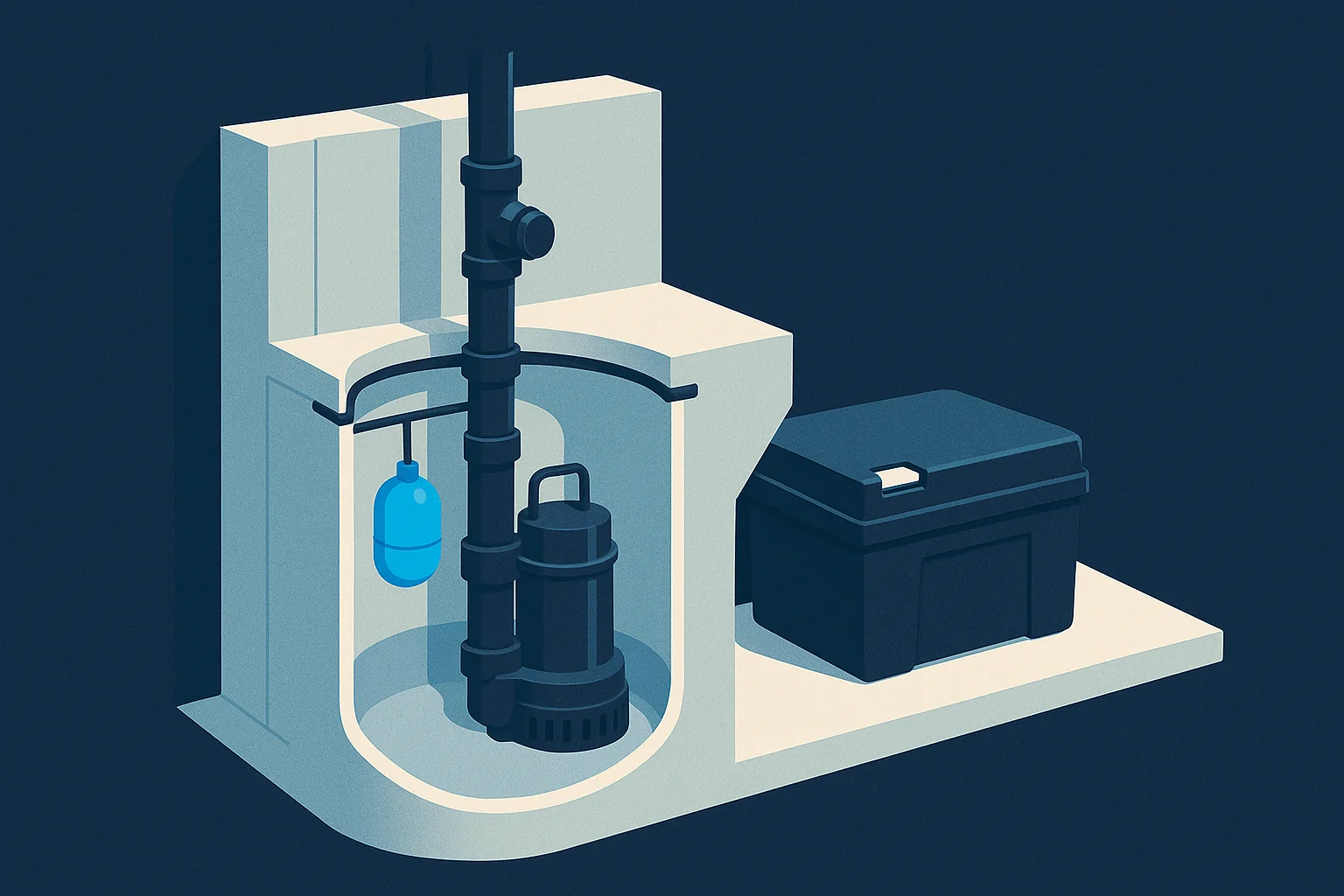

A sump pump is the only device in a house whose failure is measured in inches of water per hour. Everything else in a basement drainage assembly is passive plumbing that either works or does not. The pump is a motor, a switch, and a discharge line, and each of those three fails in a characteristic way that a household can anticipate. This article covers how a pump is sized, what backup actually means, and the two tests worth running every year. It supports our plumbing work and sits under our wet basement guide.
In This Guide
- What the Pump Is Actually Doing
- Sizing, Which Is Not a Horsepower Question
- Submersible and Pedestal, Compared
- The Switch, Which Is Where Most Failures Start
- Backup, and What the Word Should Mean
- The Discharge Line, Which Fails Every Winter
- The Two Tests, Run Twice a Year
- Signs a Pump Is Near the End
- On Cost
- Glossary
- The Decision
- Where Transit & Flow Group Fits
- Frequently Asked Questions
Transit & Flow Group coordinates projects and partners with properly licensed and insured specialty contractors when licensing is required.
What the Pump Is Actually Doing
The pump does not keep a basement dry. Drainage keeps a basement dry, and the pump is the last step in that chain, lifting collected water from the lowest point in the house to a discharge point above grade. That framing matters, because a household that understands the pump as the exit rather than the solution will keep asking the more useful question, which is why the water is arriving in the first place.
The pit collects water from the perimeter drain, from the footing drain where it is tied in, and sometimes from groundwater rising through the soil beneath the slab. When the water reaches a set level, a switch closes, the motor runs, water moves up the discharge pipe, and the switch opens again when the level falls. That cycle repeats, sometimes every few minutes during a heavy spring event, for the life of the pump. Understanding the cycle is what makes the failure modes obvious.
Sizing, Which Is Not a Horsepower Question
Households are usually offered a horsepower number and asked to choose between a smaller one and a larger one. That is not how the specification works, and choosing the biggest available pump is a common and expensive error.
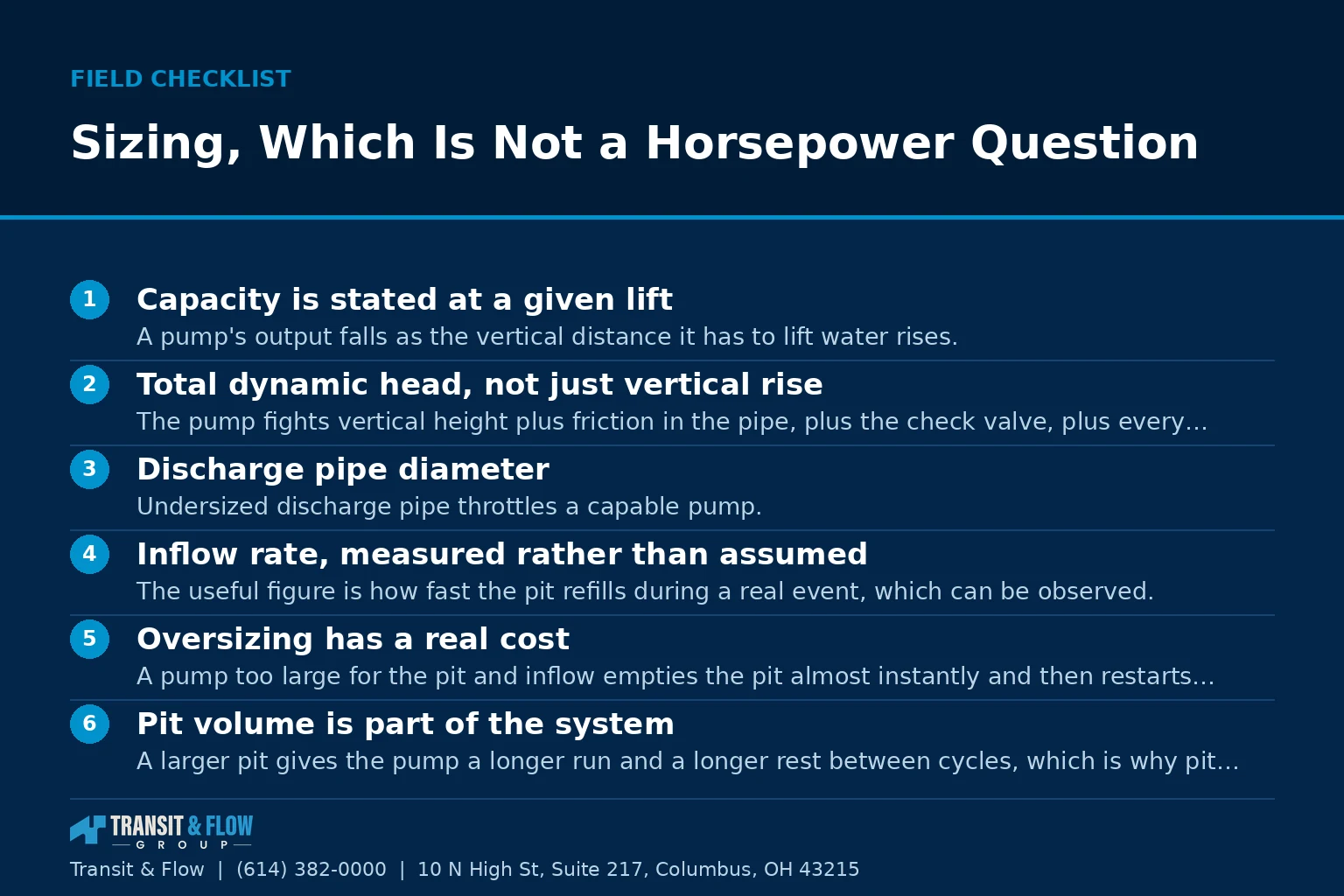
- Capacity is stated at a given lift. A pump’s output falls as the vertical distance it has to lift water rises. A capacity figure quoted without the height it applies to is not a specification, it is marketing. The number that matters is the flow available at your actual lift.
- Total dynamic head, not just vertical rise. The pump fights vertical height plus friction in the pipe, plus the check valve, plus every fitting and turn in the discharge run. A long horizontal run to a proper discharge point adds meaningfully to the load.
- Discharge pipe diameter. Undersized discharge pipe throttles a capable pump. Reducing the pipe below the pump’s outlet size is a common field shortcut that costs capacity permanently.
- Inflow rate, measured rather than assumed. The useful figure is how fast the pit refills during a real event, which can be observed. Sizing to the actual inflow beats sizing to a general rule.
- Oversizing has a real cost. A pump too large for the pit and inflow empties the pit almost instantly and then restarts, and that short cycling wears the motor and the switch faster than continuous duty would. Matching matters more than maximizing.
- Pit volume is part of the system. A larger pit gives the pump a longer run and a longer rest between cycles, which is why pit sizing and pump sizing are one decision rather than two.
Submersible and Pedestal, Compared
| Factor | Submersible | Pedestal |
|---|---|---|
| Position | Sits in the pit, below water | Motor sits above the pit on a column |
| Noise | Quieter, water dampens sound | Louder, motor is in open air |
| Pit requirements | Needs a pit wide and deep enough to house the unit | Works in a narrower pit |
| Service access | Unit must be lifted out | Motor is accessible without removing it from the pit |
| Typical service life | Generally shorter | Generally longer |
| Lid sealing | Compatible with a fully sealed lid | Complicated by the column passing through |
| Best fit | Finished basements, higher inflow, where noise and sealing matter | Narrow pits, unfinished space, where ease of service is the priority |
For most Central Ohio basements with any degree of finish, the submersible is the stronger choice, largely because the sealed lid it permits does real work on humidity and soil gas. In an unfinished basement with a narrow original pit, the pedestal remains entirely reasonable.
The Switch, Which Is Where Most Failures Start
Ask anyone who services these systems what fails and the answer is rarely the motor. It is the switch. There are three common types and each fails differently.
- Tethered float. A float on a cord that swings up and down. It is durable and it gives a long run cycle, but it needs clearance to swing and it hangs up on pit walls, on the discharge pipe, and on debris. Hanging up in the down position means the pump never starts.
- Vertical float. A float riding on a vertical rod. It fits narrow pits and cannot swing into an obstruction, but it produces a shorter cycle and the rod assembly can bind.
- Electronic or capacitive sensing. No moving float at all, which removes the mechanical failure mode entirely and introduces an electronic one. These generally require the pump be replaced or the sensor be serviced as a unit.
The practical implication is that pit debris is not cosmetic. Silt, gravel washed in from the drainage stone, and construction debris left in the pit are the leading contributors to switch failure, and clearing the pit is the single highest value maintenance action available.
Backup, and What the Word Should Mean
The failure case that matters is not a pump wearing out on a dry Tuesday. It is a severe storm producing peak inflow at the same moment the power goes out. Those two events are correlated in Central Ohio, which is the entire argument for backup capability. A system with no backup is designed to fail precisely when it is needed most.
- Battery backup. A secondary pump on a dedicated battery, with a charger that maintains it. Runtime is finite and depends on battery capacity and inflow, and the battery is a consumable with a service life that must be tracked and replaced on schedule rather than on failure.
- Water powered backup. A device that uses municipal water pressure to move sump water, with no electricity involved and no runtime limit. It consumes potable water while running, it requires adequate supply pressure, and its installation is regulated because of the backflow protection required. It is not available on a private well.
- Generator supported primary. Rather than a second pump, the primary is carried by a standby generator. This protects everything else in the house at the same time and removes the runtime question, at a materially different cost.
- A second primary pump. Two pumps in the pit at staggered levels, which addresses pump failure and excess inflow but not power loss. Useful in combination with one of the above, not as a substitute.
Whichever is chosen, a high water alarm belongs in the pit. It costs a fraction of the system and it converts an unnoticed failure into a phone notification, which is the difference between a wet floor and a replaced basement.
The Discharge Line, Which Fails Every Winter
Central Ohio winters find the weakness in a discharge line reliably. Water sitting in a shallow buried run or an exposed above grade run freezes, the line blocks, the pump runs against a closed pipe, and the motor either overheats or the water backs into the pit and over the floor. The system did not fail. The exit did.
The corrections are known. Slope the line so it drains rather than holding water. Bury below frost depth where the run permits it. Where an above grade termination is unavoidable, provide a relief opening near the foundation so a frozen far end does not deadhead the pump. Confirm the termination point discharges far enough away that the water does not return to the same soil and cycle back into the pit, which is a surprisingly common and entirely self inflicted condition. And confirm the discharge is permitted where you are, because routing sump discharge into a sanitary sewer is prohibited in many Central Ohio jurisdictions and the prohibition is enforced.
The Two Tests, Run Twice a Year
Run these in early spring, before the heaviest load arrives, and again in autumn, before freezing. They take a few minutes and they catch the great majority of failures before weather does.
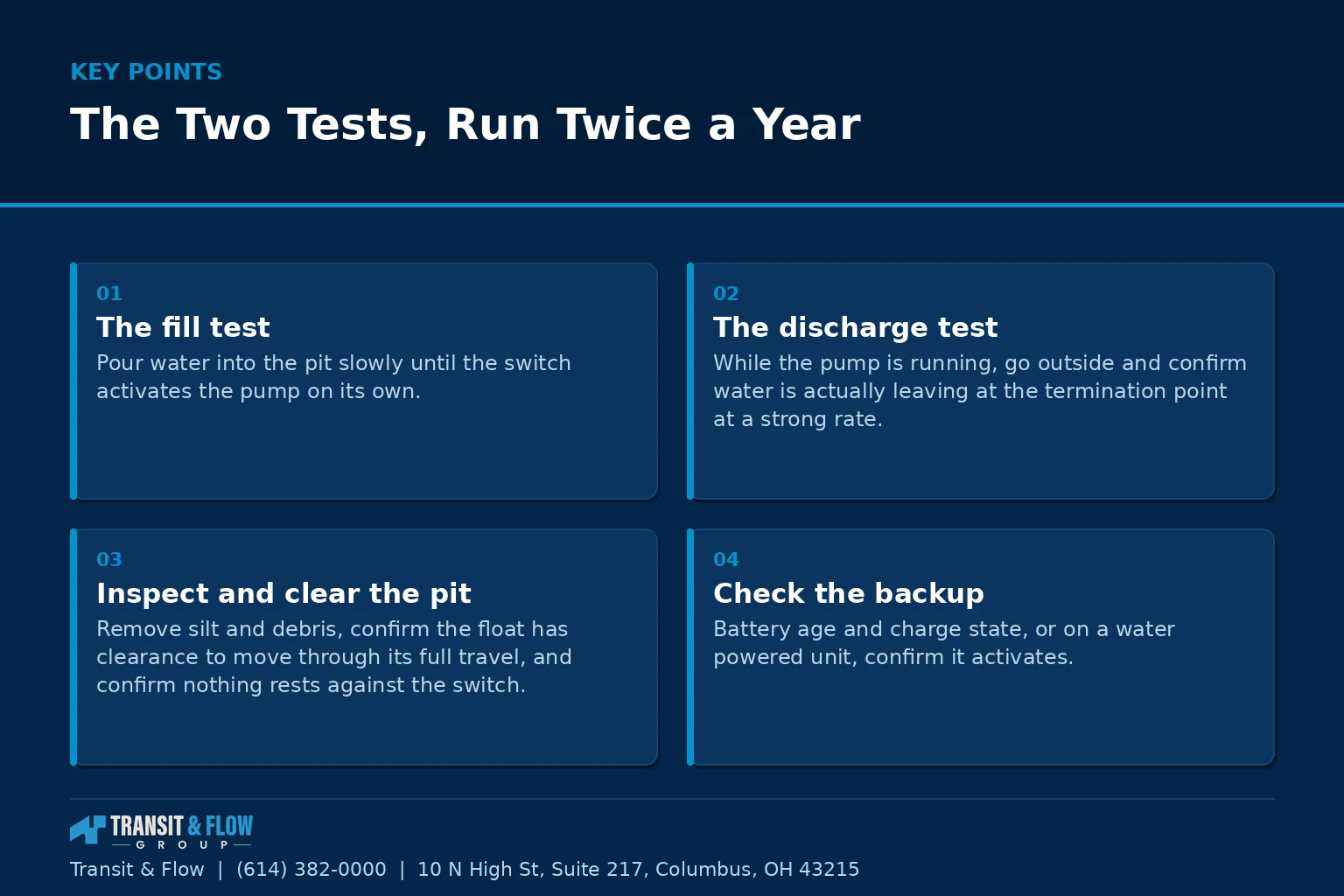
- The fill test. Pour water into the pit slowly until the switch activates the pump on its own. The point is to test the switch, not the motor, so raising the float by hand does not count. Watch the level fall, confirm the pump shuts off cleanly, and confirm it does not immediately restart, which would indicate the check valve is letting water fall back.
- The discharge test. While the pump is running, go outside and confirm water is actually leaving at the termination point at a strong rate. A pump that runs, sounds healthy, and moves nothing is describing a blocked or disconnected line, and that condition is invisible from inside.
- Inspect and clear the pit. Remove silt and debris, confirm the float has clearance to move through its full travel, and confirm nothing rests against the switch.
- Check the backup. Battery age and charge state, or on a water powered unit, confirm it activates. A backup that has never been tested is an assumption rather than a system.
- Confirm the alarm sounds and, where it notifies remotely, that the notification arrives.
- Note the date. A written service history turns a pump from something you replace after a flood into something you replace on schedule.
Signs a Pump Is Near the End
Pumps announce themselves before they quit. Running for longer than it used to on the same amount of water indicates lost capacity. Cycling far more frequently than it used to points at a check valve letting water back or at a change in inflow worth investigating on its own. New noise, vibration, or a hot housing after a normal cycle all point at the motor. Visible rust on the housing or the fasteners indicates the unit has been in service a long time in a wet environment. And a pump that has quietly stopped running at all during a wet period is not evidence of a dry basement, it is evidence that nobody has checked.
Because the cost of a scheduled replacement is trivial next to the cost of an unscheduled one, replacing a primary pump on a planned interval, and keeping the removed unit as a shelf spare if it still runs, is the most rational maintenance posture available in this category.
On Cost
This article contains no dollar figures on purpose. Pump, backup, pit, and discharge work vary widely with the configuration and with what has to be opened to reach it, and a figure published here would be treated as a benchmark it cannot be. The comparison that matters is not the price of a pump. It is the price of a pump and a backup against the cost of restoring a finished basement once, and that comparison is never close.
Glossary
- Sump pit. The basin at the low point of the basement that collects water from the drainage system.
- Total dynamic head. The full resistance a pump works against, combining vertical lift with friction losses in the discharge assembly.
- Check valve. A one way valve preventing water in the discharge line from falling back into the pit after a cycle.
- Short cycling. Rapid repeated starting and stopping, caused by a pump oversized relative to the pit and inflow, which accelerates wear.
- Deadhead. A pump running against a fully blocked discharge, moving no water and generating heat.
- Frost depth. The depth to which ground can be expected to freeze locally, which governs how deep a discharge line should be buried.
- Backflow protection. Devices and configurations preventing non potable water from entering the potable supply, required on water powered backup installations.
- High water alarm. A device that signals when the pit level rises above the normal operating range.
- Weep or relief hole. A small opening in the discharge near the pump preventing an airlock and, in some configurations, providing relief if the far end freezes.
The Decision
Option A is a single well matched primary pump, maintained on a schedule, with an alarm. Option B is that same pump plus a backup, either battery or water powered, plus the alarm. My recommendation is Option B for any basement that is finished, that stores anything of value, or that has ever taken on water, and Option A only for a bare unfinished basement with a documented history of very low inflow. The reasoning is the correlation between severe storms and power outages. A primary pump protects against wear. Only a backup protects against the specific night the whole system is being asked to perform. For the diagnostic sequence that determines whether you need a system at all, see our wet basement guide, and for handling a discovered condition mid project, our article on change orders.
Where Transit & Flow Group Fits
Transit & Flow Group coordinates plumbing and basement drainage work across Columbus and Central Ohio and partners with properly licensed and insured specialty contractors when licensing is required. Our standard on sump systems is that capacity is specified against the actual lift and the observed inflow rather than by horsepower, that discharge routing is confirmed against the jurisdiction’s requirements before installation, that freeze protection is designed rather than assumed, that a backup and an alarm are quoted as standard rather than as upsells, and that the household is shown how to run the fill test and the discharge test at handover. To have an existing system evaluated, contact us.
Frequently Asked Questions
Does buying the biggest available pump give the best protection?
No, and it is a common and expensive error. Capacity is stated at a given lift, so a flow figure quoted without the height it applies to is marketing rather than a specification, and the pump also fights friction in the pipe, the check valve, and every fitting in the discharge run. A pump that is too large for the pit and the actual inflow empties the pit almost instantly and then restarts, and that short cycling wears the motor and the switch faster than steady duty would. Matching the pump to the observed inflow, the real lift, and the pit volume is what matters, and that specification belongs to a licensed plumbing professional.
What part of a sump system actually fails first?
Rarely the motor. It is usually the switch, and each switch type fails in its own way: a tethered float can hang up on the pit wall, the discharge pipe, or debris, a vertical float can bind on its rod, and an electronic sensor introduces an electronic failure mode in place of a mechanical one. This is why pit debris is not cosmetic. Silt, gravel washed in from the drainage stone, and leftover construction debris are the leading contributors to switch failure, and clearing the pit is the highest value maintenance action available.
Is a backup pump really necessary?
The failure case worth designing around is not a pump wearing out on a dry Tuesday. It is a severe storm producing peak inflow at the same moment the power goes out, and those two events are correlated here, so a system with no backup is arranged to fail exactly when it is needed. A battery backup has finite runtime and a battery that is a consumable to be replaced on schedule. A water powered unit has no runtime limit but consumes potable water, needs adequate supply pressure, is not available on a private well, and its installation is regulated because of the backflow protection required. Whichever you choose, a high water alarm belongs in the pit, because it converts an unnoticed failure into a notification.
Why does the discharge line cause trouble every winter?
Water sitting in a shallow buried run or an exposed above grade run freezes, the line blocks, and the pump then runs against a closed pipe until it overheats or the water backs into the pit and over the floor. The system did not fail, the exit did. The corrections are known: slope the line so it drains rather than holding water, bury it below the local frost depth where the run allows, provide relief near the foundation where an above grade termination is unavoidable, and confirm the termination is far enough out that the water does not simply return to the same soil and cycle back. Frost depth and burial requirements are set locally, so confirm them with your building department.
How should I test the pump so the test actually means something?
Pour water into the pit slowly until the switch activates the pump on its own, because raising the float by hand tests the motor and skips the part that usually fails. Watch the level fall, confirm the pump shuts off cleanly, and confirm it does not immediately restart, which would suggest the check valve is letting water fall back. Then, while it is running, go outside and confirm water is leaving the termination point at a strong rate, since a pump that runs and moves nothing is describing a blocked or disconnected line that is invisible from inside. Run both tests in early spring and again in autumn, and write down the date.
Can sump discharge be routed into the sanitary sewer?
Routing sump discharge into a sanitary sewer is prohibited in many Central Ohio jurisdictions and the prohibition is enforced, so this is a question to settle with the authority over your address before anything is installed. Where the discharge is permitted to go, and how far from the foundation it must terminate, are both local determinations rather than matters of preference. A termination that dumps water back into the same soil feeding the pit is a self inflicted condition that shows up as a pump cycling far more than it should. Confirm the routing with your building department and have the work performed by a licensed contractor.
Sources
- City of Columbus, Get a Permit, permit and inspection process
- Ohio Construction Industry Licensing Board, trade licensing verification
- United States Environmental Protection Agency, moisture and mold guidance
- Ready.gov, flood preparedness guidance
About This Guide
Written and edited by Micheal Parker, founder of Transit & Flow Group. Published February 17, 2027. This guide is checked against the agency and code sources listed above, and it is revised when those sources change.
General contractor of record. Micheal Parker holds City of Columbus General Contractor Registration G12064, issued by the Columbus Department of Building and Zoning Services under Transit & Flow LLC and valid through June 30, 2027. Trade work that falls outside the scope of that registration is performed by licensed trade partners, and the responsible license holder is identified before work begins.
Transit & Flow Group, home and commercial services for Columbus and the surrounding Central Ohio communities. Phone (614) 382-0000. Email solutions@transitflowgroup.com. 10 N High St, Suite 217, Columbus, OH 43215. Contact our team or review the communities we serve.
