
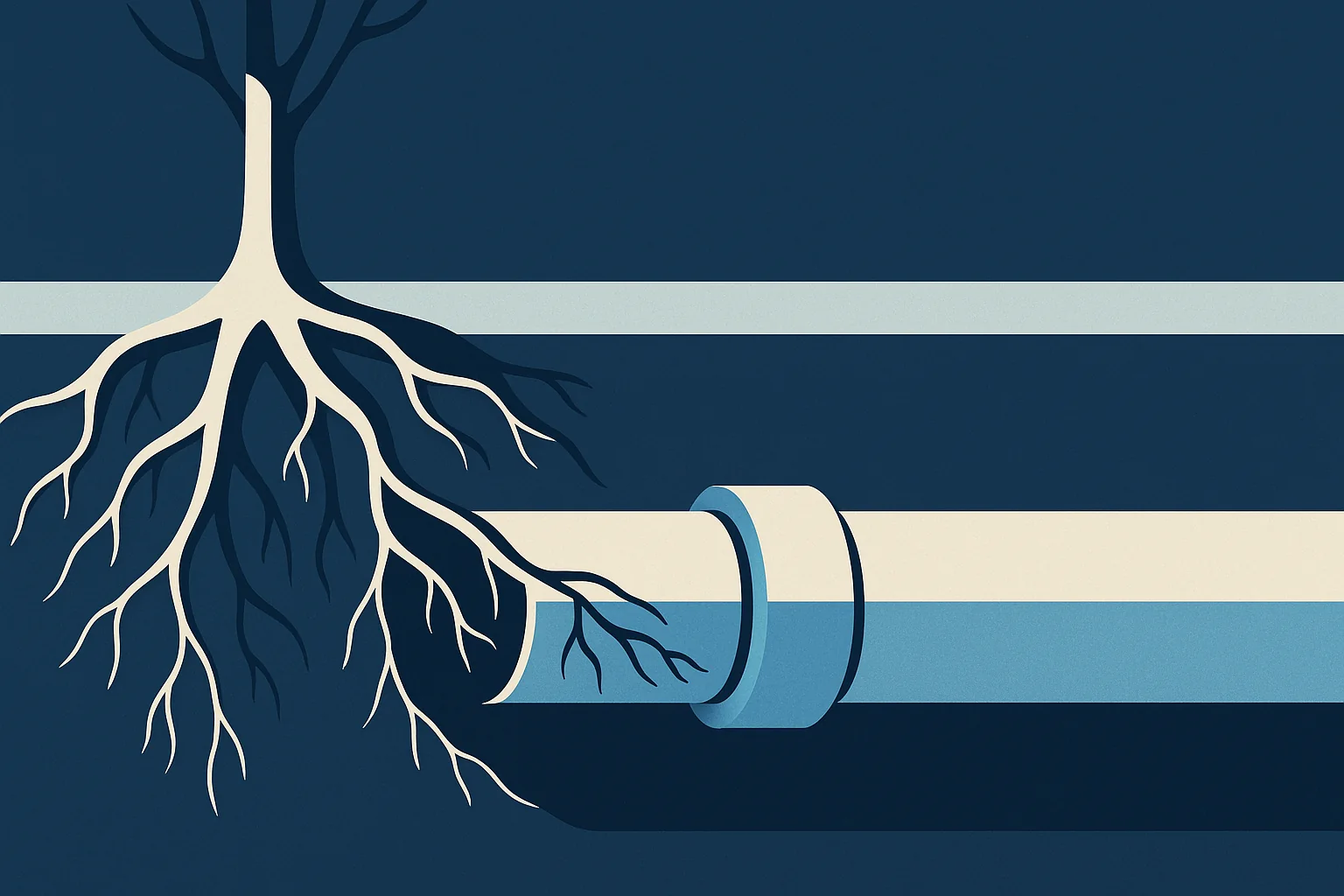

Ask any drain technician working the older parts of Franklin County what they pull out of sewer laterals most often and the answer is roots. Not wipes, not grease, roots. There is a structural reason for that concentration, and it has to do with when these neighborhoods were built, what the laterals were made of, and what got planted along the tree lawns eighty years ago. Understanding the mechanism tells you whether your street is likely affected and what actually stops it, as opposed to what merely postpones it. This article is part of our drain and sewer guide, and follows our catalog of sewer line warning signs.
In This Guide
- The Mechanism, Correctly Stated
- Why Older Columbus Neighborhoods Concentrate the Problem
- The Root Intrusion Progression
- Your Options, and What Each One Honestly Delivers
- The Honest Framework for Deciding
- Where Transit & Flow Group Fits
- Frequently Asked Questions
Transit & Flow Group coordinates projects and partners with properly licensed and insured specialty contractors when licensing is required.
The Mechanism, Correctly Stated
The common description is that roots break into sewer pipes. That is not what happens, and the correction matters because it changes the remedy.
Roots grow toward water and nutrients. A sound, sealed pipe presents neither to the surrounding soil, so roots grow past it indifferently. But a sewer lateral carries warm water with dissolved nutrients, and any opening in that pipe leaks a small amount of vapor and moisture into the soil around it. That plume is a signal. A root that encounters the plume grows toward its source, finds the opening, and enters. Once inside, it is in the richest environment it will ever encounter, and it responds by proliferating into a dense fibrous mass that fills the pipe cross-section.
So roots are a consequence of an opening, not a cause of one. Every root intrusion means there was already a joint, crack, or failed seal for the root to find. This is why cutting roots out is management rather than repair: the opening is still there when the cutting is finished, and the plume resumes the day flow resumes.
Why Older Columbus Neighborhoods Concentrate the Problem
Three conditions have to line up for heavy root intrusion, and older Central Ohio housing stock lines up all three.
- Jointed pipe material. Vitrified clay tile, the standard for residential laterals through much of the twentieth century, comes in short sections. A hundred-foot lateral in clay may have thirty or more joints, and every joint is a candidate opening once the original sealing material ages. Modern PVC by contrast is solvent-welded into long continuous runs with very few joints.
- Mature street trees. Neighborhoods platted in the early twentieth century were planted with large shade species along tree lawns, precisely the strip of ground the lateral runs beneath on its way to the street main. Those trees are now eighty to a hundred years old with root systems to match, sitting directly over the pipe.
- Time. Root intrusion is a decades-long process. A joint that began weeping in 1975 has had fifty years of root access. Newer subdivisions have the same physics and have simply not had the time.
The practical read: if your home predates roughly 1980, sits in a neighborhood with mature street trees, and has never had a camera inspection, root intrusion is a live possibility regardless of whether you have symptoms today. Subdivisions built from the 1990s onward with PVC laterals and young landscaping carry meaningfully lower exposure. This is a probability statement about construction era and material, not a claim about any specific address, and a camera inspection is what turns the probability into a fact.
The Root Intrusion Progression
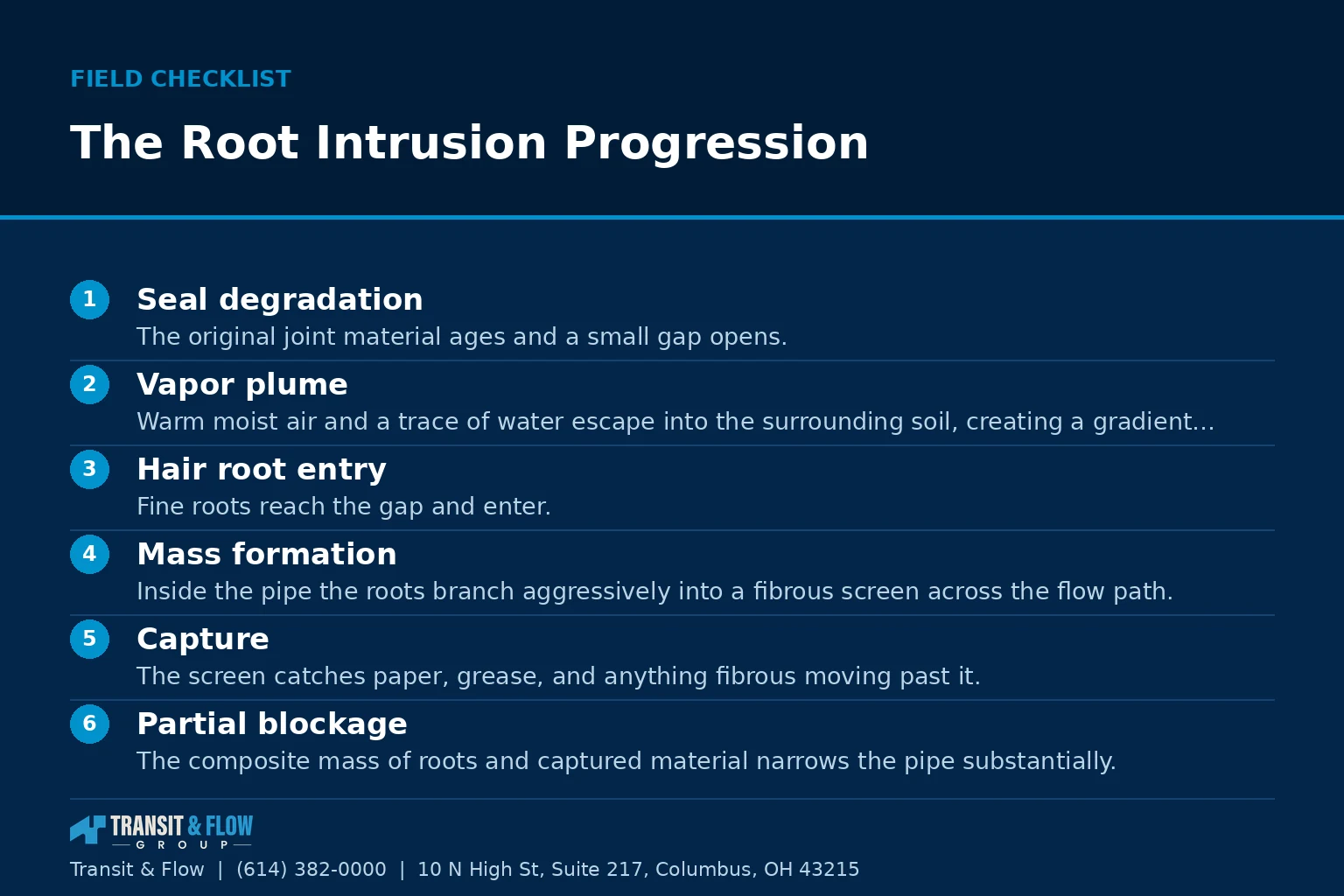
- Seal degradation. The original joint material ages and a small gap opens. Nothing is noticeable inside the house.
- Vapor plume. Warm moist air and a trace of water escape into the surrounding soil, creating a gradient roots can follow.
- Hair root entry. Fine roots reach the gap and enter. Still no symptoms; a camera at this stage shows a wisp.
- Mass formation. Inside the pipe the roots branch aggressively into a fibrous screen across the flow path.
- Capture. The screen catches paper, grease, and anything fibrous moving past it. Flow begins slowing. First symptoms appear, usually as gurgling or as a reaction to laundry.
- Partial blockage. The composite mass of roots and captured material narrows the pipe substantially. Recurring clogs begin, at shortening intervals.
- Joint damage. As the root thickens over years it exerts real force on the joint, widening the gap and eventually displacing the pipe sections. What began as a seal problem becomes a structural one.
- Full blockage or collapse. The end state, and the one that arrives as an emergency rather than as a decision.
Note where the cost curve turns. Steps one through five are correctable with a liner and no excavation. Step seven onward may not be, because lining requires a structurally continuous host pipe. That transition is the reason a baseline inspection on an older home is worth doing before symptoms appear rather than after.
Your Options, and What Each One Honestly Delivers
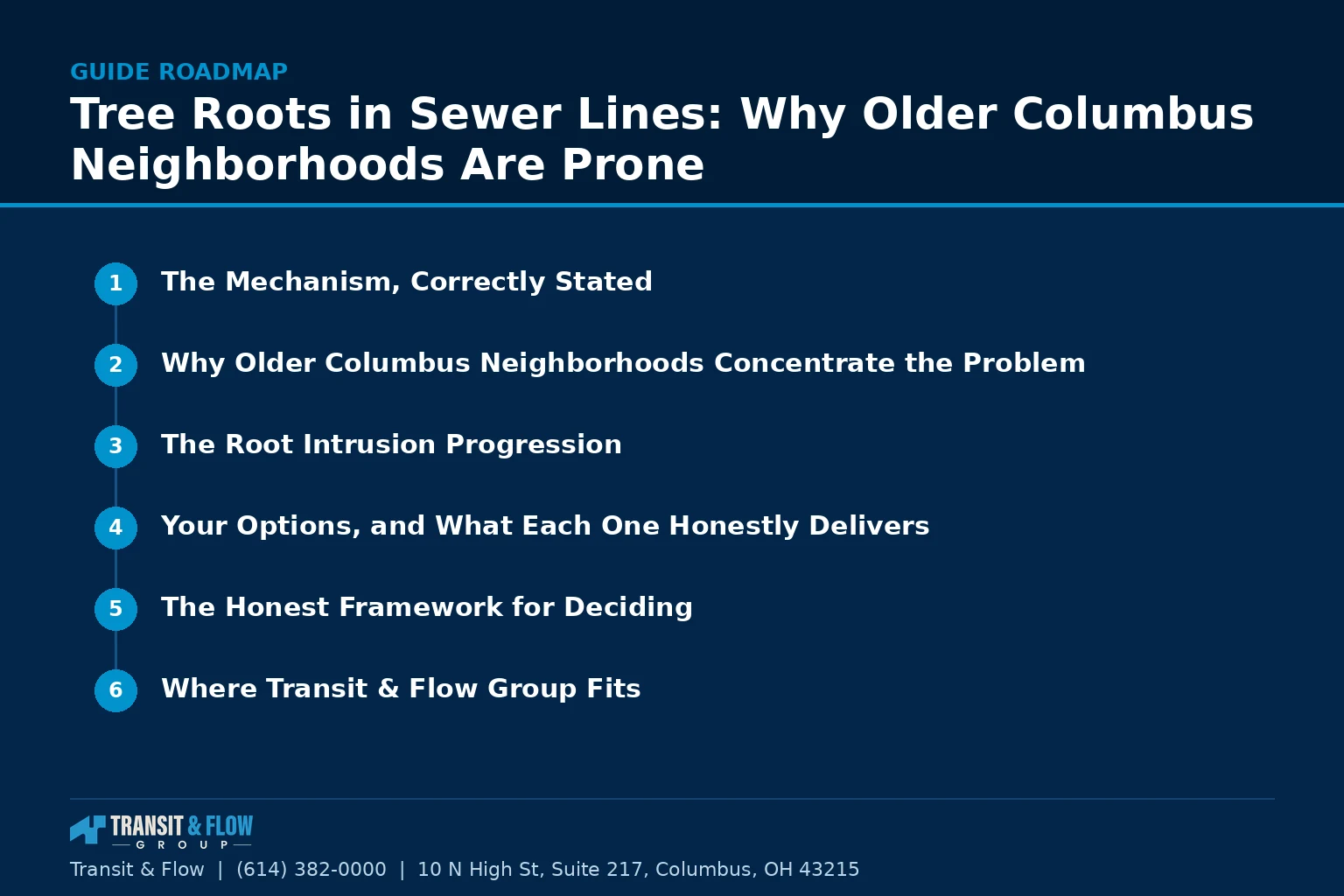
- Mechanical cutting by cable. A rotating cutting head bores through the root mass. Restores flow quickly. Leaves the root system and the opening intact, and roots regrow. Expect recurrence, typically within six to eighteen months and at shortening intervals.
- Hydro jetting with a root nozzle. More thorough than cabling because it scours the pipe wall rather than boring a channel, which buys a longer interval. Still does not close the opening. Requires an assessment of pipe condition first, since pressure in an already compromised clay line can make things worse.
- Chemical root treatment. Foaming herbicide products intended to kill root tissue inside the pipe and slow regrowth. Used as an adjunct to mechanical clearing, not a substitute. Follow label directions exactly, observe any local restrictions on discharge to the sanitary system, and understand that this manages the rate rather than closing the entry point.
- Cured-in-place lining. A resin liner cured inside the existing pipe forms a continuous, jointless interior surface. This is the first option on the list that actually ends the problem, because it removes the opening the roots were using. Trenchless, so the yard and the trees survive. Requires a host pipe that is still structurally continuous.
- Spot repair at the affected joint. Excavate and replace the specific failed section. Appropriate when the camera shows one bad joint in an otherwise sound line. Ends the problem at that location only.
- Pipe bursting or full replacement. The answer when the line has progressed past lining candidacy. Ends the problem completely and costs the most.
- Removing the tree. Rarely the right first move. It does not close the opening, other roots reach the same plume, and mature trees carry real value in these neighborhoods. Consider it only as part of a broader decision, and consult your municipality first, because street trees in the right of way are frequently not yours to remove.
The Honest Framework for Deciding
- Camera shows hair roots, pipe otherwise sound, no symptoms. Monitor with a repeat inspection in a couple of years, and plan for lining on your own timeline rather than on the pipe’s.
- Recurring clogs, camera shows a root mass, joints intact. This is the lining sweet spot. Continuing to cable is a decision to keep paying indefinitely for a problem with a bounded solution.
- Camera shows offsets or displacement at the rooted joints. Lining candidacy is in question. Get a specific answer on whether the host pipe qualifies, in writing.
- Camera shows collapse or Orangeburg material. Replacement territory. Ask which trenchless method applies and what rules the others out.
- Selling within a year or two. Different calculation, and disclosure obligations may apply. Talk to your agent about what your jurisdiction and your contract require.
- Staying long term in an older home. The baseline inspection is the highest-value thing on this page. It converts an unknown into a plan.
Where Transit & Flow Group Fits
Transit & Flow Group coordinates drain and sewer work across Columbus and Central Ohio with a simple rule for root cases: the camera runs before anyone quotes a repair, you get the video and the located distance, and the written scope says specifically why lining is or is not viable on your line. Where the work touches broader plumbing services, the same coordinator carries it. If you live in an older neighborhood and have never seen inside your lateral, request an assessment.
Frequently Asked Questions
How do I know whether my Columbus home is likely to have root intrusion?
Three conditions have to line up, and older Central Ohio housing stock tends to line up all three: jointed clay lateral material, mature street trees sitting over the pipe run, and enough decades for the process to work. If your home predates roughly 1980, sits on a street with large old shade trees, and has never had a camera inspection, root intrusion is a live possibility even with no symptoms today. That is a statement about construction era and material, not about your specific address. A camera inspection is what turns the probability into a fact.
Do roots actually break into a sewer pipe?
No, and the correction matters because it changes the remedy. A sound, sealed pipe offers nothing to the surrounding soil, so roots grow past it. An existing opening, whether an aged joint, a crack, or a failed seal, leaks warm moist vapor into the soil, and roots follow that gradient to its source and enter. So a root intrusion is evidence that an opening was already there. That is why the opening, not the root mass, is the thing that has to be addressed.
Does cutting the roots out fix the problem?
Cutting is management, not repair. Mechanical cutting by cable bores a channel through the mass and restores flow quickly, but it leaves both the root system and the opening intact, so regrowth follows and recurrence typically arrives at shortening intervals. Hydro jetting with a root nozzle scours the pipe wall rather than boring a channel, which buys a longer interval, but it still does not close the entry point and it calls for an assessment of pipe condition first. Choosing to keep cabling is a decision to keep paying indefinitely for a problem that has a bounded solution.
Is chemical root treatment worth using?
It is an adjunct to mechanical clearing rather than a substitute for it. Foaming products are intended to kill root tissue inside the pipe and slow regrowth, which manages the rate of the problem without closing the entry point the roots are using. Follow the product label directions exactly and observe any local restrictions on discharge to the sanitary system. If the goal is to end the problem rather than slow it, the conversation is about the opening.
When does a sewer lateral stop being a candidate for lining?
Cured-in-place lining requires a host pipe that is still structurally continuous, because the resin liner is formed inside the existing pipe. Early stages, from a weeping seal through an established root mass, are generally correctable with a liner and no excavation. Once a thickening root has widened the gap and displaced the pipe sections, what began as a seal problem has become a structural one and lining candidacy is genuinely in question. Ask for a specific written answer on whether your host pipe qualifies, based on what the camera shows.
Should the tree be removed?
Rarely as a first move. Removing the tree does not close the opening, other roots reach the same vapor plume, and mature trees carry real value in these neighborhoods. Treat it as one part of a broader decision rather than the decision itself. Consult your municipality before anything else, because street trees in the right of way are frequently not yours to remove.
Sources
- U.S. Environmental Protection Agency, blockages and structural failures in collection systems
- Ohio Revised Code 3781.28, excavation notice requirements
- City of Columbus, Get a Permit, permit application channels
About This Guide
Written and edited by Micheal Parker, founder of Transit & Flow Group. Published September 16, 2026. This guide is checked against the agency and code sources listed above, and it is revised when those sources change.
General contractor of record. Micheal Parker holds City of Columbus General Contractor Registration G12064, issued by the Columbus Department of Building and Zoning Services under Transit & Flow LLC and valid through June 30, 2027. Trade work that falls outside the scope of that registration is performed by licensed trade partners, and the responsible license holder is identified before work begins.
Transit & Flow Group, home and commercial services for Columbus and the surrounding Central Ohio communities. Phone (614) 382-0000. Email solutions@transitflowgroup.com. 10 N High St, Suite 217, Columbus, OH 43215. Contact our team or review the communities we serve.
