

Once a camera confirms that your sewer lateral needs more than a clearing, the conversation turns to method, and the method conversation is where homeowners most often feel out of their depth. Trenchless sounds modern and gentle. Traditional sounds crude and expensive. Neither framing is accurate, and choosing on vibe rather than on the condition of your line is how people end up with the wrong answer. This guide explains what each method physically does, what conditions each requires, and how to read a proposal that recommends one over the other. It is part of our drain and sewer guide, and follows our explanation of root intrusion in older neighborhoods.
In This Guide
- The Four Methods, Physically Described
- The Conditions Each Method Requires
- The Trade-Offs Nobody Puts in the Brochure
- A Decision Framework
- Reading the Proposal
- Where Transit & Flow Group Fits
- Frequently Asked Questions
Transit & Flow Group coordinates projects and partners with properly licensed and insured specialty contractors when licensing is required.
The Four Methods, Physically Described
Cured-in-Place Lining
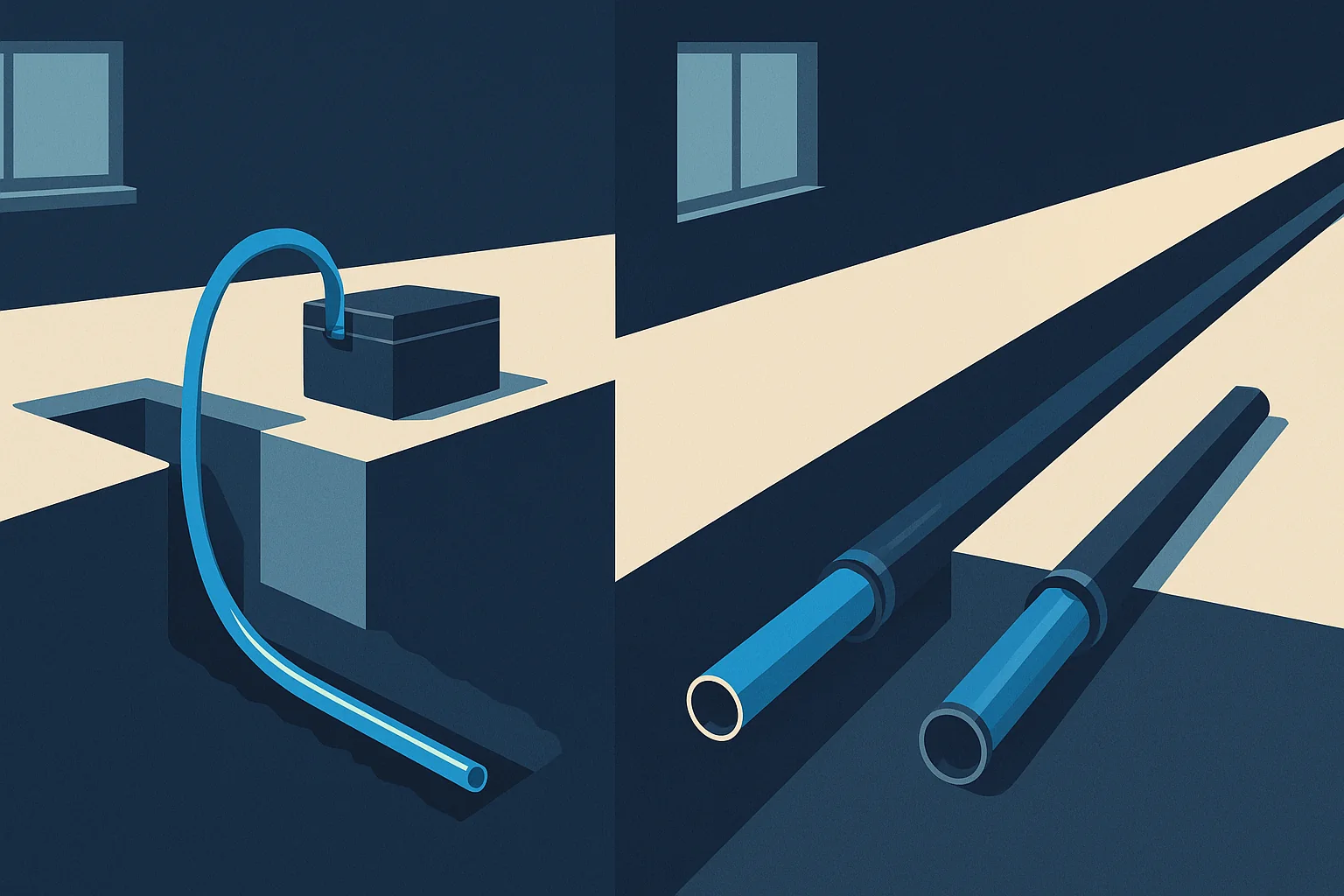
A flexible tube saturated with resin is pulled or inverted into the cleaned existing pipe, pressed against the interior wall, and cured in place with heat, steam, ultraviolet light, or ambient time depending on the resin system. When it hardens it is a continuous, jointless pipe inside the old pipe. The old pipe stays in the ground and becomes a form. Access is typically through the existing cleanout plus a small pit, so the yard is largely untouched.
Pipe Bursting
A conical bursting head is winched through the old pipe on a cable. The head is larger than the pipe’s interior, so it fractures the old pipe outward into the surrounding soil while simultaneously pulling a new continuous pipe in behind it. Access pits are excavated at each end of the run. Because the old pipe is destroyed rather than used as a form, its condition matters far less than it does for lining, and diameter can be increased.
Spot Repair
A single excavation over one located defect. The bad section is cut out, new pipe is installed with proper couplings and bedding, and the hole is backfilled and compacted. There is also a trenchless variant, a sectional liner, that repairs a limited length internally without digging.
Open-Cut Replacement
A trench is excavated along the entire run, the old pipe is removed, new pipe is laid to correct slope on proper bedding, and the trench is backfilled in compacted lifts. It is the oldest method and still the correct one in specific circumstances, described below.
The Conditions Each Method Requires
This is the part that actually decides the recommendation, and it is the part proposals most often leave implicit.
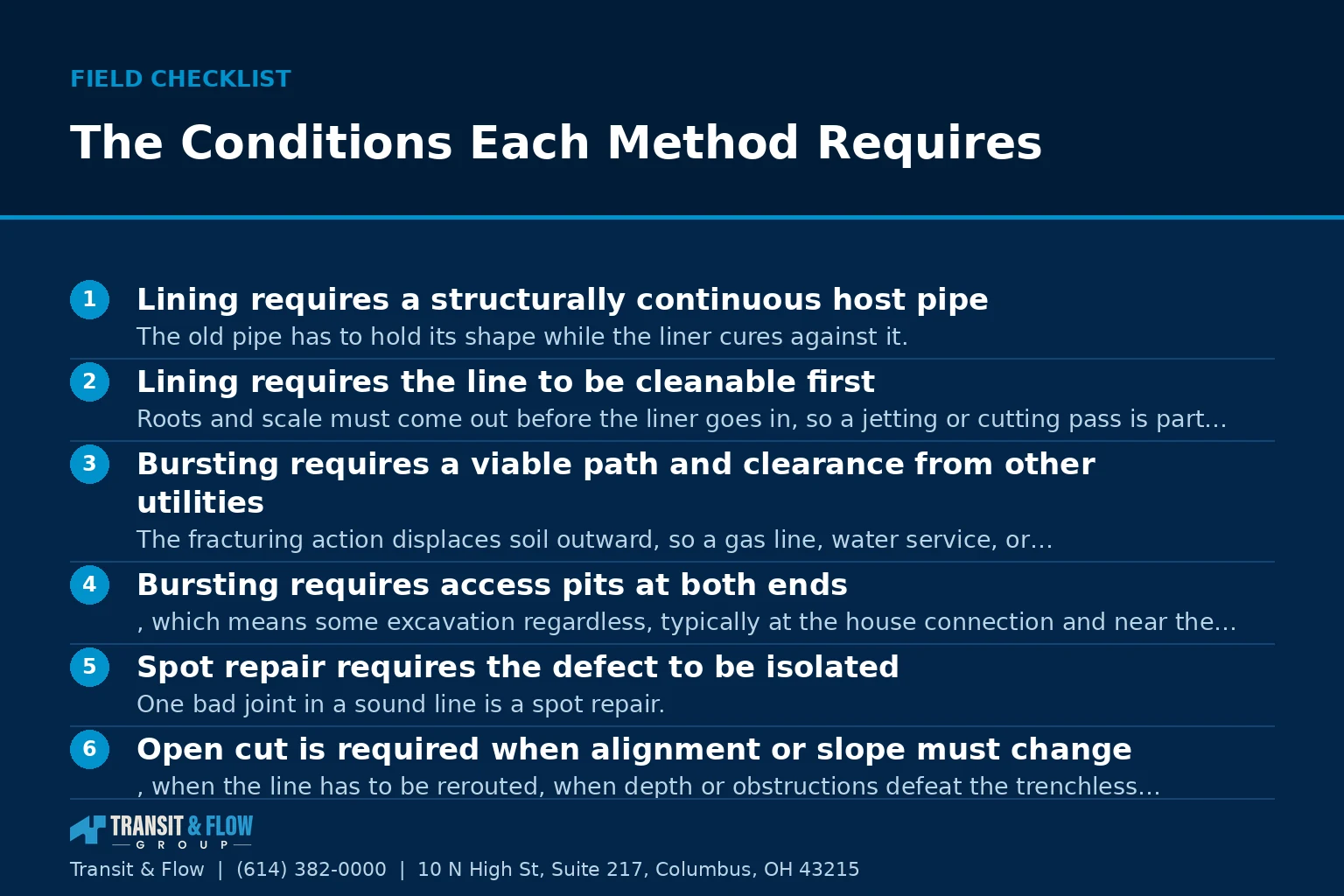
- Lining requires a structurally continuous host pipe. The old pipe has to hold its shape while the liner cures against it. Severe offsets, crushed sections, and collapses disqualify it. Significant bellies are also a problem, because lining preserves the existing alignment, including the sag. A liner does not fix slope.
- Lining requires the line to be cleanable first. Roots and scale must come out before the liner goes in, so a jetting or cutting pass is part of the scope, not an extra.
- Bursting requires a viable path and clearance from other utilities. The fracturing action displaces soil outward, so a gas line, water service, or communications conduit running close and parallel is a genuine constraint. This is one reason the utility locate is not paperwork.
- Bursting requires access pits at both ends, which means some excavation regardless, typically at the house connection and near the street.
- Spot repair requires the defect to be isolated. One bad joint in a sound line is a spot repair. Three bad joints spread across the run is a lining or replacement conversation, because you will be back.
- Open cut is required when alignment or slope must change, when the line has to be rerouted, when depth or obstructions defeat the trenchless equipment, or when the existing path is simply wrong. No trenchless method corrects a line that was installed in the wrong place at the wrong grade.
The Trade-Offs Nobody Puts in the Brochure
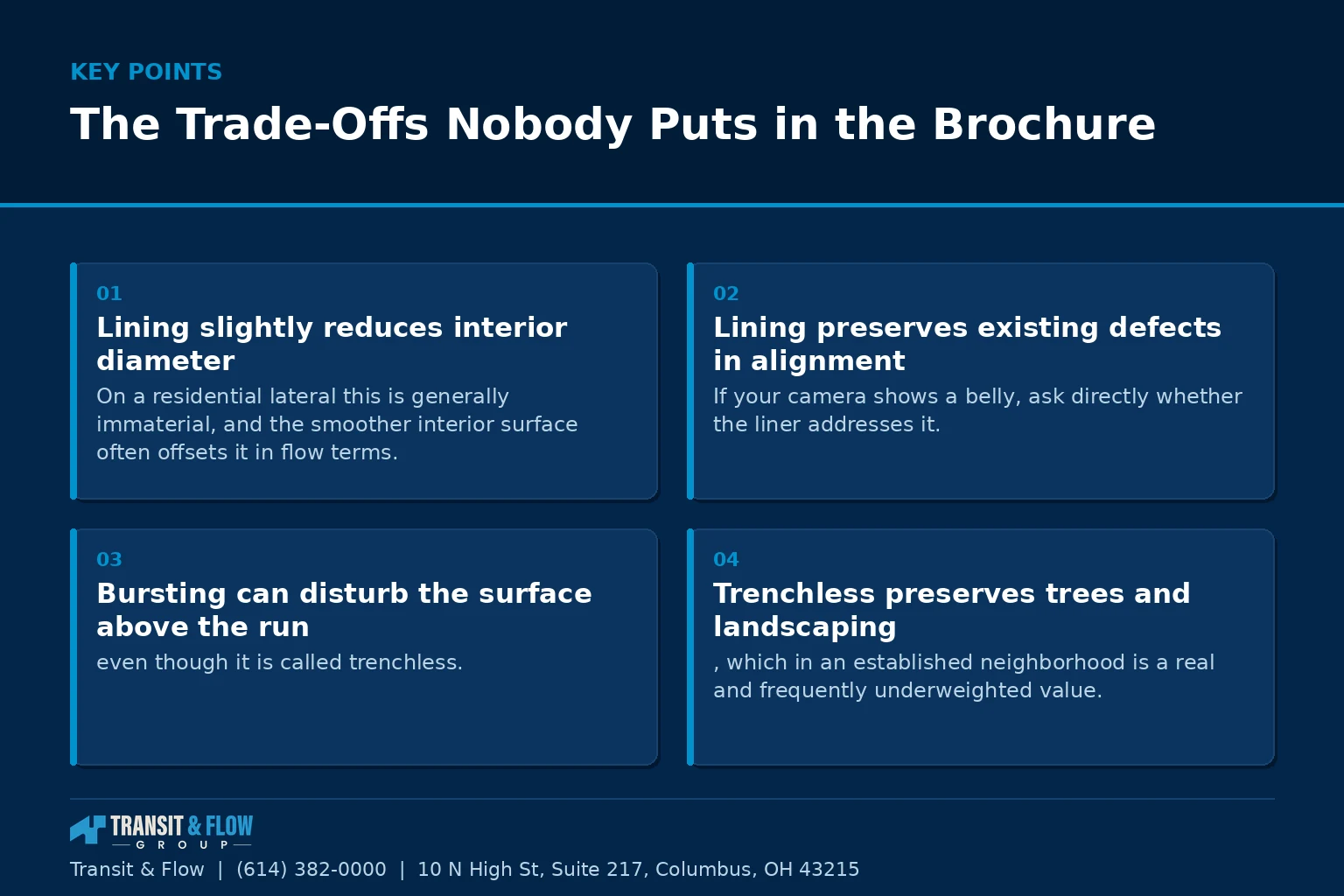
- Lining slightly reduces interior diameter. On a residential lateral this is generally immaterial, and the smoother interior surface often offsets it in flow terms. Worth knowing, not worth worrying about.
- Lining preserves existing defects in alignment. If your camera shows a belly, ask directly whether the liner addresses it. The honest answer is that it does not.
- Bursting can disturb the surface above the run even though it is called trenchless. Soil is being displaced along the whole path. Sidewalks, driveways, and hardscape over the line deserve a specific conversation.
- Trenchless preserves trees and landscaping, which in an established neighborhood is a real and frequently underweighted value.
- Open cut lets the installer verify everything visually and correct slope precisely. That verifiability is a genuine advantage, not a consolation prize.
- Open cut restoration is the long tail. The digging is fast. The settlement, the regrading, the grass, and the driveway section are what people remember, and they should be scoped in writing.
- Every method needs a post-repair camera pass. If the proposal does not include one, ask for it. It is your only proof of what was actually installed.
A Decision Framework
- One located defect, sound line elsewhere. Spot repair, or a sectional liner if the location suits it.
- Root intrusion at multiple joints, pipe still round and aligned. Full-length lining. This is the case lining was invented for.
- Interior scale in cast iron, structure intact. Descale and line.
- Orangeburg material anywhere in the run. Replacement, by bursting where the path allows. This material deforms and should not be relied on as a host.
- Collapse, severe offsets, or crushed sections. Bursting or open cut. Lining is off the table.
- Belly causing recurring standing water. Open cut at the sag to re-establish slope. Do not accept a liner as the answer to a grade problem.
- Wrong routing, or the line needs to move. Open cut, because you are installing a new line rather than restoring an old one.
- Mature trees or significant hardscape over the run, and the pipe qualifies. Weight trenchless heavily. Preserving what is above the pipe is part of the value.
Reading the Proposal
We do not publish flat prices for sewer work, and any contractor who quotes one before a camera and a locate is quoting a marketing number. Length, depth, material, soil, access, permits, and restoration all move the figure, and they are specific to your address. What you can evaluate without any pricing knowledge is whether the scope is written like a diagnosis. Work through the following checklist and confirm each item appears in writing.
- The named method, plus a statement of what specifically rules out the less invasive options.
- A reference to the camera findings, with distances, rather than a generic description of the problem.
- The linear footage, the depth, and the pipe material being installed.
- The permit, the utility locate, and the jurisdiction’s inspection.
- Restoration spelled out, including backfill method, compaction, grass, driveway or sidewalk sections, and whether a return visit for settlement is included.
- A post-repair camera pass delivered to you.
- The warranty terms, the duration of coverage, and whether the warranty transfers if you sell.
- A realistic schedule, given that Ohio law requires notice at least two working days before excavation begins.
Compare scopes before you compare totals. Two proposals with different numbers are frequently proposing different work, and the cheaper one is sometimes the one that left out restoration.
Where Transit & Flow Group Fits
Transit & Flow Group coordinates drain and sewer projects across Columbus and Central Ohio without a stake in which method gets used, because we coordinate rather than sell a single technology. That means the camera runs first, the scope names why the less invasive options were ruled out, the permit and locate are handled, and the post-repair video comes to you. Where the work touches broader plumbing services, one coordinator carries it. If you have a diagnosis and need a method decision you can trust, request an assessment.
Frequently Asked Questions
What is the real difference between trenchless and traditional sewer repair?
Traditional open cut excavates a trench along the run, removes the old pipe, and lays new pipe to corrected slope on proper bedding. Trenchless covers two different techniques. Cured-in-place lining pulls a resin saturated tube into the cleaned existing pipe and hardens it into a continuous jointless pipe inside the old one, which stays in the ground as a form. Pipe bursting winches a conical head through the old pipe, fracturing it outward into the soil while pulling a new continuous pipe in behind, with access pits at each end. The right choice follows from the condition of your line, not from which method sounds gentler.
Can a liner fix a belly or a sag in the sewer line?
No. Lining preserves the existing alignment, including the sag, because the old pipe is acting as the form the liner cures against. If your camera footage shows a belly causing recurring standing water, ask the contractor directly whether the liner addresses it, and treat any answer other than no as a reason to get a second opinion. Re-establishing slope is an excavation question, so a grade problem generally points to open cut at the sag.
Is trenchless always the less disruptive option?
Not always, and the name oversells it. Lining is genuinely gentle on a yard, since access is typically the existing cleanout plus a small pit. Bursting displaces soil along the entire path, so sidewalks, driveways, and hardscape sitting over the run deserve a specific conversation before work is scheduled. Bursting also needs access pits at both ends, which means some excavation regardless.
When is open-cut replacement still the right method?
Open cut is called for when alignment or slope has to change, when the line needs to be rerouted, when depth or obstructions defeat the trenchless equipment, or when the existing path is simply in the wrong place. No trenchless method corrects a line installed at the wrong grade or the wrong location. Open cut also lets the installer verify everything visually, which is a real advantage rather than a consolation prize. The offset is restoration, since the settlement, regrading, grass, and driveway sections are the long tail and should be scoped in writing.
What conditions rule lining out entirely?
Lining needs a structurally continuous host pipe that will hold its shape while the resin cures against it. Severe offsets, crushed sections, and collapses disqualify it, and Orangeburg material should not be relied on as a host because it deforms. The line also has to be cleanable first, so a jetting or cutting pass to remove roots and scale belongs in the scope rather than arriving later as an extra. Whether your specific line qualifies is a determination for a licensed contractor working from camera footage, not something to settle from a description.
What should I look for in a sewer repair proposal?
Read the scope before you read the total, because two proposals with different numbers are frequently proposing different work. A sound scope names the method and says what specifically ruled out the less invasive options, references the camera findings with distances, states the linear footage, depth, and pipe material, and includes the permit, the utility locate, and the jurisdiction’s inspection. It should also spell out restoration and include a post-repair camera pass delivered to you, which is your only proof of what was actually installed. Confirm the schedule accounts for Ohio law requiring notice at least two working days before excavation begins, and take any permit question to your local building department.
Sources
- Ohio Revised Code 3781.28, excavation notice requirements
- Ohio Revised Code 3781.25, definitions including working days
- U.S. Environmental Protection Agency, collection system structural failures
- City of Columbus, Get a Permit, permit application channels
About This Guide
Written and edited by Micheal Parker, founder of Transit & Flow Group. Published September 18, 2026. This guide is checked against the agency and code sources listed above, and it is revised when those sources change.
General contractor of record. Micheal Parker holds City of Columbus General Contractor Registration G12064, issued by the Columbus Department of Building and Zoning Services under Transit & Flow LLC and valid through June 30, 2027. Trade work that falls outside the scope of that registration is performed by licensed trade partners, and the responsible license holder is identified before work begins.
Transit & Flow Group, home and commercial services for Columbus and the surrounding Central Ohio communities. Phone (614) 382-0000. Email solutions@transitflowgroup.com. 10 N High St, Suite 217, Columbus, OH 43215. Contact our team or review the communities we serve.
