


Almost every deck conversation in Central Ohio arrives at the same fork within about ten minutes. Wood or composite. The question is usually framed as a price question, and framed that way it has an obvious answer, because on install day pressure treated pine is the cheapest surface you can put on a deck frame and it is not close. But install day is the worst possible moment to evaluate a decking surface, because a deck surface is not a purchase. It is a decade long relationship with a horizontal material that lives outdoors in a climate that freezes it, soaks it, bakes it, and buries it under wet leaves every autumn.
In This Guide
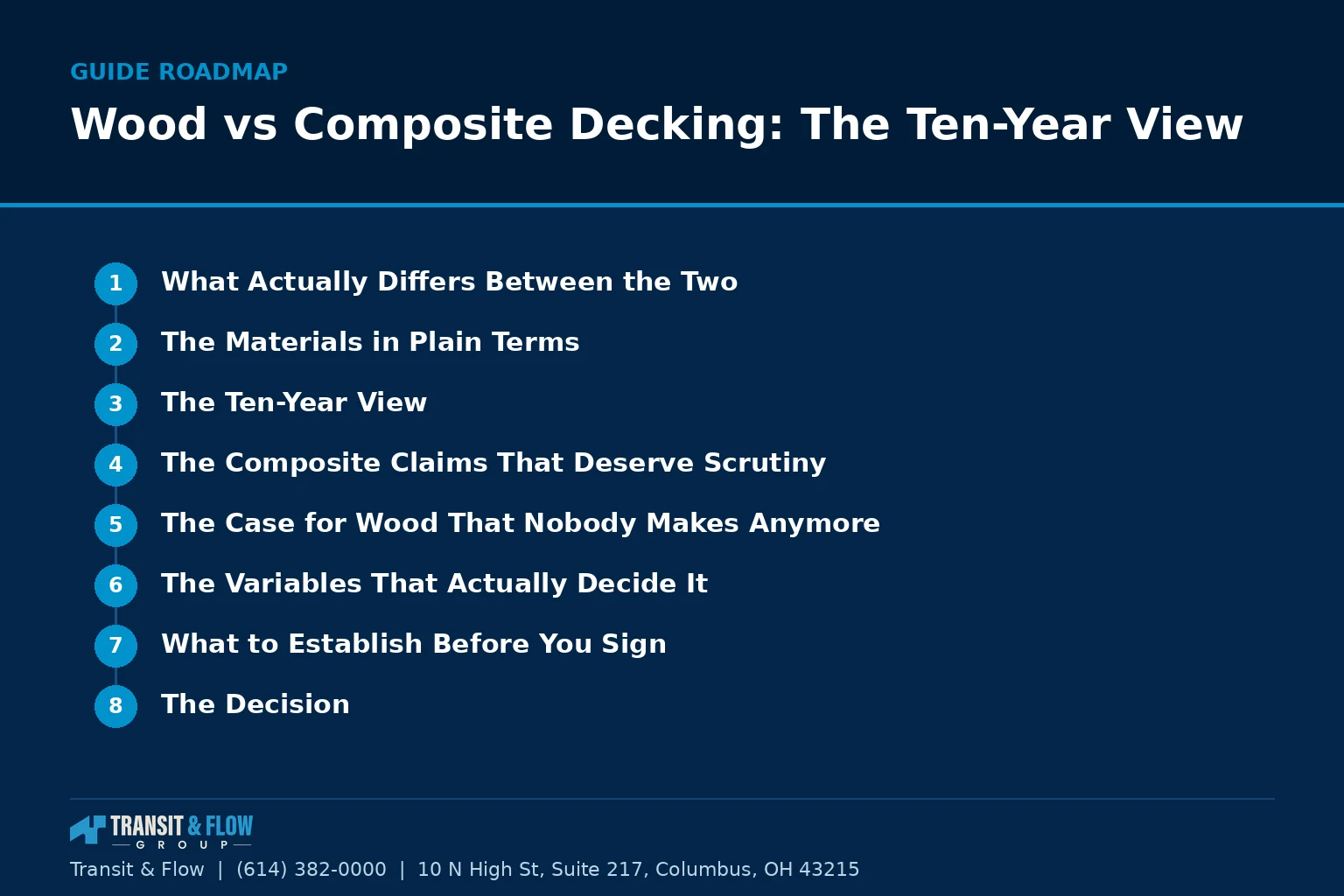
- What Actually Differs Between the Two
- The Materials in Plain Terms
- The Ten-Year View
- The Composite Claims That Deserve Scrutiny
- The Case for Wood That Nobody Makes Anymore
- The Variables That Actually Decide It
- What to Establish Before You Sign
- On Cost
- Glossary
- The Decision
- Where Transit & Flow Group Fits
- Frequently Asked Questions
The useful question is what the surface costs to own for ten years, what it looks like at the end of that period, and what it demands from you along the way. This article works that comparison honestly, including the parts of the composite sales pitch that do not survive contact with a real Ohio deck.
What Actually Differs Between the Two
The frame underneath is the same in almost every case. Pressure treated lumber joists, beams, and posts carry the load on the overwhelming majority of residential decks regardless of what the surface is made of. That matters more than most homeowners realize, because it means the choice you are making is a choice about the walking surface and the railing, not about the structure. Structural life is governed by the framing, the attachment, the hardware, and the drainage, which we cover in the deck planning guide.
What differs is how the surface responds to the four things Central Ohio does to a horizontal board: ultraviolet exposure in summer, repeated freeze and thaw cycling in winter, prolonged moisture from snow that sits rather than drains, and organic debris that holds water against the surface for weeks at a time in fall.
The Materials in Plain Terms
| Material | What it is | What it demands | How it typically fails |
|---|---|---|---|
| Pressure treated pine | Softwood treated with preservative to resist decay and insects | Cleaning and a penetrating stain or sealer on a recurring cycle, plus periodic fastener and board replacement | Checking, cupping, splintering, individual board failure, fastener backout |
| Cedar | Naturally decay resistant softwood, dimensionally calmer than pine | Same maintenance cycle as pine, slightly more forgiving of missed years | Gradual surface erosion, greying, softness at cut ends and contact points |
| Tropical hardwood | Very dense imported hardwood, hard and heavy | Oiling to retain color, specialized fasteners and installation | Colour loss to grey if unoiled, movement at fasteners, cost of repair |
| Capped composite | Wood flour and polymer core with a bonded polymer cap on the exposed faces | Washing, keeping debris cleared, keeping the underside ventilated | Cap damage from impact or abrasion, staining in gaps, colour fade in high UV zones |
| Uncapped composite | Older generation wood and polymer blend with no protective cap | Regular cleaning, and it stains and grows surface mold readily | Surface mold, staining, fading, swelling at cut ends |
| PVC | Fully synthetic cellular board with no wood content | Washing, and attention to expansion gaps at installation | Thermal movement, surface scratching, a plastic look some owners dislike |
The Ten-Year View
Here is the comparison that actually decides the question. Not the invoice, the decade.
- Year one. Wood is the clear winner on outlay. Composite costs meaningfully more for the surface and the fasteners. Both look good. Nothing about year one tells you anything useful.
- Years two through four. Wood requires its first real maintenance cycle, cleaning and refinishing. Composite requires washing. This is where the ownership paths begin to separate, and it is where most homeowners discover whether they are actually the kind of person who maintains a deck.
- Years five through seven. Wood that has been maintained on schedule looks respectable. Wood that has not is visibly weathered, and some boards are showing checking or cupping. Composite generally still looks like itself, with some colour softening on the highest exposure sections, usually the south and west facing areas and the stair treads.
- Years eight through ten. This is the divergence point. Maintained wood is on its third or fourth refinishing cycle and some boards have been swapped. Unmaintained wood is a replacement conversation. Composite is generally still serviceable and the question shifts from the surface to the frame underneath it.
- The frame question at year ten. This is the part almost nobody plans for. If the pressure treated frame is at the end of its life and the composite surface is not, you are removing a surface that still has years in it to get at the structure. Frame quality and surface quality should be matched deliberately, not by accident.
The Composite Claims That Deserve Scrutiny
Composite is a good product and it has earned most of its market share honestly. But the sales language around it consistently overstates two things, and knowing which two protects you from disappointment.
- Maintenance free is not accurate, and low maintenance is. A composite deck in Central Ohio still needs debris cleared and still needs washing. Leaf litter left on any deck surface through a wet autumn will hold moisture and grow surface organisms. On a capped composite that growth sits on the cap and washes off. On a wood deck it works into the grain. That is a real advantage, but it is an advantage in the effort required, not the elimination of it.
- Fade resistant does not mean fade proof. Every exterior surface changes under ultraviolet exposure. A quality capped composite changes slowly and evenly, which is exactly what you want, but a section shaded by a pergola for eight years will not match a fully exposed section. Ask what the published warranty actually covers on colour and over what period.
- Heat is a genuine consideration. Dark composite in full afternoon sun gets hot. If the deck faces west with no shade and the household includes bare feet or dogs, colour selection is a comfort decision, not just an aesthetic one.
- Scratching is real on some products. Furniture dragged across a capped surface, or grit ground underfoot, will mark some caps. Ask specifically about abrasion, not just about stains.
- Composite is not structural. It cannot span like lumber and it will require the joist spacing the manufacturer publishes, which is sometimes tighter than a wood deck would need. If a proposal switches you to composite without adjusting framing, that is a question worth asking directly.
The Case for Wood That Nobody Makes Anymore
Wood has been so thoroughly out marketed that the honest arguments for it rarely get made. There are several, and for the right household they are decisive.
- Repair is cheap and simple. A damaged wood board is replaced by anyone with a saw and a trip to a lumber yard. A damaged composite board from a discontinued product line is a colour matching problem that can force a larger replacement.
- The upfront difference is real money that can go into the structure. Spending the composite premium on better framing, deeper footings, superior hardware, and proper flashing at the house buys you more deck life than a nicer surface does. This is the single most underrated trade in the entire deck category.
- Wood tolerates high heat better. A wood deck in full sun is meaningfully cooler underfoot than dark composite.
- It can be changed. Wood can be stained a different colour in year six. Composite is the colour you chose on the day you chose it, for as long as it exists.
- A short holding period changes the math. If you expect to sell within four or five years, the ten year advantage of composite never arrives, and you paid for it.
The Variables That Actually Decide It
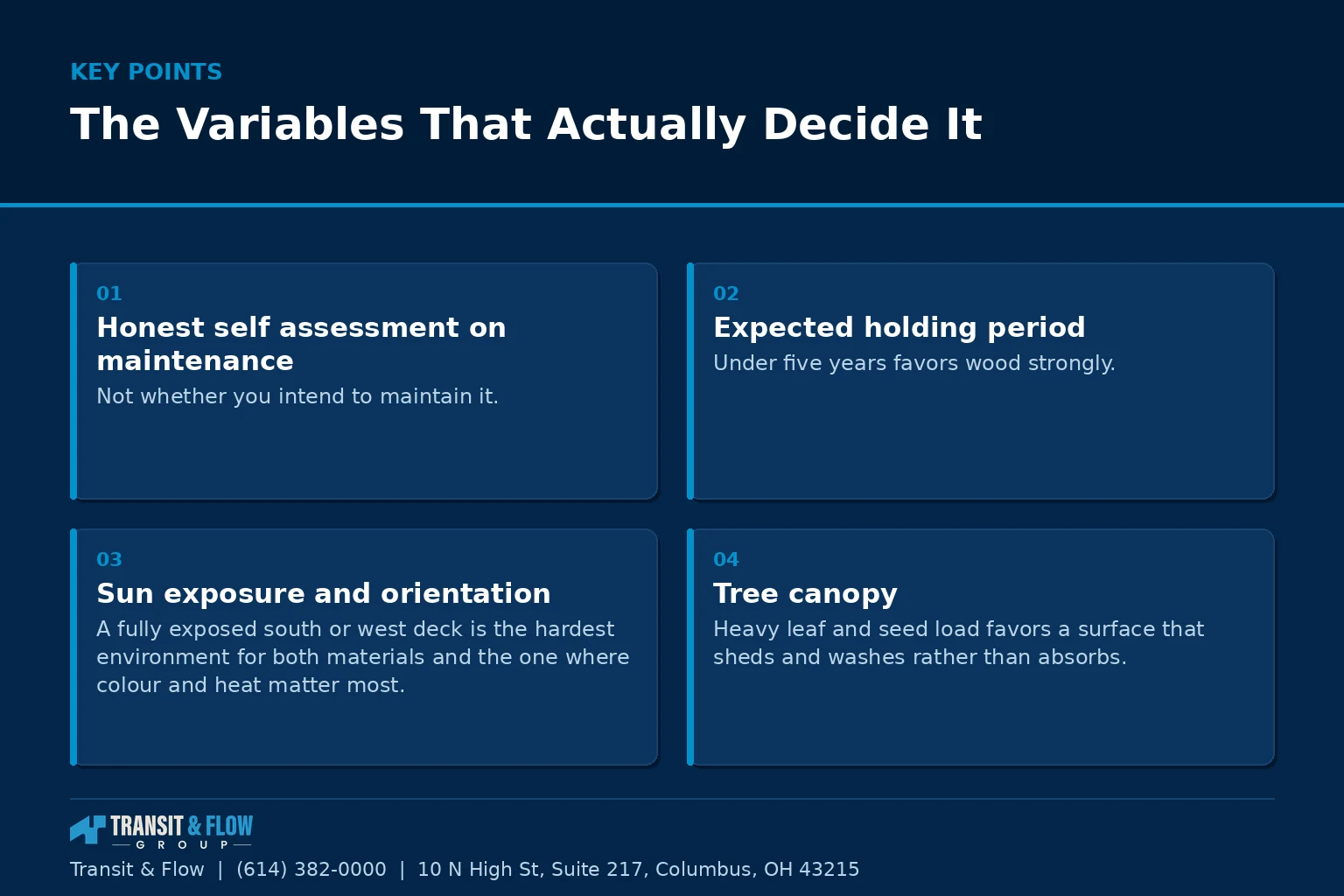
- Honest self assessment on maintenance. Not whether you intend to maintain it. Whether you have maintained comparable things. Wood punishes optimism.
- Expected holding period. Under five years favors wood strongly. Over ten years favors composite strongly. The five to ten window is genuinely close.
- Sun exposure and orientation. A fully exposed south or west deck is the hardest environment for both materials and the one where colour and heat matter most.
- Tree canopy. Heavy leaf and seed load favors a surface that sheds and washes rather than absorbs.
- Ground clearance and ventilation underneath. A low deck close to grade with poor airflow underneath is hard on every material, and it is a design problem before it is a material problem.
- Frame age on an existing deck. Putting a premium surface on a frame with unknown remaining life is a common and expensive mistake.
- Whether the deck will be covered later. A future roof or pergola changes exposure dramatically and should influence the decision now.
- Household use. Dogs, furniture that moves, grills, and heavy foot traffic all shift the calculation toward abrasion resistance and easy repair.
What to Establish Before You Sign
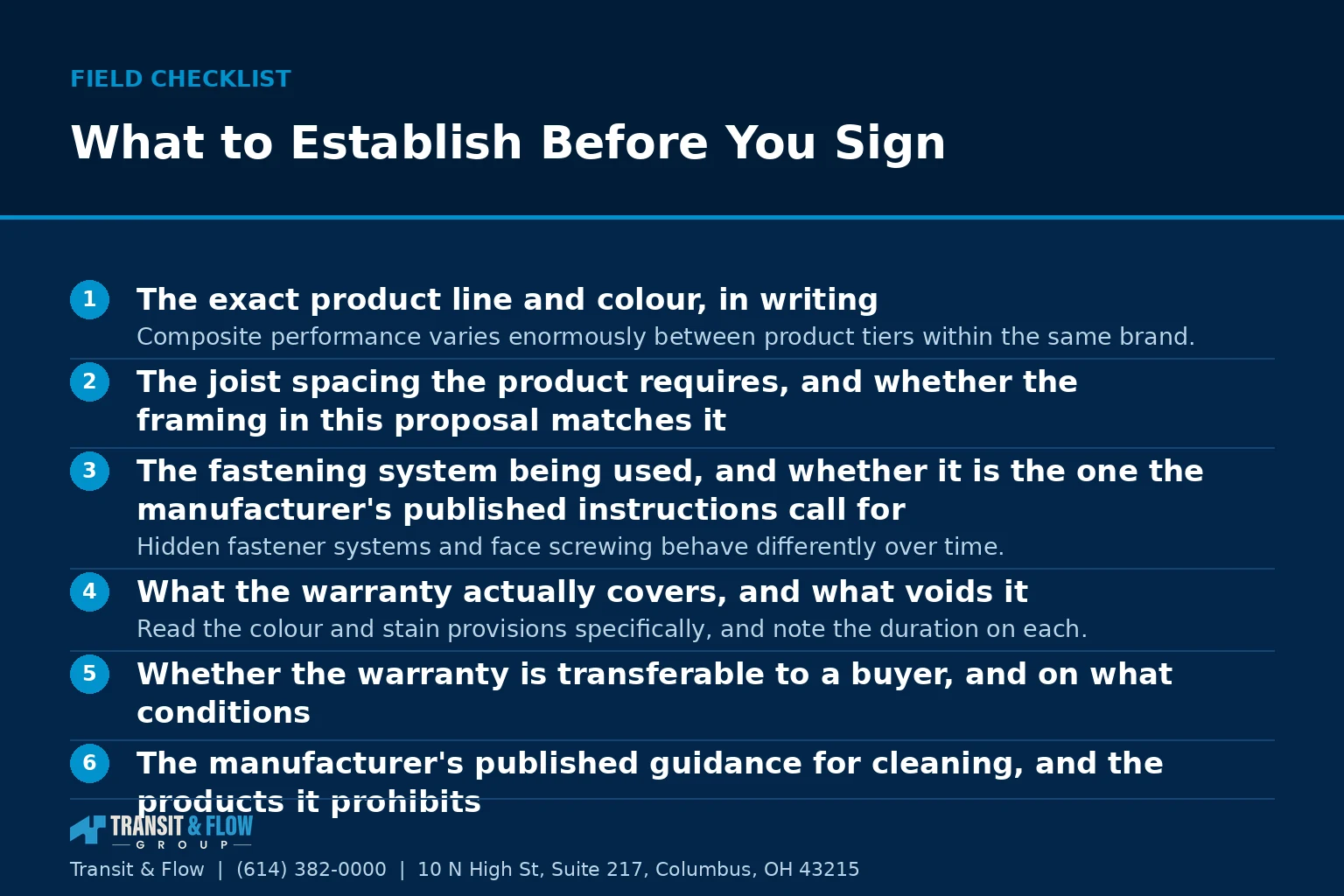
- The exact product line and colour, in writing. Composite performance varies enormously between product tiers within the same brand.
- The joist spacing the product requires, and whether the framing in this proposal matches it.
- The fastening system being used, and whether it is the one the manufacturer’s published instructions call for. Hidden fastener systems and face screwing behave differently over time.
- What the warranty actually covers, and what voids it. Read the colour and stain provisions specifically, and note the duration on each.
- Whether the warranty is transferable to a buyer, and on what conditions.
- The manufacturer’s published guidance for cleaning, and the products it prohibits.
- The handling of cut ends and edges. Field cuts expose the core on capped products and the treatment matters.
- Whether the framing is new, and its expected service life relative to the surface.
- The availability commitment on replacement boards if a section is damaged in year six.
On Cost
This article contains no dollar figures on purpose. Decking prices move with lumber and polymer markets, they vary by product tier within a single brand, and they vary by deck geometry in ways that make any number quoted here misleading by the time you read it. What does not change is the structure of the comparison: wood costs less to install and more to own, composite costs more to install and less to own, and the crossover point sits somewhere in the five to ten year range depending on how faithfully the wood would actually be maintained. Get real numbers from real proposals on your actual deck, then apply the ten year frame in this article to them.
Glossary
- Capped composite. A composite board with a bonded polymer shell on the exposed faces, which carries most of the stain and fade resistance.
- Uncapped composite. An earlier generation composite with no protective shell, more vulnerable to staining and surface growth.
- Checking. Small surface cracks that develop in wood as it dries and cycles through wet and dry conditions.
- Cupping. A board curving across its width, usually from uneven moisture on the two faces.
- Joist spacing. The center to center distance between framing members that support the decking surface.
- Hidden fastener. A clip or track system that secures boards from the side or below so no screw heads show on the surface.
- Thermal movement. Expansion and contraction of a board with temperature change, which drives the gapping requirements at installation.
- Penetrating stain. A finish that soaks into wood rather than forming a surface film, which typically wears rather than peels.
- Ground clearance. The distance between the underside of the framing and the soil, which governs airflow and drying.
- Service life. The period over which a component performs its function acceptably, which for a deck differs between the surface and the frame.
The Decision
Option A. Pressure treated or cedar decking, with the money saved on the surface redirected into the framing, the footings, the hardware, and the flashing at the house. Correct for households that will hold the property under about five years, that genuinely maintain things on a schedule, or that value cheap simple repair over a low effort surface.
Option B. Capped composite or PVC on a deliberately overbuilt frame, with the product line, colour, joist spacing, and fastening system specified in writing. Correct for households holding the property beyond about seven years, households under heavy tree canopy, and households that will not realistically refinish a deck every few years.
Recommendation: Option B for most Central Ohio homeowners building new, with one non negotiable condition. The frame under a premium surface must be built to outlast that surface. The failure mode we see repeatedly is a beautiful composite deck sitting on framing that reaches the end of its life first, which forces the owner to dismantle a perfectly good surface to fix what is underneath. If a proposal offers you an upgraded surface without a corresponding conversation about framing, footings, hardware, and how the deck meets the house, that proposal is optimizing the part you can see. Fix that before you choose a colour. And if the honest answer to the holding period question is under five years, take Option A without hesitation and put the difference into structure, because the ten year advantage you would be paying for is an advantage you will never collect.
Where Transit & Flow Group Fits
We plan and coordinate exterior projects across Central Ohio, and on deck work we push the conversation toward structure before surface every time. That means the footing and framing decisions get specified before the material selection, the attachment at the house gets treated as the highest consequence detail on the project, and the surface choice gets made against a stated holding period rather than a showroom sample. If you are weighing decking materials, or evaluating proposals that are difficult to compare because they describe different things, start a conversation with our team or review the full deck and outdoor living services we coordinate. Related reading includes our guide to planning a deck project in Central Ohio and our explanation of how coordination failures cost homeowners on projects that involve more than one trade.
Transit & Flow Group coordinates projects and partners with properly licensed and insured specialty contractors when licensing is required, and work is performed under the appropriate permits.
Frequently Asked Questions
Is wood or composite cheaper?
Wood on install day, composite over a decade, and that is the whole tension in the decision. Pressure treated pine is the least expensive surface you can put on a deck frame and it is not close. But a decking surface is not a purchase, it is a ten year relationship with a horizontal material that gets frozen, soaked, baked, and buried under wet leaves every autumn. Wood costs less to install and more to own, composite costs more to install and less to own, and the crossover sits somewhere in the five to ten year range depending on how faithfully the wood would actually be maintained.
Is composite decking maintenance free?
Low maintenance is accurate, maintenance free is not. A composite deck in Central Ohio still needs debris cleared and still needs washing, because leaf litter left through a wet autumn holds moisture and grows surface organisms on any material. The difference is that on a capped composite that growth sits on the cap and washes off, while on wood it works into the grain. That is a genuine advantage in the effort required rather than the elimination of effort.
Does switching to composite change the framing?
It can, and this is worth raising directly. Composite is not structural, it cannot span like lumber, and it requires the joist spacing the manufacturer publishes for that product, which is sometimes tighter than a wood deck would have needed. If a proposal switches the surface to composite without any corresponding adjustment to the framing, ask how the published spacing requirement is being met. The answer belongs in the written scope rather than in the field.
Does composite fade in the sun?
Fade resistant does not mean fade proof. Every exterior surface changes under ultraviolet exposure, and a quality capped composite changes slowly and evenly, which is what you want, but a section shaded by a pergola for years will not match a fully exposed section. Ask what the published warranty actually covers on colour and over what period. Heat is a separate consideration, since dark composite in full afternoon sun gets hot, which makes colour a comfort decision on a west facing deck with bare feet or dogs.
When is wood still the better choice?
When the holding period is short, when repair simplicity matters, or when the money saved on the surface would do more good in the structure. A damaged wood board is replaced by anyone with a saw and a trip to a lumber yard, while a damaged composite board from a discontinued line becomes a colour matching problem that can force a larger replacement. Wood also runs cooler underfoot in full sun and can be stained a different colour years later, which composite cannot. If you expect to sell within four or five years, the ten year advantage of composite never arrives and you paid for it anyway.
What should I establish before signing a decking proposal?
Get the exact product line and colour in writing, since composite performance varies enormously between tiers inside a single brand. Confirm the joist spacing the product requires and whether the proposed framing matches it, and confirm that the fastening system is the one the manufacturer’s published instructions call for. Read what the warranty covers and what voids it, whether it transfers to a buyer, and the published cleaning guidance including prohibited products. Establish how cut ends and edges are handled, whether the framing is new and what service life it has relative to the surface, and what commitment exists on replacement board availability years from now.
Sources
- City of Columbus, permitting and inspection information
- Ohio Construction Industry Licensing Board, contractor licensing
- U.S. Department of Energy, moisture control guidance
- National Weather Service, regional climate and seasonal conditions
About This Guide
Written and edited by Micheal Parker, founder of Transit & Flow Group. Published March 31, 2027. This guide is checked against the agency and code sources listed above, and it is revised when those sources change.
General contractor of record. Micheal Parker holds City of Columbus General Contractor Registration G12064, issued by the Columbus Department of Building and Zoning Services under Transit & Flow LLC and valid through June 30, 2027. Trade work that falls outside the scope of that registration is performed by licensed trade partners, and the responsible license holder is identified before work begins.
Transit & Flow Group, home and commercial services for Columbus and the surrounding Central Ohio communities. Phone (614) 382-0000. Email solutions@transitflowgroup.com. 10 N High St, Suite 217, Columbus, OH 43215. Contact our team or review the communities we serve.
