

Read this first. This article is an observation and evaluation guide, not a repair guide. It describes what deck failures look like and what the adopted building code and a qualified inspector address, so that you can recognize when something on your deck deserves professional attention. It does not tell you whether your deck complies with anything, it does not state the fastening, spacing, or dimensional requirements that apply to your structure, and it does not describe how any structural connection is made or corrected. If anything in this article describes something you see on your own deck, the correct next step is an assessment by a qualified professional and a conversation with your local building department, not a trip to a hardware store.
In This Guide
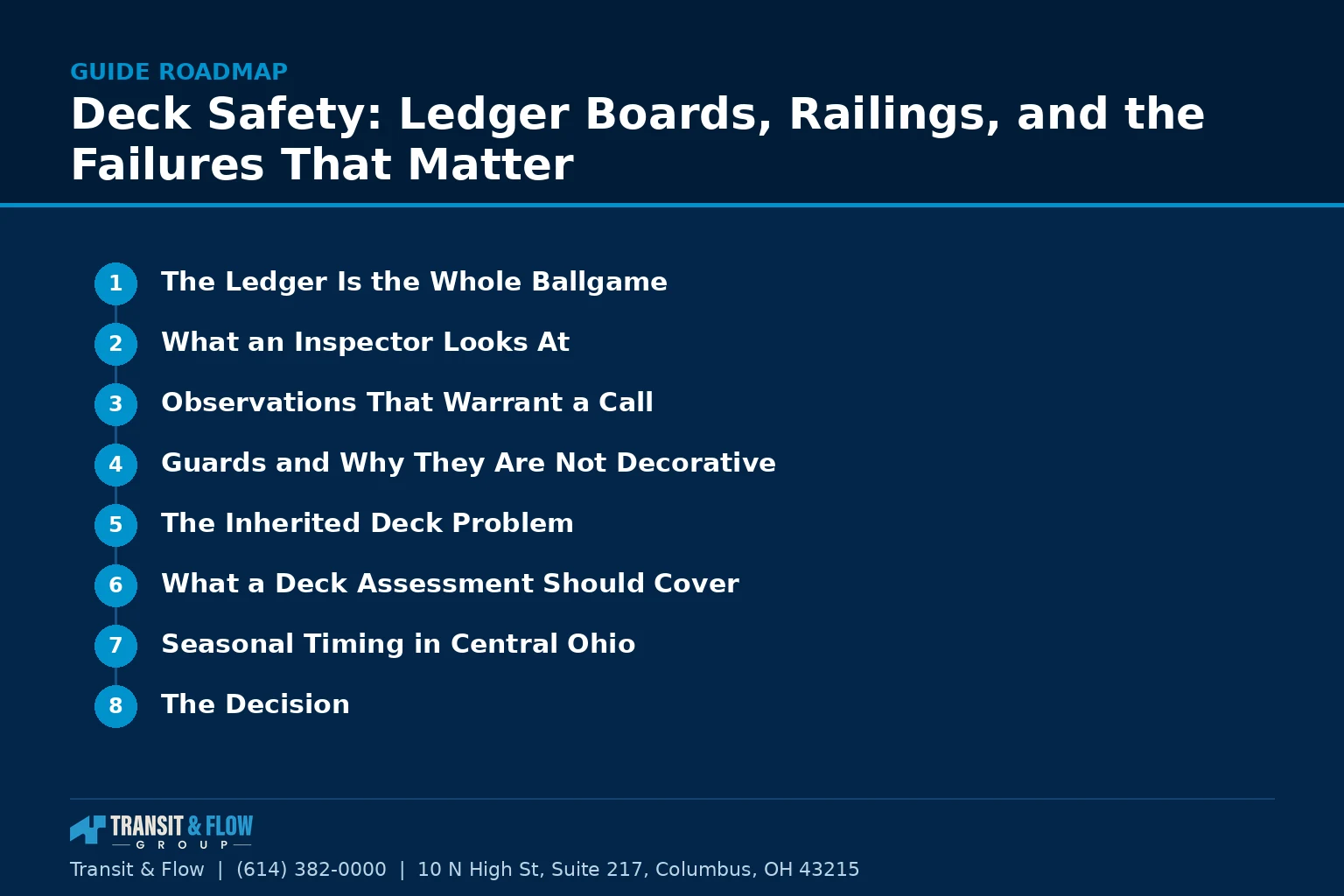
- The Ledger Is the Whole Ballgame
- What an Inspector Looks At
- Observations That Warrant a Call
- Guards and Why They Are Not Decorative
- The Inherited Deck Problem
- What a Deck Assessment Should Cover
- Seasonal Timing in Central Ohio
- On Cost
- Glossary
- The Decision
- Where Transit & Flow Group Fits
- Frequently Asked Questions
With that said, the single most useful thing a homeowner can understand about decks is this: decks do not usually fail gradually and visibly the way a roof does. They fail suddenly, at a connection, under load, and the warning signs beforehand are subtle enough that most owners walk past them for years. Deck collapses in this country cluster overwhelmingly around gatherings, because that is when the load is highest, and they cluster overwhelmingly around one specific connection.
The Ledger Is the Whole Ballgame
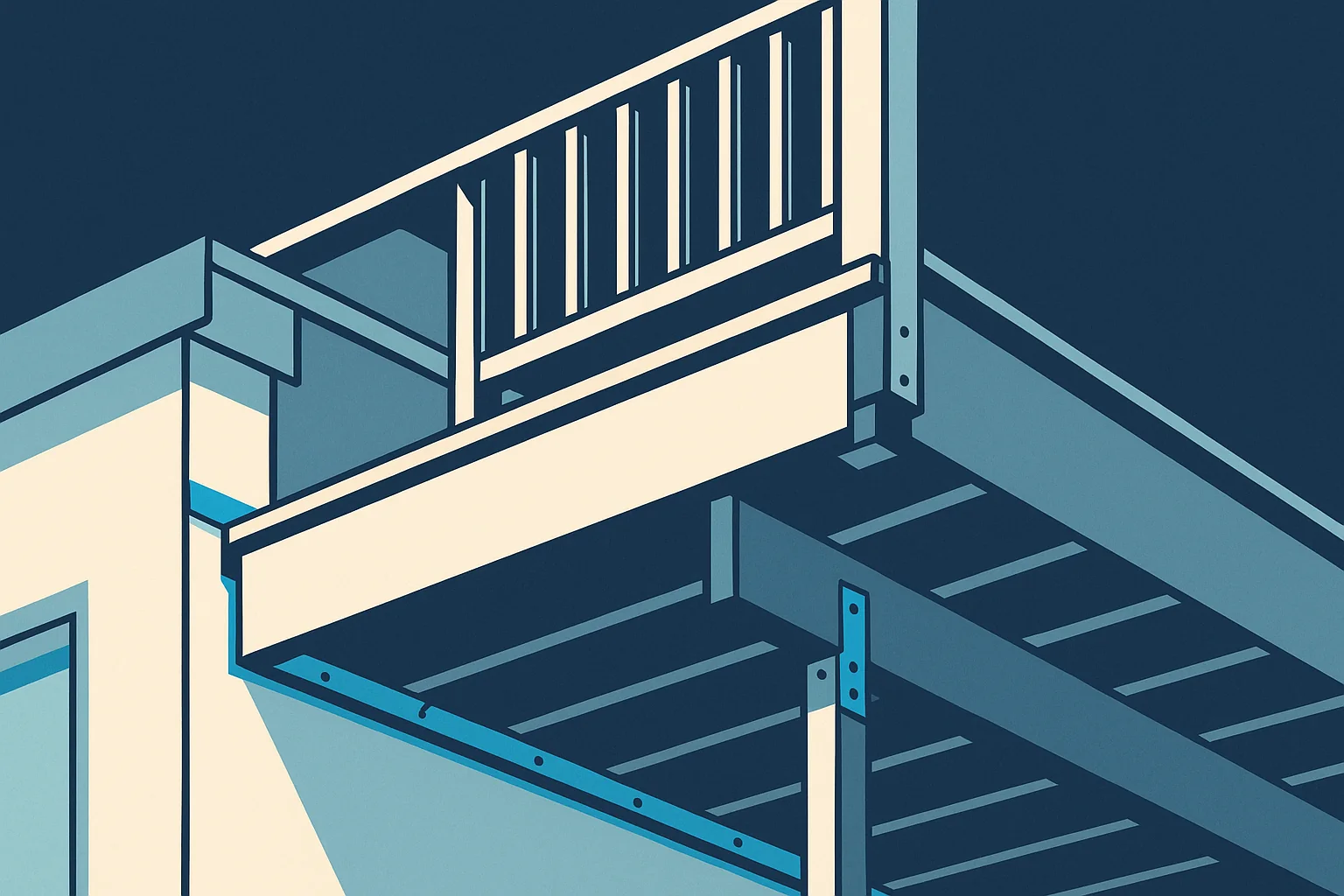
The ledger is the board that attaches an attached deck to the house. Everything the deck carries, the framing, the surface, the furniture, and every person standing on it, is transferred through that one connection into the house structure. When decks fail catastrophically, the ledger connection is the usual culprit, and it fails in two broad ways.
The first is a fastening problem. The connection was made with the wrong fasteners, too few of them, or in the wrong pattern. This is invisible from the surface and it does not announce itself. The second is a water problem. Water was allowed to get behind the ledger and stay there, and over a period of years it degraded the house framing the ledger is bolted to. The ledger itself can look sound while the material it is anchored into has quietly turned soft. This is why flashing at the ledger matters so much, and why the same principles that govern the water management layer under your siding apply directly to any deck attached to a wall.
This is also the strongest single argument for the freestanding deck configuration, which carries its own load on its own posts and does not depend on the house at all. That trade off is worked through in detail in our Central Ohio deck planning guide.
What an Inspector Looks At
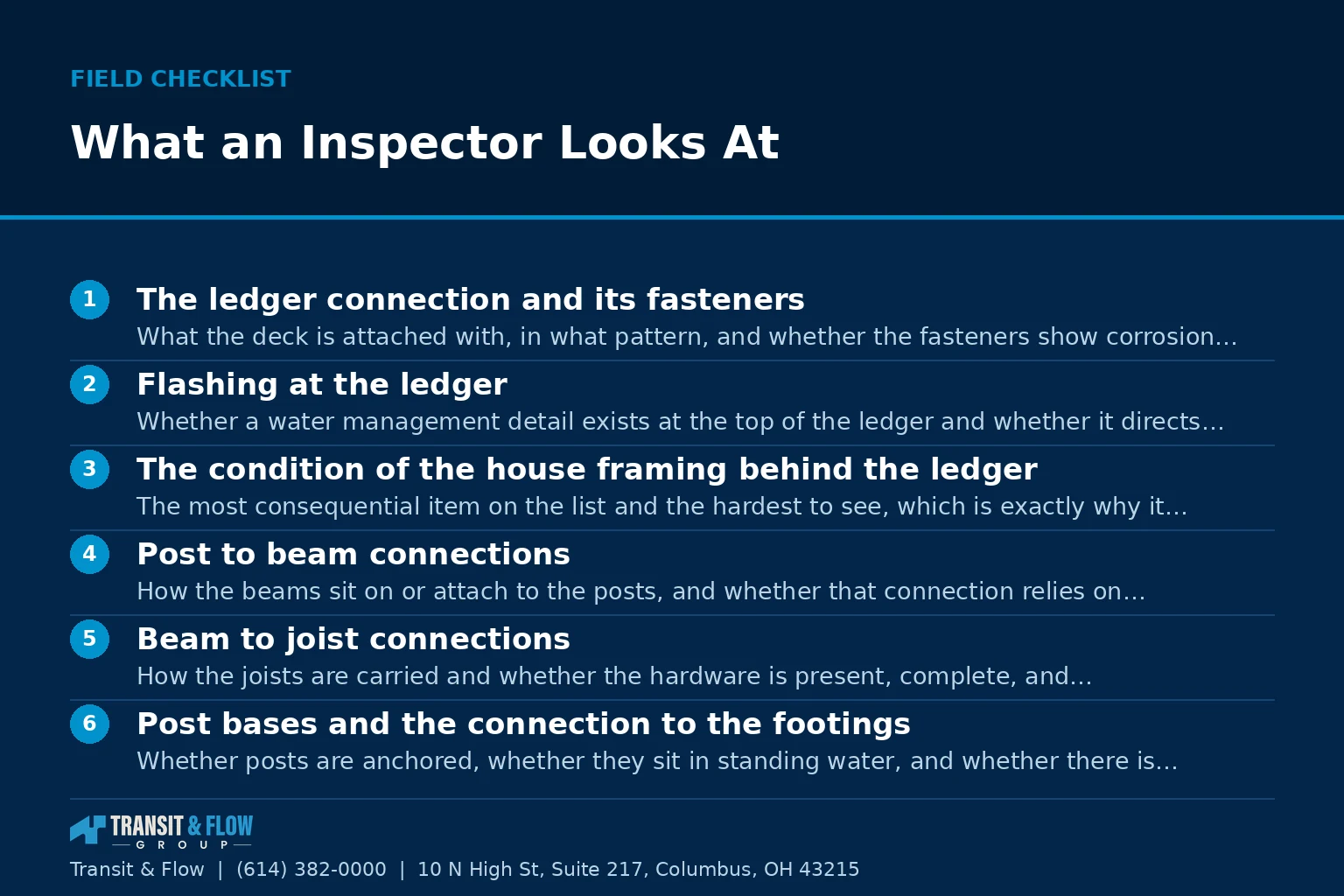
These are the areas a qualified inspector or contractor assesses on an existing deck. They are listed here as subjects, so you know what a real assessment covers and can tell whether the one you received was thorough.
- The ledger connection and its fasteners. What the deck is attached with, in what pattern, and whether the fasteners show corrosion or movement.
- Flashing at the ledger. Whether a water management detail exists at the top of the ledger and whether it directs water away from the house wall rather than into it.
- The condition of the house framing behind the ledger. The most consequential item on the list and the hardest to see, which is exactly why it gets skipped.
- Post to beam connections. How the beams sit on or attach to the posts, and whether that connection relies on fasteners loaded in a direction they were not intended for.
- Beam to joist connections. How the joists are carried and whether the hardware is present, complete, and appropriate.
- Post bases and the connection to the footings. Whether posts are anchored, whether they sit in standing water, and whether there is visible deterioration at the bottom.
- Footings. Whether they exist as designed, whether the deck has settled or shifted, and whether frost movement is evident.
- Lateral stability. Whether the deck resists side to side movement, and whether it feels different underfoot than a solid floor.
- Guards and their attachment. Not the appearance of the railing, the anchorage. Railing systems fail at the connection to the framing far more often than in the rail itself.
- Stairs, stringers, and stair connections. Stairs carry concentrated load and are a frequent site of both structural and trip related incidents.
- Hardware corrosion throughout. Fasteners and connectors in contact with treated lumber require appropriate corrosion resistance, and mismatches degrade quietly.
- Decking surface and framing beneath it. Soft spots underfoot often indicate a framing condition rather than a surface condition.
Observations That Warrant a Call
These are conditions a homeowner can notice from normal use or from standing on the ground. None of them is a diagnosis. Each is a reason to have the deck assessed by someone qualified.
| What you observe | What it may indicate | Urgency |
|---|---|---|
| The deck moves, sways, or bounces noticeably when people walk on it | A lateral stability or connection condition | Have it assessed promptly and limit use in the meantime |
| A railing moves when you lean on it or push it | An anchorage condition at the guard connection | Have it assessed promptly and keep children away from that section |
| Rust staining, streaking, or corrosion visible at fasteners or connectors | Hardware degradation, possibly a material mismatch | Assess |
| Staining, discoloration, or damage on the house siding directly below the deck attachment | Water is getting behind or through the attachment area | Assess soon, this is the highest consequence signal on the list |
| A gap has opened between the deck and the house, or the deck edge sits lower than it did | Movement at the attachment or settlement | Assess promptly and limit use |
| Posts are visibly out of plumb or the deck is not level as it was | Footing movement, frost heave, or settlement | Assess |
| Wood is soft, spongy, or crumbling at any point you can reach | Decay in a structural member | Assess promptly |
| Stair treads flex, or a stringer looks split or separated | A stair framing condition | Assess promptly and avoid the stairs |
| Standing water sits under the deck or at the base of posts after rain | A drainage condition that shortens the life of everything it touches | Assess, and address the drainage |
| You have no record of a permit or inspection for a deck built by a prior owner | Unknown construction quality throughout | Have it assessed before hosting any gathering on it |
Guards and Why They Are Not Decorative
The adopted code treats the guard as a structural element. It addresses when a guard is required, the load it must resist, and the openings within it, and an inspector verifies those things on new construction. The reason is straightforward: a guard exists to resist a person falling against it, which is a real and substantial load applied suddenly, and a railing that looks identical to a compliant one can be anchored in a way that will not hold.
Two things follow from this for an owner. First, cosmetic railing replacement is not a cosmetic project, because the anchorage is the part that matters and it is the part that gets shortcut. Second, if a deck was built or modified without permits, the guard is among the elements most likely to have been treated as trim rather than as structure. Neither of those is something to resolve by inspection from a ladder. Both are reasons to bring in someone qualified.
The Inherited Deck Problem
A large share of the decks in Central Ohio were built by a previous owner or by an unknown party, sometimes decades ago, sometimes without a permit, and sometimes to standards that were acceptable at the time and are not now. The homeowner who buys that house inherits an unknown, and a general home inspection at purchase does not open up connections or evaluate structural adequacy the way a targeted deck assessment does.
If you cannot answer the question of who built the deck, when, and whether it was permitted and inspected, you are operating on assumption. That is worth resolving on its own schedule rather than on the schedule an incident would set. The same information gap logic applies to any project where responsibility was never clearly assigned.
What a Deck Assessment Should Cover
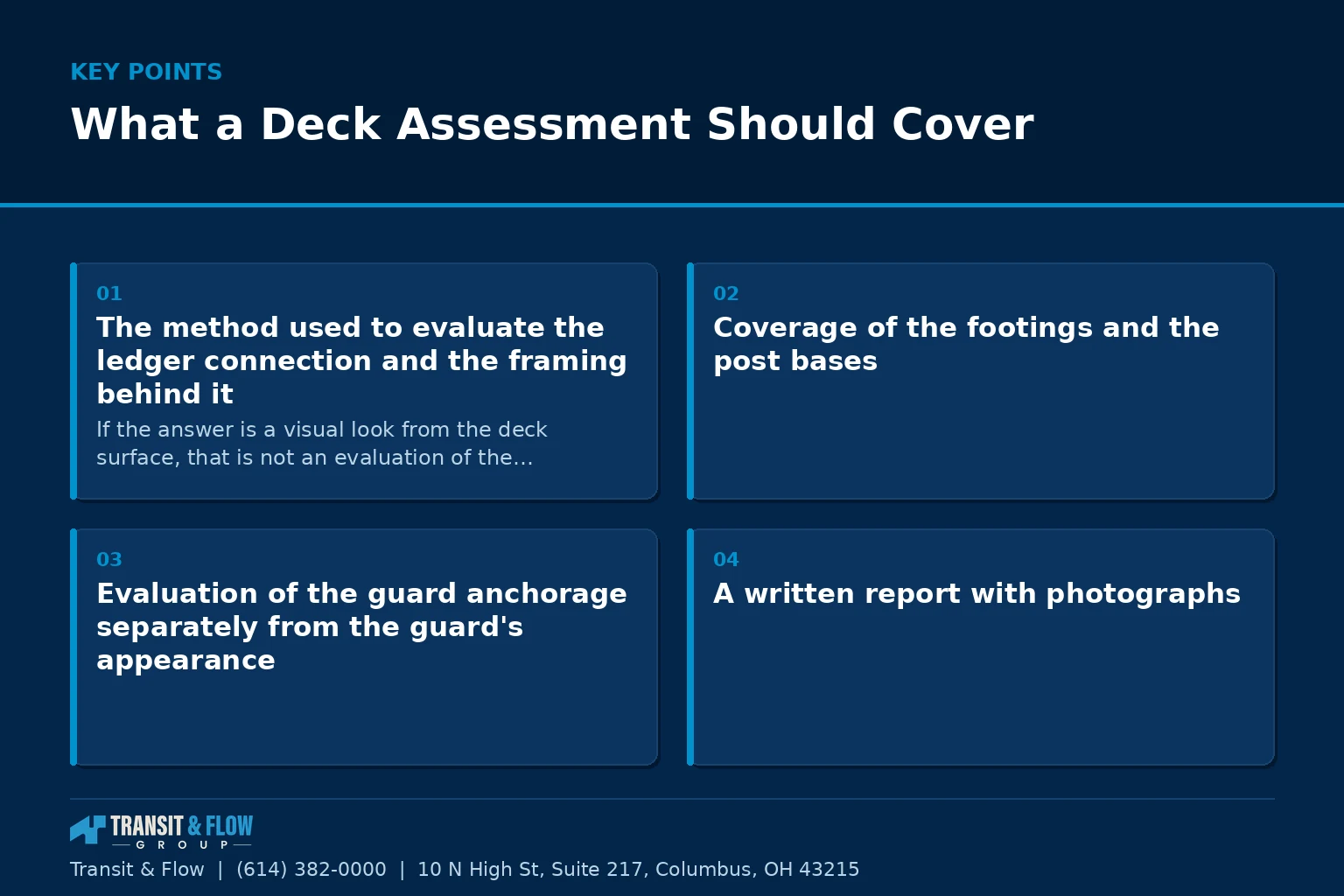
- The method used to evaluate the ledger connection and the framing behind it. If the answer is a visual look from the deck surface, that is not an evaluation of the connection.
- Coverage of the footings and the post bases.
- Evaluation of the guard anchorage separately from the guard’s appearance.
- A written report with photographs.
- A clear separation in the report between safety related items and maintenance related items.
- The name and qualifications of the person performing the assessment.
- Permit requirements for any recommended work, and who is responsible for pulling the permit.
- What changes when work is performed on a deck that predates current requirements. This one belongs with the building department and it materially affects scope.
Seasonal Timing in Central Ohio
Early spring is the right window for a deck assessment in this region, for two reasons. The deck has just come through the freeze and thaw cycling that reveals footing movement and opens connections, and any work identified can be scheduled before the outdoor season rather than during it. Waiting until the first warm weekend to think about the deck is exactly the pattern that puts assessments into the same queue as everyone else’s, and it is the pattern that leads to a gathering being hosted on a structure nobody has looked at. A spring walk around the exterior, covered in our spring inspection guide, is a natural moment to add the deck to the list.
On Cost
This article contains no dollar figures on purpose. Deck assessment and repair pricing depends entirely on what is found, on access, on whether the structure can be worked on in place, and on whether permitting is triggered. Quoting a number for an assessment would also invite exactly the wrong comparison, because the cheapest assessment is usually the one that does not evaluate the connection that matters. Judge an assessment on what it covers and what it produces, not on its price.
Glossary
- Ledger. The framing member that attaches an attached deck to the house structure.
- Freestanding deck. A deck that carries its full load on its own posts and footings without depending on the house.
- Guard. The barrier at an open side of a walking surface, which the adopted code treats as a structural element.
- Lateral load. Side to side force on a structure, distinct from the downward load of weight.
- Joist hanger. A metal connector that carries a joist where it meets a beam or ledger.
- Stringer. The sloped framing member that carries stair treads.
- Frost heave. Upward movement of soil and anything founded in it caused by freezing, which is why footing depth matters in this region.
- Flashing. A water management component that directs water away from a joint or connection.
- Anchorage. The means by which a component is secured to the structure, as distinct from the component itself.
- Grandfathering. The general concept that existing construction is evaluated against the requirements in force when it was built, subject to what the local jurisdiction actually applies when work is performed.
The Decision
Option A. Watch the deck through normal use, note any of the observations in the table above, and call for an assessment when something changes.
Option B. Schedule a structured deck assessment on a defined interval, and treat any deck whose construction history you cannot document as requiring one now.
Recommendation: Option B, without qualification, for any deck you did not personally have built and permitted. The reasoning is the asymmetry. Deck failures are rare, but they are sudden, they happen under maximum load, which means they happen with the most people on the structure, and the connection that causes them is the one no homeowner can evaluate by looking at it. That combination, low probability with severe consequence and no reliable warning, is precisely the situation where a scheduled professional assessment earns its cost many times over. Two moves carry most of the value: get the ledger connection and the framing behind it genuinely evaluated rather than glanced at, and document what you learn so the next assessment has a baseline to compare against.
Where Transit & Flow Group Fits
We coordinate exterior and structural projects across Central Ohio, and on deck work we start with the connection to the house because that is where consequence concentrates. If you have a deck of unknown history, a railing that moves, or staining on the siding below the deck attachment, start a conversation with our team and we will route it to the right qualified professional. You can also review the deck and outdoor living services we coordinate, or read our comparison of wood and composite decking over a ten year period if a rebuild is on the table.
Transit & Flow Group coordinates projects and partners with properly licensed and insured specialty contractors when licensing is required, and work is performed under the appropriate permits.
Frequently Asked Questions
Why is the ledger the part of my deck that matters most?
The ledger is the board that attaches an attached deck to the house, and everything the deck carries is transferred through that one connection into the house structure. When decks fail catastrophically, the ledger connection is the usual culprit. It fails either because of a fastening problem, which is invisible from the deck surface, or because water was allowed to get behind the ledger and stay there, degrading the house framing it is anchored into over a period of years. The ledger itself can look sound while the material behind it has quietly turned soft, which is why this is not something an owner can evaluate by looking.
What are the warning signs that my deck needs to be looked at?
The ones an owner can notice from normal use include a deck that moves, sways, or bounces when people walk on it, a railing that moves when you lean on it, rust staining or corrosion at fasteners and connectors, wood that is soft or spongy anywhere you can reach, posts that are visibly out of plumb, stair treads that flex, and standing water under the deck or at the base of posts after rain. Staining or damage on the house siding directly below the deck attachment is the highest consequence signal on that list. None of these is a diagnosis. Each is a reason to have the deck assessed by a qualified professional.
Is a wobbly deck railing actually dangerous?
The adopted code treats the guard as a structural element rather than as trim, because a guard exists to resist a person falling against it, which is a real load applied suddenly. Railing systems fail at the connection to the framing far more often than in the rail itself, and a railing that looks identical to a compliant one can be anchored in a way that will not hold. A guard that moves when you lean on it is a reason to have the deck assessed promptly and to keep children away from that section in the meantime. Whether the guard meets the requirements that apply to your structure is a determination for a qualified professional and your local building department.
I bought a house with an existing deck and I do not know who built it. What should I do?
A large share of the decks in Central Ohio were built by a previous owner or by an unknown party, sometimes without a permit, and sometimes to standards that were acceptable at the time and are not now. A general home inspection at purchase does not open up connections or evaluate structural adequacy the way a targeted deck assessment does. If you cannot answer who built the deck, when, and whether it was permitted and inspected, you are operating on assumption. Our recommendation without qualification is a structured assessment now for any deck you did not personally have built and permitted, and before hosting any gathering on it.
What should a real deck assessment include?
It should cover the ledger connection and its fasteners, the flashing at the ledger, the condition of the house framing behind the ledger, post to beam and beam to joist connections, post bases and footings, lateral stability, guards and their anchorage, stairs and stringers, hardware corrosion throughout, and the framing beneath the decking surface. Ask specifically how the ledger connection and the framing behind it will be evaluated, because a visual look from the deck surface is not an evaluation of that connection. Ask for a written report with photographs that separates safety related items from maintenance related ones, and confirm who is performing the assessment and what their qualifications are.
Will repairs to an older deck require a permit?
That determination belongs to your local building department, not to this article or to a contractor’s assurance. Whether an existing deck is evaluated against the requirements in force when it was built, and what changes once work is performed on it, is a question of what the local jurisdiction actually applies, and the answer materially affects the scope of any project. Ask the building department directly, and ask any contractor proposing work whether a permit is required and who is responsible for pulling it. Transit & Flow Group coordinates projects and partners with properly licensed and insured specialty contractors when licensing is required, and work is performed under the appropriate permits.
Sources
- City of Columbus, permitting and inspection information
- Ohio Department of Commerce, Division of Industrial Compliance, adopted building codes
- Ohio Construction Industry Licensing Board, contractor licensing
- U.S. Consumer Product Safety Commission, home structure safety information
About This Guide
Written and edited by Micheal Parker, founder of Transit & Flow Group. Published April 2, 2027. This guide is checked against the agency and code sources listed above, and it is revised when those sources change.
General contractor of record. Micheal Parker holds City of Columbus General Contractor Registration G12064, issued by the Columbus Department of Building and Zoning Services under Transit & Flow LLC and valid through June 30, 2027. Trade work that falls outside the scope of that registration is performed by licensed trade partners, and the responsible license holder is identified before work begins.
Reviewed by Micheal Parker, City of Columbus registered general contractor, registration G12064. This guide covers a permit, structural, or life safety subject. It is written as evaluation guidance only. Every determination in it routes to the authority having jurisdiction and to a professional licensed in the applicable trade, and no statement here substitutes for that review.
Transit & Flow Group, home and commercial services for Columbus and the surrounding Central Ohio communities. Phone (614) 382-0000. Email solutions@transitflowgroup.com. 10 N High St, Suite 217, Columbus, OH 43215. Contact our team or review the communities we serve.
