

Sewer laterals rarely fail without warning. They fail after months of quiet signals that most homeowners either do not notice or explain away, and by the time the signal becomes a backup on the basement floor, the cheap window for acting has closed. This guide is a catalog of those early signals, ranked by how urgently each one deserves attention, so you can act on the ones that matter and stop worrying about the ones that do not. It is part of our drain and sewer guide, and it pairs with our look at why drains keep clogging.
In This Guide
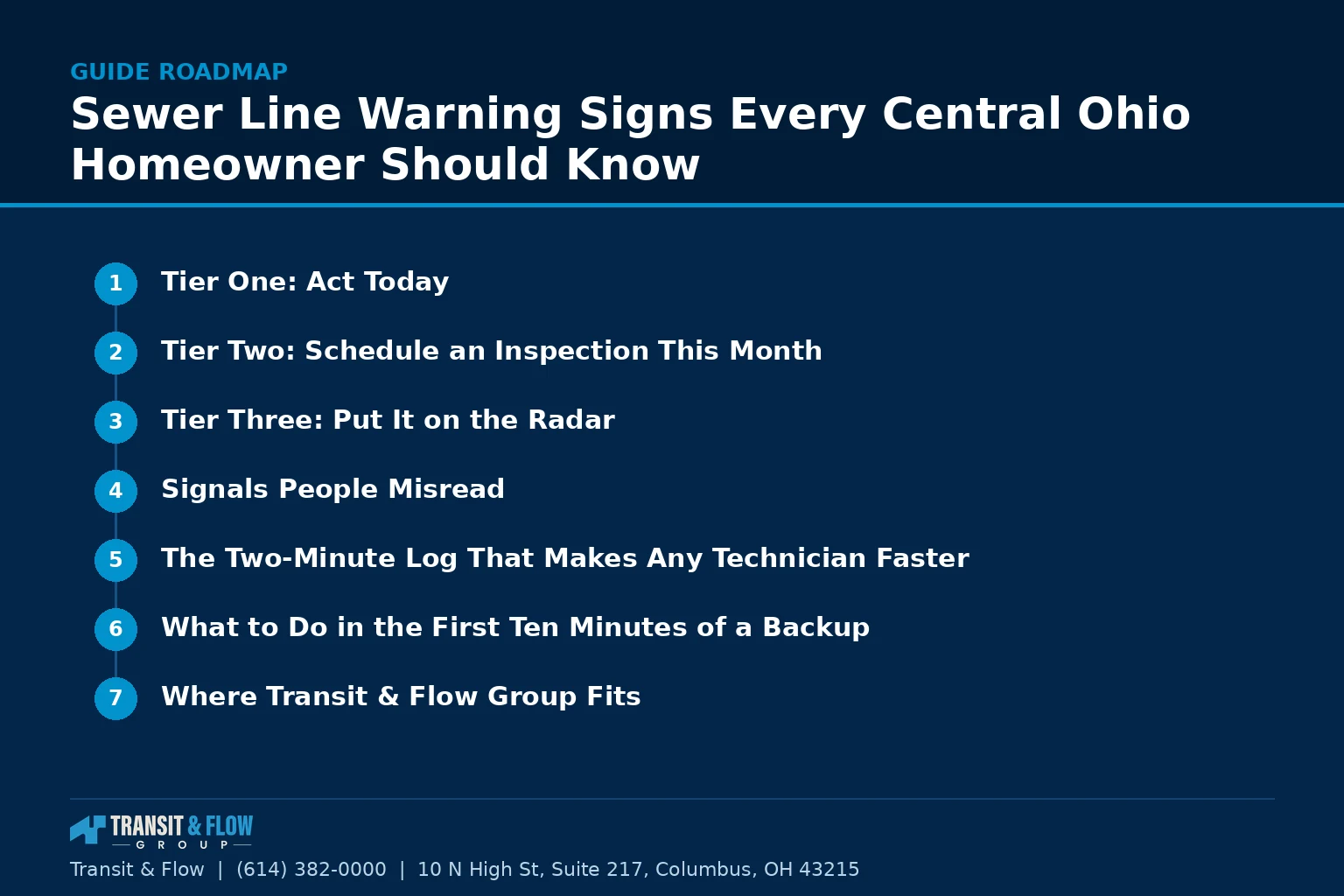
- Tier One: Act Today
- Tier Two: Schedule an Inspection This Month
- Tier Three: Put It on the Radar
- Signals People Misread
- The Two-Minute Log That Makes Any Technician Faster
- What to Do in the First Ten Minutes of a Backup
- Where Transit & Flow Group Fits
- Frequently Asked Questions
Transit & Flow Group coordinates projects and partners with properly licensed and insured specialty contractors when licensing is required.
Tier One: Act Today
These signals mean the system has already failed or is failing right now. Stop using water and get someone out.
- Water or waste appearing at a basement floor drain. The floor drain is the lowest opening in the house. Anything backing up out of it means the line below has stopped moving what you are sending down.
- Multiple fixtures backing up at once. One fixture is a branch. Several at once, on different branches, is the main line.
- Flushing a toilet raises water in a tub or shower. The water is finding the lowest available opening because the intended path is blocked.
- Sewage smell inside the house with no dry traps. If you have watered every trap and the smell persists, gas is entering somewhere it should not.
- Standing water or a soft, wet depression in the yard along the lateral path, with no rain to explain it. This is a line discharging into the soil.
Tier Two: Schedule an Inspection This Month
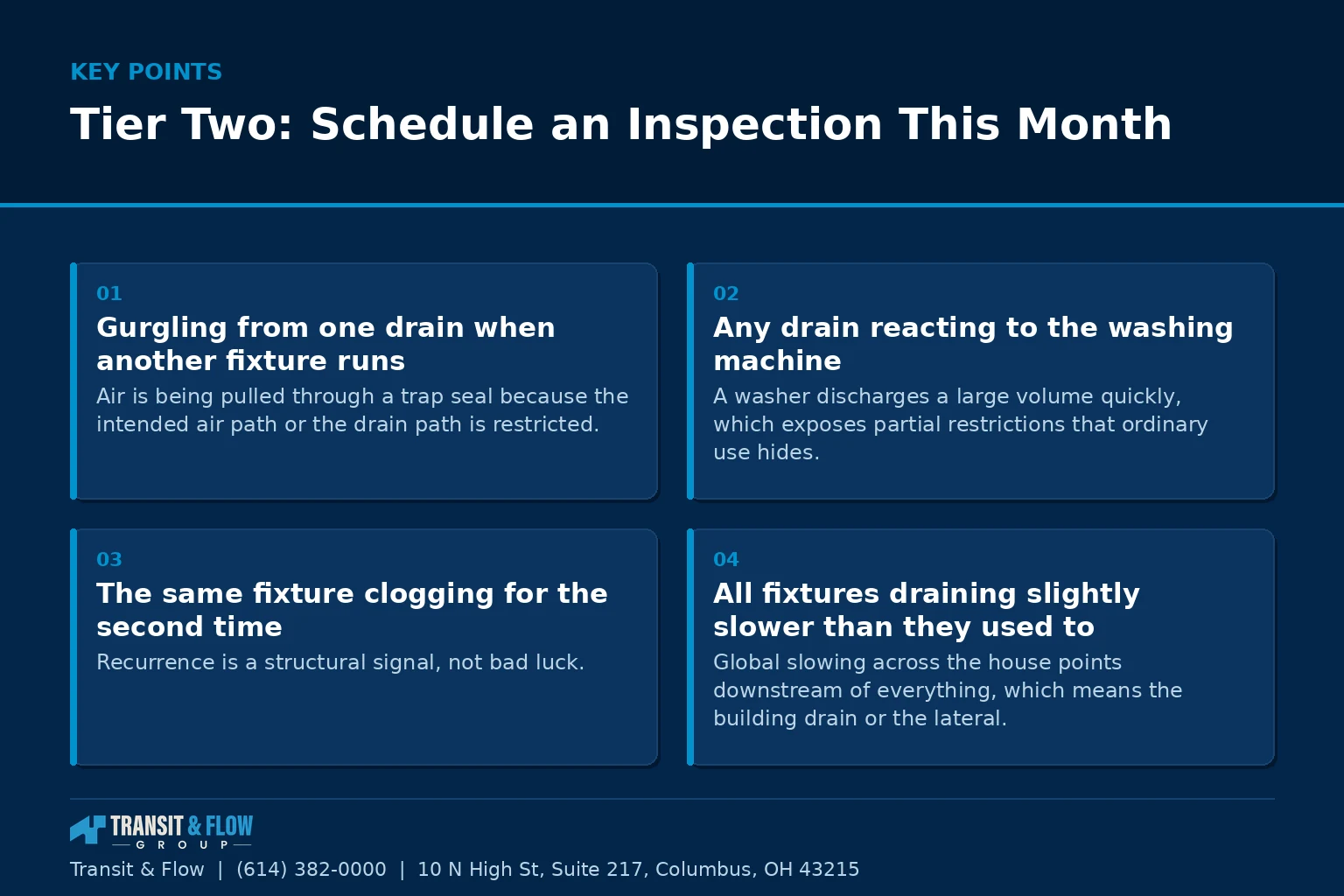
These are partial-failure signals. Nothing is flooding, and the line is telling you it is narrowing or shifting.
- Gurgling from one drain when another fixture runs. Air is being pulled through a trap seal because the intended air path or the drain path is restricted.
- Any drain reacting to the washing machine. A washer discharges a large volume quickly, which exposes partial restrictions that ordinary use hides. This is one of the most reliable early main line indicators there is.
- The same fixture clogging for the second time. Recurrence is a structural signal, not bad luck.
- All fixtures draining slightly slower than they used to. Global slowing across the house points downstream of everything, which means the building drain or the lateral.
- A toilet whose water level drops on its own between uses. Often a vent or partial blockage issue rather than a flapper problem, particularly if it started recently.
- Recurring drain flies in a bathroom or basement. They breed in organic film. Persistent populations usually mean standing waste somewhere in the line.
Tier Three: Put It on the Radar
These are not emergencies and they are not nothing. Note them, watch them, and mention them the next time anyone is working on your plumbing.
- A strip of grass over the lateral path that is greener and grows faster than the rest of the lawn. Nutrient-rich water is reaching the soil.
- Mature trees within about twenty feet of the lateral run. Not a symptom, a risk factor, and reason enough for a baseline inspection.
- A house built before 1980 with no known sewer history. Material and condition unknown, which means every future decision is being made blind.
- Recent excavation nearby. Utility work, a neighbor’s project, or new construction can disturb bedding and start settlement.
- Backups that correlate with heavy rain rather than household use. Points toward groundwater infiltration or municipal surcharge instead of a clog, and the first call is to your utility.
- An unexplained rise in water usage. Worth investigating on the supply side, not the drainage side, but it belongs in the same conversation about buried pipe.
Signals People Misread
Half of avoiding unnecessary expense is knowing which alarming things are not lateral problems.
- Odor from a rarely used bathroom or floor drain. Almost always a dried trap. Pour a quart of water in and wait a day before escalating.
- One slow shower with everything else normal. Hair at the strainer. Pull the stopper assembly first.
- A single slow kitchen sink after a holiday. Grease and food volume, usually local, usually clearable.
- A gurgle only when the dishwasher drains. Frequently an air gap or a high-loop issue at the dishwasher discharge, not the sewer.
- Only the basement bathroom backing up. If that bathroom is below the building drain it discharges through an ejector pump into a sealed pit. Check the pump before assuming the lateral.
The Two-Minute Log That Makes Any Technician Faster
- Date and time of each event.
- Which fixtures were involved, and which were not.
- What was running in the house at the time, especially laundry or dishwasher.
- Whether it had rained in the previous day.
- What was done, by whom, and whether flow returned fully or partially.
- Photos of anything visible, including water at a floor drain.
Hand this to whoever inspects the line. Pattern information is diagnostic. A technician who knows the problem tracks with laundry rather than rain, and that it has recurred three times in a year, is looking for something specific rather than starting from zero.
What to Do in the First Ten Minutes of a Backup
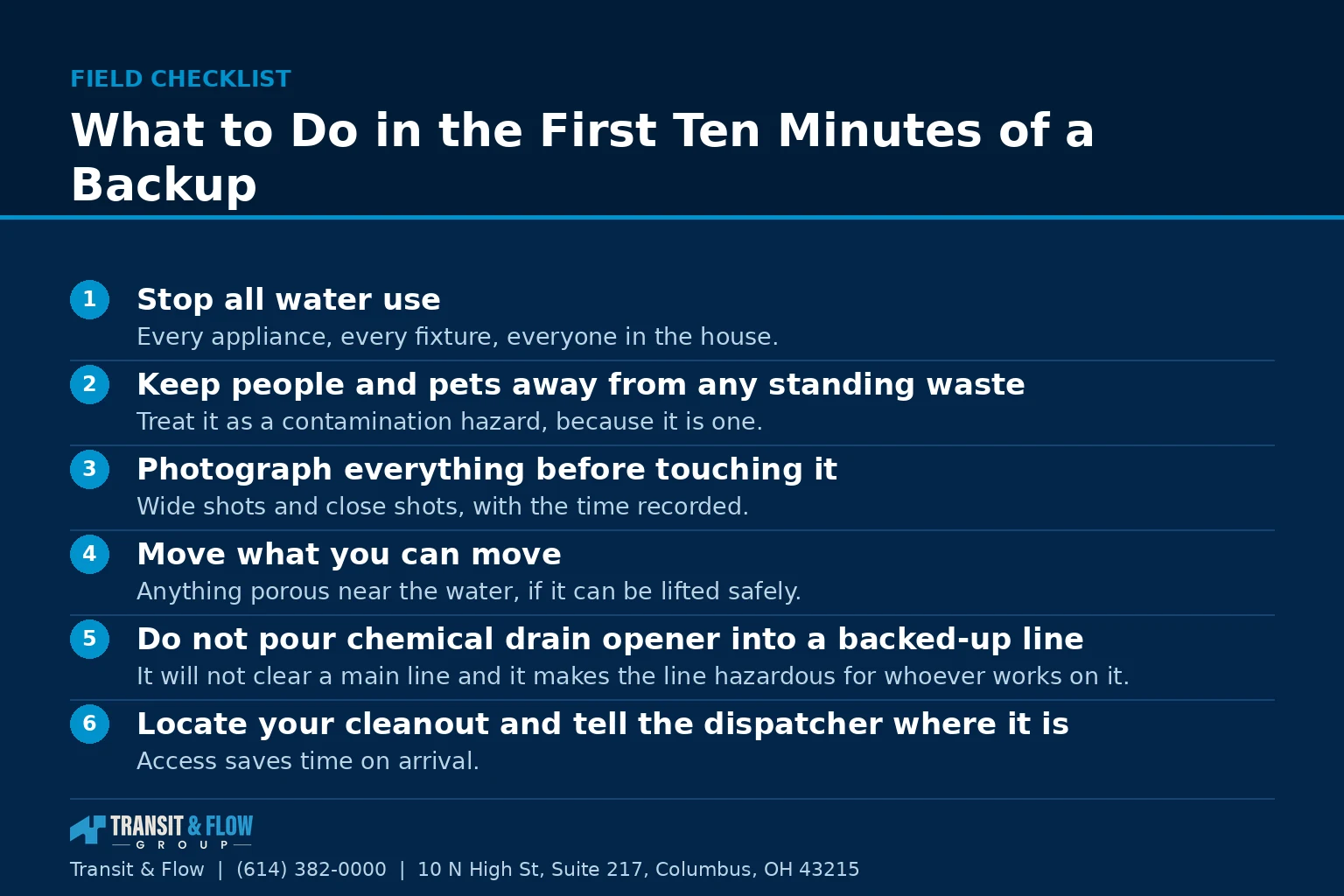
- Stop all water use. Every appliance, every fixture, everyone in the house. This is the single most effective thing you can do.
- Keep people and pets away from any standing waste. Treat it as a contamination hazard, because it is one.
- Photograph everything before touching it. Wide shots and close shots, with the time recorded.
- Move what you can move. Anything porous near the water, if it can be lifted safely.
- Do not pour chemical drain opener into a backed-up line. It will not clear a main line and it makes the line hazardous for whoever works on it.
- Locate your cleanout and tell the dispatcher where it is. Access saves time on arrival.
- Ask for a camera inspection as part of the call, not as a follow-up. The access is already open, which is the cheapest moment to get the diagnosis.
Where Transit & Flow Group Fits
Transit & Flow Group coordinates drain and sewer response across Columbus and Central Ohio, and where a backup crosses into broader plumbing work the same coordinator carries it rather than handing you to another company. Our standard on any Tier One or Tier Two signal is camera first, located and marked, video delivered to you. If your house is showing you something on this list, request an assessment.
Frequently Asked Questions
Which sewer signals mean I should stop using water right now?
Water or waste appearing at a basement floor drain, several fixtures on different branches backing up at once, a flush that raises water in a tub or shower, a sewage smell indoors after every trap has been watered, and standing water or a soft wet depression in the yard along the lateral path with no rain to explain it. Each of those indicates the system has already failed or is failing at that moment rather than narrowing slowly. Stop all water use in the house and get a qualified plumbing professional out to look at it. Continuing to run water only adds volume to a line that is no longer moving it.
Why does the washing machine reveal sewer problems before anything else?
A washer discharges a large volume of water very quickly, which is a load that ordinary sink and shower use never produces. Partial restrictions that stay invisible during normal household use show themselves when that surge hits a line that has narrowed. If any drain in the house reacts while the washer is discharging, that pattern is one of the more reliable early main line indicators there is. It belongs in the schedule-an-inspection category rather than the wait-and-see one.
Is a greener strip of grass over the sewer line really a warning sign?
It can be, because nutrient-rich water reaching the soil will feed the grass above it. On its own it is not an emergency, and it sits in the lowest tier of signals alongside mature trees near the lateral run and recent excavation nearby. The right response is to note it, watch it, and raise it the next time anyone is working on your plumbing rather than to act immediately. If it appears alongside a Tier One or Tier Two signal, treat the combination as the more urgent of the two.
Which alarming symptoms are usually not the sewer lateral?
Odor from a rarely used bathroom or floor drain is almost always a dried trap, so pour water in and wait a day before escalating. One slow shower with everything else normal usually points to the stopper assembly, and a single slow kitchen sink after a holiday is usually local grease and food volume. A gurgle that happens only when the dishwasher drains is frequently an air gap or high-loop issue at the dishwasher discharge. If only a basement bathroom below the building drain backs up, the ejector pump is worth checking before the lateral is blamed. Knowing these keeps you from paying to investigate the wrong thing.
What should I do in the first ten minutes of a backup?
Stop all water use everywhere in the house first, because that is the single most effective thing available to you. Keep people and pets away from any standing waste and treat it as a contamination hazard. Photograph everything before touching it, with wide and close shots and the time recorded, then move porous items away from the water if that can be done safely. Do not pour chemical drain opener into a backed-up line, since it will not clear a main line and it makes the line hazardous for whoever works on it. Locate your cleanout so you can tell the dispatcher where it is.
Why keep a written log of drain events?
Pattern information is diagnostic in a way that a single description of one bad morning is not. Record the date and time of each event, which fixtures were involved and which were not, what was running in the house at the time, whether it had rained the previous day, what was done and by whom, and whether flow returned fully or partially. Photographs of anything visible belong with it. A technician who arrives knowing the problem tracks with laundry rather than rain, and that it has recurred several times in a year, is looking for something specific instead of starting from zero.
Sources
- U.S. Environmental Protection Agency, sanitary sewer overflow causes and conditions
- Ohio Revised Code 3781.28, excavation notice requirements
About This Guide
Written and edited by Micheal Parker, founder of Transit & Flow Group. Published September 13, 2026. This guide is checked against the agency and code sources listed above, and it is revised when those sources change.
General contractor of record. Micheal Parker holds City of Columbus General Contractor Registration G12064, issued by the Columbus Department of Building and Zoning Services under Transit & Flow LLC and valid through June 30, 2027. Trade work that falls outside the scope of that registration is performed by licensed trade partners, and the responsible license holder is identified before work begins.
Transit & Flow Group, home and commercial services for Columbus and the surrounding Central Ohio communities. Phone (614) 382-0000. Email solutions@transitflowgroup.com. 10 N High St, Suite 217, Columbus, OH 43215. Contact our team or review the communities we serve.
