

Heat pumps generate more confident opinions per conversation than any other piece of home equipment, and most of those opinions are about a generation of technology that has moved. The honest position for Central Ohio is neither the enthusiasm nor the dismissal. A heat pump works well here under specific conditions, works poorly under others, and the difference between the two outcomes is almost entirely a design question that gets settled before installation. This article explains where the line falls. It complements our furnace replacement guide and our article on furnace sizing.
In This Guide
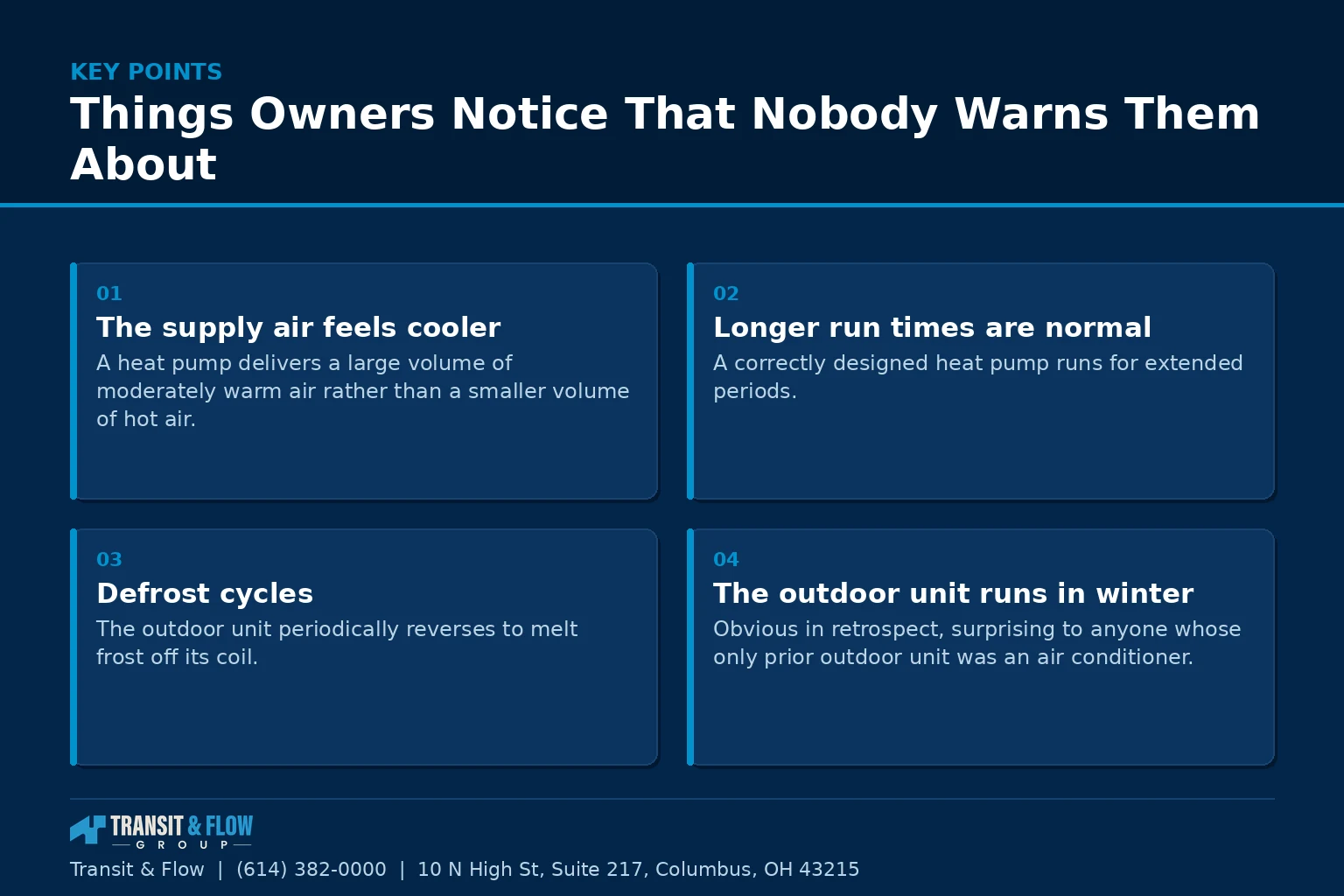
- What a Heat Pump Is Doing
- The Balance Point Is the Whole Conversation
- What Provides the Backup, and Why It Matters More Than the Heat Pump
- Things Owners Notice That Nobody Warns Them About
- Where It Fits and Where It Does Not
- What to Require in the Proposal
- Where Transit & Flow Group Fits
- Frequently Asked Questions
Transit & Flow Group coordinates projects and partners with properly licensed and insured specialty contractors when licensing is required.
One boundary. This is evaluation and planning guidance. Refrigerant work is federally regulated and requires certification, and heating and cooling installation in Ohio is licensed, permitted, and inspected work.
What a Heat Pump Is Doing
A furnace makes heat by burning fuel. A heat pump does not make heat at all. It moves heat that already exists in the outdoor air into your house, using a refrigeration cycle run in reverse. That is why a heat pump can deliver more heat energy than the electrical energy it consumes, which is impossible for any device that creates heat, and it is the entire basis of the efficiency argument.
The catch follows directly from the mechanism. As outdoor air gets colder there is less heat in it to move, so the machine’s capacity falls at exactly the moment your house needs the most. Meanwhile the amount of heat you need is rising. Somewhere those two lines cross, and that crossing point is the single most important number in a heat pump design.
The Balance Point Is the Whole Conversation
The balance point is the outdoor temperature at which the heat pump’s capacity exactly equals your house’s heating load. Above it the heat pump carries the house alone. Below it, something else has to make up the difference.
- A well-insulated house with a modest load has a lower balance point, meaning the heat pump carries more of the season by itself.
- A leaky house with a large load has a higher balance point, meaning backup heat runs more hours and the operating cost story changes.
- Cold-climate rated equipment holds far more of its capacity at low temperatures than older designs did, which pushes the balance point down substantially. This is the specific advance that changed the answer for Ohio.
- Ohio spends most of its heating season well above the design condition. The hours at which backup heat is needed are a minority of the season, which is why the annual result can be good even in a climate with genuinely cold nights.
Ask for the balance point in writing. A contractor who can state it has performed a load calculation and consulted the equipment’s capacity data at low temperature. A contractor who cannot has not designed the system, only selected a box.
What Provides the Backup, and Why It Matters More Than the Heat Pump
- Electric resistance backup. Heating elements in the air handler. Simple, reliable, and the most expensive form of heat per unit delivered, because resistance heating produces exactly as much heat as the electricity it consumes with no multiplication. In a house with a high balance point and many backup hours, this is where the operating cost surprise lives.
- Dual fuel, meaning a heat pump paired with a gas furnace. The heat pump carries the mild majority of the season, the furnace takes over below the switchover temperature. This configuration suits Central Ohio well and it is frequently the right answer for a home that already has gas service and needs both heating and cooling replaced.
- The switchover setting in a dual fuel system determines the split, and it should be set deliberately based on the relationship between local gas and electric rates rather than left at a factory default.
- Electrical service capacity. Resistance backup draws significant current. This is a real panel capacity question and it should be answered before the equipment is ordered, not discovered on installation day. Our guide to electrical panel upgrades covers what that evaluation involves.
Things Owners Notice That Nobody Warns Them About
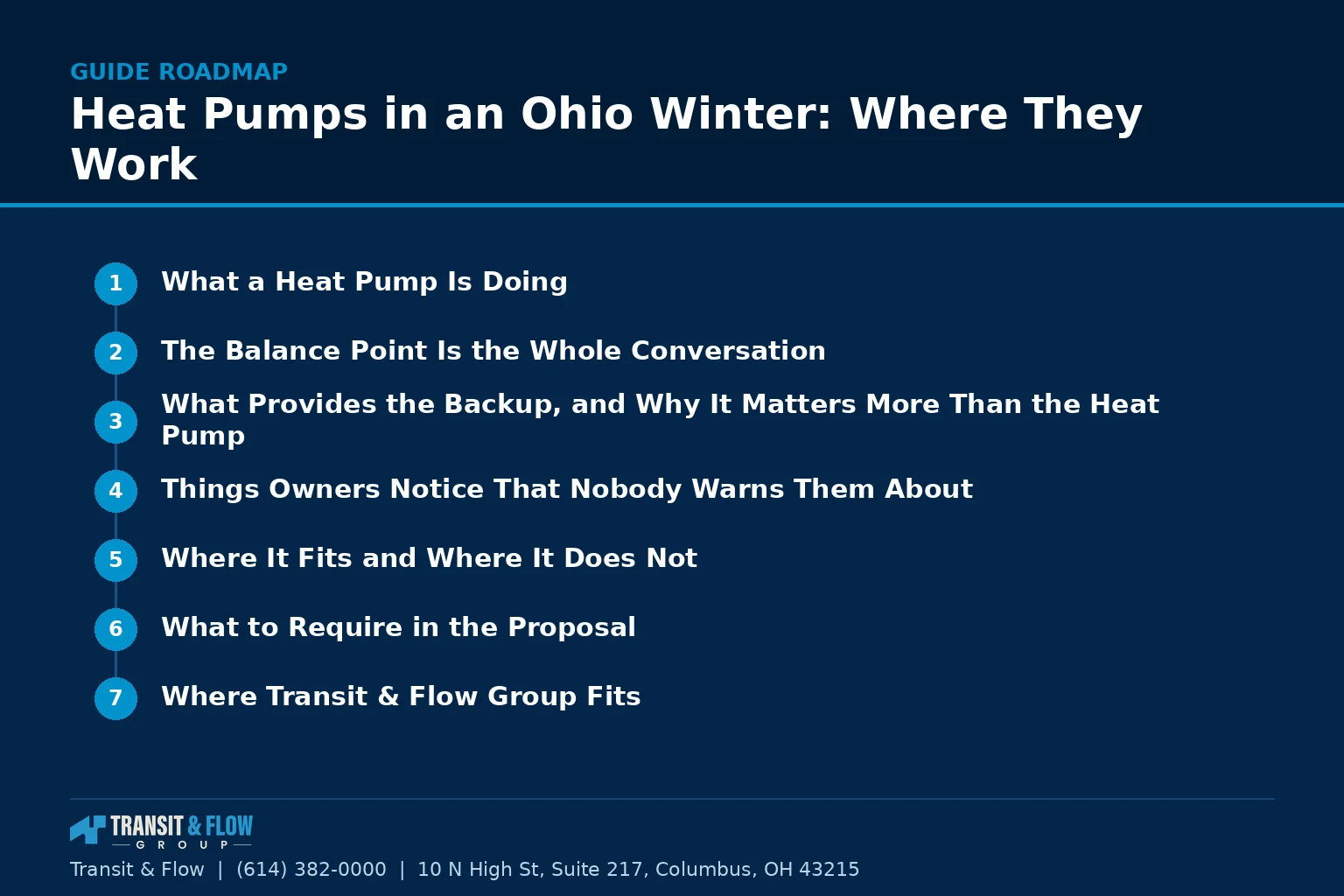
- The supply air feels cooler. A heat pump delivers a large volume of moderately warm air rather than a smaller volume of hot air. It heats the house correctly and it does not feel like a furnace at the register. People who are not told this in advance interpret it as a defect.
- Longer run times are normal. A correctly designed heat pump runs for extended periods. That is the desired behavior and it produces steadier temperatures, but it reads as “always running” to someone expecting furnace cycles.
- Defrost cycles. The outdoor unit periodically reverses to melt frost off its coil. It steams, it makes a noise at the changeover, and the indoor air may cool briefly. All normal, all alarming the first winter.
- The outdoor unit runs in winter. Obvious in retrospect, surprising to anyone whose only prior outdoor unit was an air conditioner.
- Outdoor unit placement matters more. It needs clearance from snow accumulation, drainage below it so meltwater does not refreeze around the coil, and separation from where roof runoff lands.
- Thermostat behavior is different. Deep setbacks can trigger expensive resistance backup during recovery. Heat pumps generally prefer steadier setpoints, and a thermostat designed for heat pump control handles this intelligently.
Where It Fits and Where It Does Not
- Strong fit: you need to replace air conditioning and heating in the same project, the house is reasonably insulated, the duct system is sound, and either gas service exists for dual fuel or the envelope is good enough to keep resistance backup hours low.
- Strong fit: the home has no gas service at all and currently heats with electric resistance. This is the clearest upgrade case available, because the comparison is against the most expensive form of heat.
- Workable fit: an older home where the duct system is being corrected as part of the project, since heat pumps are less tolerant of restricted airflow than furnaces.
- Poor fit: a leaky under-insulated house with resistance-only backup and no envelope work planned. The backup hours will dominate and the owner will be unhappy with the bills.
- Poor fit: a duct system that cannot deliver the required airflow and is not being addressed. Heat pump performance degrades faster than furnace performance under airflow restriction.
- Poor fit: a heating-only replacement on a functioning air conditioner with years of life left, where the value of the cooling side cannot be captured.
What to Require in the Proposal
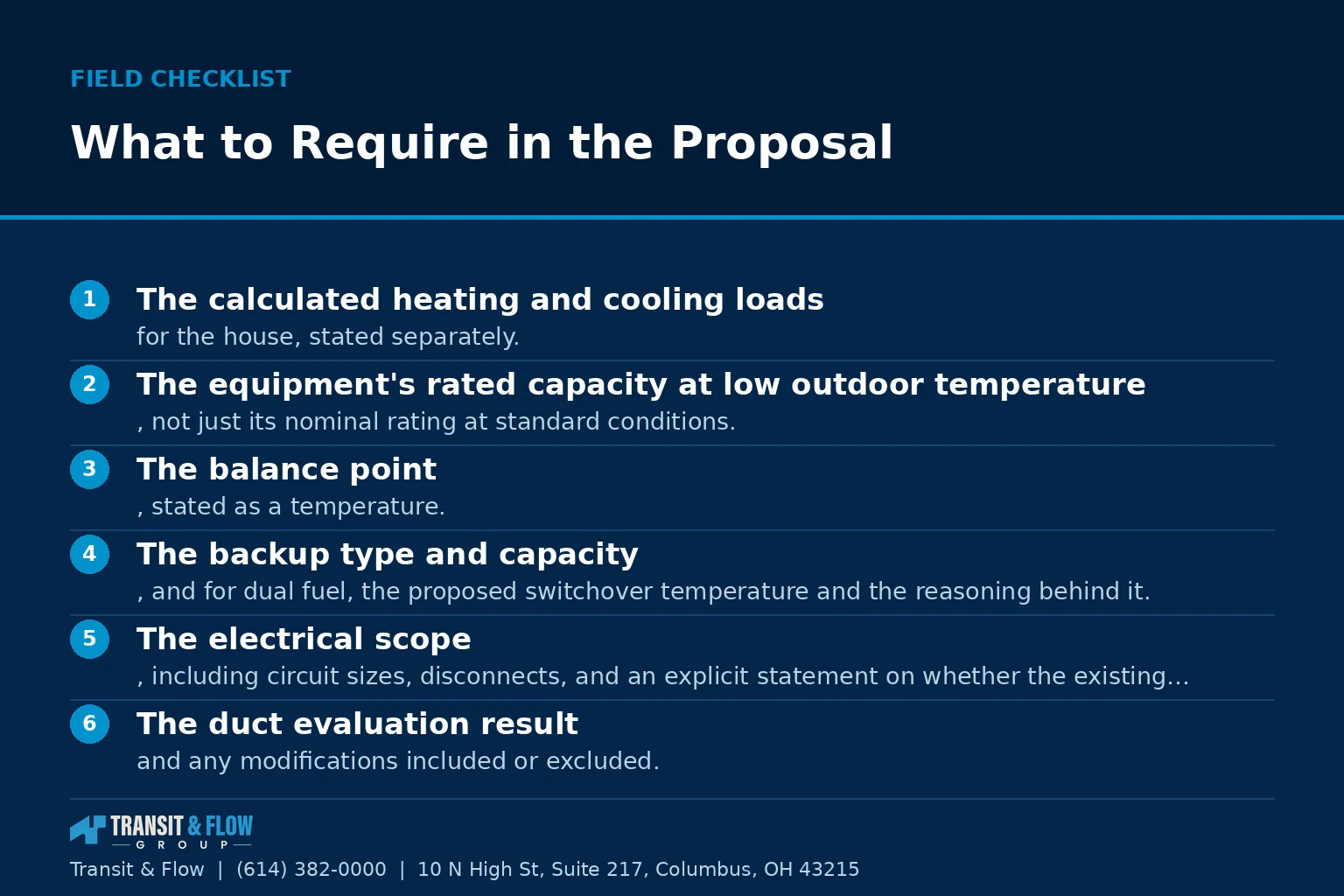
- The calculated heating and cooling loads for the house, stated separately.
- The equipment’s rated capacity at low outdoor temperature, not just its nominal rating at standard conditions. This is published data and a designer will have it.
- The balance point, stated as a temperature.
- The backup type and capacity, and for dual fuel, the proposed switchover temperature and the reasoning behind it.
- The electrical scope, including circuit sizes, disconnects, and an explicit statement on whether the existing panel has capacity.
- The duct evaluation result and any modifications included or excluded.
- The thermostat, named, and confirmation that it is designed for heat pump and backup staging control.
- Outdoor unit placement, including elevation above expected snow and the drainage plan beneath it.
- Refrigerant line set, whether existing lines are reused or replaced, and how the system will be evacuated and charged.
- Commissioning readings delivered in writing at completion, covering airflow, refrigerant charge, and backup staging verification.
- Permit and inspection, named, with who pulls it.
- Warranty terms on compressor, parts, and labor, stated separately.
On cost: this article contains no dollar figures and no operating cost comparisons on purpose. The economics depend on your local electric and gas rates, your rate structure, your actual heating and cooling loads, the balance point of the specific equipment in your specific house, how many backup hours result, and whether electrical or duct work is required. Any published comparison would be wrong for your house. Get a designed proposal with the numbers above and run the comparison against your own utility bills.
On incentives: heat pump rebates and tax credits exist at federal, state, and utility levels, and they change. Qualifying equipment lists, efficiency thresholds, funding availability, and pre-approval requirements all move between program periods. Verify any incentive directly with the administering agency or utility for the current period before it influences the decision. Treat it as contingent.
Option A is a gas furnace with a matched air conditioner. Option B is dual fuel, meaning a heat pump paired with a gas furnace on the same duct system. My recommendation for a Central Ohio home that needs both heating and cooling replaced in the same project, has gas service, and has a duct system in reasonable condition, is Option B. It captures the efficiency of the heat pump across the large mild portion of the season while keeping proven capacity for the cold nights, and it removes the single biggest risk in the heat pump case, which is unbounded resistance backup. Where only heating is being replaced and the air conditioner is sound, Option A remains correct.
Where Transit & Flow Group Fits
Transit & Flow Group coordinates heating and cooling projects across Columbus and Central Ohio and partners with properly licensed and insured specialty contractors when licensing is required. On a heat pump evaluation our standard is that the proposal states the calculated loads, the equipment capacity at low temperature, and the balance point in writing, so the design is visible rather than assumed. Because backup heat and outdoor equipment raise real electrical capacity questions, one coordinator carries both scopes. To get a designed heat pump evaluation on your house, request an assessment.
Frequently Asked Questions
Do heat pumps actually work in an Ohio winter?
Under the right design, yes, and the honest answer is neither the enthusiasm nor the dismissal. A heat pump moves heat that already exists in the outdoor air rather than making heat, so its capacity falls as the air gets colder while the house’s demand is rising. Cold-climate rated equipment holds far more of its capacity at low temperatures than older designs did, which is the specific advance that changed the answer for Ohio. Ohio also spends most of its heating season well above the design condition, so the hours requiring backup heat are a minority of the season. Whether it works in your house is a design question settled before installation, not a brand question.
What is the balance point and why does everyone keep mentioning it?
The balance point is the outdoor temperature at which the heat pump’s capacity exactly equals your house’s heating load. Above it the heat pump carries the house on its own, and below it something else has to make up the difference. A well insulated house with a modest load has a lower balance point and rides more of the season on the heat pump alone, while a leaky house with a large load has a higher balance point and runs backup heat for more hours. Ask for the balance point in writing, because a contractor who can state it has run a load calculation and consulted the equipment’s low temperature capacity data. A contractor who cannot state it has selected a box rather than designed a system.
What provides backup heat, and why does that choice matter so much?
Backup is usually either electric resistance elements in the air handler or, in a dual fuel setup, a gas furnace. Resistance heating produces exactly as much heat as the electricity it consumes with no multiplication, so in a house with a high balance point and many backup hours it is where the unwelcome operating cost surprise tends to live. Resistance backup also draws significant current, which makes electrical service capacity a real question that should be answered before equipment is ordered rather than discovered on installation day. Ask the proposal to state the backup type and capacity, the circuit sizes and disconnects, and whether the existing panel has capacity.
Is dual fuel a better fit for a Central Ohio home?
For a home that needs both heating and cooling replaced in the same project, already has gas service, and has a duct system in reasonable condition, dual fuel is frequently the right answer. The heat pump carries the large mild majority of the season and the furnace takes over below the switchover temperature, which keeps proven capacity available on the cold nights. It also removes the biggest risk in the heat pump case, which is unbounded resistance backup. The switchover setting should be set deliberately against local gas and electric rates rather than left at a factory default. Where only heating is being replaced and the air conditioner is sound, a gas furnace with a matched air conditioner remains the better option.
Is it normal for the air to feel cooler and the unit to run constantly?
Yes on both counts, and owners who are not warned in advance usually read them as defects. A heat pump delivers a large volume of moderately warm air rather than a smaller volume of hot air, so it heats the house correctly without feeling like a furnace at the register. Long run times are the desired behavior and produce steadier temperatures. The outdoor unit also runs in winter and periodically reverses to melt frost off its coil, which makes it steam, make a noise at the changeover, and briefly cool the indoor air. All of that is normal, and all of it is alarming the first winter if nobody explains it.
Should I keep using deep thermostat setbacks with a heat pump?
Generally no. Deep setbacks can trigger the resistance backup during recovery, which is the most expensive way to deliver heat and undoes the savings the setback was meant to produce. Heat pumps prefer steadier setpoints, and a thermostat designed specifically for heat pump and backup staging control handles the transitions intelligently. Ask that the thermostat be named in the proposal with confirmation that it is built for that control, rather than assuming any smart thermostat will do.
Sources
- U.S. Department of Energy, Building Technologies Office, heat pump technology and performance guidance
- Ohio Construction Industry Licensing Board, HVAC trade licensing
- City of Columbus, Get a Permit, mechanical and electrical permit channels
About This Guide
Written and edited by Micheal Parker, founder of Transit & Flow Group. Published October 30, 2026. This guide is checked against the agency and code sources listed above, and it is revised when those sources change.
General contractor of record. Micheal Parker holds City of Columbus General Contractor Registration G12064, issued by the Columbus Department of Building and Zoning Services under Transit & Flow LLC and valid through June 30, 2027. Trade work that falls outside the scope of that registration is performed by licensed trade partners, and the responsible license holder is identified before work begins.
Transit & Flow Group, home and commercial services for Columbus and the surrounding Central Ohio communities. Phone (614) 382-0000. Email solutions@transitflowgroup.com. 10 N. High St., Suite 217, Columbus, OH 43215. Contact our team or review the communities we serve.
