
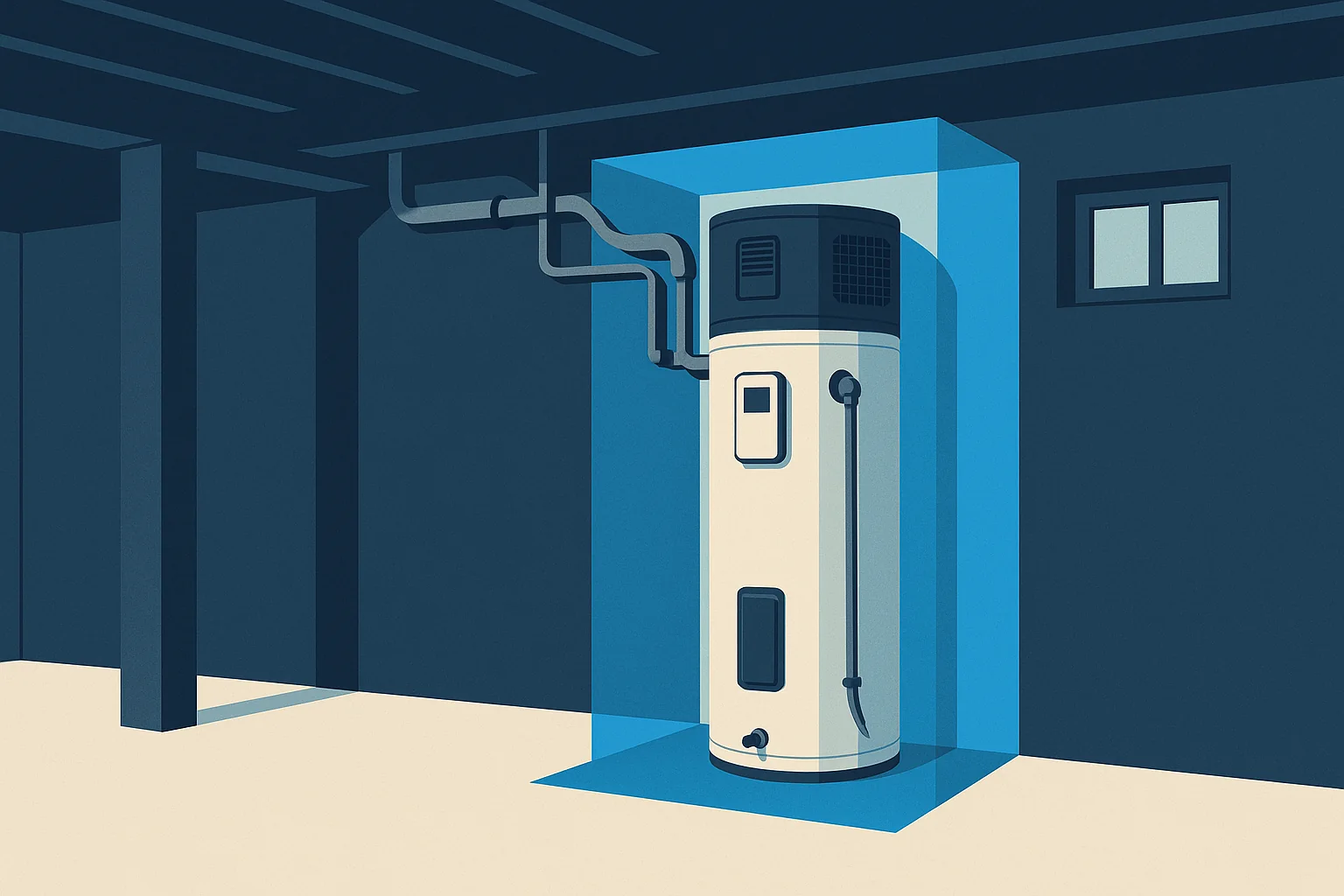

Heat pump water heaters are the most efficient way to make hot water in an average home, by a wide margin, and they are also the option most likely to disappoint the person who installs one in the wrong place. Both statements are true at once, which is why the honest version of this comparison is more useful than an endorsement. This article lays out the case for and against, and the specific conditions in an Ohio basement that decide which case applies to you. It supports our water heater service work.
In This Guide
- How the Efficiency Is Achieved
- The Case For, in an Ohio Basement
- The Case Against, Stated Honestly
- The Qualifying Checklist
- Where Transit & Flow Group Fits
- Frequently Asked Questions
Transit & Flow Group coordinates projects and partners with properly licensed and insured specialty contractors when licensing is required.
One boundary. These units require a dedicated high-current electrical circuit, condensate drainage, and plumbing connections, all permitted work in Ohio. This article helps you specify and evaluate. Never adjust or cap a temperature and pressure relief valve.
How the Efficiency Is Achieved
A standard electric water heater converts electricity into heat directly. A heat pump water heater does not generate heat at all. It moves heat, pulling it from the surrounding air and transferring it into the water, using electricity to run a compressor rather than to produce the heat itself. Moving heat is far cheaper than making it, which is the whole source of the efficiency advantage.
Everything in the case against follows from the same mechanism. If the unit takes heat out of the air, it cools that air. If it cools air, it condenses moisture, which has to drain somewhere. It needs enough air volume to draw from. It has a compressor and a fan, so it makes noise a conventional tank does not. And when the surrounding air gets cold enough, efficiency drops and the unit falls back on conventional electric elements, which is where the advantage disappears.
The Case For, in an Ohio Basement
- Operating efficiency is not a marginal improvement. Against a standard electric tank, the reduction in energy used to make the same hot water is large enough to change the household energy picture on its own.
- The dehumidification is a genuine benefit here. Central Ohio basements are humid for much of the year. A unit that removes moisture from that air while doing its actual job is solving two problems with one machine.
- No combustion means no venting and no carbon monoxide consideration. That removes an entire category of risk and an entire category of installation scope, which matters enormously in a home with an orphaned appliance on a shared chimney.
- A conditioned basement is close to the ideal environment, because a basement stays more thermally stable year round than any other space in the house.
- Incentive programs concentrate here. These units are among the most commonly supported measures, which is worth verifying through the method in our article on verifying heating incentives rather than taking on a contractor’s word.
- Most units run in multiple modes, including a fully conventional electric mode, which means a period of unusually high demand does not leave you without hot water.
The Case Against, Stated Honestly
- Space requirements are real and frequently underestimated. Manufacturers specify a minimum air volume for the room. A unit installed in a small mechanical closet with a solid door will run out of air to draw from and spend its life in conventional electric mode, delivering none of the efficiency you paid for.
- The unit is taller than a conventional tank of the same capacity, and the clearance above it matters. Low basement ceilings and joist runs are the most common physical obstacle.
- It cools the space it occupies. Welcome in a humid unfinished basement in July. Less welcome if the unit sits adjacent to finished living space or in a utility room off a conditioned area.
- Condensate has to go somewhere. A floor drain, a condensate pump, or a routed line. This is a small item that gets omitted from proposals and becomes a problem later.
- It makes noise. Compressor and fan noise, at a level comparable to a window air conditioner. In an unfinished basement, irrelevant. Below a bedroom, not irrelevant.
- Recovery in heat pump mode is slower than a gas unit, which affects capacity sizing rather than being a defect.
- It carries maintenance a conventional tank does not, specifically an air filter that needs periodic cleaning, plus the condensate path. Skipping it degrades performance quietly.
- It needs a dedicated high-current circuit. If the panel is full, an electrical upgrade enters the scope and changes the whole comparison.
The Qualifying Checklist
Run this before anyone quotes equipment. Every item has a factual answer available today.
- Measure the room volume where the unit will sit, and compare it to the manufacturer’s stated minimum for the model under consideration. Not a comparable model. That one.
- Measure the ceiling height at the installation point, including any pipe or duct crossing above it.
- Identify the condensate path. Floor drain, gravity route, or pump. Name it.
- Confirm panel capacity for a dedicated circuit, and confirm the run length from the panel to the unit.
- Identify what is on the other side of the wall and directly above. Bedroom, office, or finished family room changes the noise assessment.
- Decide whether cooling that space is acceptable in January as well as in July.
- Confirm the filter is accessible where the unit will actually sit, since maintenance that requires moving the unit does not happen.
- Size capacity to the household, accounting for slower recovery in heat pump mode rather than matching the outgoing tank.
Failing any single one of the first four items is usually disqualifying, and it is better to learn that from a tape measure than from a unit that runs in resistance mode forever.
On cost: this article contains no dollar figures on purpose. Installed price varies with electrical scope, whether a new circuit and panel capacity are required, condensate handling, unit capacity, permit requirements, and access to the mechanical space. Operating savings depend on your utility rate, your household usage, and the temperature of the space the unit sits in, none of which are universal. Get a scoped proposal and get your own usage into the comparison.
Option A is a conventional water heater, gas or standard electric, which is simple, cheap to install, and predictable. Option B is a heat pump water heater in a qualified space. My recommendation is Option B whenever the basement is unfinished or semi-finished, the room volume clears the manufacturer’s minimum, a condensate path exists, and the panel has capacity, and Option A when any of those fail. That is a genuinely conditional recommendation, and it should be. The efficiency case is strong enough to be worth pursuing and the qualifying conditions are strict enough that pursuing it in the wrong space produces an expensive standard electric water heater. Our fuel comparison article covers where this sits against the gas options.
Where Transit & Flow Group Fits
Transit & Flow Group coordinates water heater projects across Columbus and Central Ohio and partners with properly licensed and insured specialty contractors when licensing is required. Our standard is that room volume, ceiling clearance, condensate path, and panel capacity are measured and stated in writing before a heat pump unit is proposed, and that a homeowner is told plainly when their space does not qualify. Because these projects cross plumbing and electrical trades, one coordinator carries the project. To get your space qualified before you shop equipment, request an assessment.
Frequently Asked Questions
How does a heat pump water heater differ from a standard electric one?
A standard electric water heater converts electricity into heat directly. A heat pump water heater does not generate heat at all. It moves heat, pulling it from the surrounding air and transferring it into the water, using electricity to run a compressor rather than to produce the heat itself. Moving heat costs far less than making it, and that mechanism is the entire source of the efficiency advantage.
Will a heat pump water heater work in my Ohio basement?
That depends on four measurable conditions, and it is worth checking them before anyone quotes equipment. Measure the room volume where the unit will sit and compare it against the manufacturer’s published minimum for the exact model under consideration rather than a comparable one. Measure the ceiling height at the installation point, including any pipe or duct crossing above it, since these units are taller than a conventional tank of the same capacity. Then identify the condensate path and confirm the panel has capacity for a dedicated circuit. Failing any one of those four is usually disqualifying, and it is better to learn that from a tape measure than from a unit that runs in resistance mode forever.
What are the real drawbacks?
They all follow from the same mechanism. The unit cools the space it occupies, which is welcome in a humid unfinished basement in July and less welcome next to finished living space in January. It condenses moisture, so a floor drain, gravity route, or condensate pump has to be named in the scope. It has a compressor and a fan, so it makes noise comparable to a window air conditioner, which is irrelevant in an unfinished basement and not irrelevant below a bedroom. It also recovers more slowly in heat pump mode than a gas unit, and it carries maintenance a conventional tank does not, specifically an air filter that needs periodic cleaning.
Is the dehumidification actually useful?
In Central Ohio it is a genuine benefit rather than a marketing line. Basements here are humid for much of the year, and a unit that removes moisture from that air while doing its actual job is solving two problems with one machine. A basement is also close to the ideal environment for these units in general, because it stays more thermally stable year round than any other space in the house. If you have a concern about existing moisture damage or growth in the basement, have it assessed by a qualified professional rather than treating a water heater as the remedy.
What electrical and permit work does the installation involve?
These units require a dedicated high-current electrical circuit, condensate drainage, and plumbing connections, and that is permitted work in Ohio. If the panel is full, an electrical upgrade enters the scope and changes the whole comparison, so confirm panel capacity and the run length from the panel to the unit early. Requirements vary by jurisdiction, so verify what applies at your address with your local building department and have the work performed by licensed trades. Never adjust or cap a temperature and pressure relief valve.
When should I just install a conventional water heater instead?
When the qualifying conditions fail. A conventional gas or standard electric unit is simple, straightforward to install, and predictable, and it is the right answer when room volume falls short of the manufacturer’s minimum, when there is no workable condensate path, when clearance above the unit is not there, or when the panel cannot support a dedicated circuit. The efficiency case for a heat pump unit is strong enough to be worth pursuing, and the qualifying conditions are strict enough that pursuing it in the wrong space produces an expensive standard electric water heater. Ask any contractor to state room volume, ceiling clearance, condensate path, and panel capacity in writing before proposing one.
Sources
- U.S. Department of Energy, Building Technologies Office, heat pump water heater guidance
- Ohio Construction Industry Licensing Board, plumbing and electrical trade licensing
- City of Columbus, Get a Permit, plumbing and electrical permit channels
About This Guide
Written and edited by Micheal Parker, founder of Transit & Flow Group. Published November 27, 2026. This guide is checked against the agency and code sources listed above, and it is revised when those sources change.
General contractor of record. Micheal Parker holds City of Columbus General Contractor Registration G12064, issued by the Columbus Department of Building and Zoning Services under Transit & Flow LLC and valid through June 30, 2027. Trade work that falls outside the scope of that registration is performed by licensed trade partners, and the responsible license holder is identified before work begins.
Transit & Flow Group, home and commercial services for Columbus and the surrounding Central Ohio communities. Phone (614) 382-0000. Email solutions@transitflowgroup.com. 10 N. High St., Suite 217, Columbus, OH 43215. Contact our team or review the communities we serve.
