
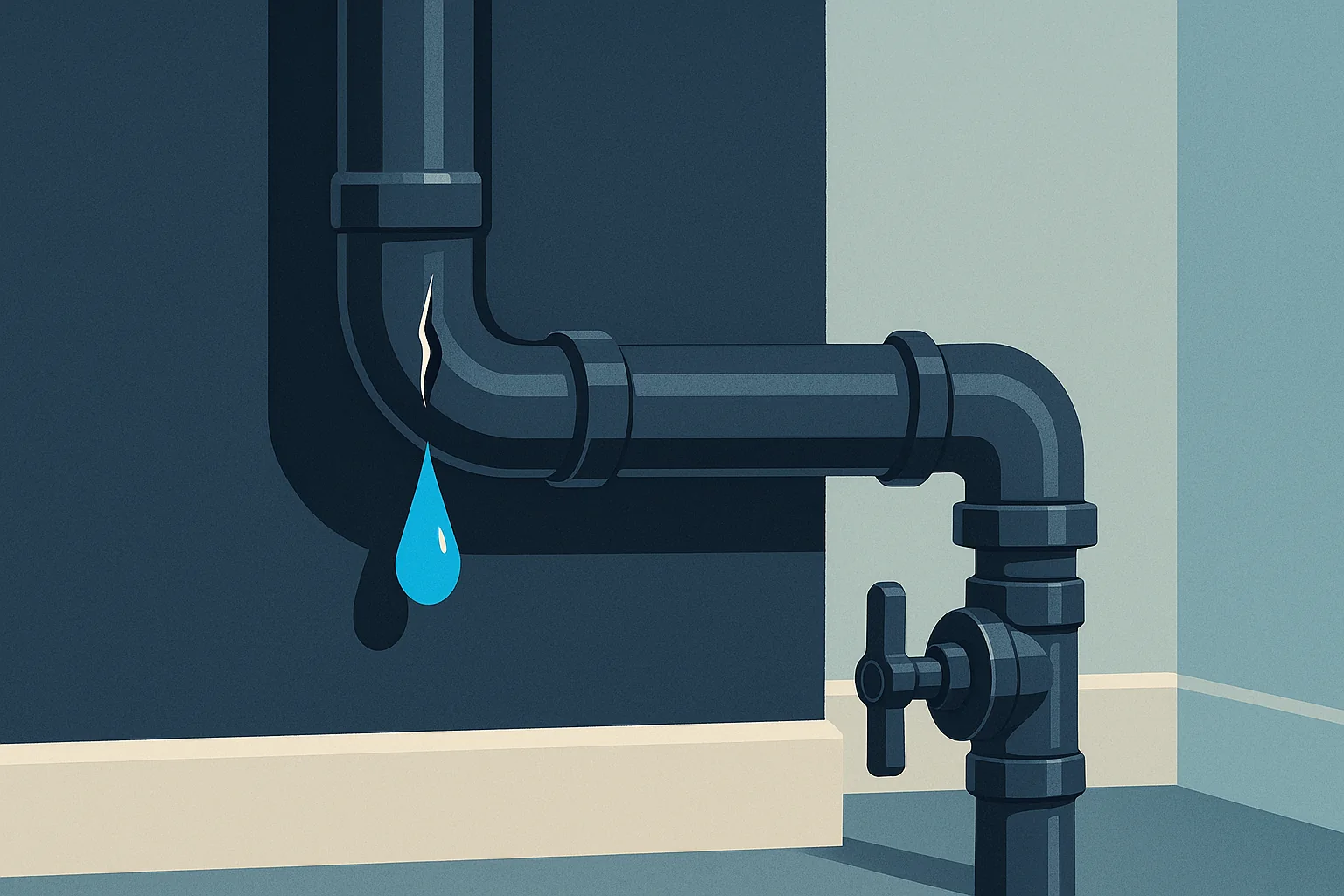

A burst supply line does not give you time to research. It gives you a decision sequence, and how well you execute the first ten minutes determines how much of the rest of the project you will be paying for. This article is written to be read before it happens, so the sequence is already in your head when it does. It supports our plumbing and restoration work.
In This Guide
- The First Ten Minutes, In Order
- Find Your Shutoff on a Dry Saturday
- Why Pipes Burst Here, and Where
- Documentation That Actually Holds Up
- What Drying Actually Requires
- Where Transit & Flow Group Fits
- Frequently Asked Questions
Transit & Flow Group coordinates projects and partners with properly licensed and insured specialty contractors when licensing is required.
Read this first. Do not walk into standing water that is touching electrical panels, outlets, appliances, or extension cords. If water is near energized equipment and you cannot reach the panel from a dry position, stay out and call the utility or emergency services. Do not stand under a ceiling that is bulging or sagging with trapped water. If you smell gas, leave the building and call from outside. If anyone has trouble breathing, that is a medical question for a physician or emergency services, not a building question.
The First Ten Minutes, In Order
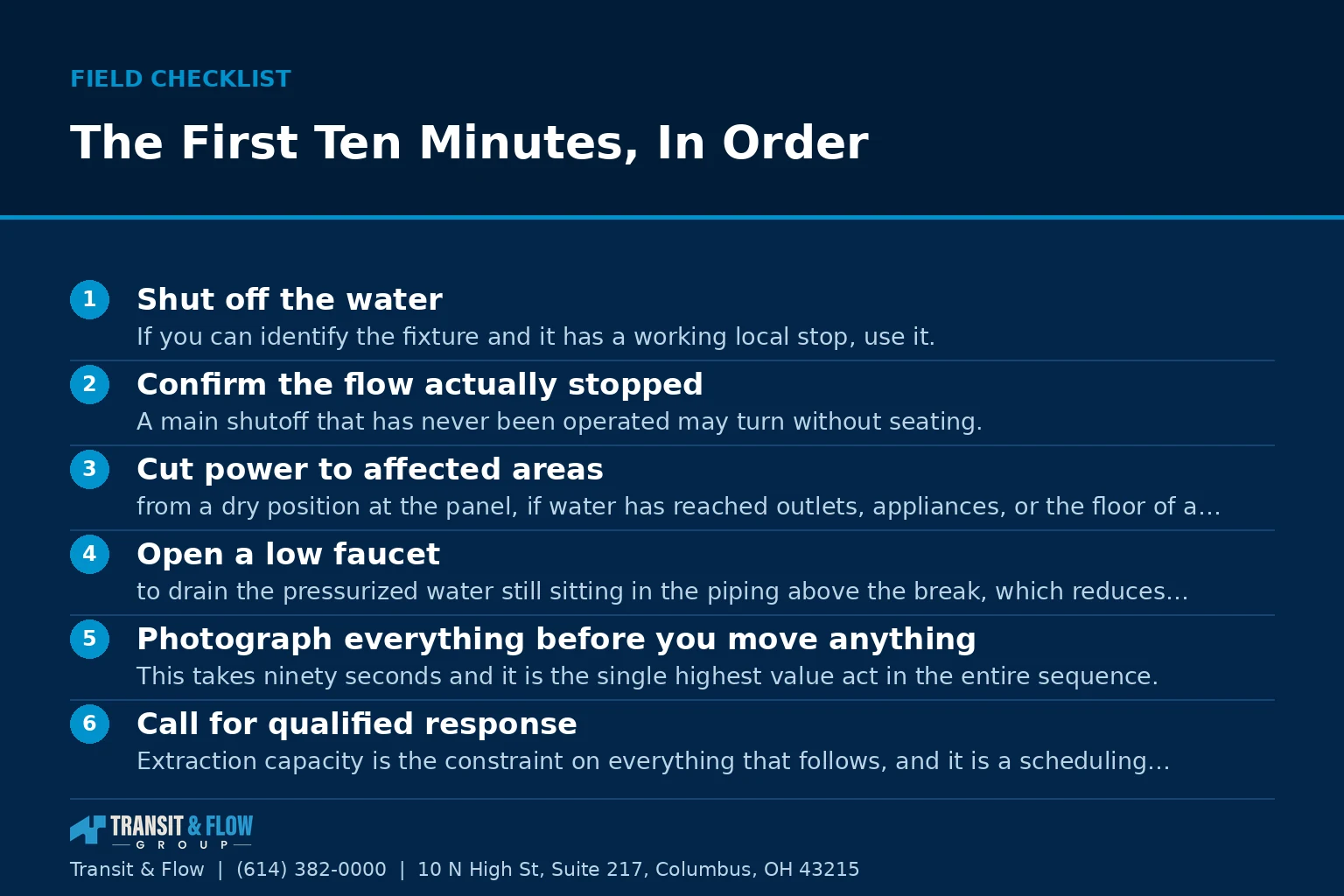
- Shut off the water. If you can identify the fixture and it has a working local stop, use it. If you cannot, go straight to the main. Do not spend three minutes hunting for a fixture stop when the main is a known quantity.
- Confirm the flow actually stopped. A main shutoff that has never been operated may turn without seating. Watch the break point for thirty seconds. If it is still running, the valve did not close.
- Cut power to affected areas from a dry position at the panel, if water has reached outlets, appliances, or the floor of a room with energized equipment. If reaching the panel means walking through water, do not.
- Open a low faucet to drain the pressurized water still sitting in the piping above the break, which reduces how much more arrives at the failure point.
- Photograph everything before you move anything. This takes ninety seconds and it is the single highest value act in the entire sequence.
- Call for qualified response. Extraction capacity is the constraint on everything that follows, and it is a scheduling queue during a regional freeze event.
- Then start moving what you can safely move. Contents off the wet floor, furniture legs onto foil or blocks, rugs lifted.
Steps one through four are the emergency. Steps five through seven are the project. Confusing the two, usually by starting to clean up before shutting off the water, is the most common and most expensive mistake homeowners make.
Find Your Shutoff on a Dry Saturday
Nearly every account of a bad water loss includes the same detail: the shutoff was found late. This is entirely preventable and it takes one afternoon.
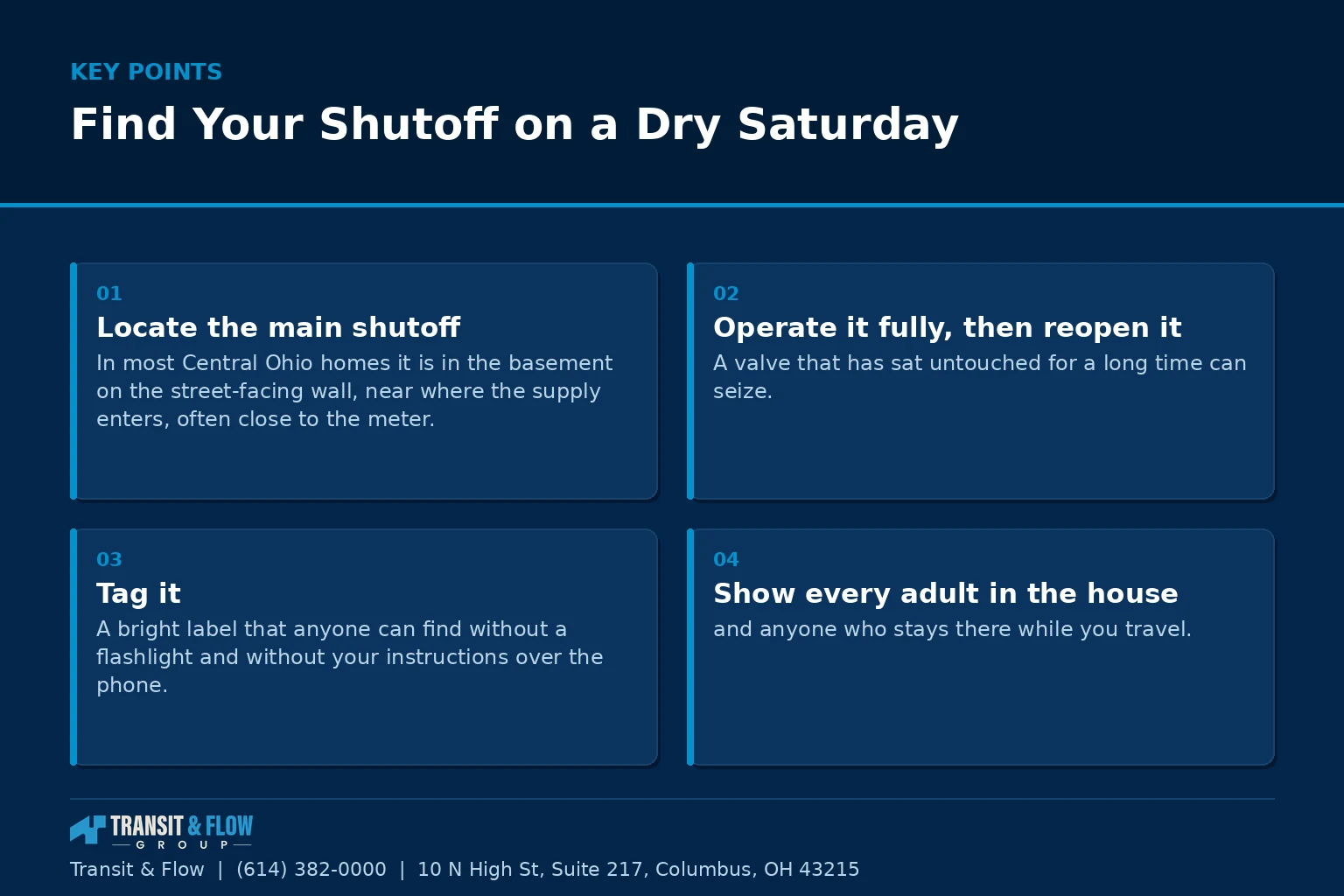
- Locate the main shutoff. In most Central Ohio homes it is in the basement on the street-facing wall, near where the supply enters, often close to the meter.
- Operate it fully, then reopen it. A valve that has sat untouched for a long time can seize. Learning that now costs a service call. Learning it during a burst costs a floor.
- Tag it. A bright label that anyone can find without a flashlight and without your instructions over the phone.
- Show every adult in the house and anyone who stays there while you travel.
- Photograph it and keep the photo somewhere you can find it under stress.
- Note whether it needs a tool. If it requires a meter key or a wrench, that tool lives next to the valve and nowhere else.
- Identify the water heater shutoff and the fixture stops while you are there, since a targeted shutoff keeps the rest of the house in service.
Why Pipes Burst Here, and Where
Water expands as it freezes. The burst is rarely at the ice itself. Pressure builds in the trapped section between the ice plug and a closed fixture, and the pipe fails at the weakest point in that section, which can be some distance away. That is why the visible damage and the frozen run are often in different places.
The second thing worth knowing is that the failure is frequently discovered at the thaw rather than at the freeze. The pipe cracks while frozen and stays sealed by ice. Water arrives when temperatures rise, often while nobody is watching for it. A quiet cold snap followed by a warm afternoon is the classic Central Ohio loss pattern.
- Exterior wall runs, particularly on the north and west faces, and anywhere insulation was disturbed by prior work.
- Unheated spaces. Crawl spaces, attics, garages, and unconditioned additions built onto older homes.
- Hose bibs and exterior spigots where the hose was left connected through the first freeze.
- Vacant or minimally heated properties, including a home left on a low setpoint during a trip.
- Rim joist areas and cantilevered floors, which are cold on three sides and routinely under-insulated.
- Runs disturbed by a remodel, where a pipe ended up outside the insulation line without anyone noticing.
Documentation That Actually Holds Up
General process information follows, not policy advice. Your coverage terms govern, and questions about what is covered belong with your carrier or your agent.
- Wide shots of every affected room before anything is moved, from at least two corners, so the extent is unambiguous later.
- The water line on walls and cabinet bases, photographed while it is still visible. It disappears as things dry and it is the clearest evidence of depth.
- The failure point itself, close up, before any repair. If a section of pipe is removed, keep it.
- Timestamps. When you discovered it, when the water was shut off, when the first call was placed, when the first responder arrived.
- A running log of names. Every person who enters, who they work for, and what they did.
- Serial numbers and model plates on affected appliances and mechanical equipment.
- Receipts for everything, including a hotel stay, a fan you bought, and the plumber who stopped the leak.
- Do not throw anything away until it has been documented and released, including materials that are obviously ruined.
What Drying Actually Requires
Fans alone are not a drying plan. Controlled drying balances airflow, humidity removal, and temperature, and it is verified by measurement rather than by touch. A wall that feels dry to the hand can hold enough moisture in the cavity behind it to keep a problem alive for weeks.
The practical consequence for a homeowner is simple. A drying operation that produces no daily moisture readings has produced no evidence that it worked. Our guide to the first 48 hours covers the drying model, the water categories, and the dry standard in full.
On cost: this article contains no dollar figures on purpose. A burst pipe response varies with the volume of water released, how long it ran, how far it traveled, which materials it reached, whether the affected area is finished, the repair scope at the failure point, and whether a claim is involved. Any published range would be wrong for nearly everyone reading it. Get a scoped written proposal on your actual loss.
Option A is stopping the water, renting equipment, and drying it yourself. Option B is stopping the water, documenting thoroughly, and bringing in qualified response immediately. My recommendation is Option B for anything beyond a small contained release on a hard surface that you caught within minutes. The reason is not effort, it is evidence. A documented drying record protects you in a claim, and water that traveled into a wall cavity or under a floor is not something a rented fan resolves. Calling early does not commit you to a large scope, and calling late removes the option of a small one. Where the water came up from a drain rather than down from a pipe, our article on basement floor drain backups covers a different response entirely.
Where Transit & Flow Group Fits
Transit & Flow Group coordinates plumbing and restoration work across Columbus and Central Ohio and partners with properly licensed and insured specialty contractors when licensing is required. Our standard is that the water source is identified and named, that moisture readings are recorded at the first visit and daily afterward, and that a repair scope is written rather than described. Because a burst line crosses plumbing, drying, and reconstruction trades, one coordinator carries the project. To get a response scoped, contact us.
Frequently Asked Questions
What is the very first thing to do when a pipe bursts?
Shut off the water. If you can identify the fixture and it has a working local stop, use that, and if you cannot, go straight to the main rather than spending three minutes hunting. Then confirm the flow actually stopped, because a main shutoff that has never been operated can turn without seating, so watch the break point for about thirty seconds. Before any of this, do not walk into standing water touching electrical panels, outlets, appliances, or cords, and if you cannot reach the panel from a dry position, stay out and call the utility or emergency services.
Why does the water keep coming after the main is closed?
Some of it is simply the pressurized water still sitting in the piping above the break, which continues to drain to the failure point. Opening a low faucet gives that water somewhere else to go and reduces how much more arrives at the break. If flow does not slow at all after thirty seconds, the more likely explanation is that the valve turned without closing. In that case the shutoff is not doing its job and you need qualified help immediately.
Where should I look for the main shutoff before I ever need it?
In most Central Ohio homes it is in the basement on the street-facing wall, near where the supply enters and often close to the meter. Find it on a dry Saturday, operate it fully and reopen it, because a valve that has sat untouched can seize, and learning that now costs a service call rather than a floor. Tag it with a bright label, photograph it, and show every adult in the house and anyone who stays there while you travel. If it needs a meter key or a wrench, that tool lives next to the valve and nowhere else.
Why did the pipe fail somewhere other than where it froze?
Water expands as it freezes, but the burst is rarely at the ice itself. Pressure builds in the trapped section between the ice plug and a closed fixture, and the pipe fails at the weakest point in that section, which can be some distance away. That is why the visible damage and the frozen run are often in different places. It is also why the frozen section is not necessarily the section that needs repair.
Why do people often discover the leak days after the cold snap?
Because the pipe frequently cracks while frozen and stays sealed by the ice inside it. The water arrives when temperatures rise and the plug melts, often while nobody is watching for it. A quiet cold snap followed by a warm afternoon is the classic Central Ohio loss pattern. That delay is the reason to check vulnerable runs during a thaw rather than only during the freeze.
What documentation matters most in the first hour?
Photograph everything before you move anything, which takes about ninety seconds and is the highest value act in the sequence. Take wide shots of every affected room from at least two corners, capture the water line on walls and cabinet bases while it is still visible, and photograph the failure point close up before any repair. Record timestamps for discovery, shutoff, first call, and first arrival, keep a running log of everyone who enters and who they work for, and hold every receipt. Do not throw anything away until it has been documented and released, and take coverage questions to your carrier or agent rather than to a contractor.
Sources
- Ohio Construction Industry Licensing Board, plumbing trade licensing
- Ohio Attorney General, consumer protection guidance on emergency contracting
- City of Columbus, Get a Permit, plumbing permit channels
About This Guide
Written and edited by Micheal Parker, founder of Transit & Flow Group. Published December 2, 2026. This guide is checked against the agency and code sources listed above, and it is revised when those sources change.
General contractor of record. Micheal Parker holds City of Columbus General Contractor Registration G12064, issued by the Columbus Department of Building and Zoning Services under Transit & Flow LLC and valid through June 30, 2027. Trade work that falls outside the scope of that registration is performed by licensed trade partners, and the responsible license holder is identified before work begins.
Transit & Flow Group, home and commercial services for Columbus and the surrounding Central Ohio communities. Phone (614) 382-0000. Email solutions@transitflowgroup.com. 10 N High St, Suite 217, Columbus, OH 43215. Contact our team or review the communities we serve.
