


Mold is the subject where homeowners get frightened into decisions, and the fear is what gets sold. The facts are less dramatic and considerably more useful. This article sets out what public health agencies actually say, what moisture has to do with it, and how to tell a legitimate remediation scope from an opportunistic one. It supports our restoration work.
In This Guide
- The Facts That Change the Conversation
- What Moisture Sources Actually Feed Growth in Ohio Homes
- What a Sound Remediation Scope Contains
- Warning Signs Worth Taking Seriously
- Small Areas and What You Can Reasonably Handle
- Where Transit & Flow Group Fits
- Frequently Asked Questions
Transit & Flow Group coordinates projects and partners with properly licensed and insured specialty contractors when licensing is required.
Read this first. Health questions belong with a physician. Nothing here is medical advice, and no contractor of any kind is qualified to tell you what a growth in your home is doing to your body. If anyone in the household has breathing difficulty, persistent symptoms, or a compromised immune system, that conversation happens with a doctor, and it happens independently of any building assessment. Do not disturb a large growth without containment, because disturbance is what puts material into the air.
The Facts That Change the Conversation
Mold spores are present in essentially every indoor environment on earth. Their presence is not by itself evidence of a problem, which is why the finding that a sample contains spores is close to meaningless without context. What matters is whether spores have found sustained moisture and started growing, and where.
Public guidance from the U.S. Environmental Protection Agency is consistent on the central point: the target is the moisture, not the growth. Remove the water source and dry the materials, and growth stops. Clean or remove growth without correcting the moisture, and it returns. Everything sound in a remediation scope follows from that one sentence.
The commonly cited window of roughly one to two days for growth to begin on wet materials is a planning threshold rather than a deadline. It tells you why speed matters after a water loss. It does not mean a home is contaminated at hour forty-nine and clean at hour forty-seven. Our first 48 hours guide treats it the same way.
What Moisture Sources Actually Feed Growth in Ohio Homes
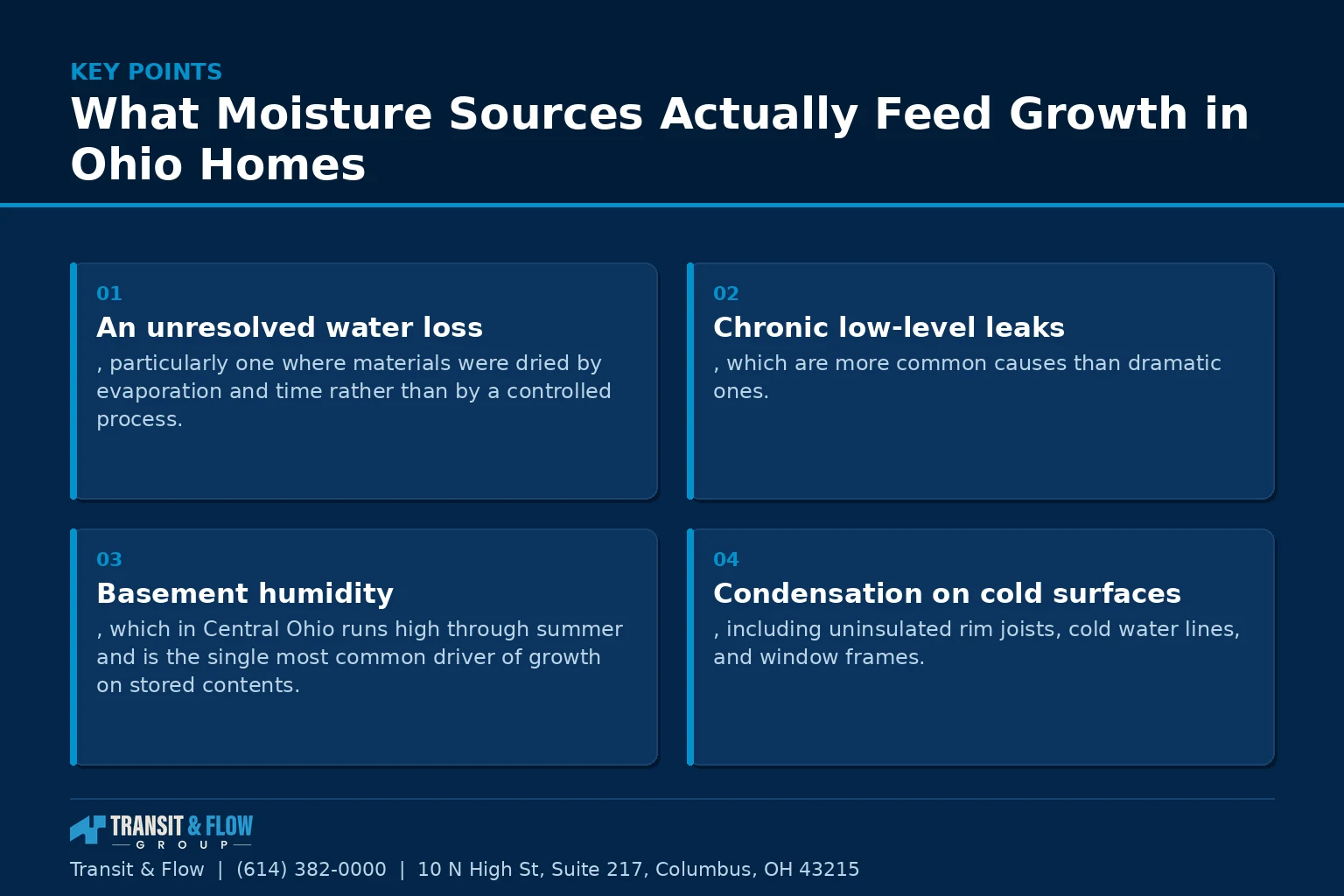
- An unresolved water loss, particularly one where materials were dried by evaporation and time rather than by a controlled process.
- Chronic low-level leaks, which are more common causes than dramatic ones. A supply line weep behind a vanity or a slow roof leak produces perfect conditions for years.
- Basement humidity, which in Central Ohio runs high through summer and is the single most common driver of growth on stored contents.
- Condensation on cold surfaces, including uninsulated rim joists, cold water lines, and window frames.
- Bathroom exhaust that terminates in the attic instead of outside, which is common in older housing stock and deposits warm moist air directly onto cold sheathing.
- Crawl space ground moisture where no vapor barrier exists or the existing one is torn.
- Ice dam water entering wall and ceiling cavities in winter, which frequently goes unnoticed until spring.
- Failed grading or downspout discharge putting water against the foundation year after year.
What a Sound Remediation Scope Contains
- The moisture source is identified and named in writing. If nobody can tell you where the water came from, the project is not ready to start.
- The source is corrected first, or corrected as part of the same scope, with the correction described specifically rather than promised generally.
- The affected area is defined by measurement, using moisture meters and where appropriate thermal imaging, because the visible boundary is almost never the actual boundary.
- Containment is established appropriate to the size of the area, with negative air where the scope warrants it, so removal does not distribute material through the rest of the house.
- Porous materials that cannot be cleaned are removed, and non-porous materials that can be cleaned are cleaned. That distinction drives most of what gets torn out and what does not.
- Materials are dried to a documented standard, verified by readings compared against an unaffected reference area in the same building.
- Completion is defined before work begins, in terms of moisture readings and visual inspection, so nobody is negotiating what finished means at the end.
- A written report is issued covering what was found, what was removed, what readings were achieved, and what correction was made to the source.
Warning Signs Worth Taking Seriously
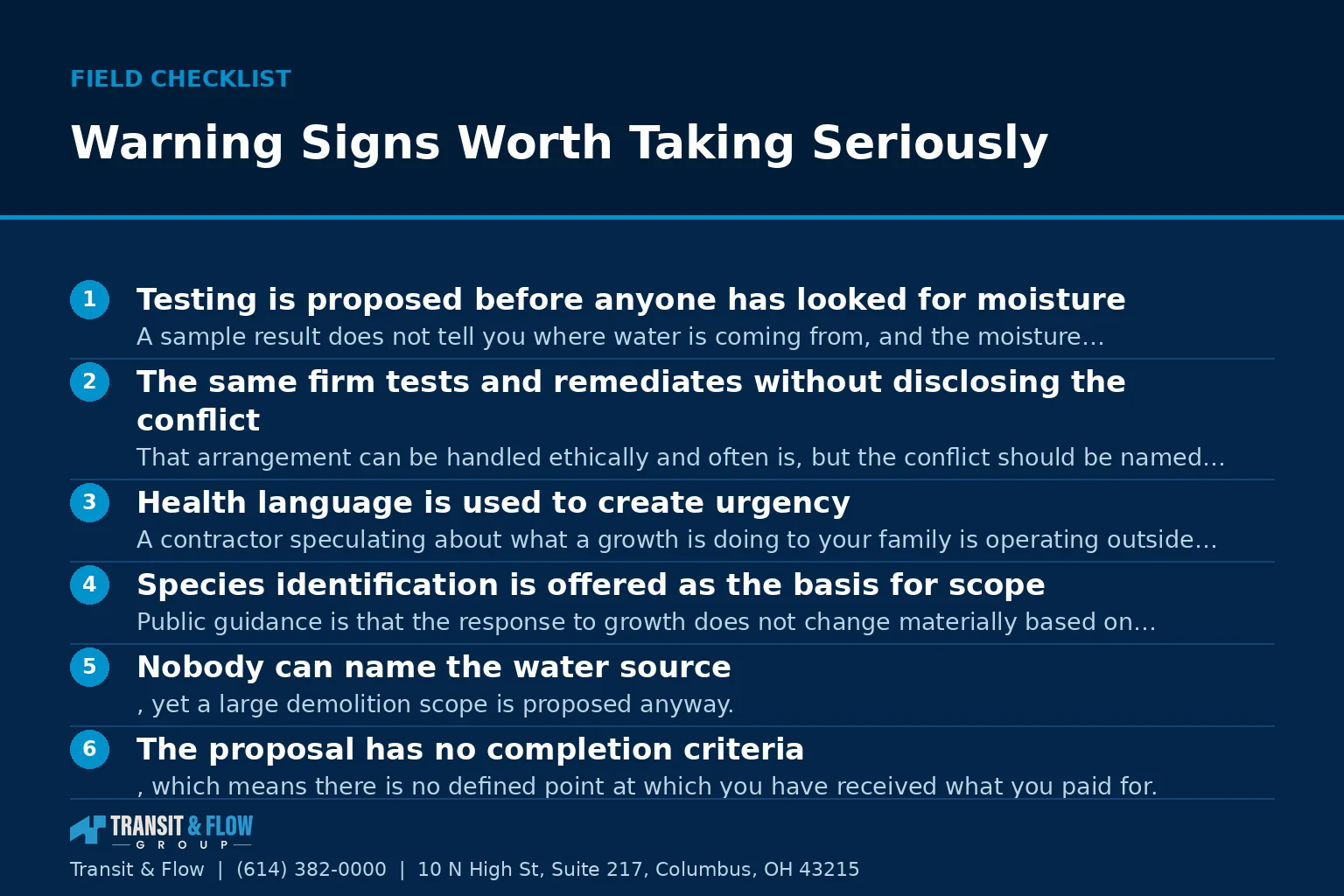
- Testing is proposed before anyone has looked for moisture. A sample result does not tell you where water is coming from, and the moisture investigation is the part that matters.
- The same firm tests and remediates without disclosing the conflict. That arrangement can be handled ethically and often is, but the conflict should be named by the contractor rather than discovered by you.
- Health language is used to create urgency. A contractor speculating about what a growth is doing to your family is operating outside their qualification.
- Species identification is offered as the basis for scope. Public guidance is that the response to growth does not change materially based on identification. Moisture and area drive the scope.
- Nobody can name the water source, yet a large demolition scope is proposed anyway.
- The proposal has no completion criteria, which means there is no defined point at which you have received what you paid for.
- A signature is requested during the first visit, particularly on any assignment of benefits document. Read anything that transfers your claim rights, and take the time to read it elsewhere.
- Fogging or chemical treatment is presented as the primary remedy rather than as an adjunct to physical removal and drying.
On cost: this article contains no dollar figures on purpose. Remediation scope varies with affected area, whether materials are porous, containment requirements, access, whether reconstruction follows, and what correction the moisture source requires. A published number would be wrong for nearly every reader. Get the moisture investigation and the written scope first, then price the specific work.
Small Areas and What You Can Reasonably Handle
EPA public guidance distinguishes small areas on hard surfaces from larger projects, and the practical reading is that a limited growth on a non-porous surface, where you know the moisture source and have corrected it, is within reach of a careful homeowner using appropriate protection and ventilation. Beyond that, and particularly where growth is inside a wall cavity, spread across porous materials, or of unknown origin, the containment requirement alone puts it out of scope for a homeowner.
Option A is testing first to find out what you are dealing with. Option B is a moisture investigation first, correcting the source, and treating growth as a consequence rather than as the diagnosis. My recommendation is Option B in nearly every case. Testing performed before the moisture question is answered generates a document rather than an answer, and it frequently costs money that would have been better spent on the meter survey that actually locates the problem. Testing has a legitimate role in a dispute, in a real estate transaction, or where a household member has a documented medical need and a physician has asked for it. Outside those situations, find the water. Where the growth followed a water loss, our guidance on verifying a contractor matters more than usual, because emergency work attracts operators who do not stay.
Where Transit & Flow Group Fits
Transit & Flow Group coordinates restoration projects across Columbus and Central Ohio and partners with properly licensed and insured specialty contractors when licensing is required. Our standard is that a moisture source is named before a remediation scope is written, that affected boundaries are established by instrument rather than by eye, and that no member of our team offers an opinion on health effects, which is a physician’s question. Because these projects usually involve plumbing or roofing corrections alongside the remediation, one coordinator carries the project. To get a moisture investigation scheduled, contact us.
Frequently Asked Questions
Does finding mold spores in a sample mean the house has a problem?
Not on its own. Spores are present in essentially every indoor environment, so a result confirming that a sample contains them is close to meaningless without context. What matters is whether spores have found sustained moisture and started growing, and where that is happening in the building. If you have a concern about growth you can see, have it assessed by a qualified professional rather than drawing a conclusion from a sample result.
Why do agencies focus on the moisture rather than the growth?
Public guidance from the U.S. Environmental Protection Agency is consistent on this point. Remove the water source and dry the materials, and growth stops. Clean or remove growth without correcting the moisture, and it returns. Everything sound in a remediation scope follows from that one sentence, which is why a project that cannot name where the water came from is not ready to start.
What moisture sources actually feed growth in Central Ohio homes?
Chronic low-level leaks are more common causes than dramatic ones, because a supply line weep behind a vanity or a slow roof leak produces sustained conditions for years. Basement humidity runs high through summer here and is the single most common driver of growth on stored contents, and condensation on cold surfaces such as uninsulated rim joists, cold water lines, and window frames does similar work. Bathroom exhaust that terminates in the attic instead of outside, crawl space ground moisture with no intact vapor barrier, and ice dam water entering wall and ceiling cavities in winter all appear regularly in older housing stock. Failed grading or downspout discharge putting water against the foundation year after year rounds out the list, along with any water loss where materials were dried by evaporation and time rather than by a controlled process.
What should a legitimate remediation scope contain?
The moisture source identified and named in writing, and corrected first or corrected as part of the same scope, with the correction described specifically rather than promised generally. The affected area defined by measurement using moisture meters, and thermal imaging where appropriate, because the visible boundary is almost never the actual boundary, and containment established appropriate to the size of the area so removal does not distribute material through the rest of the house. Porous materials that cannot be cleaned removed, non-porous materials that can be cleaned cleaned, and materials dried to a documented standard verified against an unaffected reference area in the same building. Completion criteria defined before work begins, and a written report issued at the end covering what was found, what was removed, what readings were achieved, and what was corrected at the source.
Should testing come before a moisture investigation?
In nearly every case the moisture investigation should come first, because testing performed before the moisture question is answered generates a document rather than an answer. Testing has a legitimate role in a dispute, in a real estate transaction, or where a household member has a documented medical need and a physician has asked for it. Outside those situations, the meter survey that locates the water is the better use of the money. Treat testing proposed before anyone has looked for moisture, species identification offered as the basis for scope, or a signature requested during the first visit as reasons to slow down and read everything elsewhere.
Who should answer questions about health effects?
A physician. Mold questions in a home are health questions, and no contractor of any kind is qualified to tell you what a growth is doing to your body. If anyone in the household has breathing difficulty, persistent symptoms, or a compromised immune system, that conversation happens with a doctor and happens independently of any building assessment. Anyone with a concern about existing growth should have it assessed by a qualified professional, and a contractor using health language to create urgency is operating outside their qualification.
Sources
- U.S. Environmental Protection Agency, water and indoor environment public guidance
- Ohio Construction Industry Licensing Board, contractor licensing
- Ohio Attorney General, consumer protection guidance on in-home sales and contracts
About This Guide
Written and edited by Micheal Parker, founder of Transit & Flow Group. Published December 6, 2026. This guide is checked against the agency and code sources listed above, and it is revised when those sources change.
General contractor of record. Micheal Parker holds City of Columbus General Contractor Registration G12064, issued by the Columbus Department of Building and Zoning Services under Transit & Flow LLC and valid through June 30, 2027. Trade work that falls outside the scope of that registration is performed by licensed trade partners, and the responsible license holder is identified before work begins.
Transit & Flow Group, home and commercial services for Columbus and the surrounding Central Ohio communities. Phone (614) 382-0000. Email solutions@transitflowgroup.com. 10 N High St, Suite 217, Columbus, OH 43215. Contact our team or review the communities we serve.
