


Permits are the least glamorous part of a roofing project and the part most likely to cause trouble when skipped. This guide explains how roofing permits work in Columbus, what the process looks like from application to closed permit, and how to handle the jurisdiction puzzle that comes with living in Central Ohio, where crossing a street can change whose rules apply. It is part of our roofing series, which starts with the complete roof replacement guide.
In This Guide
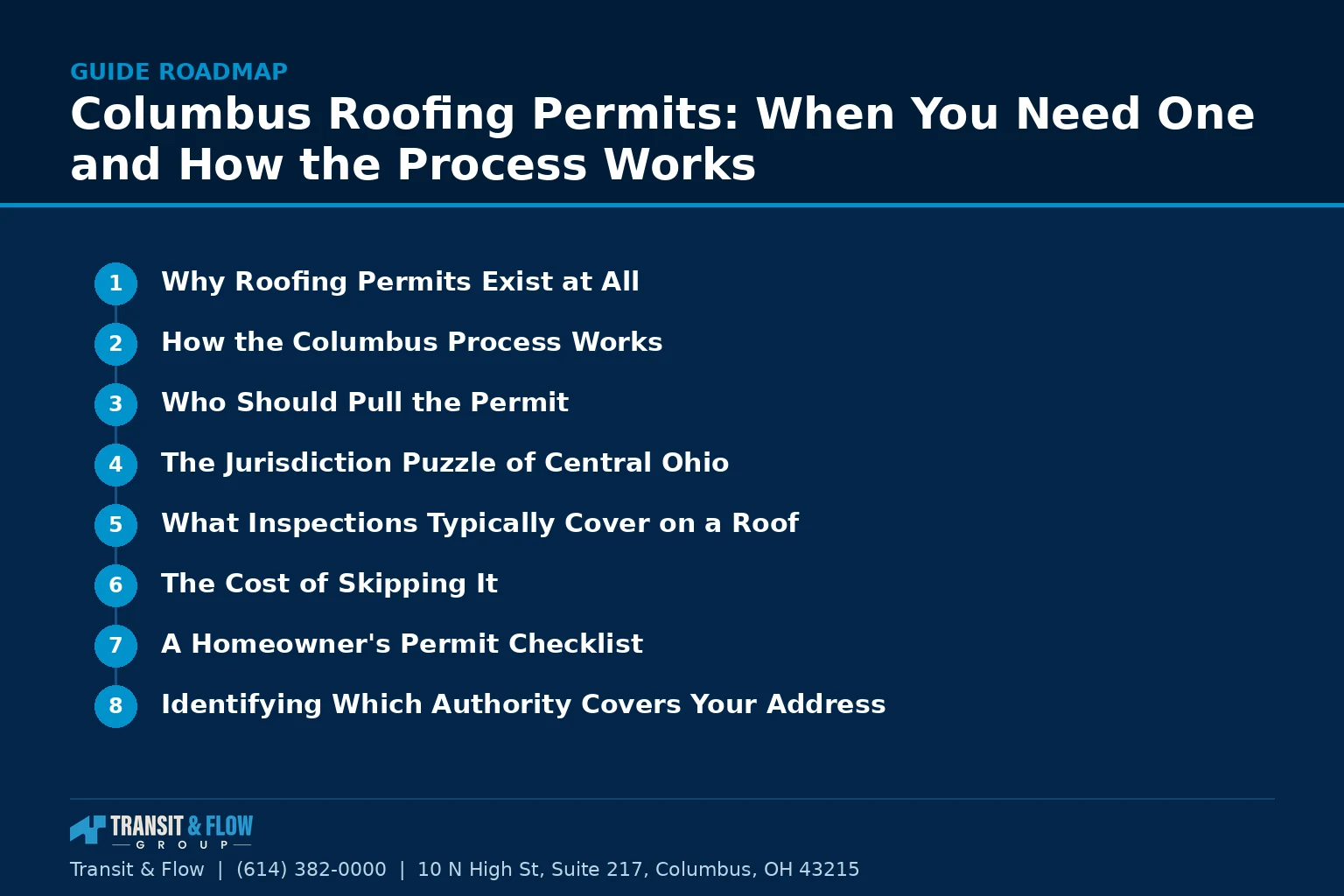
- Why Roofing Permits Exist at All
- How the Columbus Process Works
- Who Should Pull the Permit
- The Jurisdiction Puzzle of Central Ohio
- What Inspections Typically Cover on a Roof
- The Cost of Skipping It
- A Homeowner’s Permit Checklist
- Identifying Which Authority Covers Your Address
- What Goes Wrong With Roofing Permits, and Why
- Where Transit & Flow Group Fits
- Frequently Asked Questions
One note before the details: permit rules change, and the only authoritative answer for your address on any given day comes from your building department. Everything below is drawn from the City of Columbus Building and Zoning Services public information and is written to help you ask the right questions, not to replace the phone call.
Why Roofing Permits Exist at All
A roof is a structural and life-safety system. The permit process exists so that a qualified inspector, who works for you in the sense that your fees fund the department, verifies the work meets the building code the region has adopted. The permit is also a record. It proves to a future buyer, a lender, or an insurer that the roof on the house was installed under inspection. Homes trade hands in Central Ohio every day, and the closed permit in a folder is worth more than any verbal assurance from a contractor long since gone.
How the Columbus Process Works
The City of Columbus Building and Zoning Services department accepts permit applications two ways. Online, the city runs the Citizen Access Portal, where applicants register an account and file electronically. In person, completed applications are accepted at Building and Zoning Services, 111 North Front Street, Monday through Friday during business hours. The city’s own language is worth quoting because it settles a common question: a permit “authorizes a contractor or homeowner to begin work described in the project plans and description.” Homeowners can apply for their own permits in Columbus. Whether they should is a different question, answered below.
Two timing rules from the city matter for planning. Work must begin within one year of the permit being issued or the permit may expire, and once work begins, delays of more than six months can also expire it. For a roofing project measured in days, neither is usually a constraint, but they matter when a roof is part of a larger phased renovation.
Who Should Pull the Permit
The contractor performing the work should pull the permit. This is one of the clearest signals in all of contracting. The permit holder is the party answerable to the inspector, and a contractor who asks you to pull your own permit for their work is arranging for you to hold responsibility for their workmanship. Some do this because they are not registered with the jurisdiction, which is itself the answer to whether to hire them. Ask early, in writing: who pulls the permit, and will I have the permit number before tear-off begins? Our guide to reading a roofing estimate includes this in the questions every bidder should answer.
The Jurisdiction Puzzle of Central Ohio
Central Ohio is a patchwork. Columbus city limits wrap around and between suburbs, and your mailing address does not reliably tell you your permit office. A Columbus postal address can sit in Franklin Township, a Westerville address can be in unincorporated Delaware County, and a Dublin address can fall on either side of the Franklin and Delaware county line. Each municipality and township either runs its own building department or contracts with a county or state-certified authority.
The practical rule: confirm your jurisdiction before the project is scheduled, not after. Your county auditor’s parcel record identifies the taxing district, which points to the right building department. A contractor who works across Central Ohio every week will know the answer for your street, and their fluency is a useful competence check. If the answer is vague, keep asking until it is specific.
What Inspections Typically Cover on a Roof
Inspection practices vary by jurisdiction, so treat this as the general shape rather than a promise about your project. Roofing inspections commonly verify that the correct materials were installed to the approved application, that flashing and drip edge details meet code, that ventilation was addressed, and that fastening meets the manufacturer specification the code references. Some jurisdictions inspect mid-project, others at completion, and photo documentation by the contractor is increasingly accepted for details that get covered as the work proceeds. What matters to you is the closeout: the inspection is passed, the permit is closed, and the paperwork lands in your records.
The Cost of Skipping It
Unpermitted work saves a fee and a scheduling step now, and creates an open liability with no expiration date. At resale, buyers’ inspectors and title processes surface unpermitted structural work, and the negotiation that follows costs more than the permit ever would. At claim time, insurers ask questions about the roof’s installation history. And when unpermitted work is discovered by a jurisdiction, the remedy can include opening the work for inspection, which on a roof means undoing finished installation. There is no version of the math where skipping the permit wins.
A Homeowner’s Permit Checklist
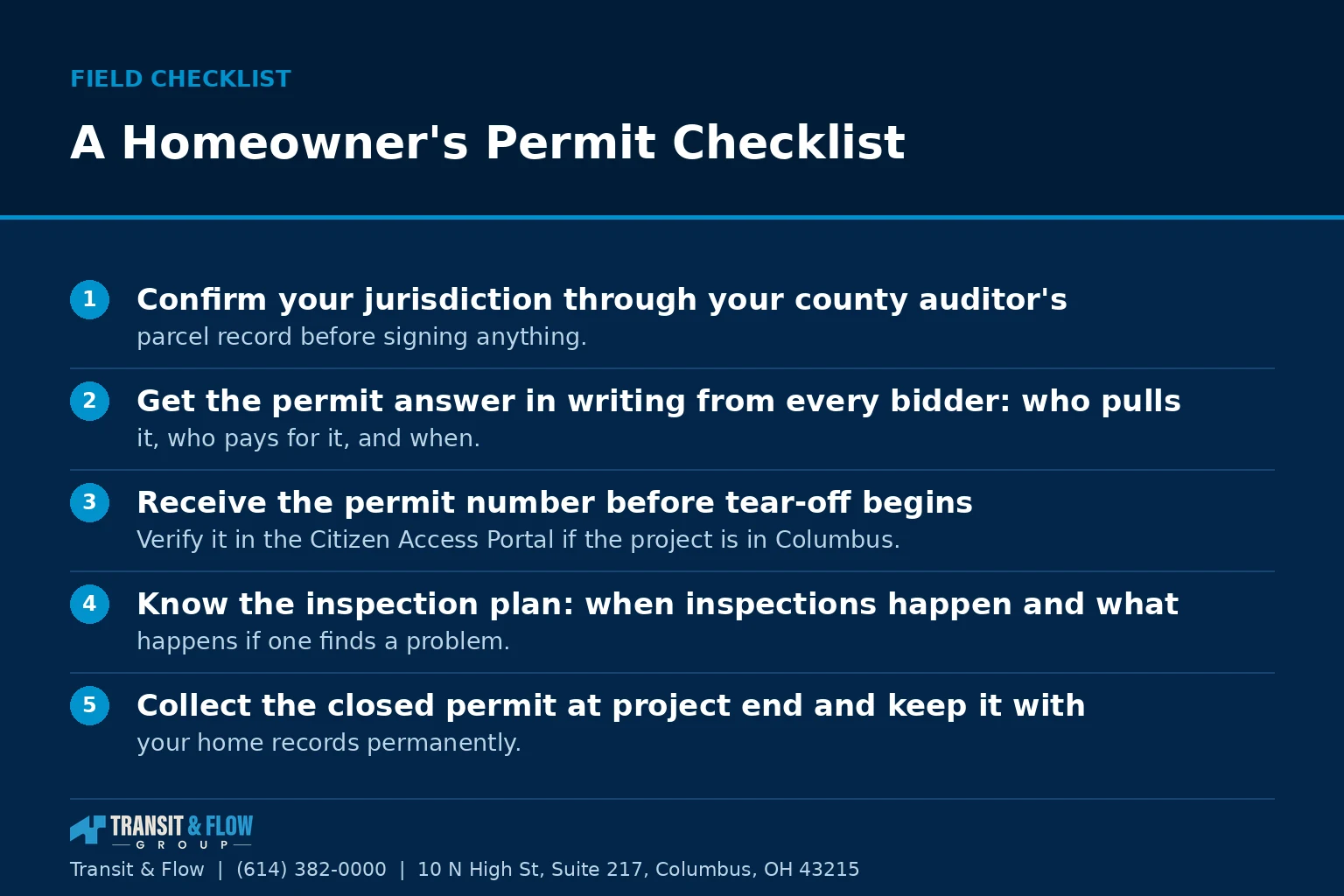
- Confirm your jurisdiction through your county auditor’s parcel record before signing anything.
- Get the permit answer in writing from every bidder: who pulls it, who pays for it, and when.
- Receive the permit number before tear-off begins. Verify it in the Citizen Access Portal if the project is in Columbus.
- Know the inspection plan: when inspections happen and what happens if one finds a problem.
- Collect the closed permit at project end and keep it with your home records permanently.
Identifying Which Authority Covers Your Address
The jurisdiction question has a small number of possible answers, and each one points to a different office. Start from the county auditor’s parcel record rather than the mailing address, then confirm directly with the office the record points to.
| Authority type | How it usually presents | What to confirm before scheduling |
|---|---|---|
| Municipal building department | The parcel sits inside the corporate limits of Columbus, Dublin, Westerville, or another incorporated city | The application channel, whether contractor registration is required, and the inspection sequence the department runs |
| County building department | The parcel sits in unincorporated territory within Franklin, Delaware, Licking, or Fairfield County | Which office holds residential jurisdiction for that parcel, since counties divide responsibility differently |
| Township served under contract | A township address where plan review and inspection are handled by a county or state-certified authority | The name of the authority that will actually issue the permit and perform the inspection |
| Split-county community | A single named community whose parcels fall on both sides of a county line | The county the parcel is recorded in, confirmed from the auditor record rather than assumed from the address |
None of this replaces the call. The department with jurisdiction is the only authority on what your address requires, and its answer governs regardless of what applied on a neighboring street.
What Goes Wrong With Roofing Permits, and Why
Permit trouble on a residential roof is almost never a dispute about the adopted code. It is a sequencing and ownership failure that was visible weeks earlier.
The jurisdiction gets identified late. A contractor bids the work assuming one office, discovers at application that another holds jurisdiction, and the crew is already scheduled. The fix is upstream: settle the jurisdiction before signing, using the parcel record.
The wrong party holds the permit. When a homeowner pulls a permit for work someone else performs, the homeowner becomes the party answerable to the inspector for that workmanship. This surfaces only when an inspection finds something, which is the worst moment to discover the arrangement.
Tear-off begins before issuance. A roof opened without an issued permit cannot be closed back up while the paperwork catches up, and weather does not wait. Requiring the permit number in hand before the first shingle comes off is the simplest protection available to a homeowner.
The permit never gets closed. The work passes, the crew leaves, and nobody collects the final documentation. An open permit behaves exactly like unpermitted work at resale, and reopening the file years later is a far larger task than closing it on schedule. Treat the closed permit as a deliverable of the project, not as an administrative afterthought.
Where Transit & Flow Group Fits
Transit & Flow Group coordinates projects and partners with properly licensed and insured specialty contractors when licensing is required. For roofing projects across Columbus and Central Ohio, permit handling is part of the coordination: the right jurisdiction identified up front, the permit pulled by the performing contractor, the number in your hands before tear-off, and the closed permit delivered with your warranty documents at the end. If you want a project where the paperwork is simply handled, start with an assessment.
Frequently Asked Questions
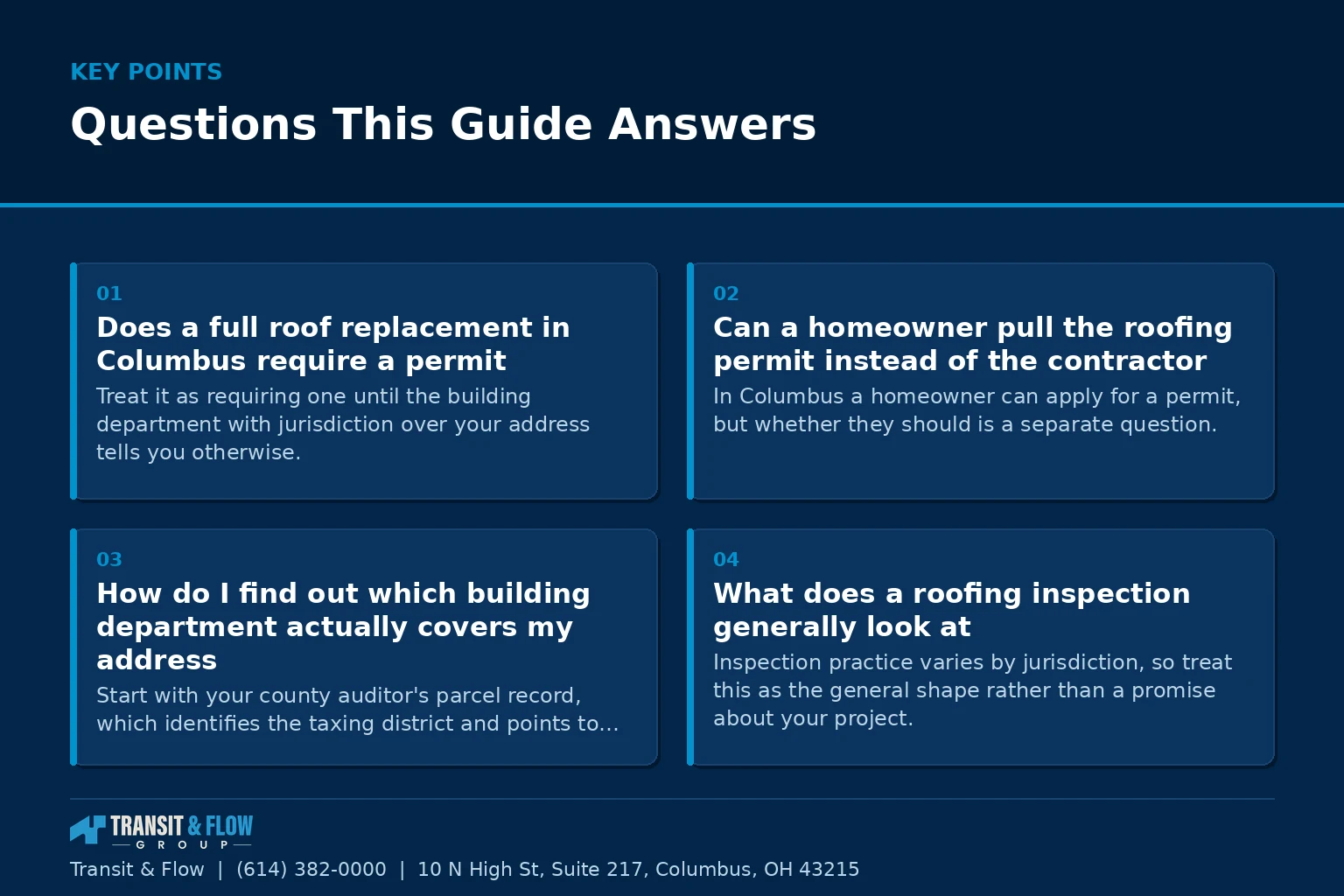
Does a full roof replacement in Columbus require a permit?
Treat it as requiring one until the building department with jurisdiction over your address tells you otherwise. A roof is a structural and life-safety system, and the permit exists so an inspector verifies the work against the code the region has adopted. The City of Columbus Building and Zoning Services department publishes its application channels and requirements, and that department, not a contractor, is the authority for your project. Permit rules also change, so confirm rather than relying on what applied to a neighbor’s roof last year.
Can a homeowner pull the roofing permit instead of the contractor?
In Columbus a homeowner can apply for a permit, but whether they should is a separate question. The permit holder is the party answerable to the inspector, so pulling the permit for someone else’s work means holding responsibility for that workmanship. When a contractor asks you to do it, ask why, because one common reason is that they are not registered with the jurisdiction. Get the answer in writing before you sign.
How do I find out which building department actually covers my address?
Start with your county auditor’s parcel record, which identifies the taxing district and points to the correct building department. Mailing addresses are unreliable in Central Ohio, where a Columbus postal address can sit in a township, a Westerville address can be in unincorporated Delaware County, and a Dublin address can fall on either side of the county line. Confirm the jurisdiction before the project is scheduled rather than after. A contractor who works across the region every week should be able to answer specifically for your street, and vagueness there is a useful signal.
What does a roofing inspection generally look at?
Inspection practice varies by jurisdiction, so treat this as the general shape rather than a promise about your project. Inspections commonly confirm that the correct materials were installed to the approved application, that flashing and drip edge details meet the adopted code, that ventilation was addressed, and that fastening follows the manufacturer’s published instructions the code references. Some jurisdictions inspect mid-project and others at completion, and photo documentation by the contractor is increasingly accepted for details that get covered as work proceeds. Ask your department what its sequence is before tear-off.
What are the consequences of roofing work done without a permit?
It saves a fee and a scheduling step now and creates an open liability with no expiration date. At resale, a buyer’s inspector or the title process can surface unpermitted structural work, and the negotiation that follows tends to cost more than the permit would have. Insurers ask about installation history at claim time. If a jurisdiction discovers the work, the remedy can include opening finished installation for inspection.
How long does a Columbus permit remain valid once it is issued?
The city’s published timing rules are that work must begin within one year of issuance or the permit may expire, and that once work has begun, delays of more than six months can also expire it. For a roofing project measured in days, neither is usually a constraint. They matter when the roof is one phase of a larger renovation that may pause. Verify the current rules with Building and Zoning Services, since these terms are set by the department and can change.
Sources
- City of Columbus, Get a Permit, application channels and requirements
- City of Columbus, Get or Track a Building Permit, portal, address, and permit timing rules
- National Roofing Contractors Association, installation standards referenced by inspections
About This Guide
Written and edited by Micheal Parker, founder of Transit & Flow Group. Published August 30, 2026. This guide is checked against the agency and code sources listed above, and it is revised when those sources change.
General contractor of record. Micheal Parker holds City of Columbus General Contractor Registration G12064, issued by the Columbus Department of Building and Zoning Services under Transit & Flow LLC and valid through June 30, 2027. Trade work that falls outside the scope of that registration is performed by licensed trade partners, and the responsible license holder is identified before work begins.
Transit & Flow Group, home and commercial services for Columbus and the surrounding Central Ohio communities. Phone (614) 382-0000. Email solutions@transitflowgroup.com. 10 N. High St., Suite 217, Columbus, OH 43215. Contact our team or review the communities we serve.
