

The hours after a storm damages your roof are when the most expensive mistakes get made, and almost none of them involve the roof itself. They involve signatures, sequences, and missing photographs. This guide gives you the exact documentation routine to run before anyone climbs a ladder, and explains why the order of operations matters more than speed. It is part of our roofing series anchored by the complete roof replacement guide.
In This Guide
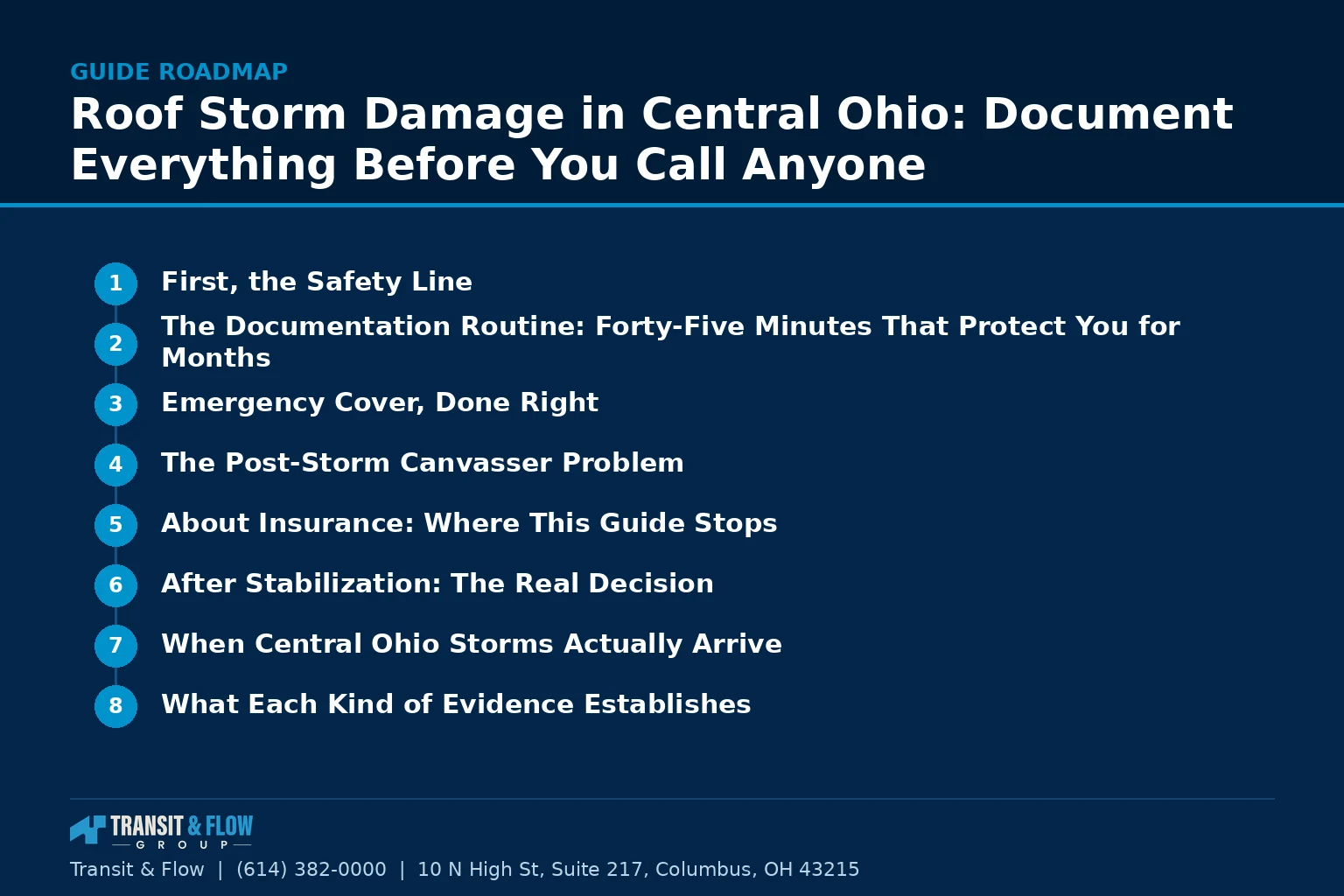
- First, the Safety Line
- The Documentation Routine: Forty-Five Minutes That Protect You for Months
- Emergency Cover, Done Right
- The Post-Storm Canvasser Problem
- About Insurance: Where This Guide Stops
- After Stabilization: The Real Decision
- When Central Ohio Storms Actually Arrive
- What Each Kind of Evidence Establishes
- Storm and Roofing Terms Worth Knowing
- How Transit & Flow Group Handles Storm Calls
- Frequently Asked Questions
First, the Safety Line
Before documentation, safety. If a tree or large limb is on the structure, if power lines are down anywhere near the house, or if the ceiling is sagging under trapped water, get people out and call emergency services and your utility. Puncture damage that opens the attic to the sky is urgent but rarely dangerous; structural loading and electricity are dangerous. Nothing in the rest of this article applies until the dangerous cases are handled by the people equipped for them.
The Documentation Routine: Forty-Five Minutes That Protect You for Months
Storm damage kicks off a sequence involving contractors, adjusters, and sometimes months of process. Every party in that sequence works from evidence, and the best evidence is dated, wide-to-tight, and taken before anything was moved or repaired. Run this routine the same day when it is safe to do so.
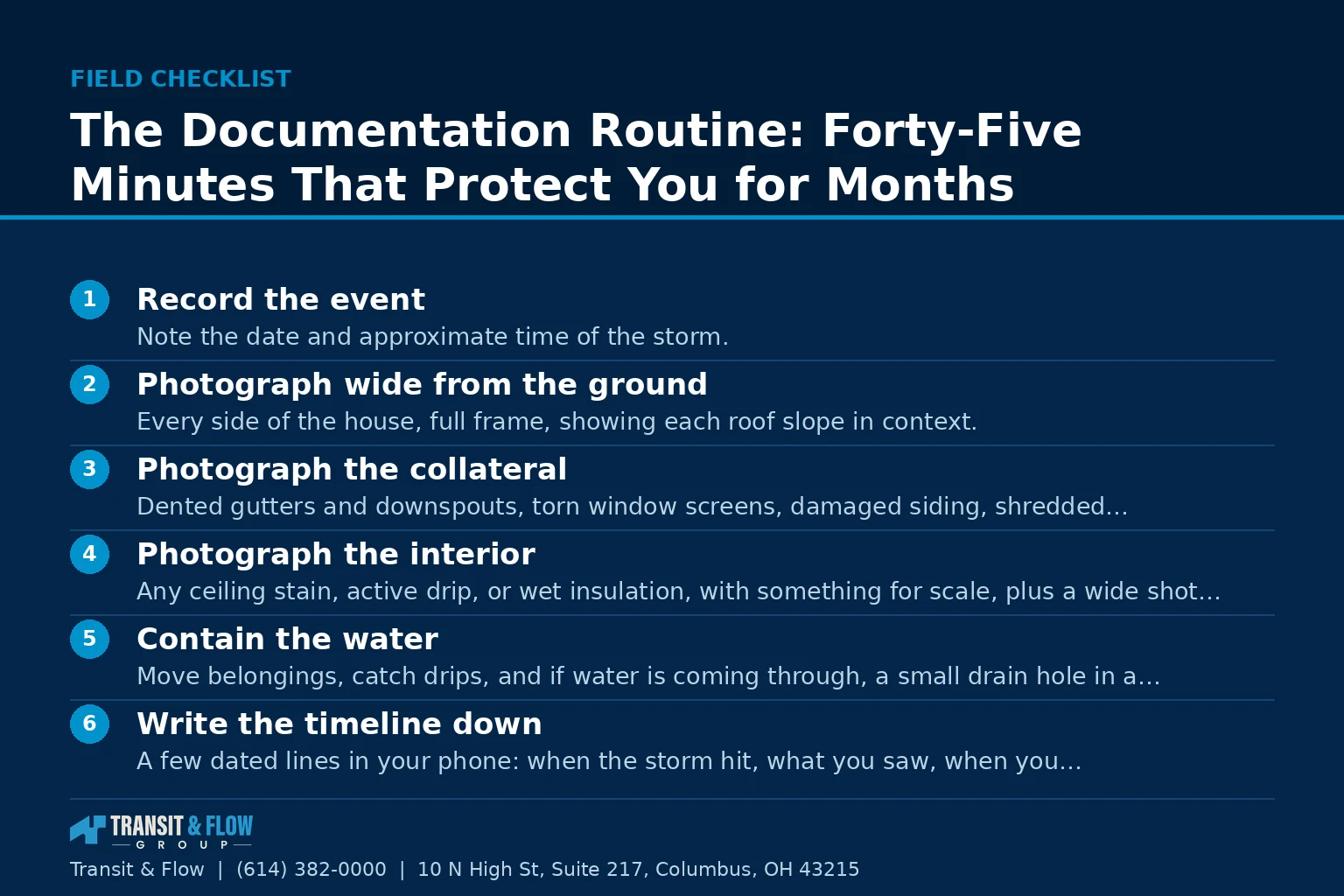
- Record the event. Note the date and approximate time of the storm. The National Weather Service office covering Central Ohio publishes storm reports and warnings; knowing when the event happened anchors everything else.
- Photograph wide from the ground. Every side of the house, full frame, showing each roof slope in context. Do not climb. Ground photos with a zoom lens or phone zoom are enough, and adjusters and contractors have their own ladder protocols.
- Photograph the collateral. Dented gutters and downspouts, torn window screens, damaged siding, shredded landscaping, hail on the ground next to a common object for scale. Collateral damage corroborates the roof damage and is routinely forgotten.
- Photograph the interior. Any ceiling stain, active drip, or wet insulation, with something for scale, plus a wide shot showing which room. Timestamped interior photos separate storm damage from pre-existing wear in later conversations.
- Contain the water. Move belongings, catch drips, and if water is coming through, a small drain hole in a bulging ceiling pocket releases it in a controlled way. Keep receipts for anything you buy to mitigate.
- Write the timeline down. A few dated lines in your phone: when the storm hit, what you saw, when you photographed, who you called. Memory fades faster than these processes move.
Emergency Cover, Done Right
If the roof is open to the weather, temporary cover is legitimate emergency work: tarping, board-over, and water diversion. Two rules keep it clean. First, photograph the damage before it is covered, because a tarp hides the evidence everyone later needs to see. Second, keep emergency stabilization separate from repair decisions. A tarp buys you weeks to make a good decision. It is not a commitment to whoever installed it, and a reputable emergency crew will say so in writing.
The Post-Storm Canvasser Problem
Severe weather brings out-of-town crews and door-to-door canvassers into Central Ohio neighborhoods within hours. Some are legitimate. The pattern to decline is pressure: sign today, exclusive inspection agreements, requests to handle everything if you just sign here. The Insurance Institute for Business and Home Safety and state consumer protection offices publish recurring warnings about post-storm contracting schemes for a reason. The test is simple and fair: any contractor worth hiring after a storm is worth hiring on the same verification you would do without one. Registration, insurance certificates, local references, written scope. A storm changes your roof, not your hiring standards. Our estimate reading guide applies in full.
About Insurance: Where This Guide Stops
Whether to file a claim, and how your policy responds, is a decision between you and your insurer, and this article deliberately offers no advice on it. What the documentation routine above does is preserve your options. Complete, dated evidence serves you in every path: a claim conversation, a repair negotiation, or a decision to handle the work directly. A contractor’s proper role in that process is honest documentation of the roof’s condition, not promises about claim outcomes, and you should be wary of anyone whose pitch is built on the claim rather than the roof.
After Stabilization: The Real Decision
Once the roof is dry and the pressure is off, the question becomes an ordinary one: repair or replace. Storm damage on a young roof usually means targeted repair with matching materials. Storm damage on a roof already deep into its lifespan often accelerates a replacement that was coming anyway, and the framework in our repair-or-replace guide walks through exactly that evaluation with evidence instead of adrenaline.
When Central Ohio Storms Actually Arrive
Storm damage in this region is seasonal, and knowing the rhythm lets you prepare the documentation habit before you need it rather than during it.
- Late winter into early spring. Freeze and thaw cycling, ice at the eaves, and the first line of gusty fronts. Damage from this window often shows up indoors as a stain weeks after the weather that caused it.
- Spring through early summer. The core severe weather season for Central Ohio, when hail and straight line wind are most likely. This is when the National Weather Service office covering the region issues the bulk of its warnings, and when canvassing crews arrive in the largest numbers.
- Midsummer. Isolated but intense afternoon storms, often with downbursts that hit a few streets hard and leave the next neighborhood untouched. Localized events are the ones most likely to be missed by a general area report, so your own dated photographs carry more weight.
- Autumn. Remnant tropical moisture and long soaking rain that finds every weakness a summer storm opened. Damage discovered now frequently originated months earlier, which is exactly why the timeline you wrote down matters.
The practical takeaway is to run the photo routine at the time of every notable event, not only when you already suspect damage. Evidence gathered before you needed it is the only evidence nobody can question later.
What Each Kind of Evidence Establishes
Not all documentation does the same work. Each type answers a different objection you may hear weeks later.
| Evidence | What it establishes | Common gap |
|---|---|---|
| Dated storm report for your area | That a qualifying weather event occurred and when | Captured after the fact from memory rather than at the time |
| Wide ground photos of every elevation | Context, orientation, and which slope is which | Only close ups exist, so nothing can be located on the roof |
| Collateral photos of gutters, screens, siding, landscaping | That the event had force at ground level, corroborating the roof | Cleaned up before it was photographed |
| Interior photos of stains, drips, wet insulation | That water entered, and roughly where | Taken after drying, when the evidence has faded |
| Pre-tarp photos | Condition before emergency cover concealed it | The tarp went on first because the crew was in a hurry |
| Written timeline and receipts | Sequence of events and mitigation effort | Reconstructed months later from memory |
Storm and Roofing Terms Worth Knowing
The vocabulary that appears in reports, scopes, and contractor conversations after a storm.
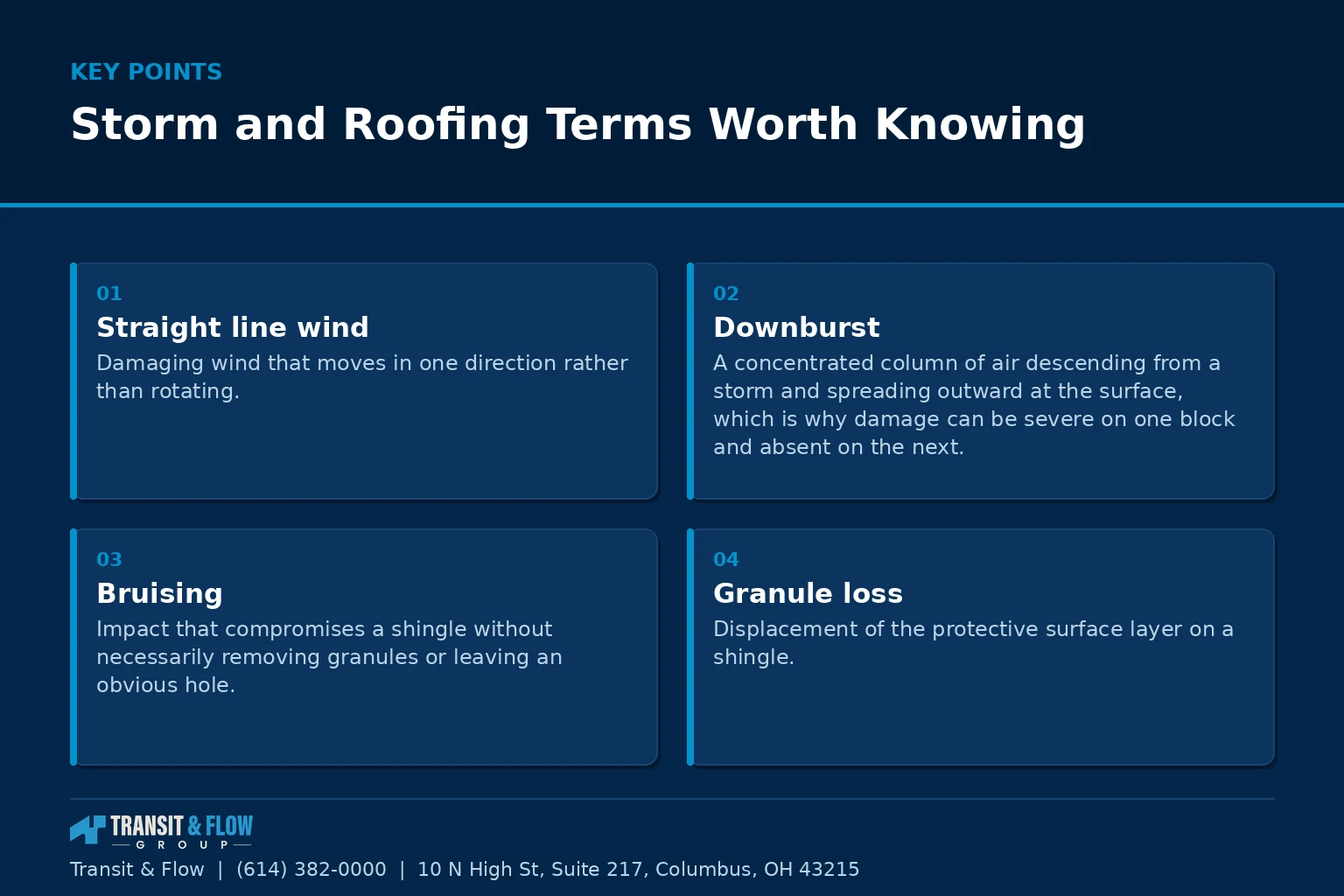
- Straight line wind. Damaging wind that moves in one direction rather than rotating. It accounts for far more Central Ohio roof damage than tornadoes do.
- Downburst. A concentrated column of air descending from a storm and spreading outward at the surface, which is why damage can be severe on one block and absent on the next.
- Bruising. Impact that compromises a shingle without necessarily removing granules or leaving an obvious hole. It is assessed by a qualified inspector rather than from the ground.
- Granule loss. Displacement of the protective surface layer on a shingle. Granules collecting at the downspout are worth photographing.
- Creased shingle. A shingle lifted and folded by wind, which may lie back down and look intact from below while no longer sealing.
- Uplift. Wind force pulling upward on the roof surface, concentrated at eaves, rakes, and ridges.
- Mitigation. Reasonable steps taken to prevent further damage after an event. Keep the receipts for whatever you buy to do it.
- Emergency stabilization. Temporary cover and water diversion, deliberately separate from any repair decision or contract.
- Scope of work. The written description of what a contractor will do, against which the finished job is judged.
- Adjuster. The party who inspects on behalf of an insurer. Your role is to have the evidence ready, not to interpret policy.
- Assignment of benefits. A document transferring certain rights to a contractor. Read anything with this effect carefully and unhurried, and take it to your own advisor before signing.
- Matching materials. Replacement components selected to blend with what remains on the roof, a factor in whether targeted repair is a reasonable path.
How Transit & Flow Group Handles Storm Calls
Transit & Flow Group coordinates projects and partners with properly licensed and insured specialty contractors when licensing is required. On storm calls across Columbus and Central Ohio, that means stabilization first, documentation you keep, and then an unhurried assessment of the roofing work actually needed, with no exclusive agreements and no pressure to decide on the driveway. If your roof just took a hit, contact us, run the photo routine above while you wait, and keep every image.
Frequently Asked Questions
What should I do first after a storm damages my roof?
Safety comes before documentation. If a tree or large limb is on the structure, if power lines are down anywhere near the house, or if a ceiling is sagging under trapped water, get people out and call emergency services and your utility. Those situations belong to the people equipped for them, and nothing else matters until they are handled. Once the dangerous cases are resolved, the documentation routine is what protects you through the months of process that follow.
Should I climb onto the roof to photograph the damage?
No. Ground level photographs taken with a zoom lens or phone zoom are enough for the record you need, and contractors and adjusters have their own ladder protocols for the close inspection. Shoot every side of the house full frame so each slope appears in context, and do it the same day when it is safe. Wide to tight, dated, and taken before anything was moved is what makes the evidence useful later.
What should I photograph besides the roof itself?
The collateral and the interior, both of which get forgotten. Dented gutters and downspouts, torn window screens, damaged siding, shredded landscaping, and hail on the ground next to a common object for scale all corroborate the roof damage. Inside, capture any ceiling stain, active drip, or wet insulation with something for scale plus a wide shot showing which room. Timestamped interior photos are what separate storm damage from pre-existing wear in later conversations.
Does accepting an emergency tarp commit me to that contractor?
It should not. Temporary cover such as tarping, board over, and water diversion is legitimate emergency stabilization, and a reputable emergency crew will confirm in writing that it is separate from any repair decision. Photograph the damage before it is covered, because a tarp hides the evidence everyone needs to see afterward. A tarp buys weeks to make a considered decision rather than a commitment made in the driveway.
How should I handle a contractor who knocks on the door after a storm?
Apply the same hiring standard you would use in ordinary weather. Some post-storm crews are legitimate, but the pattern to decline is pressure: sign today, exclusive inspection agreements, and offers to handle everything if you just sign here. Ask for registration, insurance certificates, local references, and a written scope, and verify them before anything is signed. A storm changes your roof, not your hiring standards.
Does storm damage mean the whole roof has to be replaced?
Not necessarily, and that decision belongs after stabilization rather than during it. Damage on a young roof usually points toward targeted repair with matching materials, while damage on a roof already deep into its service life often accelerates a replacement that was already coming. The evaluation should be made with photographs and a written assessment from a qualified roofing contractor, once the roof is dry and the pressure is off.
Sources
- National Weather Service, Wilmington Ohio office, storm reports and warnings for Central Ohio
- Insurance Institute for Business and Home Safety, roof damage research and post-storm guidance
- National Roofing Contractors Association, repair and installation standards
About This Guide
Written and edited by Micheal Parker, founder of Transit & Flow Group. Published September 2, 2026. This guide is checked against the agency and code sources listed above, and it is revised when those sources change.
General contractor of record. Micheal Parker holds City of Columbus General Contractor Registration G12064, issued by the Columbus Department of Building and Zoning Services under Transit & Flow LLC and valid through June 30, 2027. Trade work that falls outside the scope of that registration is performed by licensed trade partners, and the responsible license holder is identified before work begins.
Transit & Flow Group, home and commercial services for Columbus and the surrounding Central Ohio communities. Phone (614) 382-0000. Email solutions@transitflowgroup.com. 10 N. High St., Suite 217, Columbus, OH 43215. Contact our team or review the communities we serve.
