

New concrete is not finished when the crew leaves. The first days after placement determine how the surface holds up for decades, and what happens in that window is moisture management, not waiting. Curing keeps water in the slab so cement can keep reacting. Drying is a separate, slower process. The owner controls traffic, protection, deicer exposure, and drainage, and those four choices decide whether a Central Ohio slab looks the same in year ten.
In This Guide
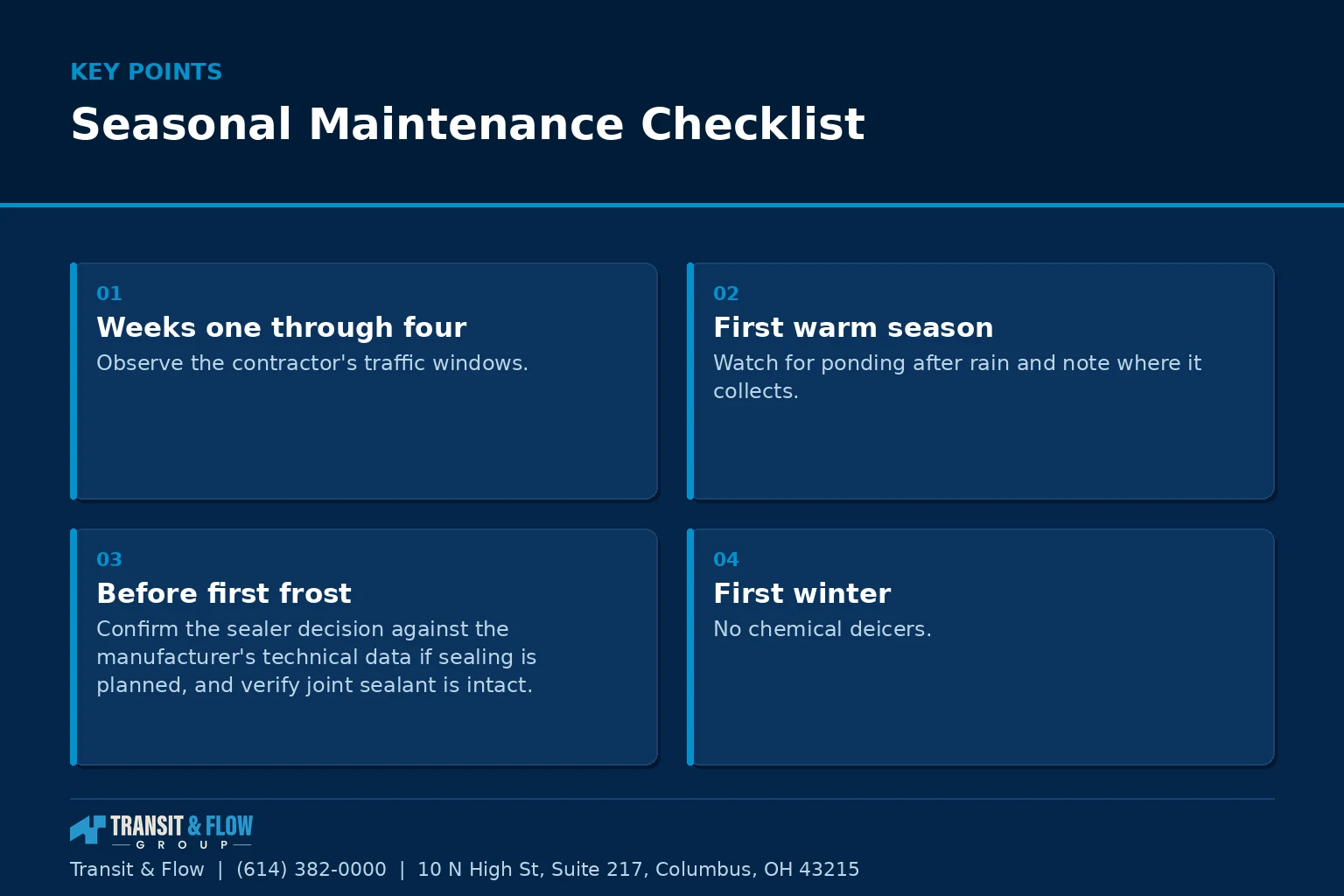
- Setting, Curing, and Drying Are Three Different Things
- Why the First Days Set the Ceiling on Durability
- Hot and Cold Weather Placement in Central Ohio
- When Traffic Can Return
- Efflorescence Is Normal and Usually Temporary
- The Sealer Question
- Deicers Are the Most Damaging Thing an Owner Does
- Snow Removal That Does Not Gouge the Slab
- Drainage Is the Long Term Variable
- Seasonal Maintenance Checklist
- The Decision
- Where Transit & Flow Group Fits
- Frequently Asked Questions
Here is what most Central Ohio property owners get wrong. They treat the first winter as a test the slab passes or fails on its own, then reach for rock salt the first time the driveway gets slick. A slab that has not been through a full seasonal cycle is most vulnerable exactly when the temptation to apply deicer is highest, and surface scaling from that first winter is permanent. It does not heal in spring.
Setting, Curing, and Drying Are Three Different Things
Setting is the transition from a plastic, workable material to a rigid one. It takes hours and it determines when the crew can trowel, broom, or stamp. Setting tells you the slab holds its shape. It tells you almost nothing about strength.
Curing is the deliberate maintenance of moisture and temperature so cement can keep hydrating. Cement gains strength by chemically combining with water. If surface water leaves before that reaction has run far enough, the top layer stops gaining strength while the concrete below continues. That is how you get a slab that is structurally fine and a surface that dusts, scales, and crazes.
Drying is the slow loss of free moisture afterward, and it continues for months. It matters for coatings and adhesives. It does not indicate strength, and it is what people confuse with curing when they assume a slab that looks dry is done. The curing duration and method for your slab depend on the mix design, placement conditions, and intended use, and your mix supplier and placing contractor state those specifics.
Why the First Days Set the Ceiling on Durability
The wearing surface is the thinnest, most exposed part of a slab, and it dries first. Scaling, spalling, dusting, and map cracking all originate in the condition of that top layer during the first several days. Once it has been compromised by premature moisture loss, no later treatment restores it. Sealers slow further damage and densifiers harden a weak surface somewhat, but neither undoes under curing.
Central Ohio adds a complication. The region gets hot, humid summer placements and cold, windy shoulder season placements, sometimes in the same scheduling month. Wind is the underrated variable. A mild day with sustained wind and low humidity pulls surface moisture faster than a still, hot one.
Hot and Cold Weather Placement in Central Ohio
Placement is governed by air temperature, concrete temperature, humidity, wind speed, and solar exposure acting together. Those factors drive the evaporation rate from the surface, which is the number that matters. Thresholds and required protective measures come from the mix supplier and the placing contractor, who are looking at the specific mix and forecast.
- Evaporation rate, not air temperature. A cool, dry, windy day can be harder on a fresh surface than a warm, humid, still one.
- Wind protection. Temporary windbreaks reduce surface evaporation during finishing and cost almost nothing.
- Evaporation retarders and fogging. Used during finishing in hot or windy conditions to hold surface moisture. These are finishing aids, not curing.
- Curing compounds, wet curing, and coverings. Membrane compounds, wet burlap, and sheeting maintain moisture differently, and the choice interacts with whether the slab will later be sealed.
- Insulating blankets in cold weather. Concrete generates heat as it hydrates and blankets retain it. Freezing before the slab has gained enough strength causes permanent internal damage.
- Subgrade condition. Placing on frozen or saturated ground creates settlement that surfaces later, and Central Ohio clay holds water long after the rain stops.
- Protection duration. Set by the mix and conditions. Pulling coverings early to move a schedule has permanent consequences.
When Traffic Can Return
Foot and vehicle traffic are separated by a wide margin, and both are ranges rather than fixed numbers. Concrete gains strength on a curve that flattens over time, and its position on that curve depends on the mix, the curing temperature, and whether curing was maintained.
Foot traffic returns first and carries lower risk because the load is light and distributed. Vehicles are a different problem. A parked car concentrates load at four small contact patches, and turning a steered wheel while stationary applies twisting force directly to the surface. That is the most common cause of early driveway damage.
- Mix design. Cement content, water to cement ratio, and admixtures move the strength gain curve substantially.
- Curing temperature. Strength gain slows sharply as temperature drops. A late October placement and a July placement are not on the same schedule.
- Whether curing was maintained. A slab that lost moisture early may never reach the strength the mix was designed for at the surface.
- Thickness and subgrade support. Both change how load distributes and how much surface stress a wheel creates.
- Load type. A car, a loaded pickup, a delivery truck, and a dumpster are four different problems, and the last two damage driveways that were fine under normal use.
- Steering while parked. Dry steering concentrates torsional stress on a surface below full strength and leaves visible scuffing.
Ask the placing contractor for your slab’s specific windows in writing, tied to the mix and the placement date.
Efflorescence Is Normal and Usually Temporary
Efflorescence is the white deposit that appears on new concrete, often after the first wet and dry cycle. Water moving through the slab dissolves soluble salts, carries them to the surface, and evaporates, leaving the salts behind. It is moisture transport, not a defect.
It is most visible in the first year and typically diminishes as available salts deplete. Recurring efflorescence in one spot usually means water is moving through the slab from below, which points back at drainage. Aggressive scrubbing or acid washing a new slab can etch the surface and do more harm than the deposit did, and if treatment is warranted the product manufacturer’s technical data governs method and dilution.
The Sealer Question
The two main categories behave completely differently. Timing, surface preparation, and coverage rate come from the sealer manufacturer’s technical data sheet. Sealing too early can trap moisture and cause the sealer itself to fail.
| Factor | Penetrating sealer | Film forming sealer |
|---|---|---|
| How it works | Reacts within surface pores | Coating blocks water at the surface |
| Appearance | Little to no change | Matte to high gloss, often wet look |
| Traction | Texture preserved | Slick when wet unless grit is added |
| Vapor movement | Slab still breathes | Restricted, a problem with moisture from below |
| Failure mode | Wears off gradually | Peels or clouds, needs stripping |
| Typical use | Driveways and walks | Decorative, stamped, colored surfaces |
| Recoat cycle | Longer, driven by wear | Shorter, more preparation each time |
Sealer interacts with the finish. A broom finish exists to provide traction, and a film forming sealer can partially fill that texture. On a sloped Central Ohio driveway that ices over, that is a safety issue, not a cosmetic one. If a film forming product goes on a traffic surface, the grit additive is not optional.
One more constraint. Some curing compounds are incompatible with some sealers, so whoever specifies the sealer needs to know what was used for curing.
Deicers Are the Most Damaging Thing an Owner Does
Take one operational rule from this article and take this one. Deicing chemicals on a first winter slab are the most common cause of premature surface failure on new concrete in Central Ohio, and the damage is not reversible.
The mechanism is physical and chemical at once. Deicers dissolve into meltwater, that solution saturates surface pores, and it refreezes overnight. Each cycle expands water inside the near surface pore structure. A new slab has not developed full surface strength, so it absorbs more and resists less. Some deicer chemistries also react with cement paste directly, a separate damage path.
- Sand for traction instead of chemistry. Clean sand provides grip without introducing salts into the pore structure, and it sweeps up in spring.
- Watch what arrives on tires. Road salt tracked in from treated public streets is a real exposure path, and rinsing during a thaw reduces it.
- Fertilizer is not a deicer. Ammonium based products sold as ice melt are aggressive toward concrete and belong on no slab.
- Read the technical data, not the bag front. Chemistry, concentration, and any concrete compatibility statement come from the manufacturer.
- Mechanical removal first. Clearing snow promptly means less compaction, less refreeze, and less reason to reach for chemicals at all.
- Shade and drainage drive the icing. Areas that ice repeatedly are where water sits or sun never reaches, and fixing drainage removes the need for treatment.
- The first season is the strict one. Practices you may relax on a mature sealed slab are not appropriate in a first winter.
Snow Removal That Does Not Gouge the Slab
Removal technique damages new concrete in avoidable ways. Steel edges dropped hard on a green surface, plow blades catching joints, and blower housings riding on the slab all leave marks that never come out.
- Use plastic or poly edged tools. Metal shovel edges chip surface paste and catch on control joints.
- Set blower skid shoes high. A blower riding on concrete scars it in straight lines you will see every summer.
- Mark the slab edges before first snow. Plow operators cannot see where concrete ends and turf begins, and edges chip.
- Brief any plow service in writing. Specify that the slab is new, no chemical deicers, and shoe height. Commercial crews rotate operators.
- Do not pile snow on the slab. Piled snow melts, refreezes, and holds saturation against the surface.
- Push rather than scrape. Leaving a thin layer to melt off beats chasing bare pavement with a hard edge.
Drainage Is the Long Term Variable
Standing water on or beside a slab turns ordinary freeze and thaw into surface destruction. Central Ohio clay drains slowly, spring rainfall is sustained, and the region cycles above and below freezing repeatedly through winter rather than staying frozen. That cycling is what makes saturation damaging here.
Look for three things after the first heavy rains. Water ponding on the slab rather than running off. Soil eroding or settling along the edge, which lets water sit against it. And downspout discharge landing on or beside the new concrete, the most common self inflicted version of the problem. Our guidance on grading and downspout discharge applies directly. Failed joint sealant matters too, since it lets water reach the subgrade.
Seasonal Maintenance Checklist
First Year
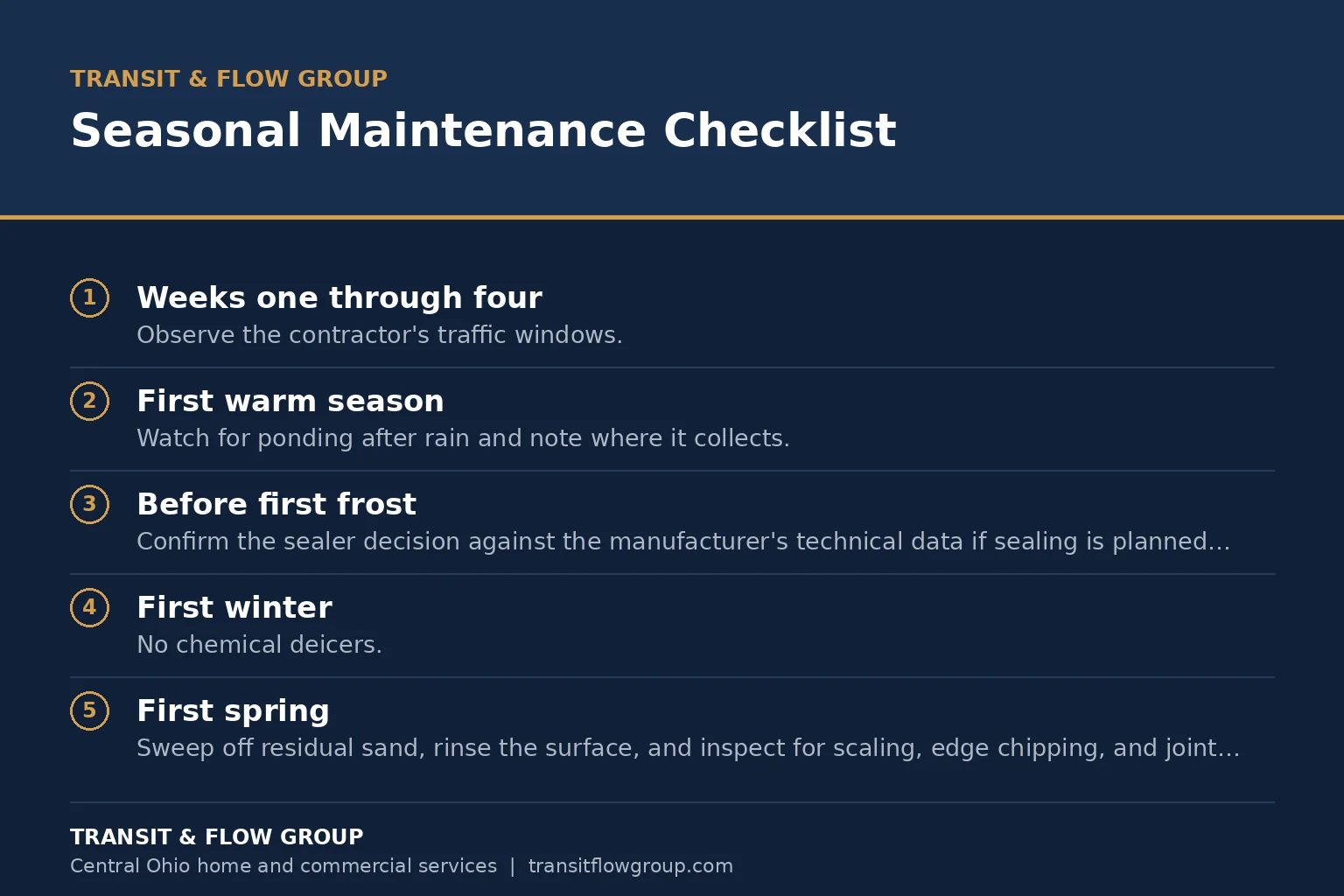
- Weeks one through four. Observe the contractor’s traffic windows. Keep heavy loads, dumpsters, and delivery trucks off. No dry steering.
- First warm season. Watch for ponding after rain and note where it collects. Keep downspout discharge directed away from the slab.
- Before first frost. Confirm the sealer decision against the manufacturer’s technical data if sealing is planned, and verify joint sealant is intact.
- First winter. No chemical deicers. Sand for traction. Plastic edged tools. Snow pushed off rather than piled on.
- First spring. Sweep off residual sand, rinse the surface, and inspect for scaling, edge chipping, and joint movement while the evidence is fresh.
Ongoing
- Every spring. Full walkaround covering joints, edges, drainage, and surface condition, documented with photos.
- Every fall. Clear debris from joints and edges, confirm gutters move water away, and stage sand early.
- Sealer recoat. Driven by product and exposure, not the calendar. The manufacturer’s data states interval and preparation.
- Joint sealant. Inspect annually. Sealant fails long before concrete does and is inexpensive to renew.
- After heavy equipment. Inspect for cracking after a dumpster, moving truck, or construction delivery has been on the slab.
- Watch the transitions. Slab to asphalt, slab to step, and slab to garage floor are where movement shows first.
This rhythm fits into broader property upkeep, and our October winterizing checklist for Central Ohio properties covers the timing.
The Decision
Option A. Treat the slab as finished when the crew leaves, resume normal use on a guess, seal it when a flyer arrives, and salt it the first time it gets slick.
Option B. Get the curing method, protection duration, and foot and vehicle traffic windows in writing from the placing contractor before placement day. Take sealer timing and product from the manufacturer’s technical data rather than from a bag. Commit to a first winter with no chemical deicers and sand for traction. Fix drainage in the first warm season while it is cheap.
Recommendation: Option B, and the deicer commitment is the highest value item on the list. Everything in Option B costs a few conversations, a bag of sand, and one afternoon of drainage work. Scaling from a first winter of salt cannot be repaired, only overlaid or replaced, and it shows up in year one on a slab meant to last thirty. The second highest value item is the written traffic window, because early vehicle loading and dry steering produce damage owners then blame on the concrete rather than the schedule.
Where Transit & Flow Group Fits
We coordinate exterior concrete work across Central Ohio, and the curing and protection plan is defined before placement rather than improvised on the day. The forecast is evaluated against the mix, protection method and duration are specified, traffic windows are delivered in writing, and drainage around the slab is addressed as part of the project rather than left for the owner to find in April. If you are planning new concrete or protecting a slab through its first season, start a conversation with our team. Our guidance on winter exterior maintenance for commercial properties and our spring exterior inspection walkaround help build the annual routine.
Transit & Flow Group coordinates projects and partners with properly licensed and insured specialty contractors when licensing is required, and work is performed under the appropriate permits.
Frequently Asked Questions
What is the difference between curing and drying
Drying is water leaving the surface. Curing is the chemical process that builds strength, and it requires moisture to continue. Concrete that dries too fast stops gaining strength at the surface, which is where scaling and dusting later show up. Curing is an active step, not the absence of one.
When can I drive on a new concrete driveway
Wait for the contractor to specify a time based on the mix, the thickness, and the conditions during placement rather than a generic number. Early loading, especially by heavy vehicles turning on the surface, is a common and avoidable cause of cracking on new residential slabs.
Should I seal new concrete right away
Sealer timing depends on the product and on how the slab was cured, and applying too early can trap moisture. Follow the manufacturer technical data for the specific product and the contractor recommendation for the specific slab, and treat the two together rather than sealing on a calendar.
Are deicing salts bad for concrete
Deicers increase the number of freeze and thaw cycles a surface experiences and can drive moisture into the surface, which is the mechanism behind scaling. New concrete is the most vulnerable. Mechanical removal and traction material carry far less risk during the first winter.
What causes surface scaling and flaking
Scaling generally comes from a surface that never gained full strength combined with saturation and freezing. Finishing water into the surface, insufficient curing, and early deicer exposure are the usual contributors. It is a surface layer failure rather than a sign the whole slab is bad.
Does drainage matter for concrete durability
Considerably. Water that stands on or beside a slab is the raw material for freeze and thaw damage and for base erosion underneath. Grading the surrounding surface so water leaves the slab is one of the higher leverage moves for long term durability in an Ohio climate.
Sources
- NIST Engineering Laboratory, cement hydration and concrete materials research
- Federal Highway Administration, concrete pavement curing, durability, and deicer performance
- National Weather Service, Wilmington Ohio, forecast and freeze data for Central Ohio
- U.S. Environmental Protection Agency, stormwater runoff and drainage practices
- International Code Council, Ohio adopted code documents
About This Guide
Written and edited by Micheal Parker, founder of Transit & Flow Group. Published May 19, 2027. This guide is checked against the agency and code sources listed above, and it is revised when those sources change.
General contractor of record. Micheal Parker holds City of Columbus General Contractor Registration G12064, issued by the Columbus Department of Building and Zoning Services under Transit & Flow LLC and valid through June 30, 2027. Trade work that falls outside the scope of that registration is performed by licensed trade partners, and the responsible license holder is identified before work begins.
Transit & Flow Group, home and commercial services for Columbus and the surrounding Central Ohio communities. Phone (614) 382-0000. Email solutions@transitflowgroup.com. 10 N High St, Suite 217, Columbus, OH 43215. Contact our team or review the communities we serve.
