

Resurfacing is the right call when the slab underneath is sound, stable, and at an elevation that still works. Replacement is right when it is not. Everything else is detail. The governing principle is simple and unforgiving: a surface treatment inherits every problem underneath it, and no overlay, coating, or topping has ever fixed a slab that was still moving.
In This Guide
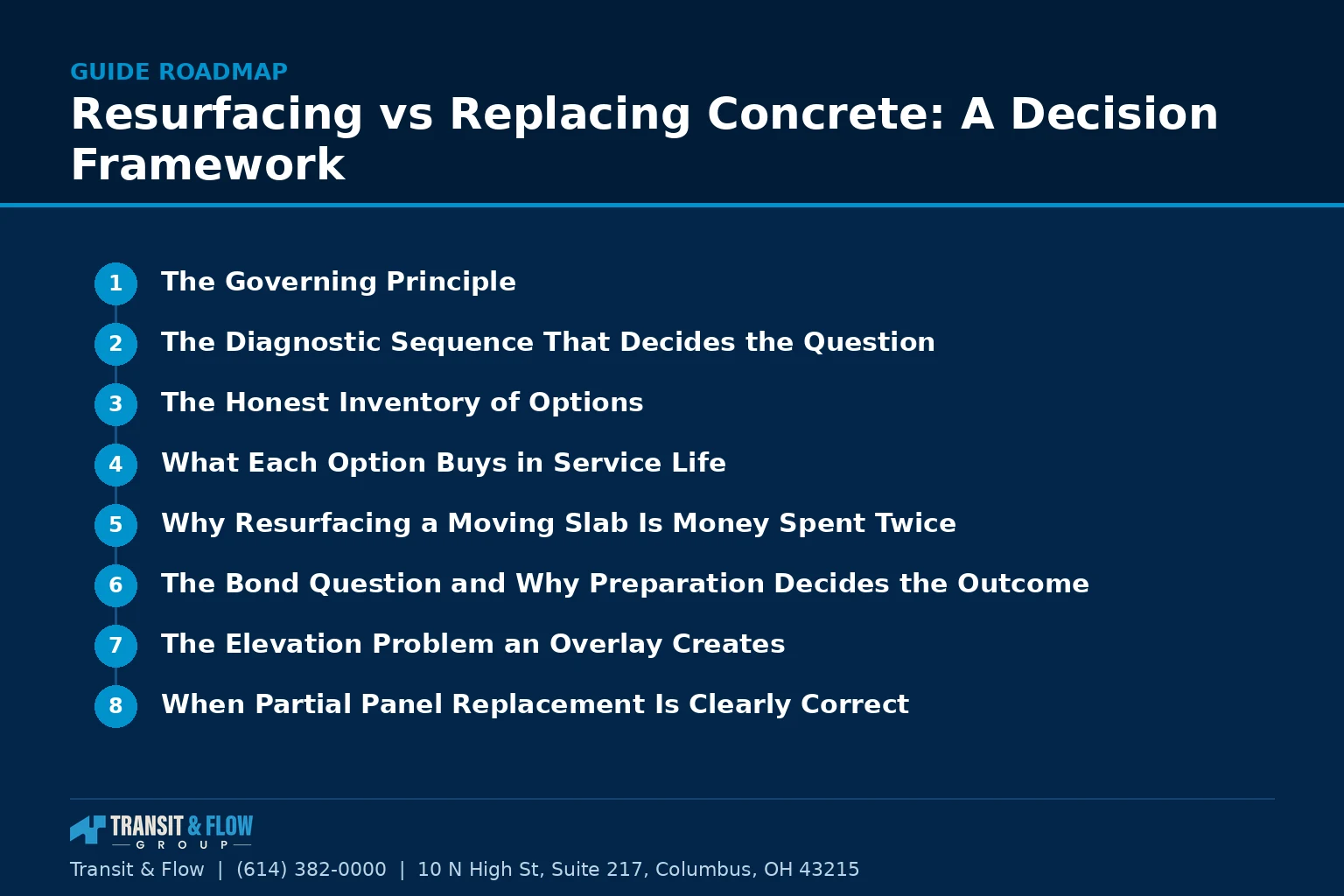
- The Governing Principle
- The Diagnostic Sequence That Decides the Question
- The Honest Inventory of Options
- What Each Option Buys in Service Life
- Why Resurfacing a Moving Slab Is Money Spent Twice
- The Bond Question and Why Preparation Decides the Outcome
- The Elevation Problem an Overlay Creates
- When Partial Panel Replacement Is Clearly Correct
- Cost Factors That Actually Move the Number
- Age and Remaining Life on the Rest of the Property
- The Decision
- Where Transit & Flow Group Fits
- Frequently Asked Questions
Here is what most Central Ohio property owners get wrong. They evaluate the decision by looking at the surface, because the surface is what they can see and what bothers them. Spalling, scaling, crazing, and staining are surface symptoms, and they are also the symptoms most easily produced by problems that have nothing to do with the surface. Run the sequence the other direction. Establish what the slab and the soil beneath it are doing first, and only then does the top inch matter.
The Governing Principle
Concrete flatwork is a system with three parts: the subgrade that carries load, the slab that distributes it, and the wearing surface that takes abuse. A resurfacing product replaces the third only.
So the diagnostic question is not how bad it looks. It is what is causing the damage, and whether that cause will still be operating after the new surface goes down. If it will, the overlay is a cosmetic delay at a real price, and the problem returns on its schedule, not yours.
The Diagnostic Sequence That Decides the Question
Run these four in order. Each can end the decision on its own, and running them out of order is how owners talk themselves into overlays that fail.
One: Is the Slab Structurally Sound
A sound slab is continuous, carries load without deflection, and is not broken into pieces that move independently. The tells are cracks with vertical displacement between the two sides, sections that rock under load, hollow sound across a broad area, and cracking through the full thickness. A slab already in pieces is a base, not a substrate.
Two: Is the Subgrade Still Supporting It
This decides most Central Ohio cases and is the one most often skipped. Much of the region sits on dense glacial till with high clay content, which shrinks in dry summers, swells when it takes on water, and drains slowly enough that water against a slab edge lingers. Add the freeze and thaw cycling Central Ohio delivers from December through March and the subgrade changes volume seasonally.
The evidence is visible if you know where to look. Voids produce a hollow ring and localized settlement. Panels dropped relative to their neighbors indicate support that is no longer uniform. Erosion at the slab edge, downspouts discharging alongside it, and long-overwhelmed gutters all point at water moving fines out from underneath. If support is still being lost, no surface treatment survives it.
Three: Is the Distress Surface Only or Full Depth
Surface distress lives in the top layer and stops there. Scaling, where the finish flakes off in sheets, and crazing, the fine map cracking that looks like dried mud, are usually surface-limited and usually trace back to finishing practice, curing, or deicing salt. That profile is the strongest case for an overlay that exists.
Full depth distress is different in kind. Cracks visible on both the top and the exposed edge, spalling that exposes aggregate and reinforcement, and joint faces deteriorated through the slab thickness mean the concrete itself has failed. The practical test: surface distress can be ground away to reach sound material at modest depth, full depth distress cannot, because there is no sound material to reach.
Four: Do the Elevations Still Work
Even a sound, stable slab is the wrong candidate if elevations are tight. Two things matter: drainage, meaning water still runs away from the structure rather than pooling, and clearance at door thresholds, garage openings, step risers, and adjacent surfaces. An overlay adds thickness, and thickness has to go somewhere.
The Honest Inventory of Options
These are the real choices, in ascending order of cost and disruption. The correct answer is very often further down this list than the owner expects and further up than the contractor proposes.
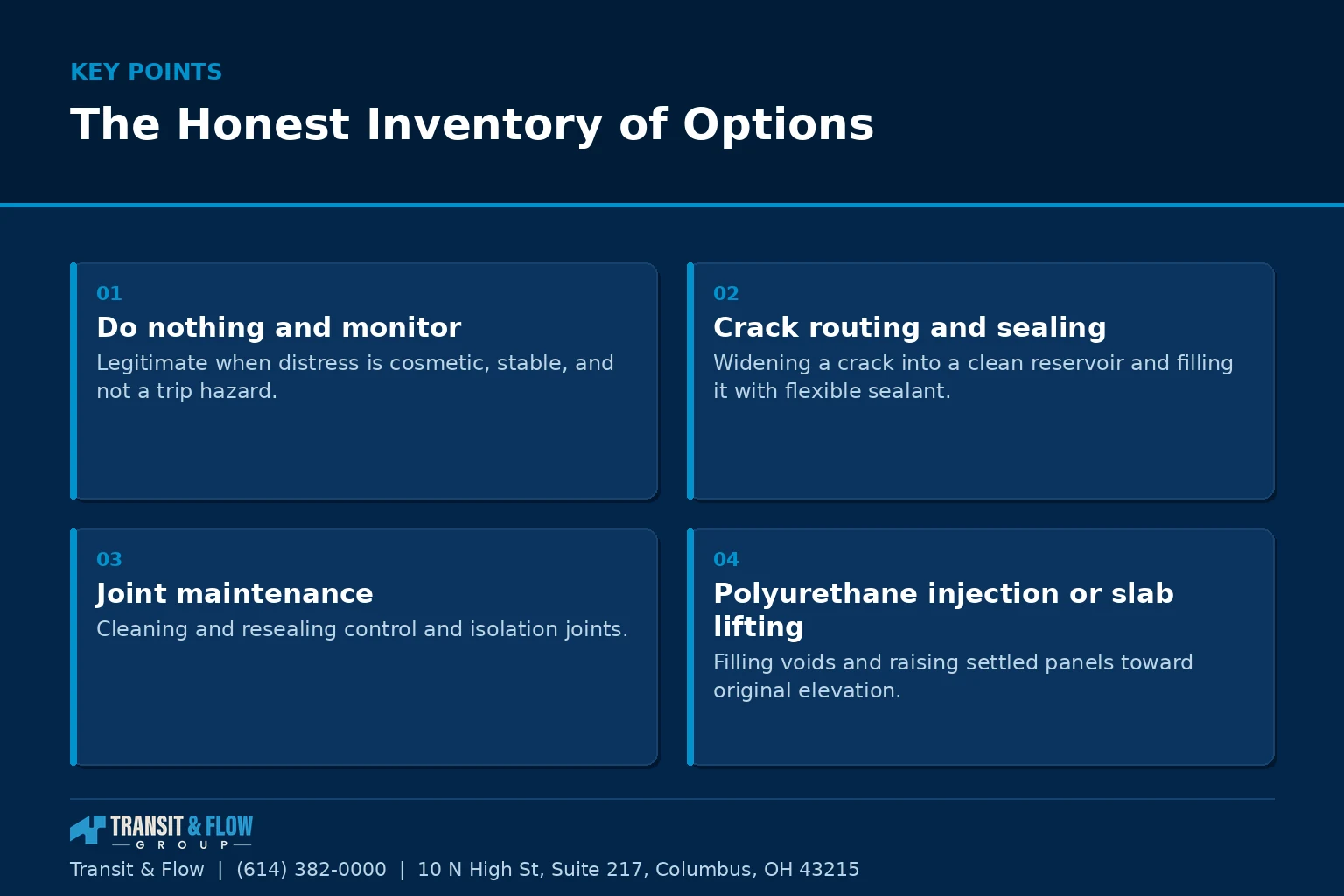
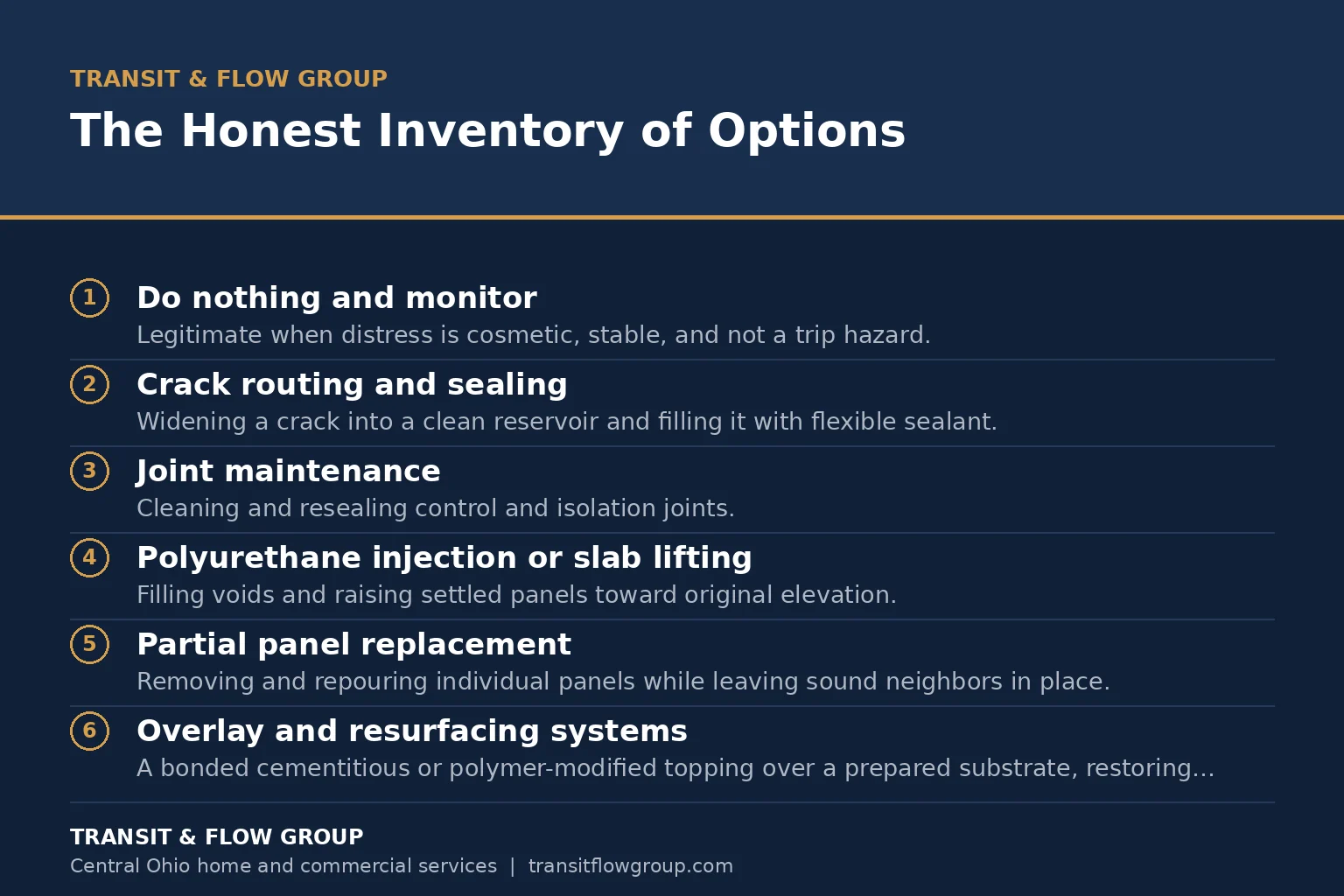
- Do nothing and monitor. Legitimate when distress is cosmetic, stable, and not a trip hazard. Photograph conditions, mark crack widths with a date, reassess after two freeze and thaw seasons.
- Crack routing and sealing. Widening a crack into a clean reservoir and filling it with flexible sealant. It does not restore structural continuity. It keeps water out, which in a climate that freezes is frequently the entire point.
- Joint maintenance. Cleaning and resealing control and isolation joints. The least glamorous item here and the one with the best return, because open joints are the primary route water takes to the subgrade.
- Polyurethane injection or slab lifting. Filling voids and raising settled panels toward original elevation. Appropriate when the slab is intact but has dropped, and only after the water source is corrected.
- Partial panel replacement. Removing and repouring individual panels while leaving sound neighbors in place.
- Overlay and resurfacing systems. A bonded cementitious or polymer-modified topping over a prepared substrate, restoring the wearing surface on a slab that is sound and stable.
- Full removal and replacement. Demolition, subgrade correction, and a new slab. The only option that addresses all three parts of the system at once.
What Each Option Buys in Service Life
Dollars are the wrong unit for comparing these. Service life on the correct substrate is the right one, because an option applied to the wrong conditions lasts a few seasons regardless of what it cost.
| Option | What it actually addresses | Service life it buys | What voids it |
|---|---|---|---|
| Monitor | Nothing, by design | Time and information, not life | A trip hazard or accelerating movement |
| Crack sealing | Water entry at the crack | Years, renewable indefinitely | Continued movement across the crack |
| Joint maintenance | Water entry at joints | Years, renewable, extends slab life | Joints spalled through their faces |
| Slab lifting | Voids and lost elevation | Long, if the water source was corrected | An uncorrected downspout or grade |
| Partial panel replacement | The failed panels only | Full new slab life on those panels | A subgrade problem spanning the area |
| Overlay | The wearing surface | Meaningful on a sound, stable, dry substrate | Movement, moisture from below, poor prep |
| Full replacement | All three parts at once | Longest available | Skipping the subgrade work |
Why Resurfacing a Moving Slab Is Money Spent Twice
An overlay is thin relative to the slab it sits on and bonded to it. Whatever the slab does, the overlay does. If two sides of a crack move relative to each other, that movement transmits straight through and the crack reflects to the new surface, usually within the first full seasonal cycle.
The financial shape is what makes it painful. You pay for the overlay, watch it fail, then pay for the replacement you were avoiding plus removal. Stability has to be settled before the overlay question is asked, and the honest answer sometimes requires watching the slab through a Central Ohio winter rather than deciding in October.
The Bond Question and Why Preparation Decides the Outcome
Assume the slab is genuinely sound and stable. The overlay can still fail, and the cause is almost always the bond. A separated overlay delaminates in sheets and sounds hollow under a tap, failing at the interface rather than within the material.
Bond depends entirely on the surface it is bonding to. Preparation is the work, and it is the line item cut when an overlay bid comes in surprisingly low.
- Removal of everything unsound. Laitance, curing compounds, sealers, previous coatings, oil, and salt residue all prevent bond and none of them are visible as separate layers.
- Mechanical surface profiling. Grinding or shot blasting opens texture for the overlay to grip. Chemical cleaning alone does not create profile.
- Substrate moisture condition. The slab has to be at the moisture state the manufacturer specifies, not whatever it happens to be that morning.
- Temperature window at placement and cure. Every system has one, and in Columbus it rules out large portions of the calendar on both ends.
- Edge and termination detailing. Overlays fail first at edges, thresholds, and joints, where the thin leading edge is exposed to traffic and water.
- The manufacturer’s data sheet for the exact product. Required profile, thickness limits, moisture limits, and bond expectations come from there and differ substantially between systems. A contractor who cannot produce it cannot warrant the result.
The Elevation Problem an Overlay Creates
Every overlay raises the finished surface. On an open patio that is irrelevant. Everywhere the flatwork meets something else it matters, and this is the constraint owners discover after the work is done.
Three failure modes recur. A door that cleared the old surface now catches at its threshold. A uniform step riser becomes short by the overlay thickness at the top or bottom of a flight, producing exactly the small inconsistency people trip on. And marginal drainage reverses, because raising a slab at the house edge reduces the fall away from the structure. Given how much of Central Ohio is flat to gently rolling, marginal drainage is the normal starting condition, and spring rainfall here will find the reversal. Where that starts interacting with a foundation, our guidance on when foundation cracking warrants an engineer is the right next read.
When Partial Panel Replacement Is Clearly Correct
Concrete flatwork is not one monolithic surface. It is jointed into panels, and those joints exist to let panels behave independently. That geometry is what makes partial replacement a real option rather than a compromise.
It is the clear answer when distress is confined to identifiable panels with sound joints around them, when those panels have a local cause such as a downspout discharge, and when the remaining panels have life left. You remove to the joint lines, correct the subgrade in that footprint, and pour new independent panels.
The honest tradeoff is appearance. New concrete will not match neighbors that have weathered fifteen years, and it will not blend later either. That preference legitimately pushes some owners toward full replacement even when partial replacement is technically sufficient.
Cost Factors That Actually Move the Number
No dollar figures appear here because they would be stale by the time you read them. These are the variables that determine where a project lands, and the ones to discuss with anyone quoting the work.
- Access for equipment and trucks. Whether a truck can reach the pour or material has to move by buggy or pump is frequently the largest swing factor on residential flatwork.
- Demolition and disposal volume. Replacement generates tonnage to break out, haul, and tip, scaling with slab thickness and reinforcement.
- Subgrade correction scope. Whether the base is reusable or requires excavation, undercutting, and imported stone changes replacement cost more than the concrete itself does.
- Surface preparation intensity for overlays. Profiling an entire surface is skilled labor with real equipment cost, and cutting it is how overlays get cheap and fail.
- Drainage and grading work. Correcting downspout discharge or regrading an edge is often what makes any of the other options durable.
- Season and cure conditions. Cold weather placement requires protection, hot dry conditions require curing measures, and both are non-negotiable.
- Jurisdiction and permitting. Franklin County contains Columbus plus municipalities including Dublin, Westerville, Hilliard, and Grove City along with unincorporated townships, and requirements for flatwork in the right of way differ among them.
Age and Remaining Life on the Rest of the Property
The slab in front of you is not the only variable. If the driveway is thirty years old and the adjacent walkway, steps, and apron are the same age and condition, resurfacing one piece of that system is a partial answer to a whole-system question, and you will be back for the rest within a few years.
The reverse holds too. If the flatwork is fifteen years old and everything around it is sound, an overlay buying another decade on a stable substrate is rational. Match the horizon of the fix to the horizon of the property. The same logic drives the repair or replace framework for an aging roof and the parallel furnace repair or replace framework.
The Decision
Option A. Resurface. Install a bonded overlay system over the existing slab, restoring the wearing surface and appearance at lower cost and with less disruption.
Option B. Remove and replace, correcting the subgrade and drainage in the same operation and starting the service clock over.
Recommendation: Option A only when all four diagnostic questions clear, and Option B whenever the second one does not. Resurfacing is a legitimate, durable choice on a slab that is sound, stable, free of full depth distress, and sitting at an elevation with room to spare. That combination is real and not rare. But the failure mode is asymmetric. A replacement that was not strictly necessary still delivers a new slab with a full service life. An overlay over a moving slab delivers nothing and costs you the replacement anyway, plus removal. When the subgrade answer is uncertain, do not split the difference. Correct the water, watch the slab through one freeze and thaw cycle, and decide with information rather than optimism.
Where Transit & Flow Group Fits
We coordinate concrete flatwork projects across Central Ohio, and the diagnostic sequence above is how we scope them. Subgrade and drainage get answered before any product is proposed, elevations at doors, steps, and thresholds are checked before an overlay is considered, partial replacement goes on the table when panel geometry supports it, and the manufacturer’s data is part of the conversation. If you want the diagnosis before the pitch, start a conversation with our team. If you are collecting bids elsewhere first, our guide to verifying a contractor in Ohio is worth ten minutes before you sign anything.
Transit & Flow Group coordinates projects and partners with properly licensed and insured specialty contractors when licensing is required, and work is performed under the appropriate permits.
Frequently Asked Questions
When does resurfacing actually make sense
Resurfacing works when the problem is genuinely limited to the surface, the slab beneath is sound and stable, the sections are not moving relative to each other, and the added height does not create a drainage or threshold problem. Remove any one of those conditions and the overlay is on borrowed time.
How long does a concrete overlay last
Service life depends almost entirely on the slab underneath and on the bond between the two, which is why an honest answer requires evaluating the existing surface first. An overlay on a stable base behaves very differently from one placed over a slab that is still moving.
Will resurfacing hide cracks permanently
No. A crack in the slab beneath will generally reflect through the overlay because the movement that created it has not been addressed. Overlays change appearance, they do not change what the base is doing.
Does resurfacing raise the height of the surface
Yes, and that is the most overlooked consequence. Added height affects garage thresholds, door clearance, transitions at the street or walkway, and the direction water leaves the surface. Check those before choosing an overlay, not after.
Is replacement always the better long term choice
Not always. Replacement is better when the cause sits below the surface, because it is the only path that lets you correct the base and the drainage. When the slab is sound and the issue is genuinely cosmetic, replacement spends money on a problem you did not have.
How do I tell if the base under my slab is still good
Look for vertical offset between sections, rocking or deflection under load, edges that have dropped, and areas where water pools against the slab. Those are base and drainage symptoms. A surface that is worn or stained but still flat and stable is a different case entirely.
Sources
- Federal Highway Administration, concrete pavement performance, repair, and rehabilitation research
- USDA Natural Resources Conservation Service Web Soil Survey, soil composition and drainage characteristics by property location
- National Weather Service, Wilmington Ohio Forecast Office, Central Ohio temperature, freeze cycle, and precipitation records
- International Code Council, Ohio adopted code text
- National Institute of Standards and Technology Engineering Laboratory, building materials and structural performance research
About This Guide
Written and edited by Micheal Parker, founder of Transit & Flow Group. Published May 21, 2027. This guide is checked against the agency and code sources listed above, and it is revised when those sources change.
General contractor of record. Micheal Parker holds City of Columbus General Contractor Registration G12064, issued by the Columbus Department of Building and Zoning Services under Transit & Flow LLC and valid through June 30, 2027. Trade work that falls outside the scope of that registration is performed by licensed trade partners, and the responsible license holder is identified before work begins.
Transit & Flow Group, home and commercial services for Columbus and the surrounding Central Ohio communities. Phone (614) 382-0000. Email solutions@transitflowgroup.com. 10 N High St, Suite 217, Columbus, OH 43215. Contact our team or review the communities we serve.
