


Every consumer protection instinct you have depends on time. Compare, verify, sleep on it, get a second opinion. An emergency removes all of it at once. Water is moving, the heat is off, or there is no power, and you are making a purchasing decision in a state that no rational buyer would choose. This article is about how to buy well anyway. It supports the way we handle urgent work.
In This Guide
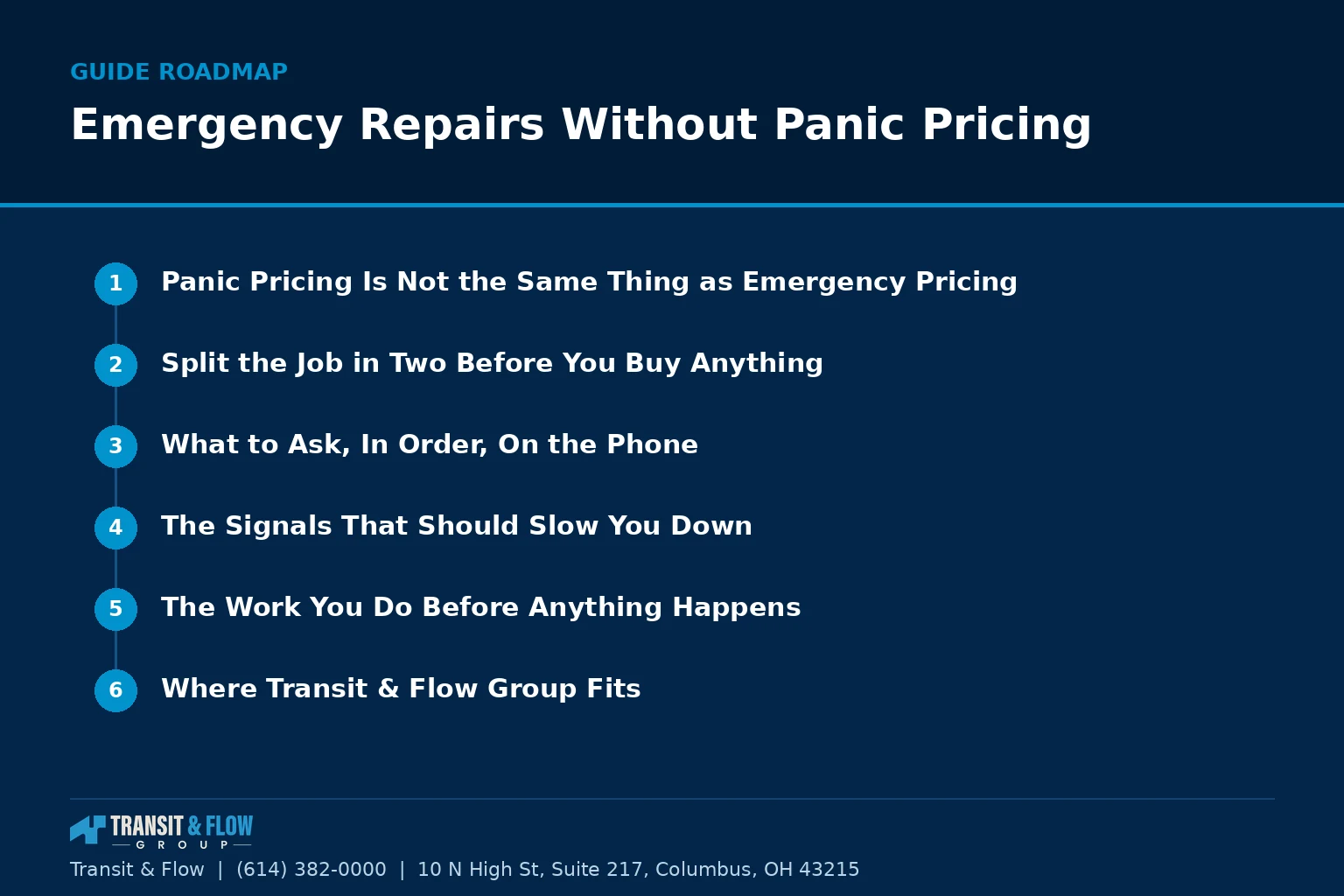
- Panic Pricing Is Not the Same Thing as Emergency Pricing
- Split the Job in Two Before You Buy Anything
- What to Ask, In Order, On the Phone
- The Signals That Should Slow You Down
- The Work You Do Before Anything Happens
- Where Transit & Flow Group Fits
- Frequently Asked Questions
Transit & Flow Group coordinates projects and partners with properly licensed and insured specialty contractors when licensing is required.
Read this first. Safety decisions are not purchasing decisions and they do not wait for any of this. If there is a gas odor, leave and call from outside. If a carbon monoxide alarm sounds, get everyone out. If water is touching energized equipment, do not enter. If anyone is having difficulty breathing, call emergency services. Nothing on this page applies until the building is safe to occupy.
Panic Pricing Is Not the Same Thing as Emergency Pricing
This distinction is the whole article, so it goes first. Emergency pricing is legitimate. A contractor who dispatches at two in the morning, on a holiday, in a storm, is paying overtime, pulling a technician off scheduled work, and carrying inventory to handle unknowns. A premium for that is honest and it should be disclosed in advance.
Panic pricing is different. Panic pricing is a number that exists because of your emotional state rather than because of the cost of the work. It is charged by someone who knows you will not call anyone else. The tell is not the size of the number. The tell is whether the person will tell you what it is before they start, put it in writing, and let you read it.
Almost everything in this article is a method for separating those two, quickly, while standing in a wet basement.
Split the Job in Two Before You Buy Anything
The single most valuable move in an emergency is recognizing that you are being asked to buy two different things at once, and that only one of them is urgent.
- The stabilization. Stop the water, restore safe heat, make the electrical condition safe, secure the opening. This is genuinely urgent, it is usually small, and it should be priced as its own scope.
- The repair. Everything that follows, including replacement equipment, reconstruction, and anything described as a system. This is not urgent. It is happening in the next several days regardless of what anyone tells you tonight.
Authorize the first. Decline to decide on the second until morning. That sentence, said out loud, is the most effective consumer protection available in an emergency, and it is entirely reasonable. A contractor who accepts it is behaving normally. A contractor who resists it has told you something important.
What to Ask, In Order, On the Phone
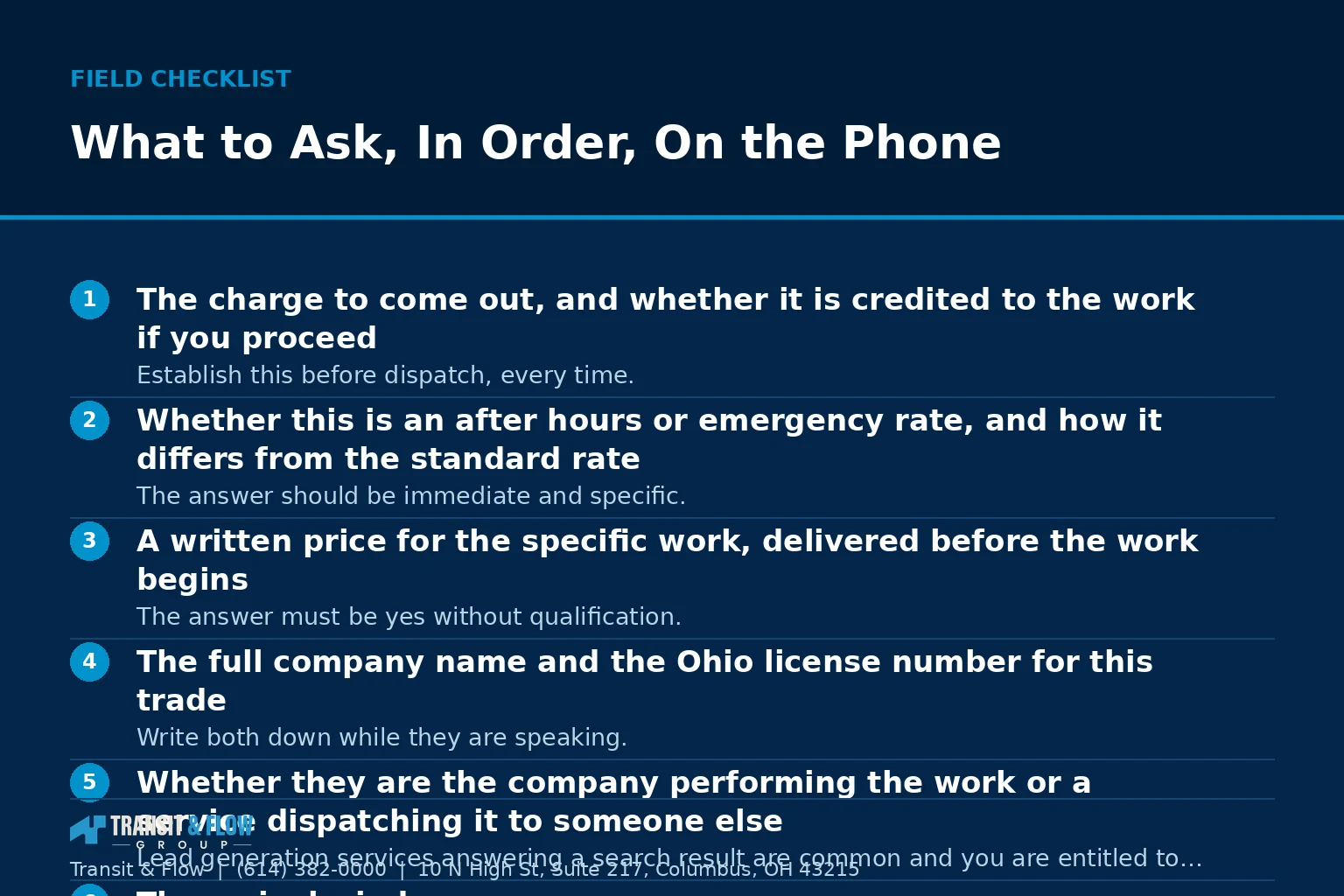
- The charge to come out, and whether it is credited to the work if you proceed. Establish this before dispatch, every time.
- Whether this is an after hours or emergency rate, and how it differs from the standard rate. The answer should be immediate and specific.
- A written price for the specific work, delivered before the work begins. The answer must be yes without qualification.
- The full company name and the Ohio license number for this trade. Write both down while they are speaking.
- Whether they are the company performing the work or a service dispatching it to someone else. Lead generation services answering a search result are common and you are entitled to know which one you called.
- The arrival window. A specific window is a sign of an organized operation.
- Anything you can do right now to limit the damage before they arrive. A contractor who answers this well is one who is oriented toward your outcome rather than the ticket.
Seven items take under two minutes. Every one of them is answerable by a legitimate operator without hesitation, and the pattern of the answers tells you more than any single answer does.
The Signals That Should Slow You Down
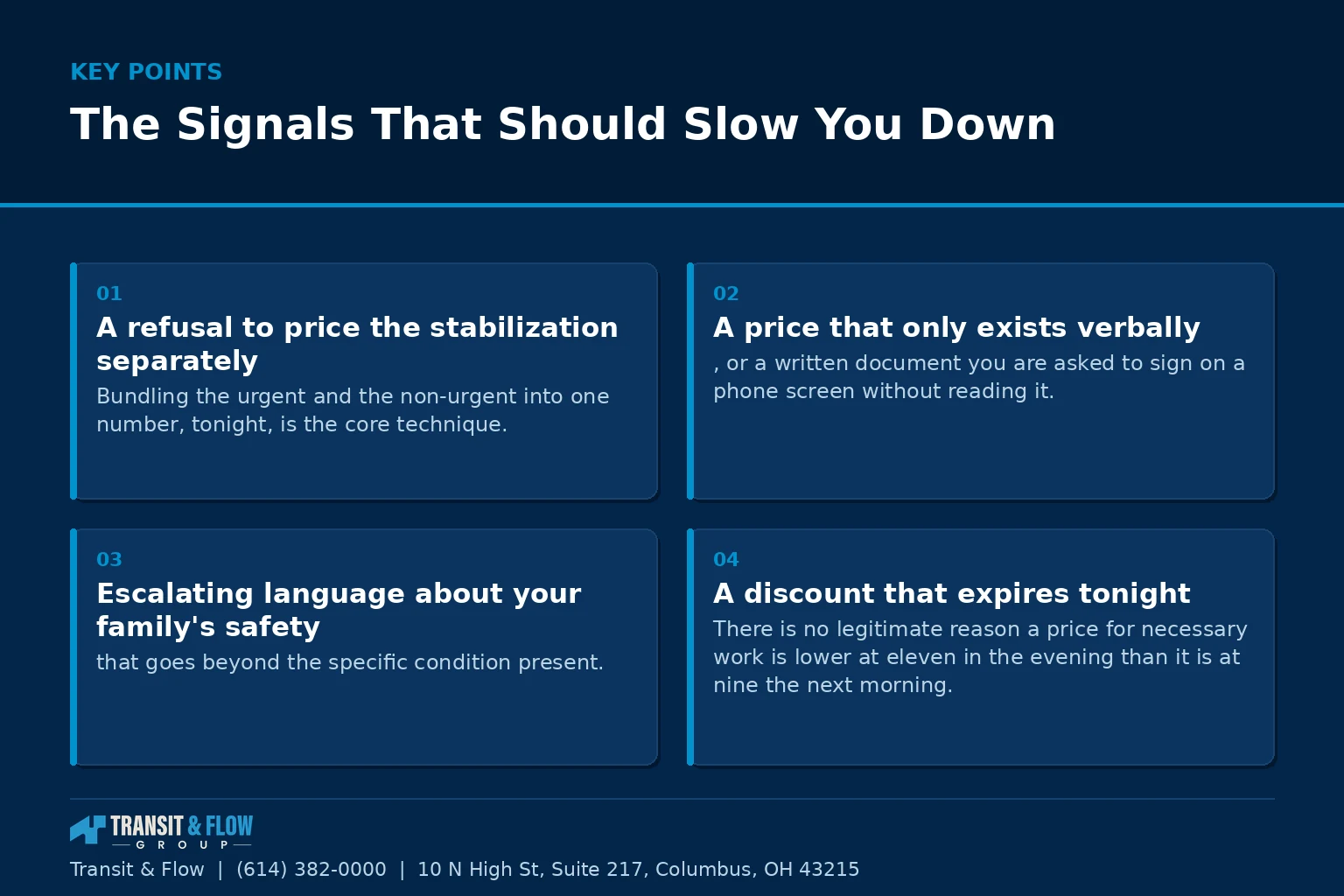
- A refusal to price the stabilization separately. Bundling the urgent and the non-urgent into one number, tonight, is the core technique.
- A price that only exists verbally, or a written document you are asked to sign on a phone screen without reading it.
- Escalating language about your family’s safety that goes beyond the specific condition present. Real hazards are described precisely. Manufactured ones are described emotionally.
- A discount that expires tonight. There is no legitimate reason a price for necessary work is lower at eleven in the evening than it is at nine the next morning.
- A large deposit demanded before any work, particularly by card, particularly for equipment not yet ordered. Our guidance on payment schedules and deposits covers what is normal.
- An assignment of benefits presented during the first visit. This transfers your claim rights to the contractor. Read it, elsewhere, with time. Never sign it standing in the affected room.
- Demolition beginning before a scope is agreed. Once material is out, your position in every subsequent conversation has changed.
- An unwillingness to give you a license number, or a number that does not verify. Verification takes a minute and the method is in our article on verifying a contractor in Ohio.
On cost: this article contains no dollar figures on purpose, and that is deliberate in an article about pricing. Emergency rates vary with trade, hour, day, travel, equipment required, whether parts are stocked, and the condition found on arrival. Publishing a number would give you a false anchor at the exact moment a false anchor is most damaging, because you would either accept a fair price you thought was high or reject a fair price you thought was low. What protects you is a written scope and a written price for your actual situation, not a range from an article.
The Work You Do Before Anything Happens
Every technique above is harder under pressure and easier if the decision was partly made in advance. This takes one evening.
- Choose your emergency contractor now, for plumbing, electrical, and heating, while you have time to check licensing and read reviews carefully. Put the numbers where a household member who is not you can find them.
- Locate and operate every shutoff, meaning the main water valve, the gas valve, and the main breaker, on a calm day. A valve you have never turned is a valve that may be seized.
- Know your equipment, including the age and model of the water heater, the furnace, and the panel, photographed and stored on your phone.
- Read your policy once, particularly the deductible and the emergency mitigation provisions, so you are not learning them during a loss.
- Agree in the household who decides, so a contractor is not able to work one family member against another at midnight.
For the specific first-hour sequences, our articles on burst pipe emergency steps and the first 48 hours after water damage cover what to do while you wait.
Option A is calling whoever answers first, accepting the emergency price, and sorting out the full repair with the same company because they are already there. Option B is authorizing only the stabilization tonight, then treating the repair as a separate purchase made in daylight with a written scope. My recommendation is Option B, without qualification. Option A is what most people do and it is not always a bad outcome, but it converts a small urgent decision into a large non-urgent one made at the worst possible moment, and it is the mechanism behind nearly every emergency contracting complaint. Continuity is worth something, and if the responding contractor earns the repair, hire them in the morning. The point is not to avoid them. The point is to make that a decision rather than a default. Where the repair turns into something larger, our guide on choosing a restoration path covers the decision structure.
Where Transit & Flow Group Fits
Transit & Flow Group coordinates urgent and planned work across Columbus and Central Ohio and partners with properly licensed and insured specialty contractors when licensing is required. Our standard on emergency calls is that the dispatch charge and the rate basis are stated on the phone before anyone is sent, that stabilization is priced and authorized separately from any repair, that no repair scope is signed during an emergency visit, and that we do not present assignment of benefits documents. Our role in a coordinated project is described in our article on what a general contractor does. To reach us, contact us.
Frequently Asked Questions
What is the difference between emergency pricing and panic pricing?
Emergency pricing is legitimate. A contractor who dispatches at two in the morning, on a holiday, in a storm, is paying overtime, pulling a technician off scheduled work, and carrying inventory to handle unknowns, and a premium for that is honest as long as it is disclosed in advance. Panic pricing is a number that exists because of your emotional state rather than because of the cost of the work, charged by someone who knows you will not call anyone else. The tell is not the size of the number. The tell is whether the person will state it before they start, put it in writing, and let you read it.
What should I actually authorize during an emergency visit?
Only the stabilization. You are being asked to buy two different things at once, and just one of them is urgent. Stabilization means stopping the water, restoring safe heat, making the electrical condition safe, or securing the opening, and it is usually small and should be priced as its own scope. The repair, meaning replacement equipment, reconstruction, and anything described as a system, is happening over the next several days regardless of what anyone tells you tonight. Saying that out loud is the most effective consumer protection available in the moment, and a contractor who resists it has told you something important.
What should I establish on the phone before anyone is dispatched?
Seven things, and they take under two minutes. The charge to come out and whether it is credited to the work, whether this is an after hours rate and how it differs from the standard rate, a commitment to a written price before work begins, the full company name and the Ohio license number for that trade, whether the company answering is the one performing the work or dispatching it elsewhere, the arrival window, and anything you can do right now to limit damage. Every one of those is answerable by a legitimate operator without hesitation, and the pattern of the answers tells you more than any single answer does.
What are the warning signs that I should slow down?
A refusal to price the stabilization separately, since bundling the urgent and the non-urgent into one number tonight is the core technique. A price that only exists verbally, or a document you are asked to sign on a phone screen without reading it. Escalating language about your family’s safety that goes beyond the specific condition present, because real hazards are described precisely and manufactured ones are described emotionally. A discount that expires tonight, a large deposit demanded before any work, demolition starting before a scope is agreed, and an unwillingness to provide a license number that verifies.
Should I sign an assignment of benefits during the first visit?
No. An assignment of benefits transfers your insurance claim rights to the contractor, which is not a document to sign standing in the affected room while water is still moving. Read it somewhere else, with time, and get advice on it if anything is unclear. If a contractor presents one during an emergency visit, treat that as a signal about how the rest of the relationship will go.
What can I do in advance so I am not deciding under pressure?
One evening of preparation makes every technique above easier. Choose your emergency contractor now for plumbing, electrical, and heating while you have time to check licensing and read reviews carefully, and put the numbers somewhere a household member who is not you can find them. Locate and operate the main water valve, the gas valve, and the main breaker on a calm day, because a valve you have never turned is a valve that may be seized. Photograph the age and model of the water heater, the furnace, and the panel, read your policy once so you know the deductible and the emergency mitigation provisions, and agree in the household who decides, so a contractor cannot work one family member against another at midnight.
Sources
- Ohio Attorney General, consumer protection guidance on home solicitation and emergency contracting
- Ohio Construction Industry Licensing Board, trade licensing verification
- City of Columbus, Get a Permit, permit requirements for repair work
About This Guide
Written and edited by Micheal Parker, founder of Transit & Flow Group. Published December 20, 2026. This guide is checked against the agency and code sources listed above, and it is revised when those sources change.
General contractor of record. Micheal Parker holds City of Columbus General Contractor Registration G12064, issued by the Columbus Department of Building and Zoning Services under Transit & Flow LLC and valid through June 30, 2027. Trade work that falls outside the scope of that registration is performed by licensed trade partners, and the responsible license holder is identified before work begins.
Transit & Flow Group, home and commercial services for Columbus and the surrounding Central Ohio communities. Phone (614) 382-0000. Email solutions@transitflowgroup.com. 10 N High St, Suite 217, Columbus, OH 43215. Contact our team or review the communities we serve.
