
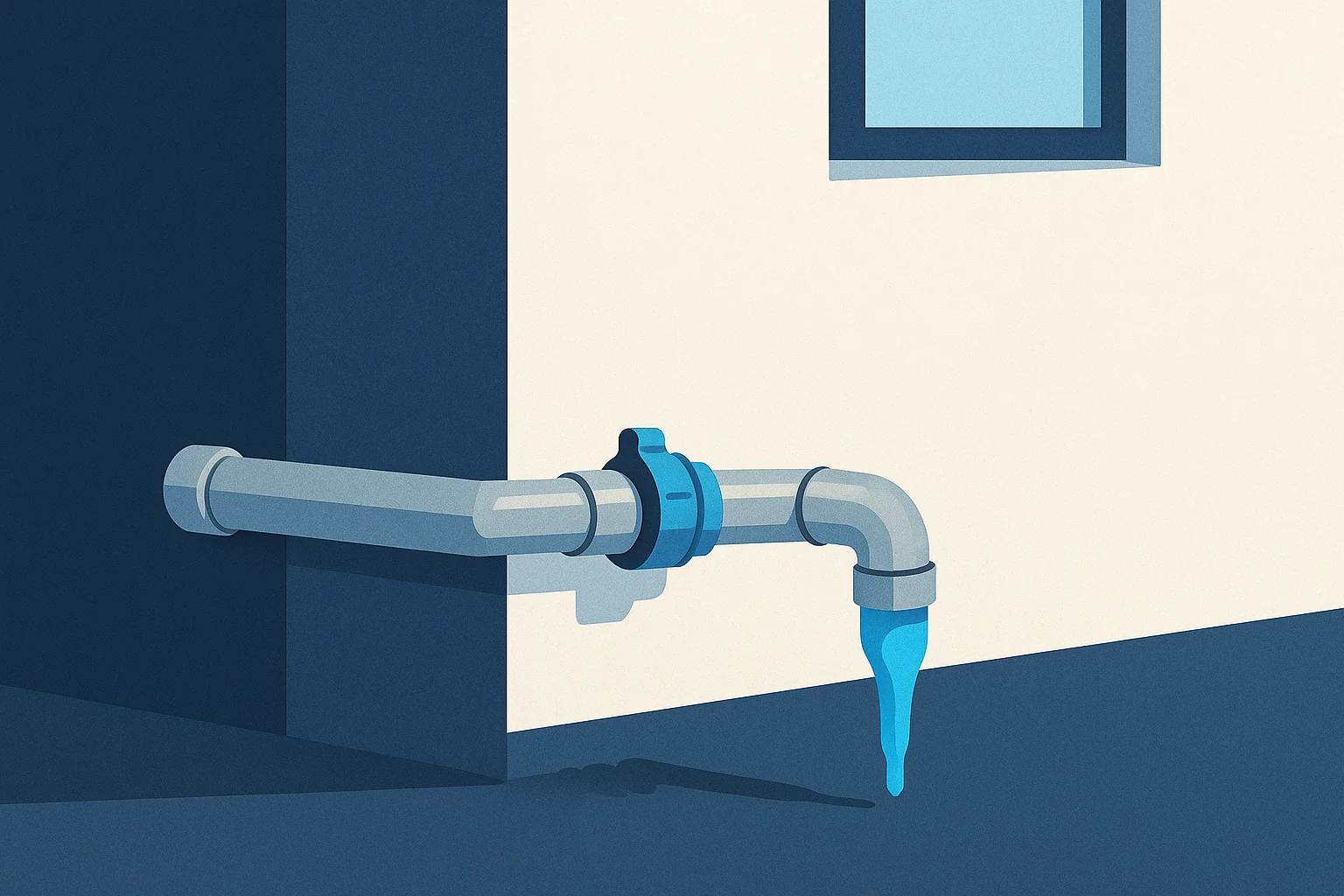

A sump pump that runs perfectly and discharges into a frozen line has failed just as completely as one that never turns on. This is the winter basement flooding cause that catches people who thought they had already solved the problem, because the pump is working and the alarm, if there is one, is not triggered by a blocked discharge. This article explains the failure and how to prevent it. It supports our drain and sewer work.
In This Guide
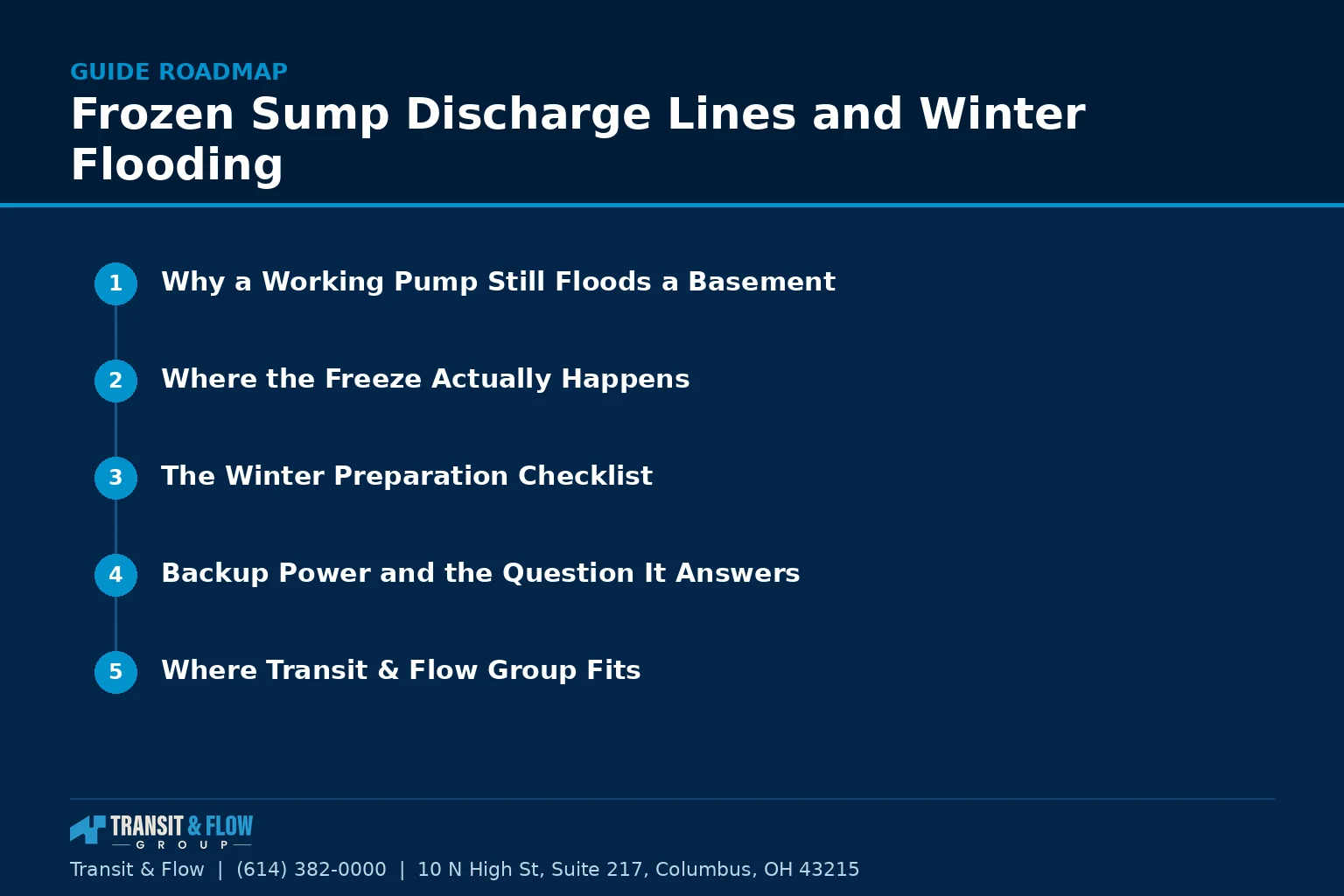
- Why a Working Pump Still Floods a Basement
- Where the Freeze Actually Happens
- The Winter Preparation Checklist
- Backup Power and the Question It Answers
- Where Transit & Flow Group Fits
- Frequently Asked Questions
Transit & Flow Group coordinates projects and partners with properly licensed and insured specialty contractors when licensing is required.
One boundary. Do not reach into a sump pit with the pump energized, and do not work on standing water near a plugged-in pump or an energized outlet. Unplug from a dry position first. Sump discharge routing is regulated in most Central Ohio jurisdictions, and connecting a sump discharge to a sanitary sewer is prohibited in many of them. Verify locally before changing where yours goes.
Why a Working Pump Still Floods a Basement
The discharge line leaves the pit, exits the foundation, and carries water away from the house. In winter, the exposed portion outside is the vulnerable part. Water sitting in that run after the pump shuts off can freeze. Ice narrows the passage, then closes it.
What happens next depends on the pump. A pump discharging into a blocked line cannot move water, so the pit fills. Some pumps trip a thermal overload and shut down. Some run continuously against the blockage until the motor fails. Either way the pit overflows, and it overflows during exactly the conditions that generate the most groundwater, which is a thaw following a hard freeze.
The second thing worth knowing is that a check valve failure makes this worse. If the check valve does not hold, water in the line drains back into the pit each cycle, the pump short cycles, and more water sits in the horizontal run where it can freeze.
Where the Freeze Actually Happens
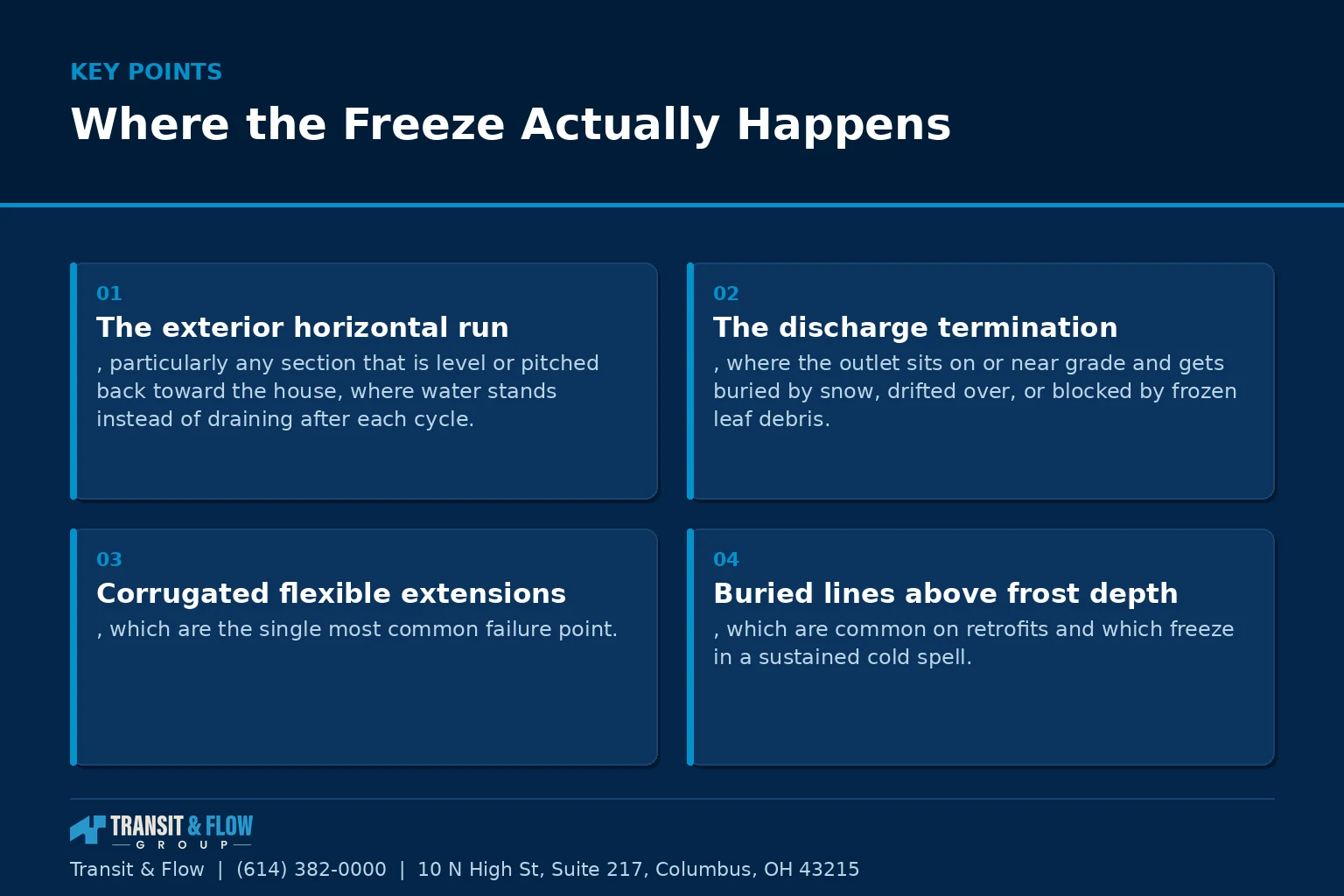
- The exterior horizontal run, particularly any section that is level or pitched back toward the house, where water stands instead of draining after each cycle.
- The discharge termination, where the outlet sits on or near grade and gets buried by snow, drifted over, or blocked by frozen leaf debris.
- Corrugated flexible extensions, which are the single most common failure point. The ribbed interior holds water in every corrugation and freezes end to end.
- Buried lines above frost depth, which are common on retrofits and which freeze in a sustained cold spell.
- Underground drywells and pop-up emitters, which can be entirely reliable in summer and entirely frozen in January.
- The elbow at the foundation exit, where the line transitions from a warm basement to outside air.
The Winter Preparation Checklist
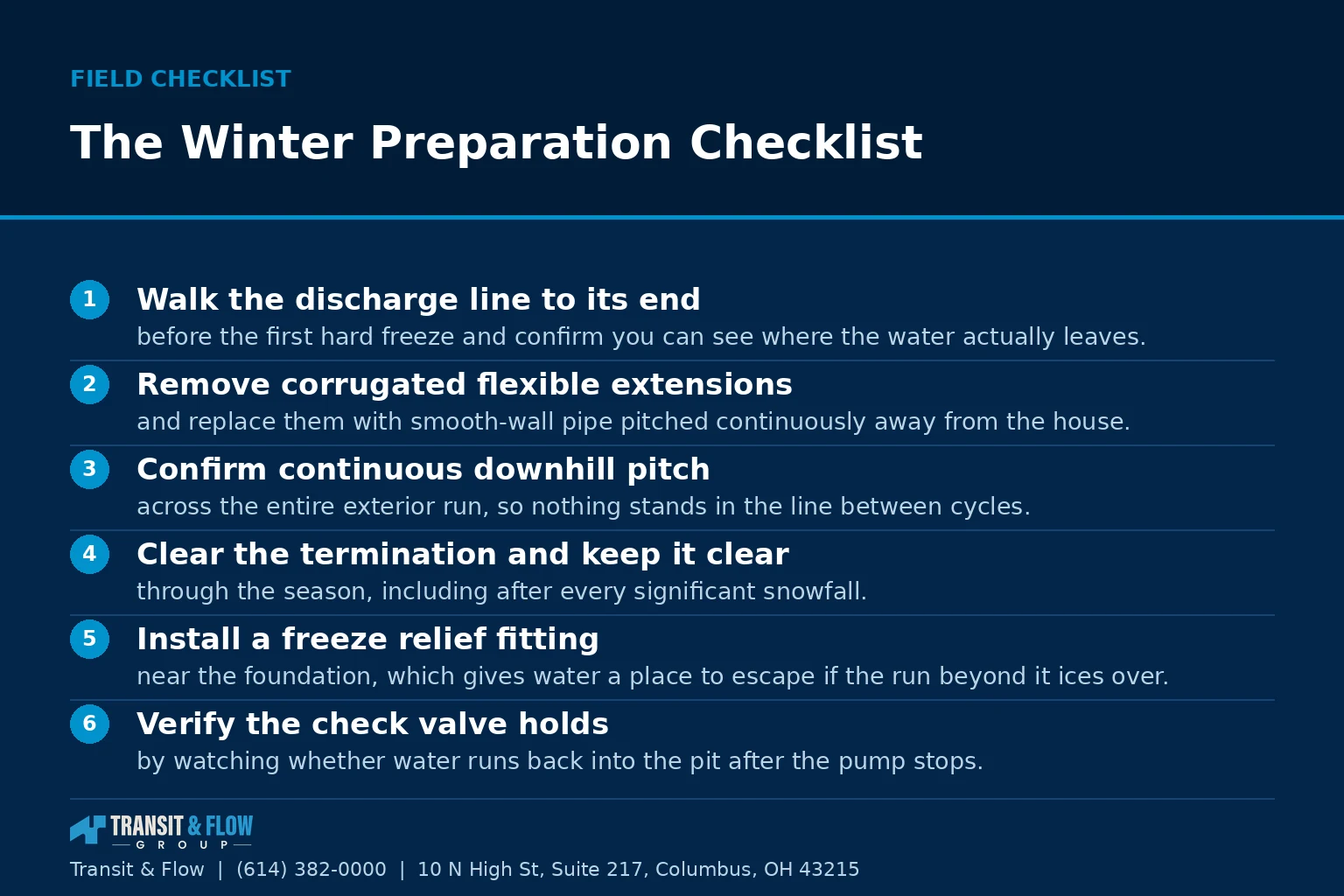
- Walk the discharge line to its end before the first hard freeze and confirm you can see where the water actually leaves. If you cannot find the end of your discharge line, that is the finding.
- Remove corrugated flexible extensions and replace them with smooth-wall pipe pitched continuously away from the house.
- Confirm continuous downhill pitch across the entire exterior run, so nothing stands in the line between cycles.
- Clear the termination and keep it clear through the season, including after every significant snowfall. Snow drifted over an outlet is a blockage.
- Install a freeze relief fitting near the foundation, which gives water a place to escape if the run beyond it ices over. This is the single highest-value component on the list and it is inexpensive.
- Verify the check valve holds by watching whether water runs back into the pit after the pump stops.
- Test the pump itself by filling the pit with a bucket and confirming the float rises, the pump starts, the pit empties, and the pump stops cleanly.
- Confirm the pump is on its own circuit and that the receptacle is functioning, since a tripped shared circuit takes the pump out silently.
- Add a high water alarm if there is not one, because the entire failure mode of this article is silent until the water is on the floor.
- Confirm the discharge does not run toward the foundation, a walkway, or a neighboring property, which is both a re-entry problem and, on the walkway, a winter liability problem.
Backup Power and the Question It Answers
Winter storms take power out, and a sump pump without power is not a pump. A backup system is worth considering, and the important thing is to understand what each type does and does not solve.
- Battery backup pumps run a second pump on stored power. They handle an outage of limited duration and they run at reduced capacity. Battery condition needs annual verification, because a battery that has quietly failed is indistinguishable from one that has not until the outage arrives.
- Water powered backup pumps use municipal supply pressure and need no electricity at all. They are unavailable on a well, they consume potable water while running, and they require a backflow prevention arrangement that is subject to local rules.
- A portable generator covers the pump and everything else, with the absolute condition that it operates outdoors, away from windows and doors, and never in a garage. Our guidance on generators covers the tradeoffs.
- None of these solve a frozen discharge line. That is the point worth stating plainly. Backup power addresses one failure. Everything in the checklist above addresses a different one, and a household that installed a battery backup and never looked at the discharge line has covered half the risk.
On cost: this article contains no dollar figures on purpose. Discharge line correction ranges from replacing an extension to re-routing and burying a line below frost depth, and pump work ranges from a replacement unit to a full pit, pump, valve, and alarm rebuild. Scope depends on your grade, your soil, the distance to an acceptable discharge point, and local requirements. Get the run walked and the scope written before you price it.
Option A is checking the discharge line each fall and correcting problems as you find them. Option B is re-engineering the discharge once, with smooth-wall pipe, verified pitch, a freeze relief fitting, and a termination that cannot be buried, so the seasonal check becomes a two-minute visual rather than a project. My recommendation is Option B. This is a system that fails silently, during the worst possible weather, into the most expensive room to dry out, and the correction is a one-time scope on most properties. Where a basement has flooded before, treat the response sequence in our floor drain backup article and our first 48 hours guide as required reading before the next storm.
Where Transit & Flow Group Fits
Transit & Flow Group coordinates drain and sewer and plumbing work across Columbus and Central Ohio and partners with properly licensed and insured specialty contractors when licensing is required. Our standard is that the full discharge run is walked and photographed before a sump proposal is written, that the termination point and local discharge rules are confirmed rather than assumed, and that a high water alarm is offered on every pit we touch. To get a sump system assessed before winter, request an assessment.
Frequently Asked Questions
How can a basement flood when the sump pump is working?
Because the pump and the discharge line are two separate points of failure. Water sitting in the exposed exterior portion of the discharge after the pump shuts off can freeze, ice narrows the passage, and then it closes. A pump discharging into a blocked line cannot move water, so the pit fills regardless of how well the pump itself is running. Some pumps trip a thermal overload and shut down, others run continuously against the blockage until the motor fails, and either way the pit overflows. It tends to happen during a thaw following a hard freeze, which is exactly when groundwater is highest.
Where does a sump discharge line usually freeze?
The exterior horizontal run is the main exposure, particularly any section that is level or pitched back toward the house where water stands between cycles. The termination is next, especially where the outlet sits on or near grade and gets buried by snow, drifted over, or blocked by frozen leaf debris. Corrugated flexible extensions are the single most common failure point, because the ribbed interior holds water in every corrugation and freezes end to end. Buried lines above frost depth, underground drywells and pop-up emitters, and the elbow at the foundation exit round out the list.
What should I check before the first hard freeze?
Walk the discharge line to its end and confirm you can see where the water actually leaves, because if you cannot find the end of the line, that is the finding. Replace corrugated flexible extensions with smooth-wall pipe pitched continuously away from the house, and confirm that pitch across the whole exterior run. Keep the termination clear through the season, including after every significant snowfall, since drifted snow over an outlet is a blockage. Verify the check valve holds, test the pump by filling the pit with a bucket, confirm the pump is on its own functioning circuit, and add a high water alarm if there is not one.
Does a battery backup pump protect against a frozen discharge line?
No, and this is the point worth stating plainly. Backup power addresses one failure, which is loss of electricity during a winter storm, and a frozen line is a different failure entirely. A household that installed a battery backup and never looked at the discharge line has covered half the risk. Battery backups run a second pump at reduced capacity for a limited duration and need annual battery verification, water powered units use municipal supply pressure and require a backflow prevention arrangement subject to local rules, and a portable generator must operate outdoors away from windows and doors and never in a garage. None of them moves water through a line full of ice.
Why does a failing check valve make freezing more likely?
If the check valve does not hold, water in the discharge line drains back into the pit after each cycle. That causes the pump to short cycle, and it leaves more water sitting in the horizontal exterior run where it can freeze. You can observe the symptom without touching anything by watching whether water runs back into the pit after the pump stops. A check valve that is not holding is worth correcting before winter rather than after, because it compounds the exact failure this article describes.
Can I redirect my sump discharge wherever it is convenient?
No. Sump discharge routing is regulated in most Central Ohio jurisdictions, and connecting a sump discharge to a sanitary sewer is prohibited in many of them, so verify locally before changing where yours goes. Beyond the rules, the discharge should not run toward the foundation, a walkway, or a neighboring property, since the first creates a re-entry problem and the second creates a winter liability problem. Also observe the safety boundary at the pit itself: do not reach into a sump pit with the pump energized, and unplug from a dry position before working near standing water.
Sources
- U.S. Environmental Protection Agency, sanitary sewer overflow and inflow guidance
- Ohio Construction Industry Licensing Board, plumbing trade licensing
- City of Columbus, Get a Permit, plumbing permit channels and discharge requirements
About This Guide
Written and edited by Micheal Parker, founder of Transit & Flow Group. Published December 11, 2026. This guide is checked against the agency and code sources listed above, and it is revised when those sources change.
General contractor of record. Micheal Parker holds City of Columbus General Contractor Registration G12064, issued by the Columbus Department of Building and Zoning Services under Transit & Flow LLC and valid through June 30, 2027. Trade work that falls outside the scope of that registration is performed by licensed trade partners, and the responsible license holder is identified before work begins.
Transit & Flow Group, home and commercial services for Columbus and the surrounding Central Ohio communities. Phone (614) 382-0000. Email solutions@transitflowgroup.com. 10 N High St, Suite 217, Columbus, OH 43215. Contact our team or review the communities we serve.
