


The install quote is the least important number in this decision. In Central Ohio the outcome is governed by three things: the base under the surface, the drainage away from the house, and what repair looks like in year eight. Pavers are a flexible system that can be lifted and reset. Stamped concrete is monolithic, and when a monolithic system cracks, you own the crack permanently.
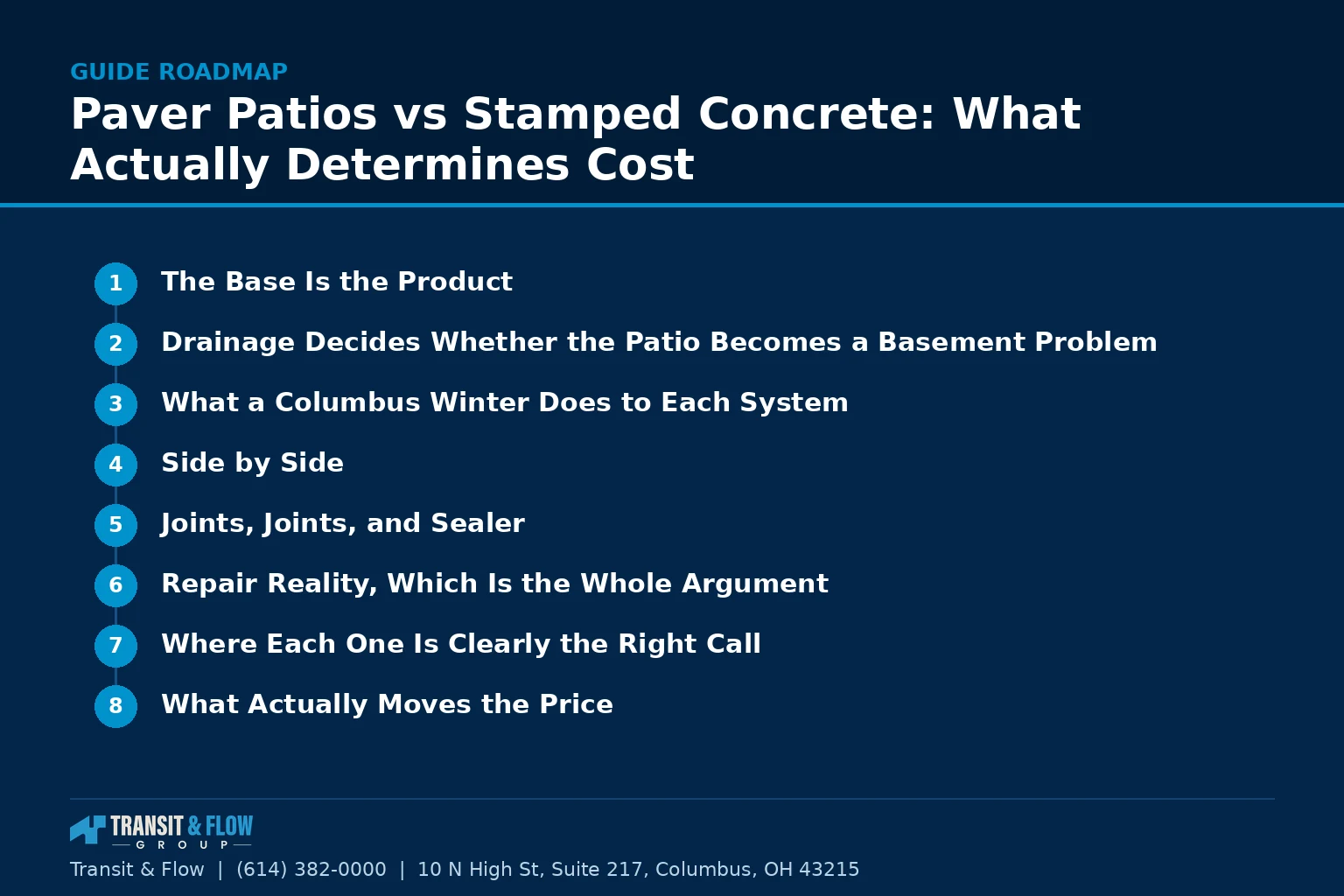
In This Guide
- The Base Is the Product
- Drainage Decides Whether the Patio Becomes a Basement Problem
- What a Columbus Winter Does to Each System
- Side by Side
- Joints, Joints, and Sealer
- Repair Reality, Which Is the Whole Argument
- Where Each One Is Clearly the Right Call
- What Actually Moves the Price
- Questions to Ask Your Contractor
- The Decision
- Where Transit & Flow Group Fits
- Frequently Asked Questions
Here is what most Central Ohio homeowners get wrong. They compare the two as products, as though the choice were between two finishes at two prices. The surface is a small fraction of the outcome. Excavation depth, base material, compaction, separation over clay, and slope are the rest, and none of it appears in a photograph. Two contractors can quote the same patio a third apart, and the difference is buried where you never see it.
The Base Is the Product
Almost every patio failure in this region is a base failure, not a surface failure. Pavers do not sink. The base under them consolidates and the pavers follow. Stamped concrete does not crack because concrete is weak. It cracks because something under it moved, or because the slab was never given a place to relieve shrinkage.
Central Ohio subgrade is largely glacial till, meaning clay with variable silt and gravel. Clay holds water, expands when wet, and contracts when dry. Isolating the surface from that movement is the base’s entire job, and its depth is the largest cost variable a good contractor manages.
- Excavation depth. Driven by the subgrade, not a standard number. A contractor quoting identical excavation on every lot has not looked at yours.
- Aggregate base material. Dense graded crushed stone with fines that lock together. Round gravel and unwashed fill will not hold a load.
- Compaction in lifts. A plate compactor densifies only the top few inches, so a base dumped to full depth is tight on top and loose underneath.
- Geotextile separation. Fabric between clay and aggregate stops the two from mixing. Without it, clay migrates into the stone over years of cycling.
- Edge restraint. Pavers interlock only if the perimeter is held. Restraint spiked into compacted base keeps the field from spreading.
- Subgrade proof rolling. Rolling the cut before stone goes down reveals soft pockets. Finding one now costs an hour. Finding it later costs a rebuild.
- Slab thickness and reinforcement. The stamped equivalent, with joint layout, all decided before a stamp mat touches the surface.

Drainage Decides Whether the Patio Becomes a Basement Problem
A patio is a large impervious surface against your foundation. Water landing on it goes away from the house or toward it. A patio installed flat, or pitched back because the installer matched an existing grade, concentrates water at the wall, where it enters the backfill zone and travels down.
The symptom shows up three or four springs later as efflorescence on a basement wall, a damp corner, or a sump pump running during storms when it never used to. By then, correcting the pitch means taking the patio apart. Grading and downspout discharge belong in the design phase.
Two practical points. Downspouts must not discharge onto or under a new patio without a buried line carrying that water past the edge. And fall must be consistent across the full width, including at corners where two slope runs meet and installers routinely leave a flat spot. On tight lots, permeable pavers over an open graded base are a legitimate engineered answer, not a marketing feature.
What a Columbus Winter Does to Each System
Central Ohio produces a high number of freeze and thaw cycles rather than one long deep freeze, and that matters more than the low temperature. A February crossing freezing several times a week is harder on hardscape than a sustained northern winter.
Pavers handle this by moving. Each unit is independent, the joints absorb differential movement, and heave that would crack a slab shows up as a slight rise that relaxes in spring. What hurts pavers is a base that traps water, because ice lensing in saturated stone produces heave that does not fully recover.
Concrete handles this by resisting, until it does not. A slab is one piece, so differential movement converts to tensile stress and relieves as a crack along the weakest path, rarely the control joint you wanted it to follow.
Deicing salt is the second winter factor and it is one sided. Chloride deicers accelerate surface scaling on concrete, especially slabs finished tight or placed in marginal weather. Once a stamped slab scales, the color and texture you paid for are gone and can only be overlaid. Pavers cure under controlled conditions, tolerate salt far better, and a spalled unit is a single swap.
Side by Side
| Factor | Paver Patio | Stamped Concrete |
|---|---|---|
| Relative install cost | Higher per square foot on install day | Lower, and the number quotes lead with |
| Base requirements | Deep aggregate in lifts, geotextile over clay, bedding layer, edge restraint. The base is the structure. | Granular base, generally shallower, with slab thickness and reinforcement doing the work |
| Freeze and thaw behavior | Flexible. Joints absorb movement and seasonal heave largely recovers. | Rigid. Movement converts to tensile stress and relieves as cracking. |
| Cracking and settlement | Does not crack as a system. Settlement shows as a low area or lippage. | Cracking is the primary failure mode. Settlement produces a step or a fracture. |
| Repairability | Fully reversible. Lift, correct the base, reset the units, re-sand. | Effectively irreversible. Patch, overlay, or sawcut and replace. |
| Ongoing maintenance | Joint sand top up, weed and ant control, optional sealing, occasional re-leveling | Resealing on interval, joint upkeep, crack filling, salt avoidance |
| Appearance over time | Weathers evenly. Color runs through the unit. | Color lives near the surface. Fades with UV, and scaling exposes gray concrete. |
| Resale perception | Read as the premium option, and condition tends to hold | Strong when intact. Cracked or patched reads as deferred maintenance. |
| Salt tolerance | Good, and damaged units are replaceable | Poor, and scaling is permanent |
| Utility access underneath | Lift, trench, reset. The patio survives. | Break out the area and pour a patch that will not match. |
Joints, Joints, and Sealer
Both systems have a joint story and they are opposites. Paver joints are meant to be maintained. Polymeric sand, jointing sand with a binder activated by water, resists washout and suppresses weeds and ants far better than plain sand. It still degrades at edges and low spots, and topping it up is ownership, not defect.
Control joints exist to tell the slab where to crack. Cut deep enough and spaced closely enough, shrinkage relieves along those lines. Too shallow, too far apart, or laid out for symmetry rather than slab geometry, and the slab cracks where it wants.
Sealer is the other recurring cost. Color, sheen, and much of the resistance to moisture and salt live in a film that wears and needs reapplication on an interval set by exposure and traffic. Skipping it is how a stamped patio goes dull and chalky, and applying it over a damp slab produces clouding that has to be stripped.
Repair Reality, Which Is the Whole Argument
A paver repair is a half day with no visual trace. The installer marks the settled area, lifts the units by hand, corrects the base, resets the same pavers, and re-sands. A damaged unit is replaced from the same lot or borrowed from under a grill. Nothing shows afterward.
A stamped repair is a permanent visible scar. A crack can be routed and filled, which stabilizes it and softens it slightly, but it remains a line across the patio. A settled section has to be sawcut out and replaced, and it will not match. Color comes from integral color, color hardener, release agent, and sealer, all interacting with cure conditions on the day of the pour and then aging under weather. Reproducing that on a patch at a different age is not a skill problem. It is not achievable. You accept a visible patch or you overlay the whole patio.
Where Each One Is Clearly the Right Call
- Pavers, when the subgrade is questionable. Wet clay, recent fill, or a regraded lot. A flexible system tolerates what a slab will not.
- Pavers, when anything runs underneath. Irrigation, lighting, or a gas run to a grill. Access becomes a lift and reset, not a demolition.
- Pavers, when a visible defect would not be tolerated. If a crack across the middle would bother you for a decade, buy the system that does not crack.
- Pavers, on a heavily salted path. Any surface deiced through a Columbus winter is a poor candidate for a decorative concrete finish.
- Stamped concrete, on a large simple field with good subgrade. Stable ground and straightforward geometry make a well jointed slab strong value.
- Stamped concrete, when budget binds. An honest slab on a proper base beats an underbuilt paver patio at the same price.
- Stamped concrete, on a shorter ownership horizon. Maximum visual impact per dollar is legitimate if the sealer is maintained.
What Actually Moves the Price
- Square footage. Larger areas spread mobilization across more surface, so the per foot number falls as area rises.
- Access for equipment. A gate a skid steer fits through versus a yard reached by wheelbarrow is the largest hidden multiplier in pricing.
- Excavation and spoil removal. Every cubic yard is loaded, hauled, and disposed of, and wet clay is heavier and slower than dry soil.
- Base depth required by the subgrade. The honest variable. A flat rate here means a good lot is padded or a bad one is underbuilt.
- Pattern complexity. Herringbone, circle kits, and mixed sizes add cutting and waste, and multiple stamp patterns add crew time during a pour that will not wait.
- Steps and elevation change. The most labor intensive element in any patio. Every riser is a small structure with its own base and drainage.
- Edge and border detail. Soldier courses, contrasting borders, curves, and inlays all require cutting, unit by unit on a curved edge.
- Restoration. Lawn repair, plant replacement, downspout reconnection, and the access route. Quotes that omit it are incomplete, not cheaper.
Questions to Ask Your Contractor
These are aimed at one thing, whether the base will be built correctly. An installer who builds bases properly answers all of them with specifics.
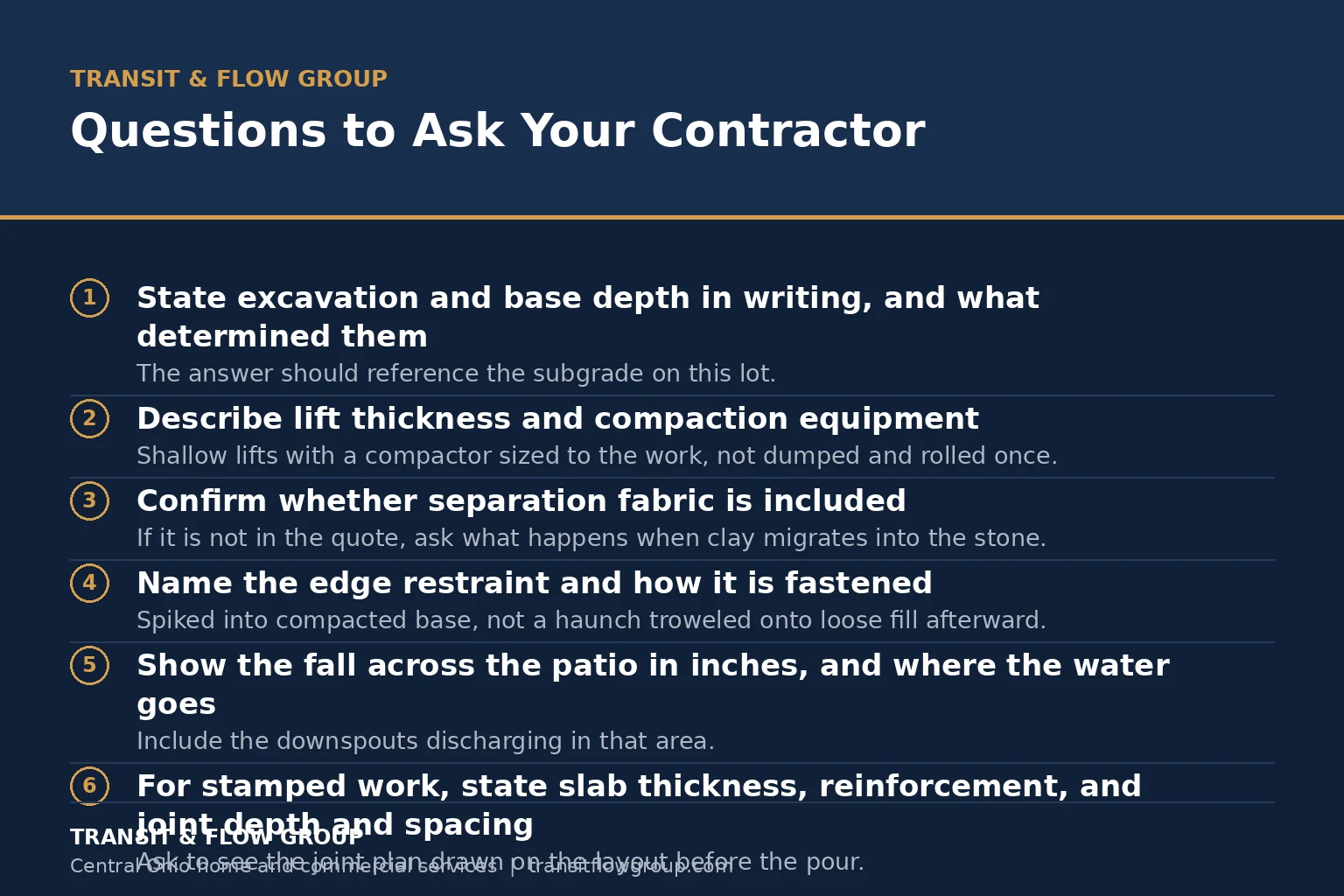
- State excavation and base depth in writing, and what determined them. The answer should reference the subgrade on this lot.
- Describe lift thickness and compaction equipment. Shallow lifts with a compactor sized to the work, not dumped and rolled once.
- Confirm whether separation fabric is included. If it is not in the quote, ask what happens when clay migrates into the stone.
- Name the edge restraint and how it is fastened. Spiked into compacted base, not a haunch troweled onto loose fill afterward.
- Show the fall across the patio in inches, and where the water goes. Include the downspouts discharging in that area.
- For stamped work, state slab thickness, reinforcement, and joint depth and spacing. Ask to see the joint plan drawn on the layout before the pour.
- Explain physically how a settled area gets repaired. For pavers that is a lift and reset. A vague stamped answer tells you what the warranty is worth.
- Confirm whether settlement is covered or excluded. Exclusions are common, and they exclude the exact failure the base was meant to prevent.
- Verify licensing, registration, and insurance independently. Our guide on verifying a contractor in Ohio covers what to check.
The Decision
Option A. Choose stamped concrete for the lower install day price, maintain the sealer on interval, keep deicing salt off it, and accept that any crack or settlement becomes a permanent visible feature of the patio.
Option B. Choose pavers, pay more on install day, direct the extra spend into excavation depth, base quality, fabric, and edge restraint rather than pattern complexity, and accept routine joint maintenance for a surface that can be repaired without a trace.
Recommendation: Option B for most Central Ohio properties, with one condition that outranks the material choice. Clay subgrade and heavy freeze and thaw cycling both favor a flexible system, and the repair asymmetry is decisive. A paver patio that settles is a half day fix. A stamped patio that cracks is a defect you look at for a decade. But a properly built stamped patio on a real base outperforms an underbuilt paver patio every time. If the budget only reaches pavers by shortening the excavation, skipping the fabric, or thinning the stone, buy stamped concrete on a correct base instead. Never buy the surface by cutting the thing holding it up.
Where Transit & Flow Group Fits
We coordinate patio and hardscape projects across Franklin County and the surrounding counties, and we scope the base and the drainage before the surface. The subgrade is evaluated on your lot, base depth is set to what it requires, fall away from the foundation is designed rather than inherited, and downspout discharge is resolved in scope. If you are comparing quotes and want the parts you cannot see put in writing, start a conversation. You can also review our landscape and hardscape services and, if the project includes an elevated structure, our guidance on footings and frost depth.
Transit & Flow Group coordinates projects and partners with properly licensed and insured specialty contractors when licensing is required, and work is performed under the appropriate permits.
Frequently Asked Questions
Which lasts longer in Ohio, pavers or stamped concrete?
Both can last decades when the base is right. The difference is what happens when something moves. Pavers are a flexible system that can be lifted and reset, so settlement is repairable. Stamped concrete is monolithic, and a crack in a monolithic slab is permanent unless the section is replaced.
Why do two contractors quote the same patio so differently?
The visible surface is nearly identical in both proposals. The difference is normally excavation depth, base material and thickness, compaction method, whether a separation layer is used over clay, edge restraint, and how drainage is handled. Ask for those specifics in writing and the price gap usually explains itself.
Does a patio need to slope away from the house?
Any hard surface adjacent to a structure needs positive fall away from it, because a patio that pitches back toward the foundation delivers concentrated water to the exact place you least want it. This is one of the most common causes of a new patio creating a new basement problem.
Do paver joints need to be maintained?
Yes. Joint stabilization keeps the interlock working, resists weed establishment, and limits washout at the edges. Joint material is consumable and gets replenished over the life of the patio. A proposal that never mentions joints is describing an incomplete system.
Is stamped concrete ever the better choice?
It can be, particularly where a large continuous surface is wanted, where the pattern and color are central to the design intent, and where the owner accepts that repair means replacing a section. Consistent appearance across a wide area is the case where it is clearly the right call.
What does sealer actually do?
On stamped concrete, sealer carries the color and sheen and is a recurring maintenance item, not a one time step. On pavers, sealer is optional and mainly affects appearance and stain resistance. In both cases sealer is a finish, and it does not compensate for a base that was built wrong.
Sources
- USDA Natural Resources Conservation Service, Web Soil Survey, site specific soil data including drainage class and shrink swell behavior
- U.S. Environmental Protection Agency, permeable pavement systems and open graded base design
- U.S. Environmental Protection Agency, Soak Up the Rain, managing stormwater runoff at the property scale
- Ohio State University Extension, Ohioline, research based guidance on soils, drainage, and landscape practice in Ohio
About This Guide
Written and edited by Micheal Parker, founder of Transit & Flow Group. Published April 21, 2027. This guide is checked against the agency and code sources listed above, and it is revised when those sources change.
General contractor of record. Micheal Parker holds City of Columbus General Contractor Registration G12064, issued by the Columbus Department of Building and Zoning Services under Transit & Flow LLC and valid through June 30, 2027. Trade work that falls outside the scope of that registration is performed by licensed trade partners, and the responsible license holder is identified before work begins.
Transit & Flow Group, home and commercial services for Columbus and the surrounding Central Ohio communities. Phone (614) 382-0000. Email solutions@transitflowgroup.com. 10 N High St, Suite 217, Columbus, OH 43215. Contact our team or review the communities we serve.
