

Read this first. The sidewalk in front of your house, the tree lawn between it and the curb, the curb itself, and the drive approach carrying your car from street to driveway are usually not governed by the residential building permit process. They sit in the public right of way, and authority over them belongs to a municipal or county engineering department, not the plans examiner who would review an addition. That means a separate permit, a separate approval path, and in most jurisdictions a contractor specifically registered or bonded with that jurisdiction before anyone touches the concrete.
In This Guide
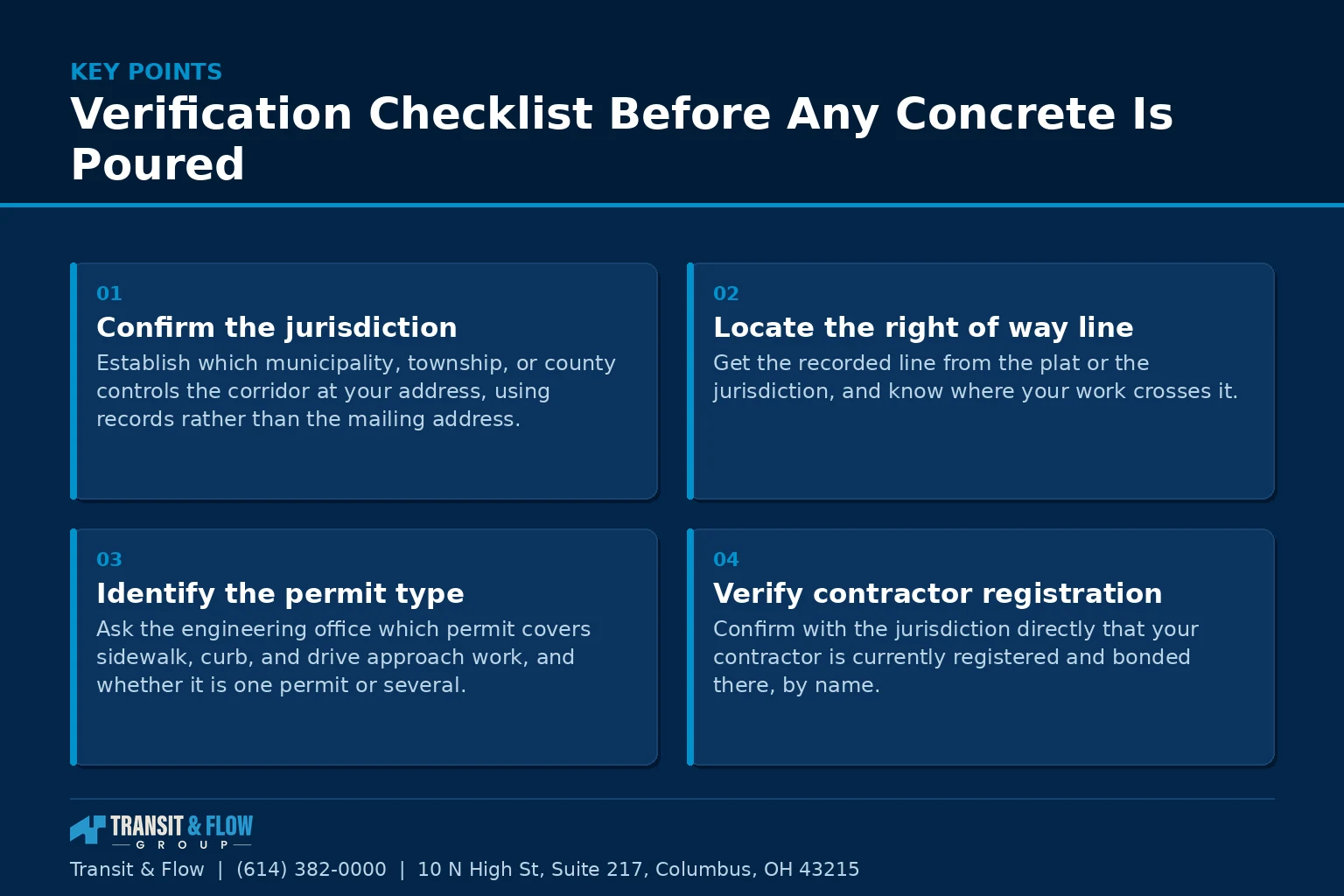
- What the Right of Way Actually Is
- Why Franklin County Is a Patchwork
- A Right of Way Permit Is Not a Building Permit
- Contractor Registration, Bonding, and Insurance
- The Accessibility Dimension
- Utility Location Is Not Optional Here
- Inspection and Acceptance
- The Open Permit Problem at Resale
- Sidewalk Repair Programs and Assessment Notices
- Verification Checklist Before Any Concrete Is Poured
- Questions to Ask Your Contractor
- The Decision
- Where Transit & Flow Group Fits
- Frequently Asked Questions
Here is the thing most Central Ohio property owners get wrong. They assume that because they mow the tree lawn, shovel the walk, and get the assessment notice when it needs repair, they own it and can do as they like with it. Maintenance responsibility and approval authority are different things, and they are routinely split. You can be legally obligated to keep that concrete in good condition and still have no authority to alter it without a permit from the jurisdiction controlling the corridor.
What the Right of Way Actually Is
The public right of way is the corridor dedicated for public travel and utilities, and it is almost always wider than the paved street. On a typical residential street it runs past the curb, across the tree lawn and sidewalk, and often a few feet beyond toward the house. Your deed may run to the street centerline subject to that dedication, or it may stop at the right of way line. Either way, the public interest in the corridor controls what happens in it.
So the line you picture, usually where your lawn meets the sidewalk, is often not the line that matters. The right of way line is a surveyed, recorded boundary shown on the plat. Work on the house side follows one process. Work on the street side follows another, administered by a different office.
Why Franklin County Is a Patchwork
Franklin County is not one jurisdiction for this purpose. It is dozens. Columbus controls its own right of way. Dublin, Westerville, Grove City, and every other incorporated municipality control theirs. Unincorporated township areas generally fall to the county engineer for the roadway corridor. State routes add the Ohio Department of Transportation as a further layer where the corridor is state controlled.
Mailing addresses do not resolve this. Many properties with Columbus mailing addresses sit inside another municipality or a township, where the rules are set by a different engineer with different registration requirements and a different inspection process. A contractor properly registered in Columbus may have no standing two miles away. Confirm the jurisdiction through the county auditor’s property record and the jurisdiction’s own address lookup, before you solicit bids, because the answer changes who you are allowed to hire.
A Right of Way Permit Is Not a Building Permit
These two instruments answer different questions and are issued by different people. Confusing them is why owners call the building department, hear that flatwork needs no permit, and proceed straight into a violation.
| Dimension | Building permit | Right of way permit |
|---|---|---|
| Question it answers | Is the structure safe and code compliant | May this work occur in the public corridor, and on what conditions |
| Issuing office | Building department or plans examination | Municipal or county engineer, service department, or public works |
| Who may hold it | Often the owner or a licensed contractor | Frequently only a contractor registered or bonded with that jurisdiction |
| What is reviewed | Structure, framing, loads, connections | Location, grade, drainage, traffic control, restoration, accessibility |
| Inspection focus | Concealed work before cover | Subgrade, forms, placement, and final acceptance of the public improvement |
| How it closes | Final inspection and record closure | Acceptance of the improvement, sometimes with a maintenance or warranty period |
| Consequence of skipping | Stop work order, correction, open permit | Removal and replacement at owner expense, plus restoration of the corridor |
The last row deserves attention. In the right of way, the remedy is not always to fix the defect. It can be removal and replacement to the published standard, because the improvement becomes part of a public system the jurisdiction must maintain.
This article states no dimensions, slopes, thicknesses, fees, or bond amounts, because those are set locally. Right of way construction standards are published by each jurisdiction as specifications and standard drawings, they are amended, and they differ between neighboring municipalities. Ask for the standard drawing by name and number. Every right of way jurisdiction has one, and a contractor who works there will know which sheet applies.
Contractor Registration, Bonding, and Insurance
This is the gate most homeowners never see coming. Working in the public right of way typically requires the contractor to be registered with that jurisdiction, bonded to it, and insured naming it. The bond exists so the public has recourse if the improvement fails or the corridor is left damaged. It is a condition of the permit, not a general business credential.
Registration is jurisdiction by jurisdiction. It is not statewide, not transferable, and registration in one Franklin County municipality carries no weight in the next. It is also distinct from state licensing and from the residential registration required for building permits. A concrete contractor can be legitimate, insured, and busy and still be ineligible to pull a right of way permit at your address. Verifying that specific eligibility is covered in our guide to verifying a contractor in Ohio.
The Accessibility Dimension
A public sidewalk is a pedestrian facility, and federal accessibility law reaches it. When a sidewalk or street is altered, accessibility obligations attach to that alteration. This is why a drive approach reconstruction can pull in requirements that have nothing to do with your driveway, and why a sidewalk replacement near a corner can trigger the curb ramp question.
The curb ramp question is simple to state and expensive to discover late. When work near an intersection alters the pedestrian route, the jurisdiction may require the curb ramps serving that crossing to be brought to current accessible standards as part of the project. Detectable warning surfaces, landing areas, and the running and cross slopes of the walk are all governed. None of those values are yours to choose or to estimate in the field.
Ask at permit application whether the scope triggers a ramp obligation, before the bid is accepted, because a curb ramp is a materially different scope than a sidewalk panel. The same standards framework governs accessible design in buildings, which we cover in our overview of commercial accessibility code basics.
Utility Location Is Not Optional Here
The right of way is where the utilities live. Gas, water, sanitary, storm, electric, and communications lines concentrate in the tree lawn and under the sidewalk precisely because that is public corridor. Excavation for a drive approach or a sidewalk replacement is excavation over dense utility infrastructure, and Ohio law requires notification first.
Central Ohio clay complicates it. Clay holds water, moves with freeze and thaw cycles, and transmits load poorly, which is why subgrade preparation here is a real line item rather than a formality. The full requirement is covered in our article on Ohio utility line location before you dig.
Inspection and Acceptance
Right of way work is inspected differently than building work. The jurisdiction is not only confirming compliance, it is deciding whether to accept the improvement into a public system it will own and maintain. Acceptance is an affirmative act.
- Preconstruction notification. Notice is usually required before work begins so an inspector can be scheduled, and pouring without it can void the permit.
- Subgrade and forms. The inspection that matters most, because it is the last moment base preparation and form layout are visible.
- Traffic and pedestrian control. If the walk or a lane is closed, the permit dictates how people and vehicles are routed around the work.
- Restoration of the corridor. Tree lawn, disturbed pavement, and adjacent panels are restored to the jurisdiction’s satisfaction, not the contractor’s.
- Final acceptance. The formal act closing the permit and taking the improvement into the public system.
- Warranty or maintenance period. The bond is often held for a defined period after acceptance, during which defects are the contractor’s to correct.
The Open Permit Problem at Resale
A right of way permit issued and never accepted stays open. It sits on the jurisdiction’s record attached to the address and surfaces during a real estate transaction, on a timeline set by a closing date. That is the worst moment to learn a drive approach poured four years ago was never inspected.
Resolving it late is harder than clearing a stale building permit. The concrete is in place, the subgrade is unverifiable, and the contractor is frequently gone. The jurisdiction’s options narrow to accepting it on some documented basis or requiring replacement to current standard, which may have changed since the pour. The parallel discipline on the building side is discussed in our guide to permits in Columbus and Franklin County.
Work done with no permit at all ends the same way. There is no record to close, but there is unapproved concrete in a public corridor, and the obligation to correct it follows the property.
Sidewalk Repair Programs and Assessment Notices
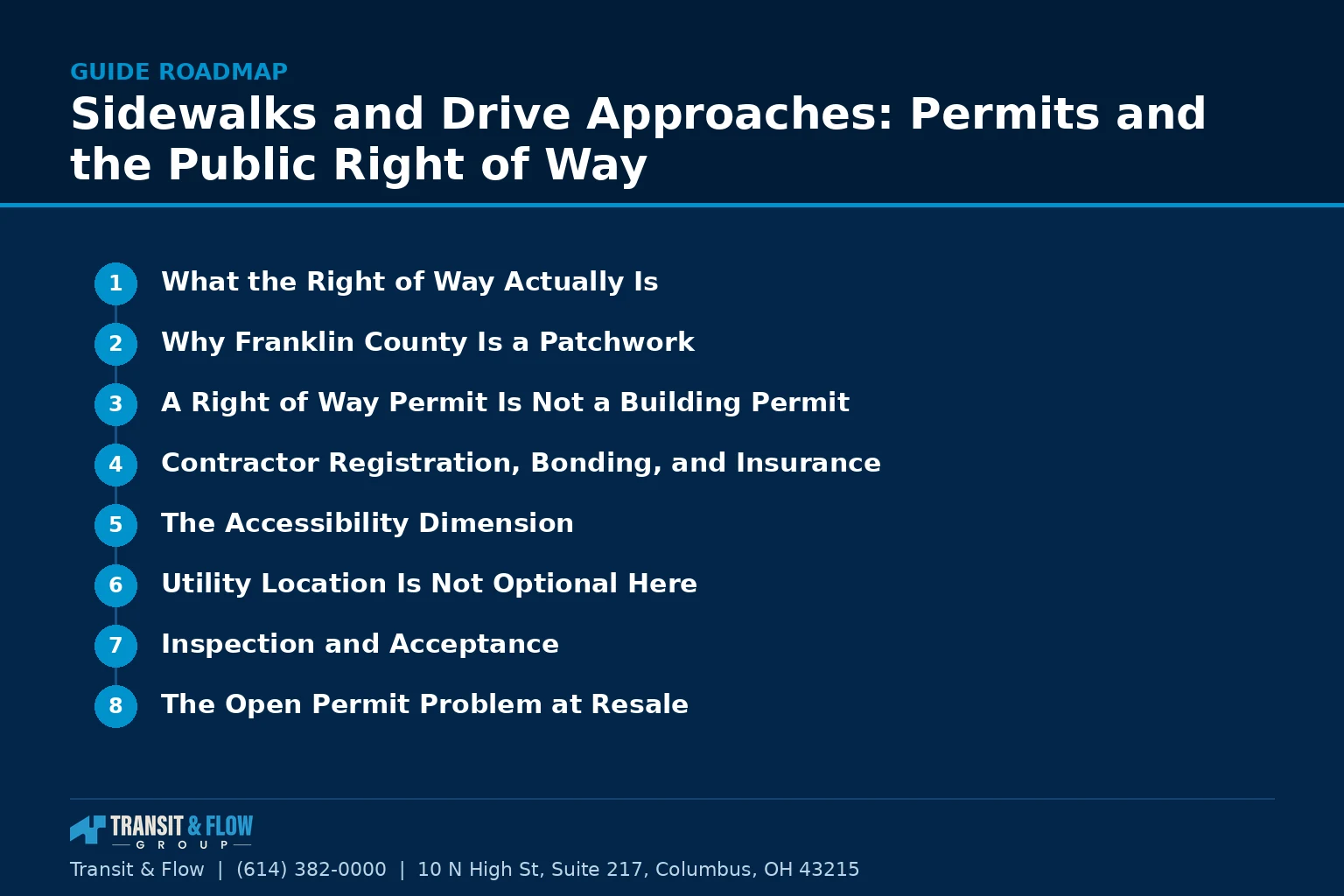
Many Central Ohio jurisdictions run periodic sidewalk inspection programs. The jurisdiction surveys an area, identifies panels that fail its criteria, and notifies the adjoining owner that repair is required. If the owner does not act within the stated window, the jurisdiction performs the work and assesses the cost against the property, typically through the tax duplicate.
This is the clearest illustration of the split between responsibility and authority. The owner pays, and the jurisdiction dictates the standard, the scope, and often the acceptable contractor. Owners who hire their own contractor in response to a notice often find the repair does not satisfy the program, either because the scope was smaller than the notice required or because the contractor was not registered. Freeze and thaw cycling on Central Ohio clay is why these programs exist, and the region’s flat to gently rolling terrain gives the water nowhere obvious to go.
Verification Checklist Before Any Concrete Is Poured
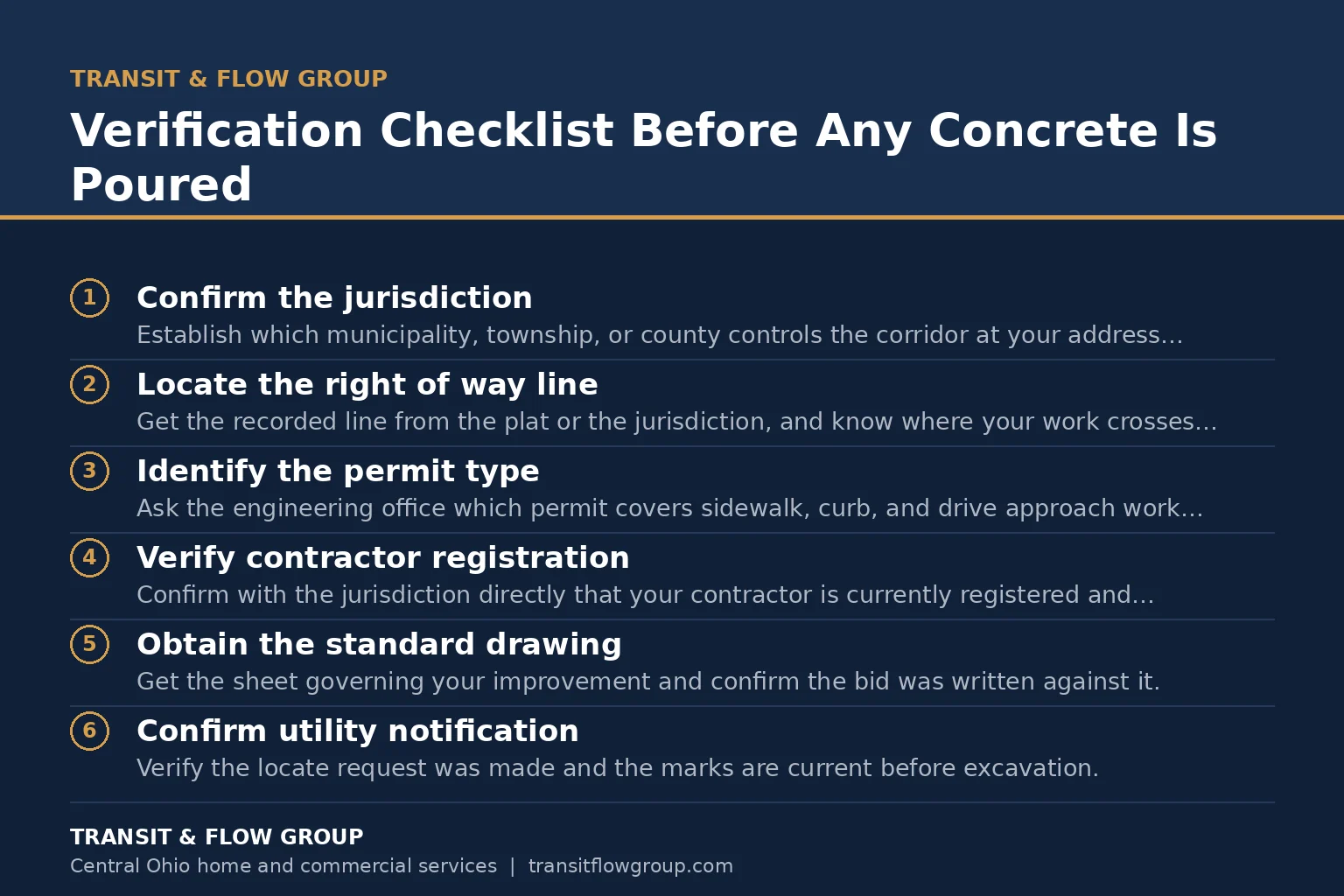
Run this before a bid is accepted. Every item is verifiable in a phone call or a records lookup.
- Confirm the jurisdiction. Establish which municipality, township, or county controls the corridor at your address, using records rather than the mailing address.
- Locate the right of way line. Get the recorded line from the plat or the jurisdiction, and know where your work crosses it.
- Identify the permit type. Ask the engineering office which permit covers sidewalk, curb, and drive approach work, and whether it is one permit or several.
- Verify contractor registration. Confirm with the jurisdiction directly that your contractor is currently registered and bonded there, by name.
- Obtain the standard drawing. Get the sheet governing your improvement and confirm the bid was written against it.
- Confirm utility notification. Verify the locate request was made and the marks are current before excavation.
- Fix the inspection points. Know which inspections are required, who calls them, and how much notice each needs.
- Define restoration. Establish in writing what restoration of the tree lawn and adjacent pavement means and who pays.
- Get the acceptance document. Obtain written confirmation the permit closed and the improvement was accepted, and keep it permanently.
Questions to Ask Your Contractor
- Registration by jurisdiction. Have them name the controlling jurisdiction and confirm their current registration and bond there.
- Who pulls the permit. Confirm they will pull it in their own name, and treat a request that you pull it as information about their eligibility.
- The governing standard. Ask which standard drawing number the work is built to, and expect a specific answer.
- Scope across the line. Establish where the work crosses the right of way line and what falls under which permit.
- Accessibility scope. Ask whether the jurisdiction flagged any curb ramp obligation and whether it is in the bid.
- Inspection responsibility. Ask who schedules each inspection and what happens if one is missed.
- Closeout documentation. Ask what they hand you at completion, and expect the closed permit to be part of it.
The Decision
Option A. Treat the sidewalk and drive approach as ordinary flatwork, hire on price, and let the contractor decide what permitting applies.
Option B. Confirm the controlling jurisdiction first, verify the contractor’s registration and bond with that jurisdiction by name before signing, require that the permit be pulled in the contractor’s name against the published standard drawing, and hold final payment until the improvement is inspected and formally accepted.
Recommendation: Option B, without exception, because the exposure here is asymmetric in a way other residential work is not. On the private side of the line, a defect is your problem and your remedy. In the public right of way, the jurisdiction has an independent interest, a published standard it must apply consistently, and remedies that include ordering removal of concrete you already paid for. The contractor’s exposure ends when the check clears. Yours attaches to the parcel, follows it to closing, and can be enforced by assessment. The verification takes an afternoon and it is the cheapest part of the project.
Where Transit & Flow Group Fits
We coordinate exterior and site work across Central Ohio, and right of way permitting is a defined project phase rather than a detail delegated to whoever shows up with a form. Jurisdiction confirmation happens before scope. Registration and bonding are verified before a subcontractor is engaged. Inspections are scheduled points in the plan, and the closed permit is delivered at completion. If you are planning sidewalk, curb, or drive approach work, start a conversation with our team. You may also find our Columbus permitting process overview useful as background on how local review actually runs.
Transit & Flow Group coordinates projects and partners with properly licensed and insured specialty contractors when licensing is required, and work is performed under the appropriate permits.
Frequently Asked Questions
What is the public right of way
It is the corridor along a street that the public authority controls for travel and utilities. It frequently extends past the curb and onto what looks like a front yard, which is why the sidewalk and the drive approach often fall under municipal authority even when the adjoining property is privately owned.
Do I need a permit to replace my own sidewalk
Work in the right of way generally requires authorization from the jurisdiction that controls it, and requirements vary between municipalities in the Columbus area. Confirm with the authority having jurisdiction over your address rather than assuming the rules from a neighboring city apply.
Who is responsible for maintaining the sidewalk in front of my house
Responsibility is set by local ordinance and it is not uniform across Central Ohio. In many jurisdictions maintenance duties fall to the adjoining property owner even though the improvement sits in public right of way. Read the ordinance that applies to your address.
Does accessibility law apply to a residential sidewalk
Federal accessibility standards govern facilities covered by the law, and public pedestrian facilities are the usual point of contact for a residential project. Where a sidewalk or curb ramp is part of a public route, the standards and the local engineering requirements shape the design rather than homeowner preference.
What happens if work in the right of way is done without approval
The jurisdiction can require correction or removal, and unapproved work can create problems at resale or when a future permit is requested. The cost of doing it twice is far higher than the cost of the permit, which is why the authorization step belongs at the front of the schedule.
Do I still need utility locates for a sidewalk
Yes. Utility locates are required before excavation regardless of how shallow the work seems, and the corridor near the street is exactly where utilities concentrate. The Ohio Utilities Protection Service process exists for this and it is not optional.
Sources
- Ohio Revised Code, statutory framework for public roads, rights of way, and assessments
- Ohio Department of Commerce, Division of Industrial Compliance, adopted building codes and code administration
- U.S. Department of Justice ADA, accessibility obligations for public entities and pedestrian facilities
- 2010 ADA Standards for Accessible Design, accessible route and ramp design requirements
- Ohio Utilities Protection Service, required notification before excavation
About This Guide
Written and edited by Micheal Parker, founder of Transit & Flow Group. Published May 14, 2027. This guide is checked against the agency and code sources listed above, and it is revised when those sources change.
General contractor of record. Micheal Parker holds City of Columbus General Contractor Registration G12064, issued by the Columbus Department of Building and Zoning Services under Transit & Flow LLC and valid through June 30, 2027. Trade work that falls outside the scope of that registration is performed by licensed trade partners, and the responsible license holder is identified before work begins.
Reviewed by Micheal Parker, City of Columbus registered general contractor, registration G12064. This guide covers a permit, structural, or life safety subject. It is written as evaluation guidance only. Every determination in it routes to the authority having jurisdiction and to a professional licensed in the applicable trade, and no statement here substitutes for that review.
Transit & Flow Group, home and commercial services for Columbus and the surrounding Central Ohio communities. Phone (614) 382-0000. Email solutions@transitflowgroup.com. 10 N High St, Suite 217, Columbus, OH 43215. Contact our team or review the communities we serve.
