
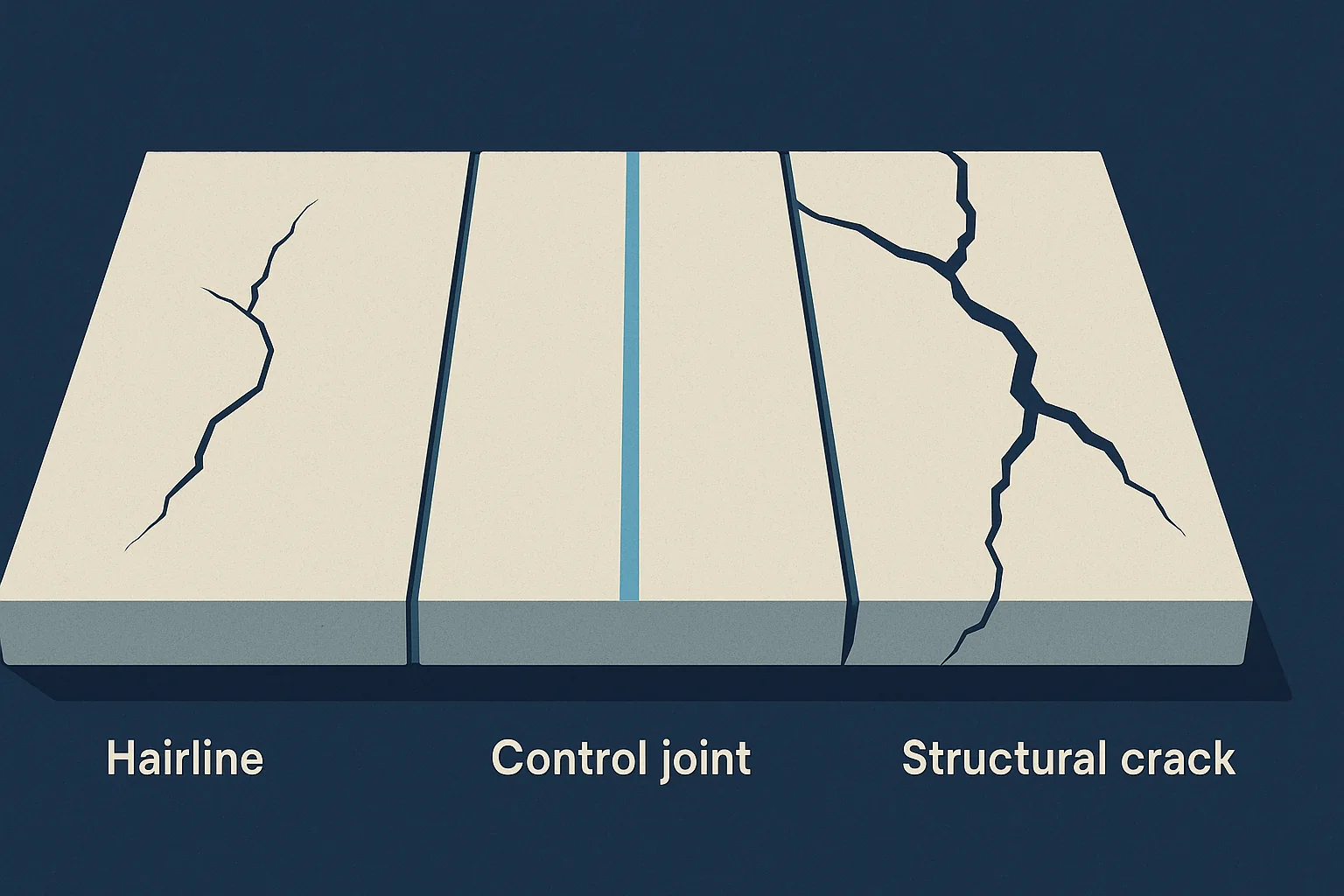

Nearly all concrete cracks. The useful question is not whether your driveway, patio, or garage slab has cracked but which mechanism produced it, because the mechanism tells you whether the crack is cosmetic, whether it will keep moving, and whether spending money now changes anything. A hairline map pattern and a crack with one side sitting lower are entirely different problems with entirely different price tags.
In This Guide
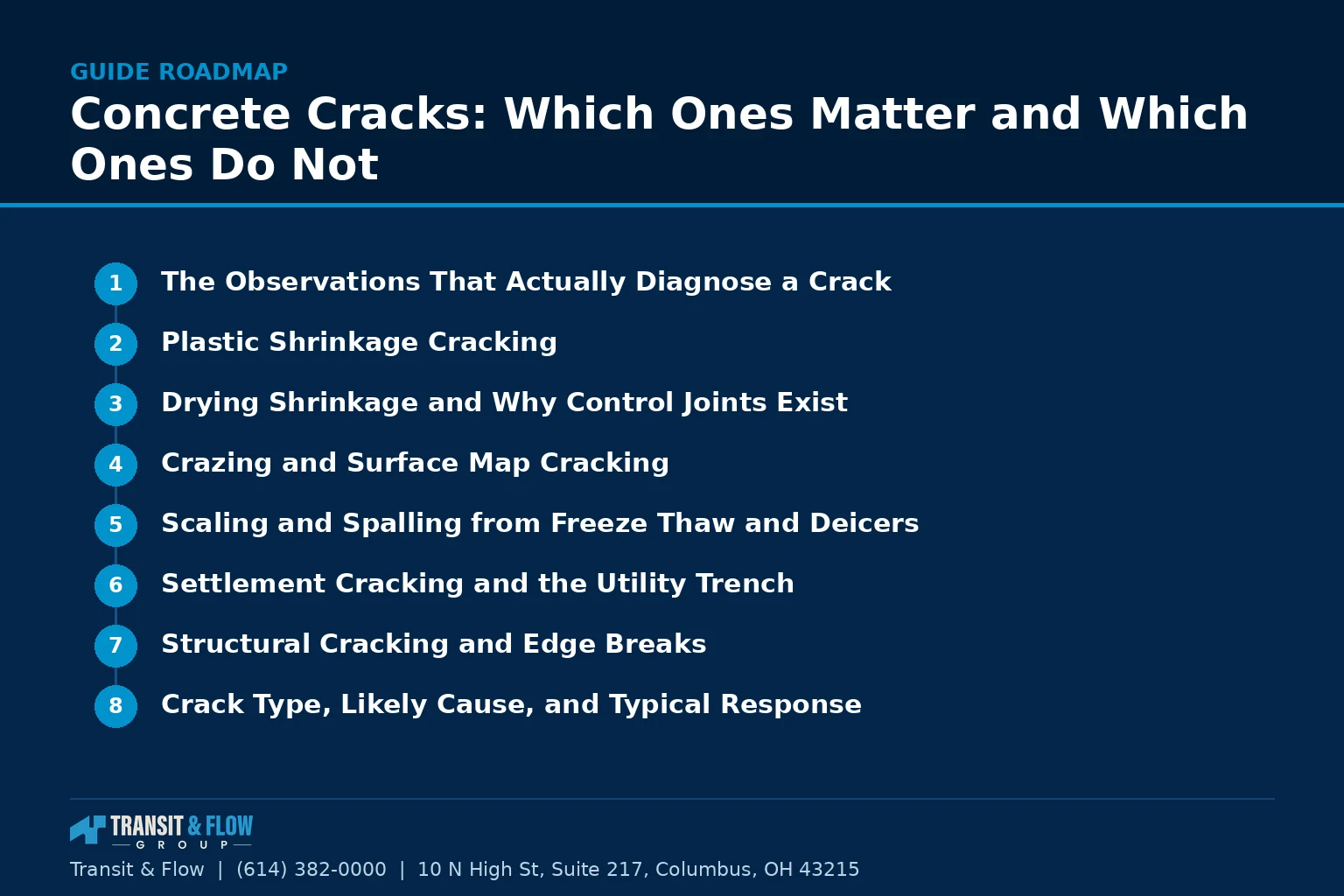
- The Observations That Actually Diagnose a Crack
- Plastic Shrinkage Cracking
- Drying Shrinkage and Why Control Joints Exist
- Crazing and Surface Map Cracking
- Scaling and Spalling from Freeze Thaw and Deicers
- Settlement Cracking and the Utility Trench
- Structural Cracking and Edge Breaks
- Crack Type, Likely Cause, and Typical Response
- When a Crack Is a Reason to Call a Professional
- What Each Repair Actually Accomplishes
- The Order of Operations Most People Get Backwards
- The Decision
- Where Transit & Flow Group Fits
- Frequently Asked Questions
Here is what most Central Ohio property owners get wrong. They treat crack width as the diagnostic. Width is the least informative thing about a crack. Pattern, location, edge condition, and whether the two sides sit in the same plane tell you far more, and cost nothing to observe. A wide crack that has not moved in fifteen years is a maintenance item. A tight crack that has opened since spring is a signal about what is happening under the slab.
The Observations That Actually Diagnose a Crack
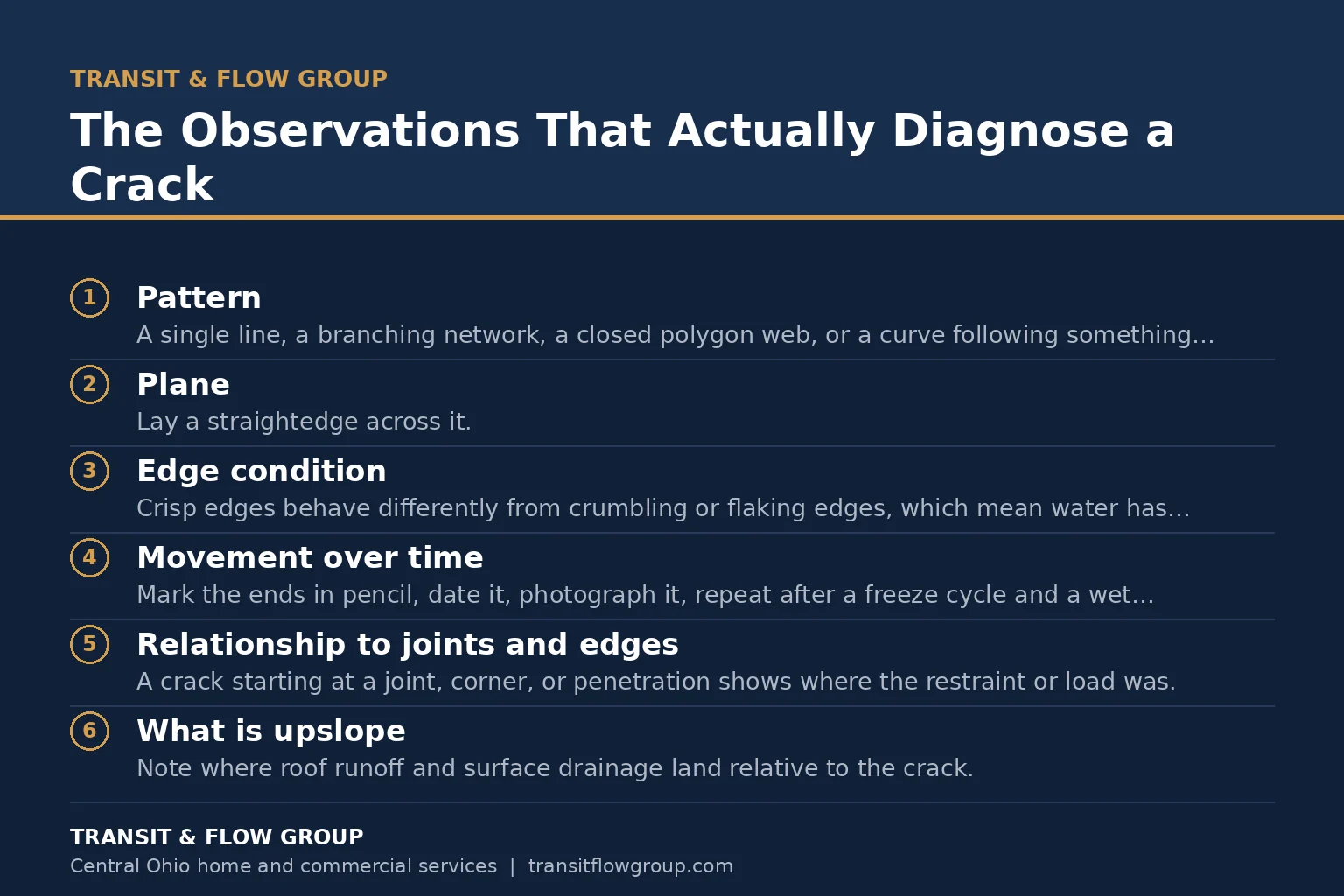
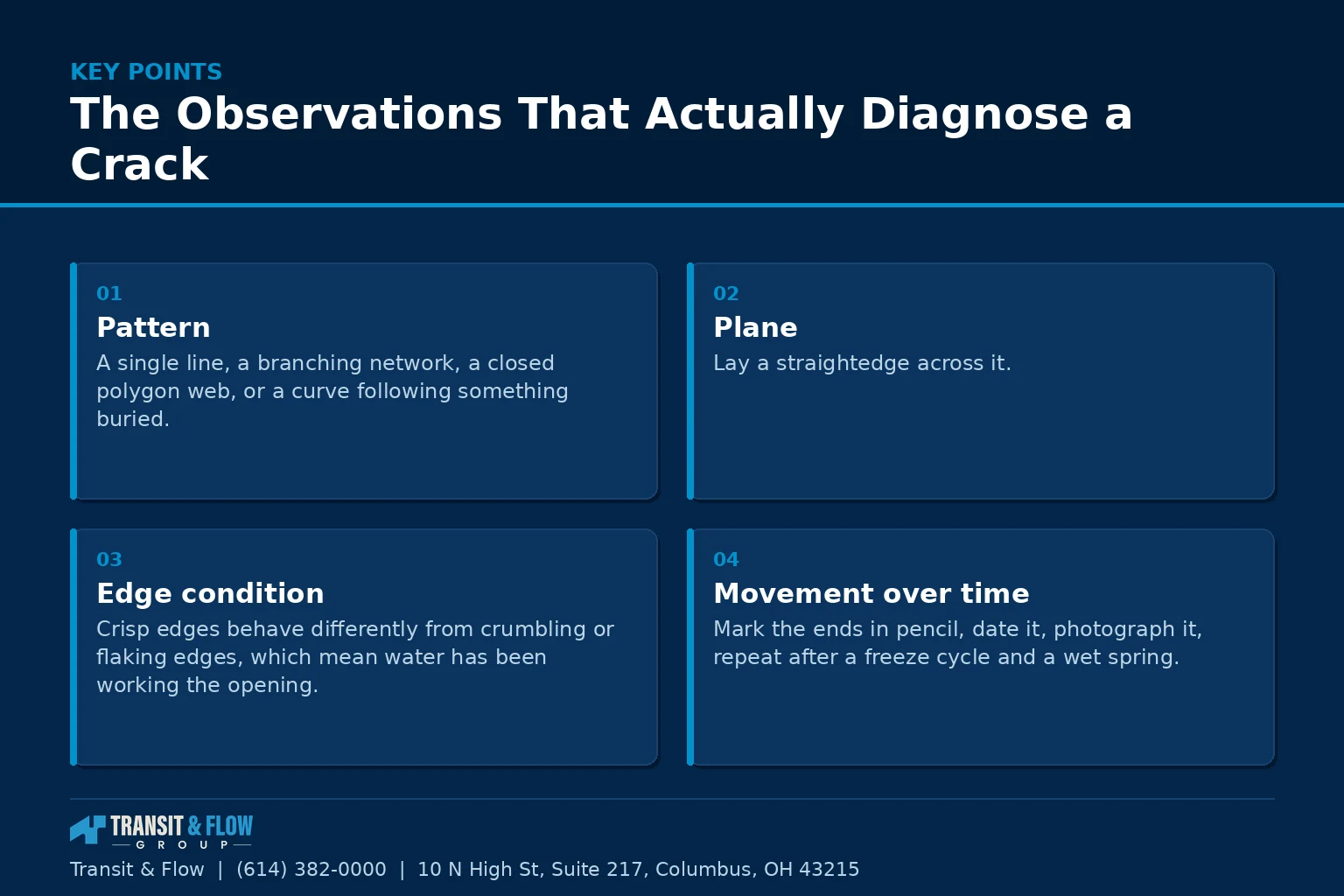
- Pattern. A single line, a branching network, a closed polygon web, or a curve following something buried. Each points somewhere different.
- Plane. Lay a straightedge across it. Sides flush means a shrinkage or restraint problem. One side lower means something under the slab moved.
- Edge condition. Crisp edges behave differently from crumbling or flaking edges, which mean water has been working the opening.
- Movement over time. Mark the ends in pencil, date it, photograph it, repeat after a freeze cycle and a wet spring. Stable and progressing get different answers.
- Relationship to joints and edges. A crack starting at a joint, corner, or penetration shows where the restraint or load was.
- What is upslope. Note where roof runoff and surface drainage land relative to the crack. Water is the variable behind most slab problems here.
Plastic Shrinkage Cracking
These form while the concrete is still plastic, during finishing or within hours of placement. The signature is short, roughly parallel, often diagonal cracks that do not reach the slab edges or go through the full thickness. They cluster, and look drawn on rather than broken through.
The cause is surface water evaporating faster than bleed water replaces it. Wind matters more than air temperature, which is why Central Ohio produces these on breezy spring days that feel mild rather than in August heat. It implicates site management: placing in evaporative conditions without a retarder, windbreaks, fogging, or prompt curing.
The cracks rarely widen much, but they admit water, and in a freeze and thaw climate any surface opening is a durability liability. Seal them, keep water off the slab, accept the cosmetic result. Replacement is almost never justified on plastic shrinkage alone.
Drying Shrinkage and Why Control Joints Exist
Concrete shrinks as it dries and keeps shrinking slowly long after. If the slab is restrained anywhere, by subgrade friction, a foundation wall, a post, or its own geometry, shrinkage produces tension, and concrete has very little tensile capacity. So it cracks. The only choice is whether it cracks where you told it to or where it decides.
That is the purpose of a control joint: a deliberately weakened line, tooled during finishing or saw cut shortly after, creating a plane where the crack forms below the surface where nobody sees it. Joints do not prevent cracking. They locate it.
A drying shrinkage crack that escaped the joint pattern is a single, relatively straight, full depth crack running from an edge or a reentrant corner, both sides still in plane. It shows up where a joint was cut too shallow, too late, or omitted. Panel proportion and spacing relative to thickness matter. Doorways, narrow strips beside a garage, and L shaped patios are the usual failure points.
It widens as drying continues, then stabilizes unless water gets in and freeze and thaw starts working the edges. Route and seal it, and accept that the crack is now the joint.
Crazing and Surface Map Cracking
Crazing is a network of very fine, shallow cracks forming closed irregular polygons, most visible as the surface dries after rain. It is nearly always cosmetic, living in the top skin of the paste.
The cause is a surface layer that dried or shrank differently from the concrete below. Overworking the surface, working bleed water back in, finishing too early, or curing inconsistently all produce it.
The crazing does not progress, but the practices that cause it frequently leave a weak surface layer, and that in a deicer exposure is the setup for scaling later. Read crazing on an exterior Central Ohio slab as a durability warning rather than damage, keep salts off it, and seal it.
Scaling and Spalling from Freeze Thaw and Deicers
Scaling is loss of the surface mortar, leaving a rough, pitted, sometimes aggregate exposed finish spreading in patches. Spalling is deeper loss, flaking in plates or breaking away along a crack or joint edge. Both are freeze and thaw damage, usually accelerated here by deicing chemicals.
Central Ohio is a hard freeze and thaw environment not because winters are extreme but because they are indecisive. The region crosses freezing repeatedly all season, and each crossing lets water in the pore structure expand. National Weather Service records are the honest reference for how many cycles a winter delivered.
Scaling implicates a short list: inadequate air entrainment for exterior exposure, water added at the truck to ease placement, finishing that trapped bleed water, or curing that stopped early. It can also implicate the owner, since deicing a first winter slab accelerates everything.
It progresses reliably and is the failure mode most likely to end in replacement. Surface repairs are temporary because the problem is in the material, not on it. Stop deicer exposure, seal if the surface will still take it, and plan panel replacement on a schedule you control rather than one the winter picks.
Settlement Cracking and the Utility Trench
This is the category where the concrete is innocent. The slab broke because the ground beneath it moved. One side has dropped relative to the other, the panel may tilt or dish, and the crack often curves rather than running straight, following the boundary of whatever failed below.
Two causes dominate here. The first is poorly compacted backfill over a utility trench. A trench for a water service, sewer lateral, gas line, or downspout drain backfilled loosely consolidates for years, and concrete poured across it inherits that timeline. A crack running a suspiciously straight line from the street is usually a trench.
The second is the soil. Central Ohio glacial till includes clay fractions that change volume with moisture, and the spring rainfall pattern delivers repeated saturation and drying. The NRCS Web Soil Survey tells you what is under your address rather than what the neighborhood generally has.
Trench settlement slows as backfill consolidates. Moisture driven movement continues as long as the moisture regime does, making it a drainage problem wearing a concrete costume. Replacing the slab without fixing the water buys a newer version of the same crack, so grading and downspout discharge are the actual repair.
Structural Cracking and Edge Breaks
Structural cracking is the label for a pattern indicating the slab was loaded beyond what it could carry, or a crack changing in a way the other categories do not explain. The markers are vertical displacement, a crack that widens along its length, cracks radiating from a load point, and cracks that read differently each check.
Edge and corner breaks are the loading case owners see most: an apron crumbling where delivery trucks turn, an edge fractured where a tire rides half on and half off. These point to edge thickness and perimeter base support more than to concrete quality.
This article states no crack width, displacement, or load capacity separating acceptable from unacceptable. Those determinations belong to a licensed professional engineer evaluating your slab, its reinforcement, thickness, support, and intended loading, under the adopted code published through the Ohio codes portal. Any number quoted as a universal threshold is a sales position, not a fact.
Crack Type, Likely Cause, and Typical Response
| What you see | Likely mechanism | Typical response |
|---|---|---|
| Short parallel diagonal cracks, surface only | Plastic shrinkage | Seal, monitor, accept |
| Single straight full depth crack, sides flush | Drying shrinkage with restraint | Route and seal as a joint |
| Fine closed polygon network in the top skin | Crazing | Keep deicers off, seal, watch for scaling |
| Surface mortar loss spreading in patches | Scaling from freeze thaw and deicers | Stop deicer use, plan panel replacement |
| Flaking or breaking along a joint edge | Spalling, water cycling in the opening | Repair the edge, seal it, fix drainage |
| One side lower, panel tilted or dished | Subgrade settlement | Fix drainage, then lift or replace |
| Curved crack tracking a line from the street | Utility trench consolidation | Lift or replace once movement slows |
| Widening crack with vertical offset | Possible structural | Professional evaluation first |
| Broken corner or crumbled apron edge | Edge loading, thin edge support | Partial replacement of that section |
When a Crack Is a Reason to Call a Professional
- Vertical displacement. Flush sides mean the slab moved in plane. Offset sides mean the ground moved, and the repair must address the ground.
- Documented progression. A marked and photographed crack that reads differently across seasons has an active cause.
- Any crack on a slab that supports something. A garage slab carrying a post, a stoop tied to the house, a slab bearing on a foundation element. That is no longer flatwork.
- Interior symptoms at the same time. Sticking doors or drywall cracks at openings alongside exterior movement suggest one cause acting site wide.
- Cracking near a foundation wall. Different mechanism, different stakes, covered in our guide to foundation cracks and when to involve an engineer.
- New water intrusion. If slab movement coincides with water entering the structure, read our Central Ohio wet basement guide first.
- Voids under the slab. A hollow sound when tapped, or flex underfoot, means support is gone. That is a subgrade evaluation, not a crack repair.
What Each Repair Actually Accomplishes
- Crack sealing. Flexible sealant keeping water and debris out. It buys durability and nothing else, restoring no continuity and stopping no movement. Wrong when sides are offset.
- Routing and sealing. Cutting the crack into a clean reservoir, then sealing. The durable version, because the sealant has geometry to work with and can take seasonal movement. Right for stable shrinkage cracks, useless for scaling.
- Epoxy or polyurethane injection. Structural epoxy can restore continuity in a crack that is not moving. Polyurethane fills and seals a crack that is wet or moving. Neither suits ongoing settlement, since you would bond a slab across a growing void.
- Slabjacking or polyurethane lifting. Grout or foam injected beneath a settled slab to fill voids and raise it to plane. It corrects elevation and restores support, full stop. It cannot repair a broken slab or fix the drainage that caused the settlement. Wrong on a slab that is scaling or badly fractured.
- Partial panel replacement. Saw cutting and replacing panels to existing joint lines. A genuine reset of the failed area at a fraction of full cost, correct when damage is confined and the base is sound or fixable in that footprint. Its limit is cosmetic: new concrete will not match weathered concrete for years.
- Full replacement. Removal and repour with the base reworked and joints laid out properly. It fixes base preparation, slope, thickness, and joint pattern, which nothing else does. Wrong while water management remains uncorrected, because you will buy the same slab twice.
- Resurfacing and overlays. A thin cementitious layer over the existing slab. It buys appearance only, adds no structure, stops no movement, and reflects every active crack beneath it within a few cycles. Wrong for anything but a sound slab with a cosmetic surface problem.
The Order of Operations Most People Get Backwards
The instinct is to fix the concrete first and look at the site afterward. That order is wrong whenever water is involved, which here is most of the time. Runoff, grading, and any subsurface drain act on the subgrade. Correct those, let a season pass, then evaluate the slab.
Jurisdiction matters too. Replacement in the right of way, including an apron or the sidewalk portion of a drive, is often permitted and inspected separately, and requirements differ between Columbus, Dublin, Westerville, and the surrounding townships. Confirm which authority governs your address and that whoever does the work is registered there, which our guide on verifying a contractor in Ohio covers.
The Decision
Option A. Treat the crack as a concrete problem. Collect quotes to seal, resurface, lift, or replace, and choose on price.
Option B. Diagnose the mechanism first. Record pattern, plane, edge condition, and movement across one seasonal cycle. Correct drainage before touching concrete. Then match the method to the mechanism, and involve a licensed professional wherever displacement, progression, or structural support is in play.
Recommendation: Option B, and the diagnostic phase costs almost nothing. The asymmetry is stark. A misdiagnosed crack means paying for a repair aimed at the wrong mechanism, then paying again when it returns, at higher cost. Sometimes the right answer is to seal it and stop thinking about it, the cheapest outcome available and the one nobody selling concrete volunteers. Two moves capture most of the value: mark and date the crack before you call anyone, and fix where the water goes before you fix what the water did.
Where Transit & Flow Group Fits
We evaluate flatwork and slab conditions across Central Ohio and scope work around the mechanism rather than the symptom. That means diagnosing the cracking before quoting a repair, addressing drainage and subgrade inside the scope rather than as a later upsell, laying out joints correctly on new work, and saying plainly when the answer is monitoring instead of spending. If you want cracking read accurately before committing money, start a conversation with our team.
Transit & Flow Group coordinates projects and partners with properly licensed and insured specialty contractors when licensing is required, and work is performed under the appropriate permits.
Frequently Asked Questions
Is it normal for new concrete to crack
Some cracking is expected because concrete shrinks as it cures and it is not strong in tension. That is why joints exist. The question is not whether a slab cracked, it is whether the crack landed where the design intended and whether the two sides are still level with each other.
What is the difference between a shrinkage crack and a structural crack
Shrinkage cracks are usually narrow, appear early, and leave both sides of the slab in the same plane. Cracks that indicate a support or movement problem tend to widen over time, show vertical offset between the two sides, or continue through joints and edges rather than stopping at them.
Should I fill every crack I see
No. Filling a crack that is still moving simply relocates the failure and can trap water. Establish whether the crack is stable first by monitoring width and offset across a full seasonal cycle, then choose a treatment that matches the cause you identified.
Do cracks mean the concrete was low quality
Not necessarily, and blaming the mix is the most common misread. Placement conditions, curing, joint spacing and timing, and the support beneath the slab all influence cracking. A good mix placed on a poor base still cracks in the pattern the base dictates.
What does a crack with a height difference between the sides mean
Vertical offset means the two sides of the slab are no longer supported the same way, which points at the base or the soil rather than the concrete. That is a different repair conversation than a hairline crack, and it usually needs someone to look at what water is doing on that part of the property.
When does cracking justify replacement instead of repair
Replacement becomes the rational choice when the cracking is widespread, when sections have moved relative to each other, or when the cause sits underneath the slab and cannot be corrected without removing it. Repairing the surface over an unresolved base problem buys time, not a solution.
Sources
- Federal Highway Administration, concrete pavement distress and repair practice
- NIST Engineering Laboratory, cement and concrete materials research
- International Code Council, Ohio codes, the adopted code text governing structural determinations
- USDA NRCS Web Soil Survey, soil composition and behavior by specific address
- National Weather Service, Wilmington Ohio, temperature and precipitation records for Central Ohio
About This Guide
Written and edited by Micheal Parker, founder of Transit & Flow Group. Published May 12, 2027. This guide is checked against the agency and code sources listed above, and it is revised when those sources change.
General contractor of record. Micheal Parker holds City of Columbus General Contractor Registration G12064, issued by the Columbus Department of Building and Zoning Services under Transit & Flow LLC and valid through June 30, 2027. Trade work that falls outside the scope of that registration is performed by licensed trade partners, and the responsible license holder is identified before work begins.
Transit & Flow Group, home and commercial services for Columbus and the surrounding Central Ohio communities. Phone (614) 382-0000. Email solutions@transitflowgroup.com. 10 N High St, Suite 217, Columbus, OH 43215. Contact our team or review the communities we serve.
