


Records win claims. Not memory, not intensity of conviction, and not how obviously true the damage looks to the person who lives there. This article is about the records system itself, the one you build before a storm and operate during one, so that what you hand over is complete rather than assembled from a phone gallery under pressure. It supports our roofing and restoration work.
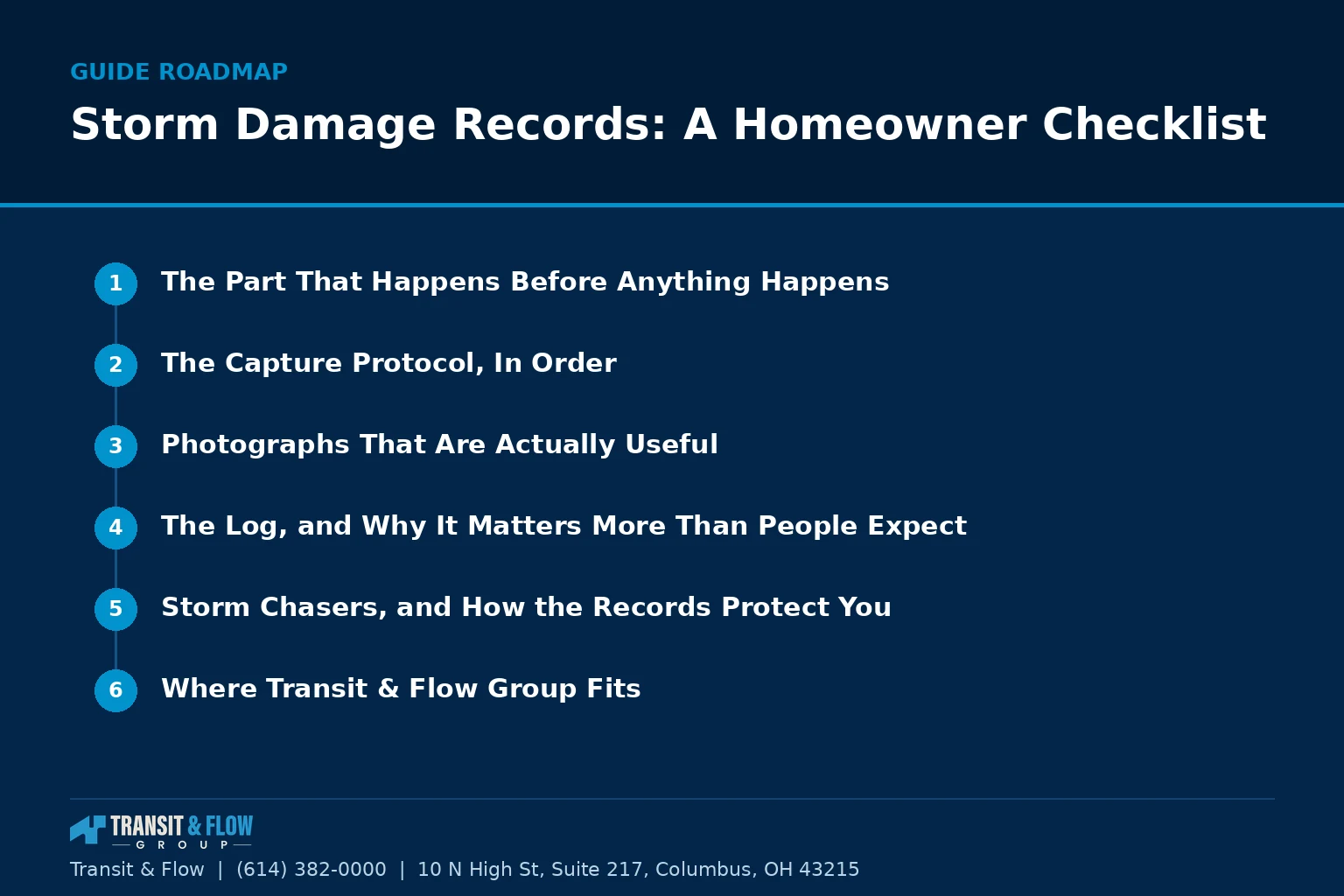
In This Guide
- The Part That Happens Before Anything Happens
- The Capture Protocol, In Order
- Photographs That Are Actually Useful
- The Log, and Why It Matters More Than People Expect
- Storm Chasers, and How the Records Protect You
- Where Transit & Flow Group Fits
- Frequently Asked Questions
Transit & Flow Group coordinates projects and partners with properly licensed and insured specialty contractors when licensing is required.
Read this first. This is general process information about record keeping. It is not insurance advice, it is not legal advice, and it does not interpret your policy. Your policy terms and your carrier govern what is covered, and questions about coverage belong with your carrier, your agent, or a licensed public adjuster. On safety, do not get on a roof after a storm, do not approach downed lines or anything they are touching, and do not enter a structure with visible movement or a sagging ceiling.
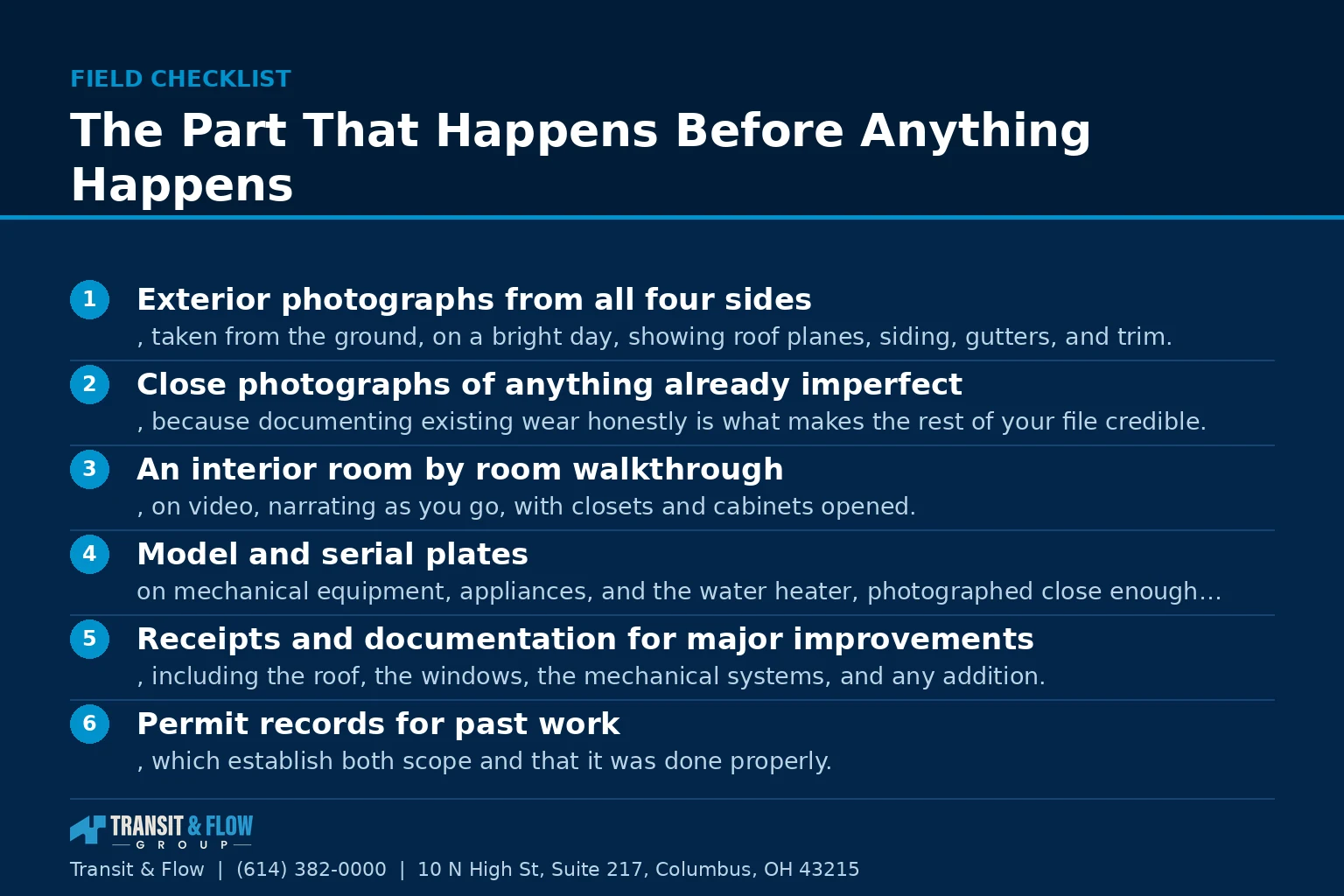
The Part That Happens Before Anything Happens
The strongest record in any storm file is the one created on a clear day. It establishes condition before the event, which is the single hardest thing to prove afterward and the point on which disagreements most often turn.
- Exterior photographs from all four sides, taken from the ground, on a bright day, showing roof planes, siding, gutters, and trim.
- Close photographs of anything already imperfect, because documenting existing wear honestly is what makes the rest of your file credible.
- An interior room by room walkthrough, on video, narrating as you go, with closets and cabinets opened.
- Model and serial plates on mechanical equipment, appliances, and the water heater, photographed close enough to read.
- Receipts and documentation for major improvements, including the roof, the windows, the mechanical systems, and any addition.
- Permit records for past work, which establish both scope and that it was done properly.
- A copy of your policy declarations page, stored where a fire or flood cannot reach it.
- All of it stored off site, in cloud storage or with a family member. A record that lives only on a device inside the house is not a record.
Refresh this once a year. Tie it to something you already do, such as the seasonal heating check, so it does not depend on remembering.
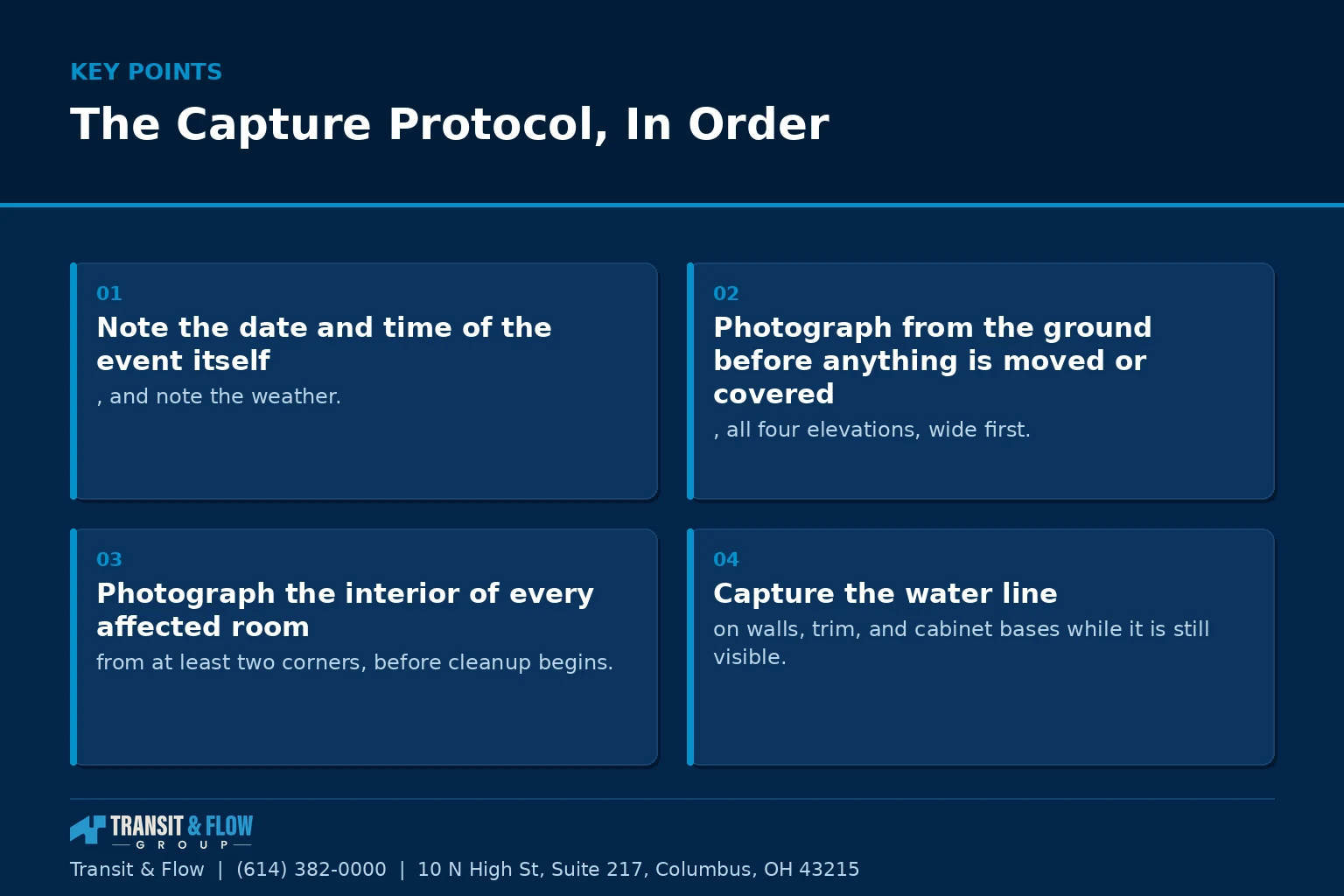
The Capture Protocol, In Order
- Note the date and time of the event itself, and note the weather. Regional weather records are public and available afterward, and a specific event date anchors the entire file.
- Photograph from the ground before anything is moved or covered, all four elevations, wide first.
- Photograph the interior of every affected room from at least two corners, before cleanup begins.
- Capture the water line on walls, trim, and cabinet bases while it is still visible. It fades, and it is the clearest single piece of evidence about depth.
- Photograph damaged contents individually, including brand and model where visible, before anything is discarded.
- Document temporary protection as you install it, including tarps, board-up, and any diversion, with a photograph before and after.
- Keep every receipt, including materials, equipment rental, lodging, meals if displaced, and the emergency trade call that stopped the damage.
- Start a written log immediately and keep it running, recording every call, every visit, every name, and every promise, with dates and times.
- Do not discard anything until it has been documented and released, including materials that are obviously destroyed.
- Back up the whole file off site the same day. Not next week.
Photographs That Are Actually Useful
Most homeowner storm files fail in the same way. They contain forty close-up photographs of damage and nothing that establishes where in the house any of it is.
- Shoot in a wide, medium, close sequence at every location, so any close shot can be placed in the building by anyone reviewing the file.
- Include a scale reference, a tape measure or a common object, in close shots of dimensional damage.
- Leave timestamps on, and do not edit, crop aggressively, or enhance images. Original files carry their own data and that data is part of what makes them useful.
- Photograph the undamaged as well as the damaged, since an adjuster establishing scope needs the boundary and you benefit from it being accurate.
- Use video with narration for walkthroughs and stills for specific items. Video is fast and complete, stills are precise.
- Photograph from a fixed position on repeat visits, so progression over days is visible in a consistent frame.
- Stay off the roof. Ground level and upper story windows cover more than people assume, and a qualified inspection produces the roof photographs.
Where the damage is specifically to the roof, our article on roof storm damage documentation covers what a competent roof inspection records that a homeowner cannot capture from the ground.
The Log, and Why It Matters More Than People Expect
A storm response involves a lot of people over several weeks and almost all of the coordination happens verbally. A running log converts that into a record. Every entry takes fifteen seconds and the cumulative value is disproportionate.
- Date, time, name, company, and role for every contact.
- What was said, in one line, particularly anything committed to or scheduled.
- Every document received, when it arrived, and from whom.
- Every document signed, with a copy retained, and this applies with special force to any assignment of benefits. Do not sign a document transferring your claim rights without reading it away from the person presenting it.
- What was mitigated and when, because a duty to take reasonable steps to prevent further damage is a standard feature of property policies and your log is the evidence you met it.
- Any verbal approval or denial, followed by a short written confirmation of your understanding sent to the same person.
On cost: this article contains no dollar figures on purpose. Storm response scope varies with the extent of damage, the materials affected, temporary protection required, whether the structure is habitable, and what reconstruction follows. Any published range would be wrong for most readers. Get a written scope on your actual loss.
Storm Chasers, and How the Records Protect You
A significant storm brings operators into the area who were not here before it and will not be here after. Complete records are the practical defense, because they let you take your time. When you can prove condition and extent independently, you do not need anyone to inspect quickly, and you do not need to sign anything on the day.
Verify anyone who knocks using the method in our article on verifying a contractor in Ohio, and treat urgency itself as the signal. A legitimate contractor will still be available tomorrow.
Option A is documenting after an event, thoroughly, at the time it happens. Option B is maintaining a standing pre-loss record refreshed annually and then executing the capture protocol on top of it. My recommendation is Option B. Option A is entirely workable and most people do it, but it leaves the hardest question unanswered, which is what the property looked like the day before. That single gap is where storm claims turn into disagreements. An hour on a clear Saturday closes it permanently, and the same file serves an appraisal, a sale, and a maintenance history. For the response side of a water event, our first 48 hours guide covers what happens alongside the documentation.
Where Transit & Flow Group Fits
Transit & Flow Group coordinates roofing and restoration work across Columbus and Central Ohio and partners with properly licensed and insured specialty contractors when licensing is required. Our standard is that inspection findings are recorded photographically and delivered to the homeowner as their own file rather than held internally, that we do not ask for a signature on a first visit, and that we do not offer opinions on what your policy covers, which is your carrier’s role. To get a documented storm assessment, contact us.
Frequently Asked Questions
What is the most valuable storm record I can create?
The one made on a clear day, before anything happens. It establishes the condition of the property before the event, which is the single hardest thing to prove afterward and the point on which disagreements most often turn. Exterior photographs from all four sides taken from the ground on a bright day, an interior video walkthrough with closets and cabinets opened, model and serial plates on mechanical equipment and appliances, receipts for major improvements, and permit records for past work all belong in it. Refresh it once a year and tie it to something you already do, such as the seasonal heating check.
What order should I document things in after a storm?
Work outward from the event and capture what fades first. Note the date and time of the event and the weather, since regional weather records are public and a specific date anchors the whole file. Photograph all four elevations from the ground before anything is moved or covered, then every affected room from at least two corners before cleanup begins, then the water line on walls, trim, and cabinet bases while it is still visible. Photograph damaged contents individually before anything is discarded, document temporary protection as you install it, keep every receipt, and back the whole file up off site the same day.
Why do most homeowner photo files fail?
They contain forty close-up photographs of damage and nothing that establishes where in the house any of it is. Shoot a wide, medium, close sequence at every location so any close shot can be placed in the building by anyone reviewing the file. Include a scale reference such as a tape measure in close shots of dimensional damage, leave timestamps on, and do not edit, crop aggressively, or enhance images, because the original files carry data that is part of what makes them useful. Photograph the undamaged areas as well, since anyone establishing scope needs the boundary and you benefit from it being accurate.
Should I get on the roof to take pictures?
No. Do not get on a roof after a storm, do not approach downed lines or anything they are touching, and do not enter a structure with visible movement or a sagging ceiling. Ground level and upper story windows cover more than people assume, and the roof photographs are what a qualified inspection produces. That is a safety boundary rather than a documentation preference.
Why does a written log matter so much?
Because a storm response involves a lot of people over several weeks and almost all of the coordination happens verbally. A running log converts that into a record, and every entry takes about fifteen seconds. Record the date, time, name, company, and role for every contact, one line on what was said, every document received and from whom, and every document signed with a copy retained. Also log what was mitigated and when, because a duty to take reasonable steps to prevent further damage is a standard feature of property policies and the log is your evidence that you met it.
How do good records protect me from storm chasers?
They let you take your time, which is the whole defense. A significant storm brings operators into the area who were not here before it and will not be here after, and their leverage comes from urgency. When you can prove condition and extent independently, you do not need anyone to inspect quickly and you do not need to sign anything on the day. Be especially careful with any assignment of benefits, and do not sign a document transferring your claim rights without reading it away from the person presenting it. Verify anyone who knocks, and treat urgency itself as the signal, because a legitimate contractor will still be available tomorrow.
Sources
- Ohio Attorney General, consumer protection guidance on home solicitation and storm contracting
- Ohio Construction Industry Licensing Board, contractor licensing verification
- National Roofing Contractors Association, roofing system references
About This Guide
Written and edited by Micheal Parker, founder of Transit & Flow Group. Published December 13, 2026. This guide is checked against the agency and code sources listed above, and it is revised when those sources change.
General contractor of record. Micheal Parker holds City of Columbus General Contractor Registration G12064, issued by the Columbus Department of Building and Zoning Services under Transit & Flow LLC and valid through June 30, 2027. Trade work that falls outside the scope of that registration is performed by licensed trade partners, and the responsible license holder is identified before work begins.
Transit & Flow Group, home and commercial services for Columbus and the surrounding Central Ohio communities. Phone (614) 382-0000. Email solutions@transitflowgroup.com. 10 N High St, Suite 217, Columbus, OH 43215. Contact our team or review the communities we serve.
