
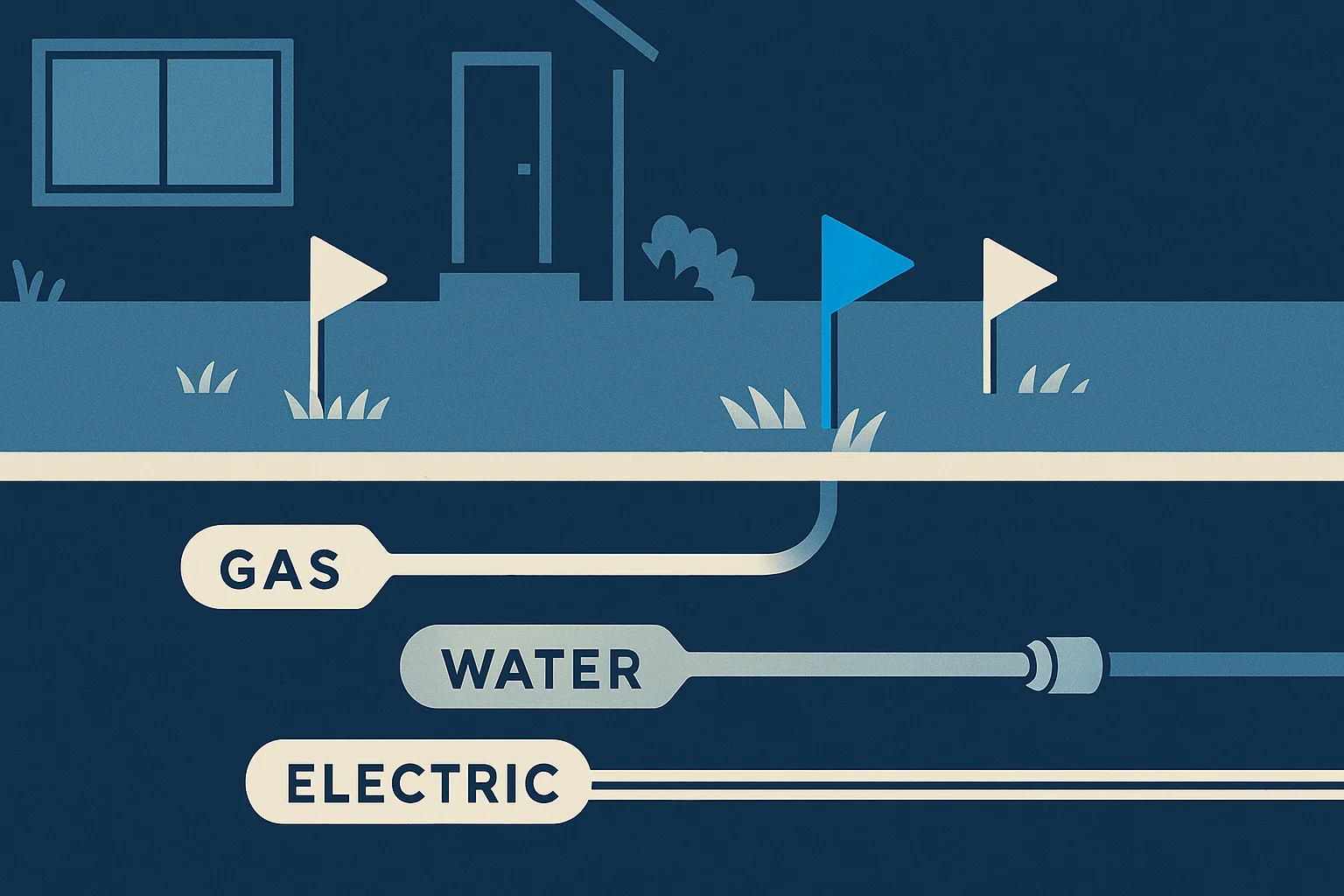

Before anyone puts a shovel, an auger, or a trencher into the ground in Ohio, the law requires notice. It is not a courtesy, it is a statutory obligation, and it exists because buried gas, electric, water, and communications lines share the same few feet of soil as your sewer lateral. This guide explains what the law requires, how the notification process works, what the paint colors on your lawn mean, and what to verify before a contractor breaks ground on your property. It is part of our drain and sewer guide, and it accompanies our look at basement floor drain backups.
In This Guide
- What Ohio Law Requires
- How the Process Actually Works
- What the Colors Mean
- What the Locate Does Not Cover
- If You Strike a Line
- What to Verify Before Your Contractor Digs
- Three Kinds of Locate Compared
- What Goes Wrong and Why
- Where Transit & Flow Group Fits
- Frequently Asked Questions
Transit & Flow Group coordinates projects and partners with properly licensed and insured specialty contractors when licensing is required.
What Ohio Law Requires
Ohio Revised Code section 3781.28 sets the notice requirement. In the words of the statute, notice must be provided “at least two working days, not including the day of the notification, but not more than sixteen calendar days before commencing excavation.”
Two details in that sentence carry practical weight. “Working days” excludes Saturdays, Sundays, and legal holidays, so a Thursday notice does not clear a Saturday dig. And the sixteen-day ceiling means a ticket does not stay valid indefinitely; a project that slips several weeks needs a fresh notification rather than a reliance on old marks.
This article summarizes the statute for planning purposes and is not legal advice. Read the current text of the sections cited at the end, and confirm the specific requirements and any local rules that apply with your jurisdiction and your utility before excavation begins.
How the Process Actually Works
- The excavator files a notice describing the location and the nature of the planned work. This is done by phone or online, and it generates a ticket number.
- The notification center distributes the ticket to every member utility with facilities in the area described.
- Each utility responds within the statutory window, either by marking its underground facilities or by indicating it has none in the area.
- Marks appear on the ground in paint, flags, or both, in standardized colors.
- The excavator verifies the response is complete before digging, and this is the step most often skipped.
- Excavation proceeds with care near the marks, using hand digging or vacuum excavation within the tolerance zone around a marked facility rather than mechanized equipment.
- Marks are maintained through the work and a fresh ticket is filed if the project runs past the ticket’s life.
What the Colors Mean
The color code is a national standard, so the paint on your lawn reads the same in Columbus as it does anywhere else.
- Red. Electric power lines, cables, conduit, and lighting cables.
- Yellow. Gas, oil, steam, petroleum, and other flammable or gaseous material. Treat yellow as the highest-consequence marking on your property.
- Orange. Communications, alarm and signal lines, cable, and conduit.
- Blue. Potable water.
- Green. Sewers and drain lines.
- Purple. Reclaimed water, irrigation, and slurry lines.
- Pink. Temporary survey markings.
- White. Proposed excavation, marked by the excavator before the utilities arrive to show them where the work will occur.
White is the one homeowners rarely recognize and the one that most improves accuracy. When the dig area is pre-marked in white, locators know exactly where to concentrate.
What the Locate Does Not Cover
This is the gap that produces most homeowner surprises, and it deserves to be stated plainly.
- Privately owned lines are generally not marked. The utility marks its own facilities up to the point of service. The gas line running from the meter to a detached garage, the electric feed to a shed, the irrigation system, the invisible fence, and in most cases your sewer lateral itself are yours, and locating them is a separate private locate service.
- Depth is not guaranteed. Marks indicate horizontal position, not how deep the line runs. Soil moves, grades change, and depth assumptions have caused a great many strikes.
- Accuracy has a tolerance. The mark represents an approximate centerline, which is why the law requires careful, non-mechanized excavation within the tolerance zone.
- Marks expire. Paint fades, flags get mowed, and the ticket has a defined life. Old marks are not a current locate.
If You Strike a Line
Damage to a gas line is a life-safety emergency, not a repair problem. The sequence matters.
- Stop work immediately and leave the area on foot, moving upwind and uphill, and take everyone with you.
- Do not operate anything that could produce a spark. No equipment, no vehicles, no light switches, no phones until you are well clear of the area.
- Do not attempt to stop the leak, cover it, or repair it.
- Call 911 from a safe distance, then call the utility operator.
- Keep others away until emergency responders arrive and take control.
- Report any damage to any line, even minor nicks. A scored coating on an electric or gas line becomes a failure later, and unreported damage is both a hazard and a liability.
What to Verify Before Your Contractor Digs
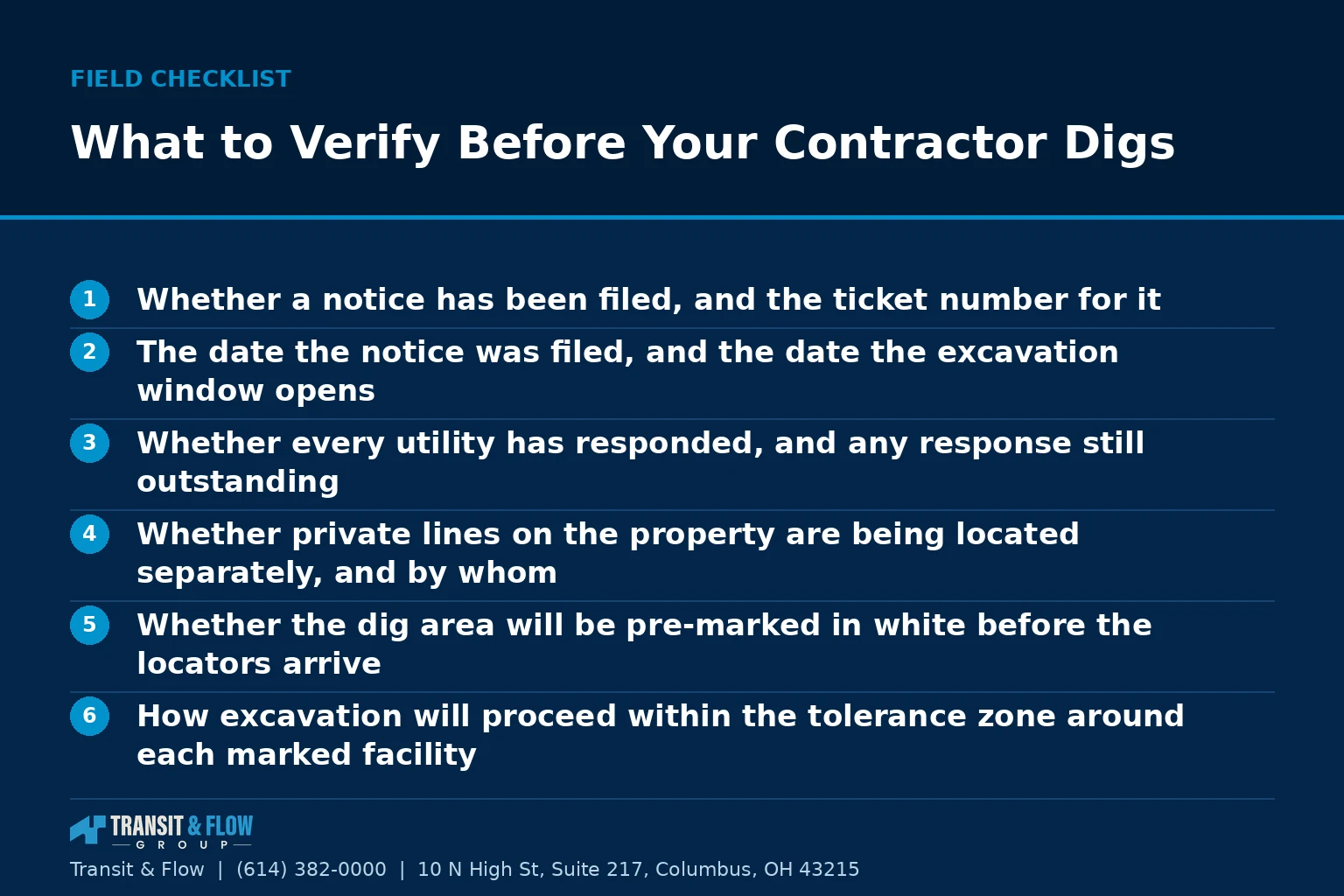
- Whether a notice has been filed, and the ticket number for it.
- The date the notice was filed, and the date the excavation window opens.
- Whether every utility has responded, and any response still outstanding.
- Whether private lines on the property are being located separately, and by whom.
- Whether the dig area will be pre-marked in white before the locators arrive.
- How excavation will proceed within the tolerance zone around each marked facility.
- Who files the new notice if the schedule slips past the ticket window.
- Whether the permit for the work is separate from the locate, and who is pulling it.
Ask for the ticket number in writing. A contractor who cannot produce one is telling you something important about the rest of the job.
Three Kinds of Locate Compared
Homeowners often assume one phone call produces a complete picture of what is under the yard. It does not. Three distinct services exist, they cover different things, and only the first is triggered by the statutory notice.
| Service | What it covers | Who arranges it | What it leaves out |
|---|---|---|---|
| Standard utility locate | Member utility facilities up to the point of service | The excavator, through the statutory notice | Everything privately owned past the meter or the point of service |
| Private locate | Owner-side lines such as a feed to a detached structure, irrigation, or a lateral | The property owner or the contractor, as a separate engagement | Facilities the standard locate already marks, and anything undetectable by the method used |
| Subsurface investigation | Direct confirmation of a facility by exposing it with hand or vacuum methods | The contractor, usually where a marked line crosses the planned work | Areas outside the specific points investigated |
On a residential project that crosses the front yard, the standard locate plus a private locate is the sensible baseline. Where a marked line runs through the planned excavation rather than near it, confirming the facility directly is the step that prevents the strike.
What Goes Wrong and Why
Strikes are rarely the result of someone ignoring the law outright. They come from a small set of process failures that repeat across jobs, and each one is visible before the shovel moves.
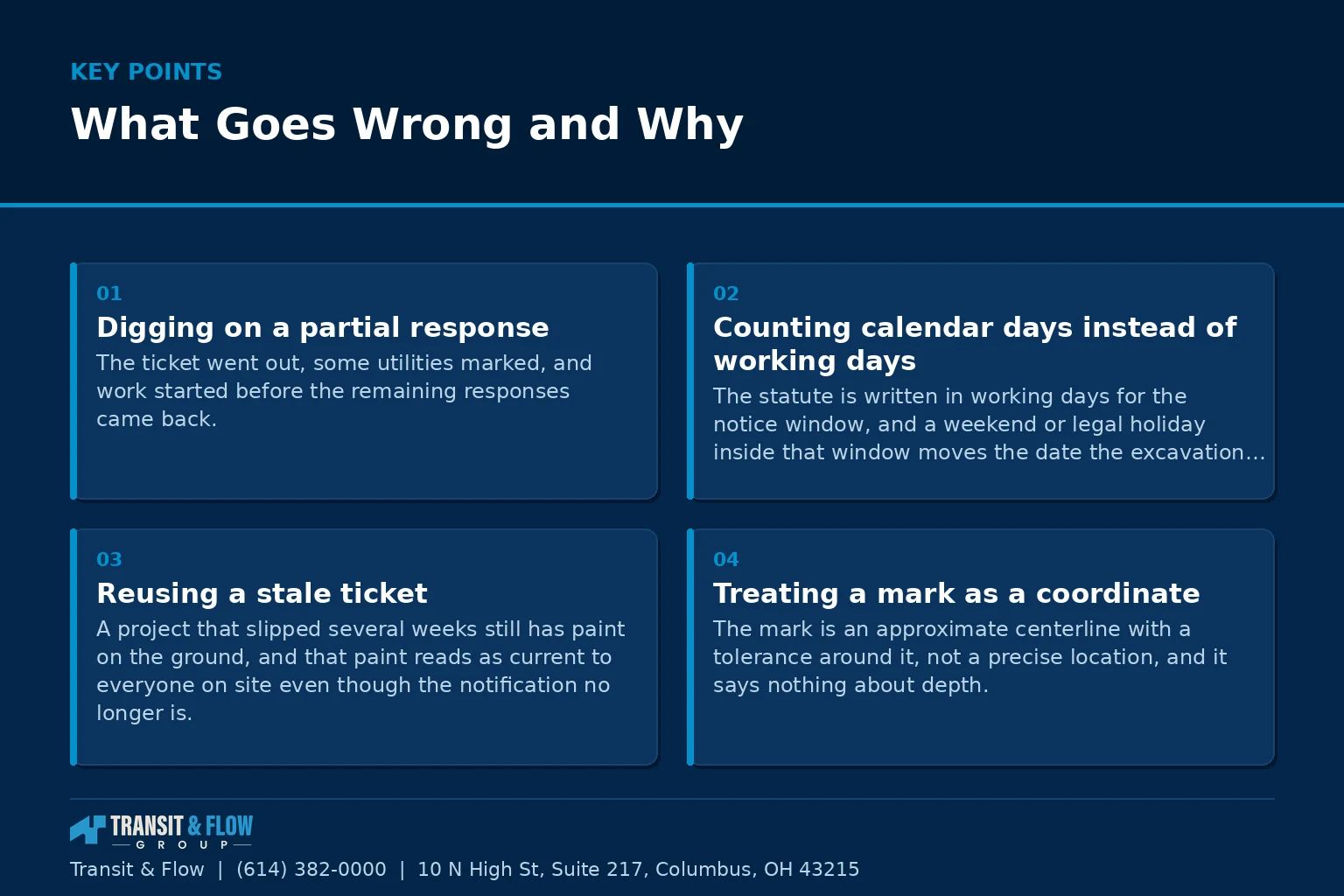
- Digging on a partial response. The ticket went out, some utilities marked, and work started before the remaining responses came back. An unmarked facility looks identical to an absent one.
- Counting calendar days instead of working days. The statute is written in working days for the notice window, and a weekend or legal holiday inside that window moves the date the excavation window opens.
- Reusing a stale ticket. A project that slipped several weeks still has paint on the ground, and that paint reads as current to everyone on site even though the notification no longer is.
- Treating a mark as a coordinate. The mark is an approximate centerline with a tolerance around it, not a precise location, and it says nothing about depth.
- Assuming the private lines were included. The single most common homeowner surprise, and the one that most often damages something the homeowner then pays to replace.
- Nobody owning the paperwork. When the notice, the private locate, and the permit each belong to a different party by assumption rather than by agreement, at least one of them does not happen.
Where Transit & Flow Group Fits
On any drain and sewer project that involves excavation across Columbus and Central Ohio, Transit & Flow Group treats the notice, the locate, and the permit as scope items that appear on the written proposal rather than as assumptions. You get the ticket number, the marks stay maintained through the work, and the schedule is built around the statutory window instead of against it. Where a project touches broader plumbing services, one coordinator carries it. To plan work that involves digging, request an assessment.
Frequently Asked Questions
How far in advance does Ohio law require notice before digging?
Ohio Revised Code section 3781.28 requires notice at least two working days, not counting the day of notification, and not more than sixteen calendar days before excavation begins. Working days exclude Saturdays, Sundays, and legal holidays, so a Thursday notice does not clear a Saturday dig. The sixteen day ceiling also means a ticket does not stay valid indefinitely, and a project that slips several weeks needs a fresh notification rather than reliance on old marks. This is a summary for planning purposes and not legal advice, so read the current statute and confirm local rules with your jurisdiction and utility.
Does the locate cover the lines on my own property?
Generally not. The utility marks its own facilities up to the point of service, which leaves the gas line running from the meter to a detached garage, the electric feed to a shed, irrigation, an invisible fence, and in most cases the sewer lateral itself outside the standard locate. Those are privately owned, and finding them is a separate private locate service that someone has to arrange and pay for. Establish before the dig who is locating the private lines, because assuming they were included is one of the most common homeowner surprises.
Do the marks show how deep a line is buried?
No. The marks indicate horizontal position only, and depth is not guaranteed by the locate. Soil moves and grades change over time, and depth assumptions have caused a great many strikes. The mark also represents an approximate centerline rather than an exact one, which is why the law requires careful hand digging or vacuum excavation within the tolerance zone rather than mechanized equipment.
What do the paint colors on the lawn mean?
The color code is a national standard, so the marks read the same in Columbus as anywhere else. Red is electric power, yellow is gas, oil, steam, petroleum, and other flammable or gaseous material, orange is communications and signal lines, blue is potable water, green is sewer and drain, purple is reclaimed water and irrigation, and pink is temporary survey marking. White is the one homeowners rarely recognize, and it is the excavator’s pre-marking of the proposed dig area. Treat yellow as the highest consequence marking on the property.
What should happen if a line is struck during excavation?
Damage to a gas line is a life safety emergency rather than a repair problem. Work stops, everyone leaves the area on foot moving upwind and uphill, and nothing that could produce a spark gets operated, including equipment, vehicles, light switches, and phones, until well clear. No one should attempt to stop, cover, or repair the leak. Call 911 from a safe distance, then the utility operator, and keep others away until responders take control. Damage to any line, including a minor nick, gets reported, because a scored coating becomes a failure later.
What should I confirm with a contractor before they break ground?
Ask for the ticket number in writing, along with the date the notice was filed and the date the excavation window opens. Confirm that every utility has responded, that private lines are being located separately and by a named party, and that the dig area will be pre-marked in white before the locators arrive. Establish how excavation will proceed inside the tolerance zone, who files a new notice if the schedule slips, and whether a permit is required separately from the locate. A contractor who cannot produce a ticket number is telling you something important about the rest of the job.
Sources
- Ohio Revised Code 3781.28, notice of excavation requirements
- Ohio Revised Code 3781.25, definitions, including working days
- Ohio Revised Code 1.14, computation of time and legal holidays
- City of Columbus, Get a Permit, permit application channels
About This Guide
Written and edited by Micheal Parker, founder of Transit & Flow Group. Published September 25, 2026. This guide is checked against the agency and code sources listed above, and it is revised when those sources change.
General contractor of record. Micheal Parker holds City of Columbus General Contractor Registration G12064, issued by the Columbus Department of Building and Zoning Services under Transit & Flow LLC and valid through June 30, 2027. Trade work that falls outside the scope of that registration is performed by licensed trade partners, and the responsible license holder is identified before work begins.
Transit & Flow Group, home and commercial services for Columbus and the surrounding Central Ohio communities. Phone (614) 382-0000. Email solutions@transitflowgroup.com. 10 N High St, Suite 217, Columbus, OH 43215. Contact our team or review the communities we serve.
