


Natural stone counters are sold on beauty and owned on habit. The daily routine that keeps granite, quartzite, or marble looking the way it did on installation day is short, unglamorous, and almost entirely about what you do in the first sixty seconds after a spill. Most of the damage that shows up on stone counters years later was not caused by anything dramatic. It was caused by a series of small delays. This article covers the routine, the products, and the failures worth understanding. It supports our countertop work and sits under our countertop materials comparison.
In This Guide
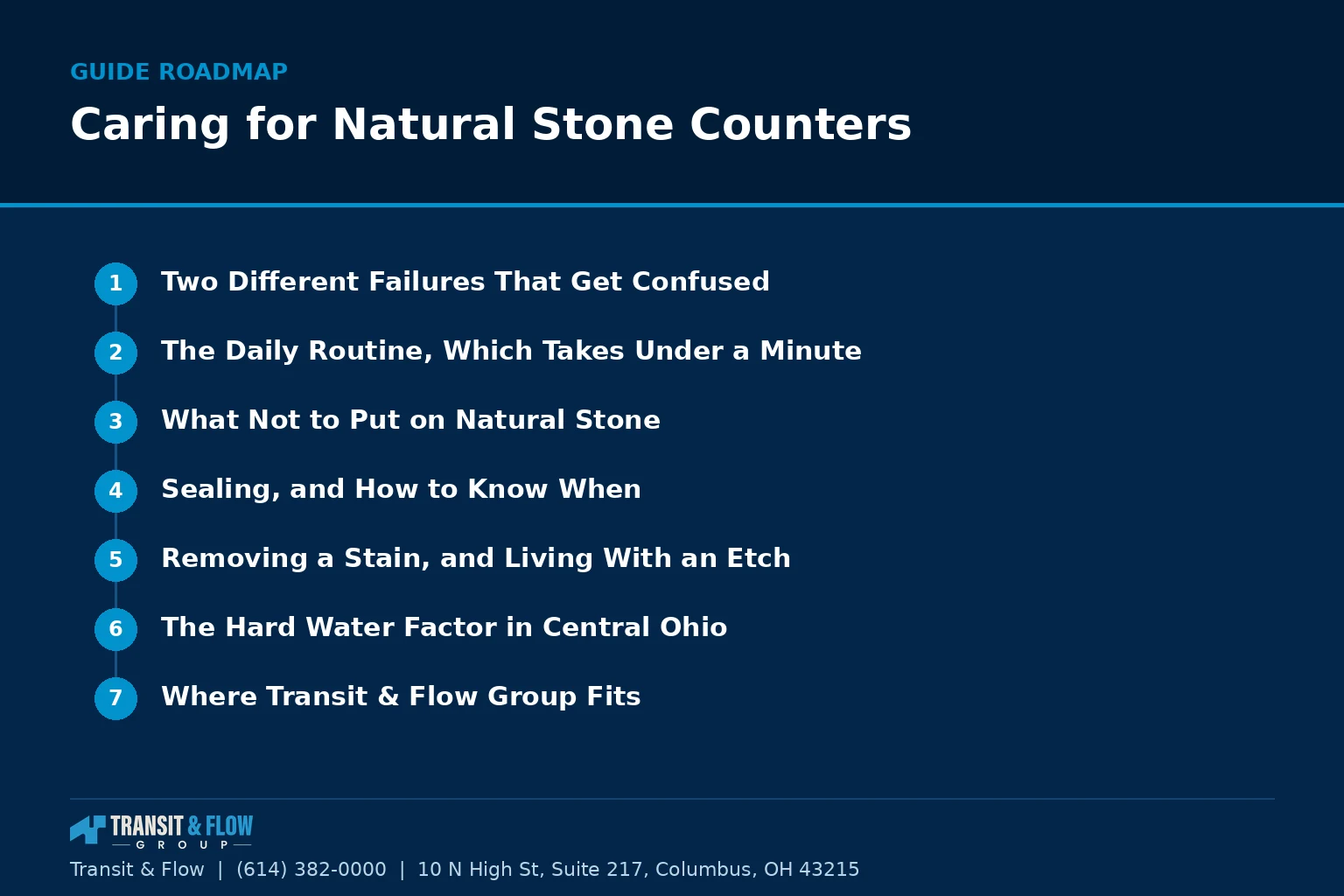
- Two Different Failures That Get Confused
- The Daily Routine, Which Takes Under a Minute
- What Not to Put on Natural Stone
- Sealing, and How to Know When
- Removing a Stain, and Living With an Etch
- The Hard Water Factor in Central Ohio
- Glossary
- Where Transit & Flow Group Fits
- Frequently Asked Questions
Transit & Flow Group coordinates projects and partners with properly licensed and insured specialty contractors when licensing is required.
Two Different Failures That Get Confused
Almost every complaint about a stone counter is either a stain or an etch, and the two are opposites in every practical way. Telling them apart determines whether the fix is possible and who performs it.
A stain is something absorbed into the stone. It is darker than the surrounding surface, it sits below the polish rather than in it, and it is a porosity problem. Sealing prevents it. The usual culprits are oil, wine, coffee, and anything with strong pigment left to sit.
An etch is a chemical reaction with the stone itself. Acid dissolves a microscopic layer of calcium based stone, leaving a dull spot that is lighter rather than darker, often visible only at an angle in raking light. Sealing does not prevent it, because the sealer is in the pores rather than on the surface. Marble and limestone etch readily. Granite and true quartzite essentially do not, which is the single strongest practical argument for those materials in a working kitchen.
If a spot is darker, you have a stain and a porosity issue. If a spot is duller and lighter, you have an etch and an acid issue. They are treated by different means and confusing them wastes effort.
The Daily Routine, Which Takes Under a Minute
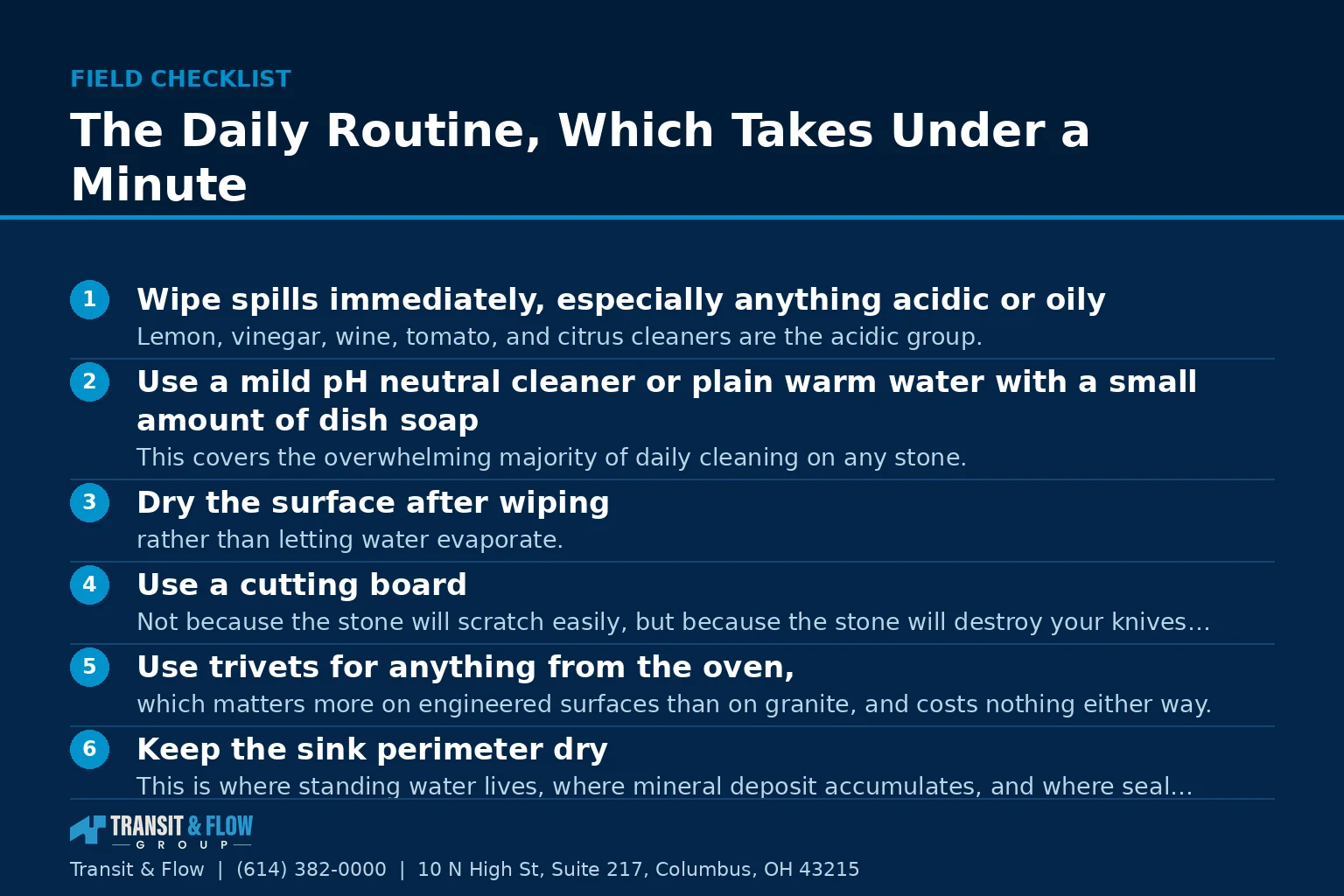
- Wipe spills immediately, especially anything acidic or oily. Lemon, vinegar, wine, tomato, and citrus cleaners are the acidic group. Olive oil and butter are the absorbing group. Time is the variable you control.
- Use a mild pH neutral cleaner or plain warm water with a small amount of dish soap. This covers the overwhelming majority of daily cleaning on any stone.
- Dry the surface after wiping rather than letting water evaporate. In hard water areas this is the difference between a clean counter and a persistent mineral film.
- Use a cutting board. Not because the stone will scratch easily, but because the stone will destroy your knives and because the board keeps food acids off the surface entirely.
- Use trivets for anything from the oven, which matters more on engineered surfaces than on granite, and costs nothing either way.
- Keep the sink perimeter dry. This is where standing water lives, where mineral deposit accumulates, and where seal failure shows up first.
That is the entire daily routine. Everything else in stone care is periodic rather than daily.
What Not to Put on Natural Stone
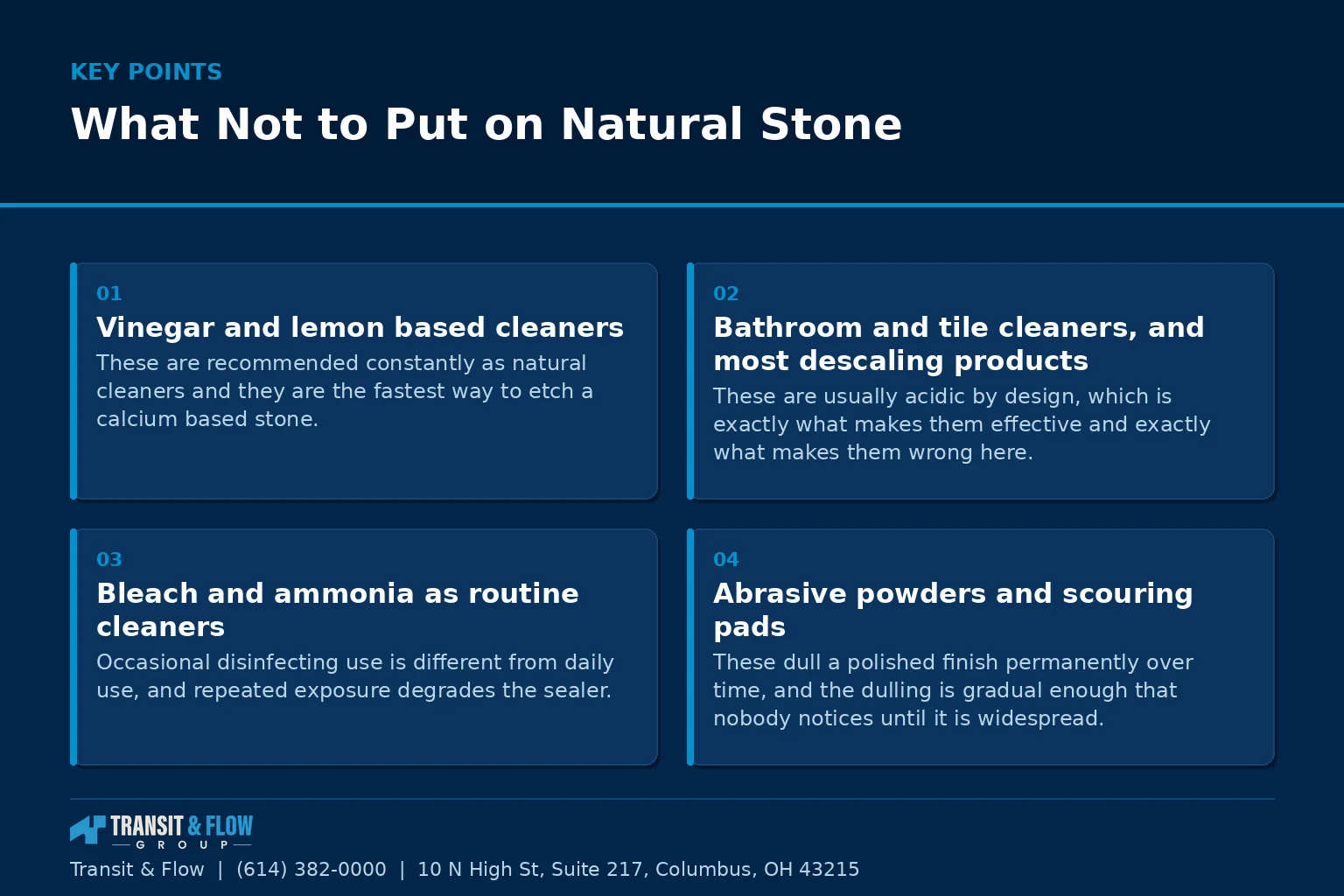
- Vinegar and lemon based cleaners. These are recommended constantly as natural cleaners and they are the fastest way to etch a calcium based stone.
- Bathroom and tile cleaners, and most descaling products. These are usually acidic by design, which is exactly what makes them effective and exactly what makes them wrong here.
- Bleach and ammonia as routine cleaners. Occasional disinfecting use is different from daily use, and repeated exposure degrades the sealer.
- Abrasive powders and scouring pads. These dull a polished finish permanently over time, and the dulling is gradual enough that nobody notices until it is widespread.
- Generic all-purpose sprays with unlisted acids. If the label does not say it is safe for natural stone, assume it is not.
- Wax and shine products. These build a film that clouds over time and complicates any later restoration.
Sealing, and How to Know When
There is no universal resealing interval, because porosity varies enormously between stones. A dense dark granite may go a long time without needing anything. A light porous stone may need attention often. Any published schedule is a guess about your stone made by someone who has not seen it.
Use the water test instead. Place a small amount of water on the surface in a few locations, including next to the sink and next to the range where wear is highest. Leave it for several minutes, then wipe. If the stone darkened where the water sat, the sealer has worn through and it is time to reseal. If it did not darken, nothing needs doing. Run the test seasonally and let the stone tell you.
Resealing itself is straightforward. The surface must be clean and completely dry, the product is applied evenly and allowed to dwell for the time the manufacturer states, and the excess is buffed off before it dries in place. The most common mistake is leaving excess sealer to cure on the surface, which produces a hazy film that then has to be removed. Follow the product instructions rather than a general procedure, because sealers differ.
Removing a Stain, and Living With an Etch
A stain is drawn out rather than scrubbed off. The standard approach is a poultice, meaning an absorbent paste applied over the stain, covered, and left to dry slowly so it pulls the absorbed material back out of the stone as it dries. The correct absorbent depends on what caused the stain, since oil, organic pigment, and rust behave differently. It frequently takes more than one application and it requires patience rather than force. Scrubbing a stain harder accomplishes nothing, because the stain is not on the surface.
An etch is a different situation. The surface itself has been altered, so nothing can be drawn out. Light etching on a polished surface can sometimes be improved with a polishing compound made for the stone. Deeper or widespread etching is a refinishing job for a stone restoration professional, and on marble it may be more sensible to accept it. Households that live happily with marble are generally the ones who decided in advance that accumulated patina reads as character rather than as damage. That decision is best made before purchase rather than after the first etch.
For any significant stain or etch on an expensive surface, test any product in an inconspicuous area first, such as inside the sink cutout edge or under an overhang, before applying it to a visible field.
The Hard Water Factor in Central Ohio
Much of Central Ohio runs hard water, and it shows on counters in a specific and frustrating way. Mineral deposit builds at the faucet base, around the sink perimeter, and anywhere standing water is allowed to evaporate. On a dark or honed surface it reads as a cloudy film that ordinary cleaning does not remove, because the deposit is mineral rather than soil.
The trap is that products marketed for hard water removal are almost always acidic, which is the exact category that etches calcium based stone. On marble or limestone, that standard fix causes a worse problem than the one it solves. The reliable approach is prevention through drying rather than removal through chemistry. Where the water condition is severe, treating it at the supply side addresses counters, fixtures, glassware, and appliances at once, which is the same underlying issue described in our article on hard water and water heaters.
On cost: this article contains no dollar figures on purpose. Sealer products, poultice materials, and professional stone restoration all vary with the stone, the size of the affected area, the severity of the damage, and local availability. What is consistent is that prevention costs a small fraction of restoration, and that the water test costs nothing at all.
Glossary
- Stain. Material absorbed into the stone, appearing darker than the surrounding surface.
- Etch. A chemical alteration of the stone surface by acid, appearing duller and lighter than the surrounding surface.
- Sealer. A penetrating product occupying the pores of natural stone so liquids remain on the surface long enough to be wiped.
- Poultice. An absorbent paste applied over a stain and allowed to dry slowly, drawing the absorbed material back out.
- pH neutral. Neither acidic nor alkaline, which is the safe category for routine stone cleaning.
- Honed. A matte finish that shows mineral deposit and etching differently than a polished finish.
- Water test. Placing water on the surface and observing whether the stone darkens, which indicates the sealer has worn.
- Patina. The accumulated surface character of a stone in service, which some households value and others regard as damage.
Option A is a maintenance approach built on scheduled resealing at a fixed interval. Option B is a maintenance approach built on the water test plus disciplined immediate wiping. My recommendation is Option B, and the reasoning is that fixed schedules fail in both directions. They lead households to reseal stone that did not need it, which wastes effort and can build residue, and they lead households to skip a reseal that was overdue because the calendar said it was not time yet. The stone reports its own condition accurately and for free. Test seasonally, wipe immediately, dry the sink perimeter, and keep acidic cleaners out of the kitchen entirely. Those four habits prevent the large majority of damage that stone restoration professionals are called for. For the material decision behind all of this, see our countertop materials comparison and our comparison of quartz and granite.
Where Transit & Flow Group Fits
Transit & Flow Group coordinates countertop projects across Columbus and Central Ohio and partners with properly licensed and insured specialty contractors when licensing is required. Our standard is that the maintenance profile of a material is explained before it is selected rather than after installation, that the specific stone is identified by name rather than by category, that sealer type and manufacturer instructions are handed over in writing at closeout, and that households are told plainly which cleaners will damage the surface they just bought. To have a countertop material reviewed against how your household actually cooks and cleans, contact us.
Frequently Asked Questions
How do I tell a stain from an etch on my counter?
Look at whether the spot is darker or lighter than the surrounding surface. A stain is material absorbed into the stone, so it is darker and sits below the polish rather than in it, and it is a porosity problem that sealing prevents. An etch is a chemical reaction with the stone itself, so it is duller and lighter, often visible only at an angle in raking light, and sealing does not prevent it because the sealer sits in the pores rather than on the surface. Confusing the two wastes effort, because they are addressed by entirely different means.
How often should natural stone be resealed?
There is no universal interval, because porosity varies enormously between stones and any published schedule is a guess about a stone the author has not seen. Use the water test instead: place a small amount of water on the surface in a few places, including next to the sink and next to the range where wear is highest, leave it several minutes, then wipe. If the stone darkened where the water sat, the sealer has worn through and it is time to reseal, and if it did not darken, nothing needs doing. Run the test seasonally and let the stone report its own condition.
Which cleaners should never go on natural stone?
Vinegar and lemon based cleaners top the list, because they are recommended constantly as natural cleaners and they are the fastest way to etch a calcium based stone. Bathroom and tile cleaners and most descaling products are acidic by design, which is what makes them effective elsewhere and wrong here. Bleach and ammonia used routinely degrade the sealer, abrasive powders and scouring pads dull a polished finish gradually enough that nobody notices until it is widespread, and wax or shine products build a film that clouds and complicates later restoration. If a label does not say the product is safe for natural stone, assume it is not.
What actually removes a stain from stone?
A stain is drawn out rather than scrubbed off, because it is not sitting on the surface. The standard approach is a poultice, an absorbent paste applied over the stain, covered, and allowed to dry slowly so it pulls the absorbed material back out as it dries. The correct absorbent depends on what caused the stain, since oil, organic pigment, and rust behave differently, and it frequently takes more than one application. Test any product in an inconspicuous area first, such as inside the sink cutout edge or under an overhang.
Can an etched spot be repaired?
The surface itself has been altered, so nothing can be drawn out of it. Light etching on a polished surface can sometimes be improved with a polishing compound made for that stone. Deeper or widespread etching is a refinishing job for a stone restoration professional, and on marble it may be more sensible to accept it. Households that live happily with marble generally decided in advance that accumulated patina reads as character, and that decision is best made before purchase rather than after the first etch.
Why does my counter look cloudy even after cleaning?
Much of Central Ohio runs hard water, and mineral deposit builds at the faucet base, around the sink perimeter, and anywhere standing water evaporates. On a dark or honed surface it reads as a film that ordinary cleaning does not remove, because the deposit is mineral rather than soil. The trap is that products marketed for hard water removal are almost always acidic, which is the exact category that etches calcium based stone, so the standard fix causes a worse problem than it solves. Prevention through drying the sink perimeter is the reliable approach, and where the water condition is severe, treating it at the supply side addresses counters, fixtures, and appliances at once.
Sources
- Ohio Construction Industry Licensing Board, trade licensing verification
- U.S. Environmental Protection Agency, water quality and household water resources
- U.S. Consumer Product Safety Commission, household cleaning product safety resources
- Ohio Attorney General, consumer protection guidance on home improvement contracts
About This Guide
Written and edited by Micheal Parker, founder of Transit & Flow Group. Published January 17, 2027. This guide is checked against the agency and code sources listed above, and it is revised when those sources change.
General contractor of record. Micheal Parker holds City of Columbus General Contractor Registration G12064, issued by the Columbus Department of Building and Zoning Services under Transit & Flow LLC and valid through June 30, 2027. Trade work that falls outside the scope of that registration is performed by licensed trade partners, and the responsible license holder is identified before work begins.
Transit & Flow Group, home and commercial services for Columbus and the surrounding Central Ohio communities. Phone (614) 382-0000. Email solutions@transitflowgroup.com. 10 N High St, Suite 217, Columbus, OH 43215. Contact our team or review the communities we serve.
