


Quartz and granite end up on the same shortlist in most kitchen projects, and the comparison usually gets settled on appearance, which is the one factor that will not predict how you feel about the surface in five years. Both are excellent materials. Neither is better than the other in the abstract. They fail differently, they are maintained differently, and they suit different households. This article separates the real differences from the sales differences. It supports our countertop work and sits under our countertop materials comparison.
In This Guide
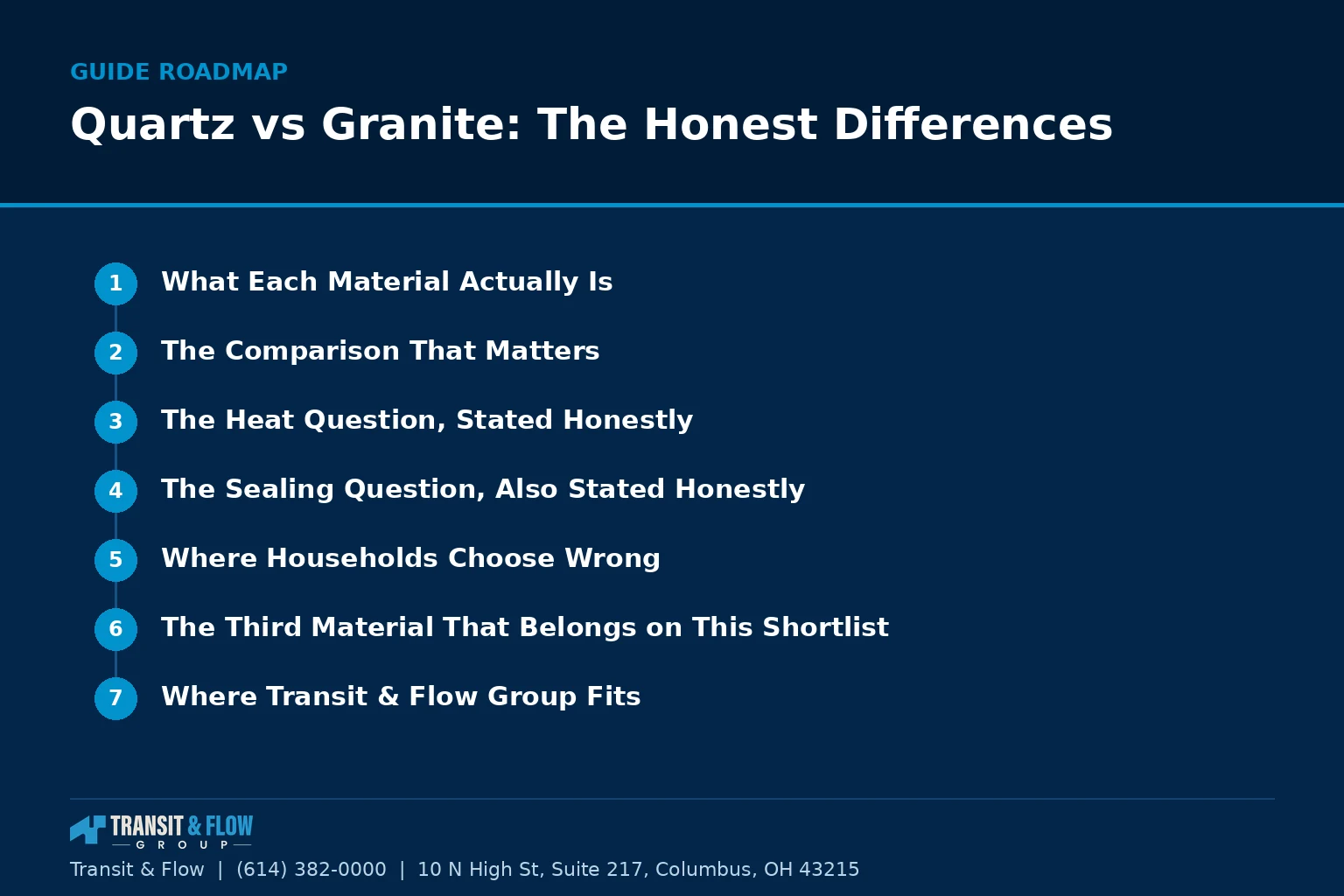
- What Each Material Actually Is
- The Comparison That Matters
- The Heat Question, Stated Honestly
- The Sealing Question, Also Stated Honestly
- Where Households Choose Wrong
- The Third Material That Belongs on This Shortlist
- Glossary
- Where Transit & Flow Group Fits
- Frequently Asked Questions
Transit & Flow Group coordinates projects and partners with properly licensed and insured specialty contractors when licensing is required.
What Each Material Actually Is
Granite is a quarried natural stone. It is cut from the earth in blocks, sliced into slabs, and finished. Every slab is different because geology made it rather than a factory, which means the slab you approve is the slab you get and no two kitchens are identical.
Engineered quartz is a manufactured product. Ground natural quartz is combined with a polymer binder and pigment, then pressed and cured into slabs. The quartz content is high, which is where the hardness comes from, and the binder is what makes it non-porous. That binder is also the source of its one real weakness, because polymers respond to heat in ways that stone does not.
Hold that distinction, because nearly every practical difference between the two materials follows from it. One is stone with pores. The other is stone particles held in plastic with no pores at all.
The Comparison That Matters
| Factor | Engineered quartz | Granite |
|---|---|---|
| Porosity | Non-porous. Nothing to seal, ever. | Porous to varying degrees by stone. Sealing is part of ownership. |
| Staining | Highly resistant. Spills sit on the surface. | Resistant when sealed. Oil and wine are the usual offenders when sealing lapses. |
| Heat tolerance | The weak point. The binder can scorch or discolor under a hot pan. | The strong point. Handles high heat without damage. |
| Scratch resistance | Very high. Difficult to scratch in normal use. | Very high. Difficult to scratch in normal use. |
| Repairability | Difficult. A chip or scorch is hard to patch invisibly because the field is uniform. | Good. Natural variation hides a repair well. |
| Consistency | Predictable. What the sample shows is what the run looks like. | Variable. Slab selection is required, not optional. |
| Seam visibility | Usually less visible, because pattern matching is simpler. | Depends entirely on the stone and the fabricator. |
| Ultraviolet stability | Some products discolor in direct sustained sunlight. Check the specification. | Stable. Suited to sunrooms and strong window exposure. |
| Outdoor use | Generally not recommended by manufacturers. | Commonly used outdoors. |
| Maintenance | Wipe and go. No annual task. | Wipe, plus periodic resealing on a schedule. |
The Heat Question, Stated Honestly
This is where quartz marketing and quartz reality diverge, and it deserves plain language. Engineered quartz is not damaged by warm. It is damaged by hot, and the threshold is lower than most households assume. A pan straight off a burner or out of the oven, set directly on the surface, can leave a discolored mark or a fine crack from thermal shock. That mark is permanent in practical terms.
The correct framing is that quartz requires a habit rather than a chore. Trivets near the range, used every time, and the problem does not exist. Granite requires a chore rather than a habit, meaning periodic sealing that takes a few minutes and is easy to forget. Which of those you would rather own is a genuine question about your household, and it is a better question than which material is better.
Households with several cooks, teenagers, or anyone who will not reliably reach for a trivet should weigh granite more heavily. Households where one or two people cook attentively will find the trivet habit trivial and will appreciate never sealing anything.
The Sealing Question, Also Stated Honestly
Sealing granite is often described as a burden and it is not much of one. The test is simple. Put a small amount of water on the surface and leave it for several minutes. If the stone darkens where the water sat, the seal has worn and it is time to reseal. If it beads and the stone does not darken, nothing needs doing.
Resealing is wiping a product across a clean dry surface, letting it sit, and buffing off the excess. It takes a fraction of an evening for a whole kitchen. The failure mode is not difficulty, it is forgetting, and the consequence of forgetting is a stain from oil or wine that had time to soak in. Granite varies in porosity by a wide margin, and some dense stones need attention far less often than others. Ask about your specific stone rather than about granite generally.
Where Households Choose Wrong
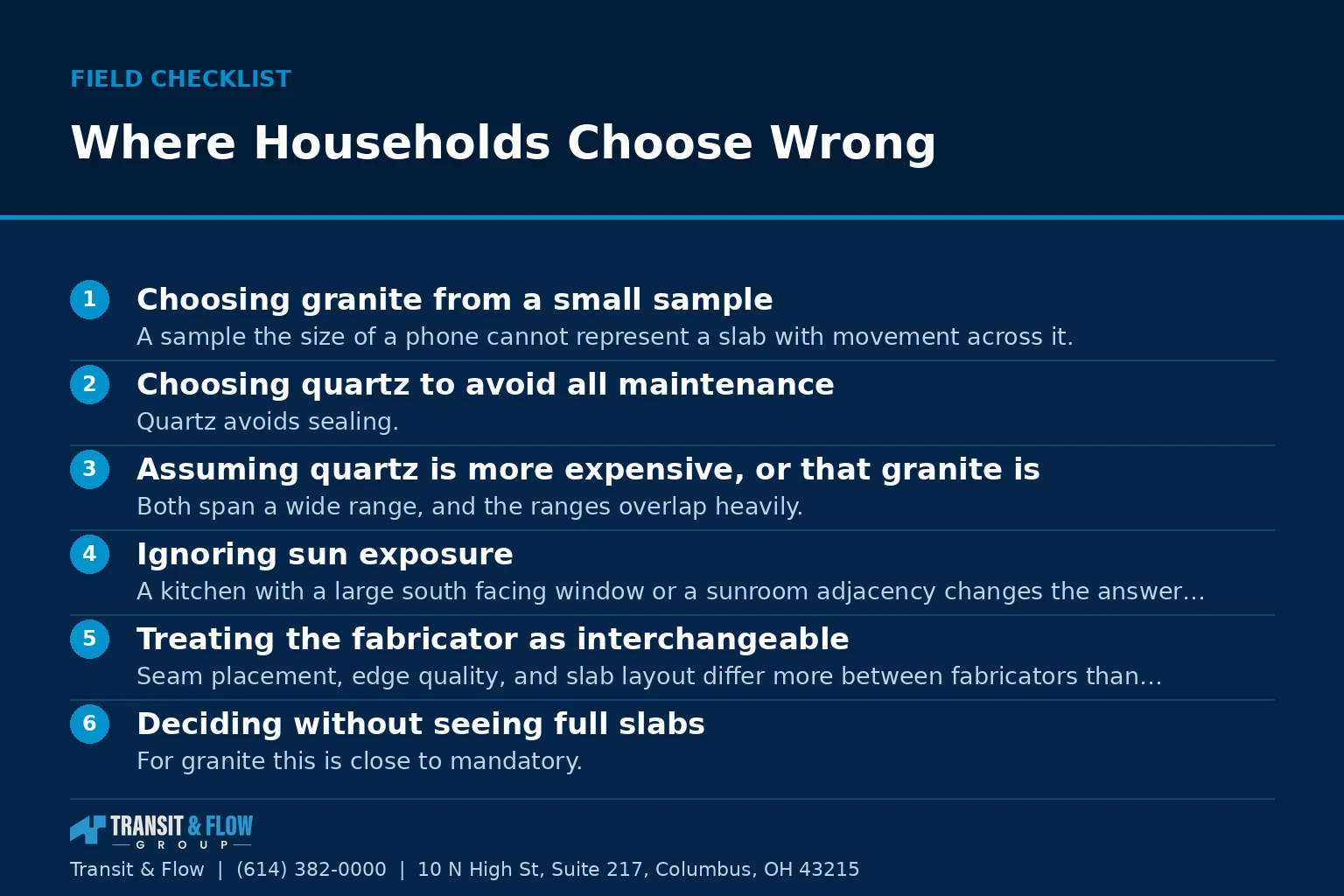
- Choosing granite from a small sample. A sample the size of a phone cannot represent a slab with movement across it. The sample tells you the color family. It does not tell you what the kitchen will look like.
- Choosing quartz to avoid all maintenance. Quartz avoids sealing. It does not avoid trivets, and it does not avoid caution with certain cleaners.
- Assuming quartz is more expensive, or that granite is. Both span a wide range, and the ranges overlap heavily. Price follows the specific product, the slab, the fabrication complexity, and the layout, not the category.
- Ignoring sun exposure. A kitchen with a large south facing window or a sunroom adjacency changes the answer, because some engineered products are not rated for sustained direct sunlight.
- Treating the fabricator as interchangeable. Seam placement, edge quality, and slab layout differ more between fabricators than between these two materials.
- Deciding without seeing full slabs. For granite this is close to mandatory. For quartz it is still worth doing, because large format patterning reads differently at scale.
On cost: this article contains no dollar figures on purpose. Quartz and granite pricing depends on the specific product line or stone, slab yield against your layout, seam count, edge profile, cutouts, whether the slab must be individually selected, removal and disposal of the existing surface, and plumbing disconnect and reconnect. Two kitchens of identical square footage can differ substantially on the same material. Get a written quote against your actual measurements with the exclusions named.
The Third Material That Belongs on This Shortlist
Households comparing quartz and granite are frequently shown quartzite as well, and the naming is close enough to engineered quartz that the difference gets lost in the conversation. It is worth stating plainly, because the confusion costs money.
Quartzite is a natural stone, quarried like granite, not manufactured like engineered quartz. True quartzite is often harder than granite and carries the kind of soft veining people associate with marble, which is exactly why it sells. It is porous, so it seals like granite rather than needing nothing like quartz. In other words it behaves like the natural stone column of the comparison above, with a different appearance.
The complication is that material sold under the quartzite name is sometimes a softer stone that looks similar and does not perform the same way. That matters because a softer stone will etch from ordinary kitchen acids in a way real quartzite does not. Ask two questions before committing. Ask what the stone is by name rather than by category, and ask how it was verified. A supplier who deals in natural stone seriously will have a direct answer to both. Vagueness on either one is the finding, and it is available for free before any deposit changes hands.
If you are drawn to the look of marble but not to its behavior, verified quartzite is the material most likely to satisfy you, and it should be evaluated against granite rather than against quartz, because it maintains like granite.
Glossary
- Engineered quartz. A manufactured slab of ground natural quartz bound with polymer resin and pigment.
- Porosity. The degree to which a material absorbs liquid into its structure rather than holding it on the surface.
- Sealer. A penetrating product that occupies the pores of natural stone so liquids sit on top long enough to be wiped away.
- Thermal shock. Damage caused by a rapid temperature change across a material rather than by heat alone.
- Slab yield. How much usable countertop your layout produces from a given slab, which determines how many slabs are needed.
- Movement. The visible pattern of veining and color variation across a natural stone slab.
- Honed. A matte finish produced by stopping short of a full polish.
Option A is engineered quartz. Option B is granite. My recommendation for most Central Ohio households is Option A, engineered quartz, and the reason is narrow and specific. Its single weakness is heat, and heat is controlled by a habit that costs nothing and is performed at the moment of risk. Granite’s single weakness is a maintenance task performed on a schedule nobody keeps, and the consequence of missing it arrives silently as a stain. Habits at the point of risk are more reliable than scheduled chores. That said, Option B is the better answer for three specific households: those who cook seriously with high heat and multiple people at the range, those with strong sustained sun exposure in the kitchen, and those who want a surface with genuine variation that no neighbor will duplicate. If you choose granite, choose your slab in person and put the resealing test on a recurring reminder. For the full material landscape, see our countertop materials comparison, and for how this fits the larger project, our kitchen planning guide and our article on where kitchen budgets actually go.
Where Transit & Flow Group Fits
Transit & Flow Group coordinates countertop projects across Columbus and Central Ohio and partners with properly licensed and insured specialty contractors when licensing is required. Our standard is that the material decision is made against how the household actually cooks rather than against a showroom sample, that slab selection is arranged in person for natural stone, that seam placement is shown on a layout before anything is cut, and that removal, disposal, plumbing disconnect, and support hardware are named in the written scope rather than discovered at installation. To have a countertop decision reviewed against your layout and your household, contact us.
Frequently Asked Questions
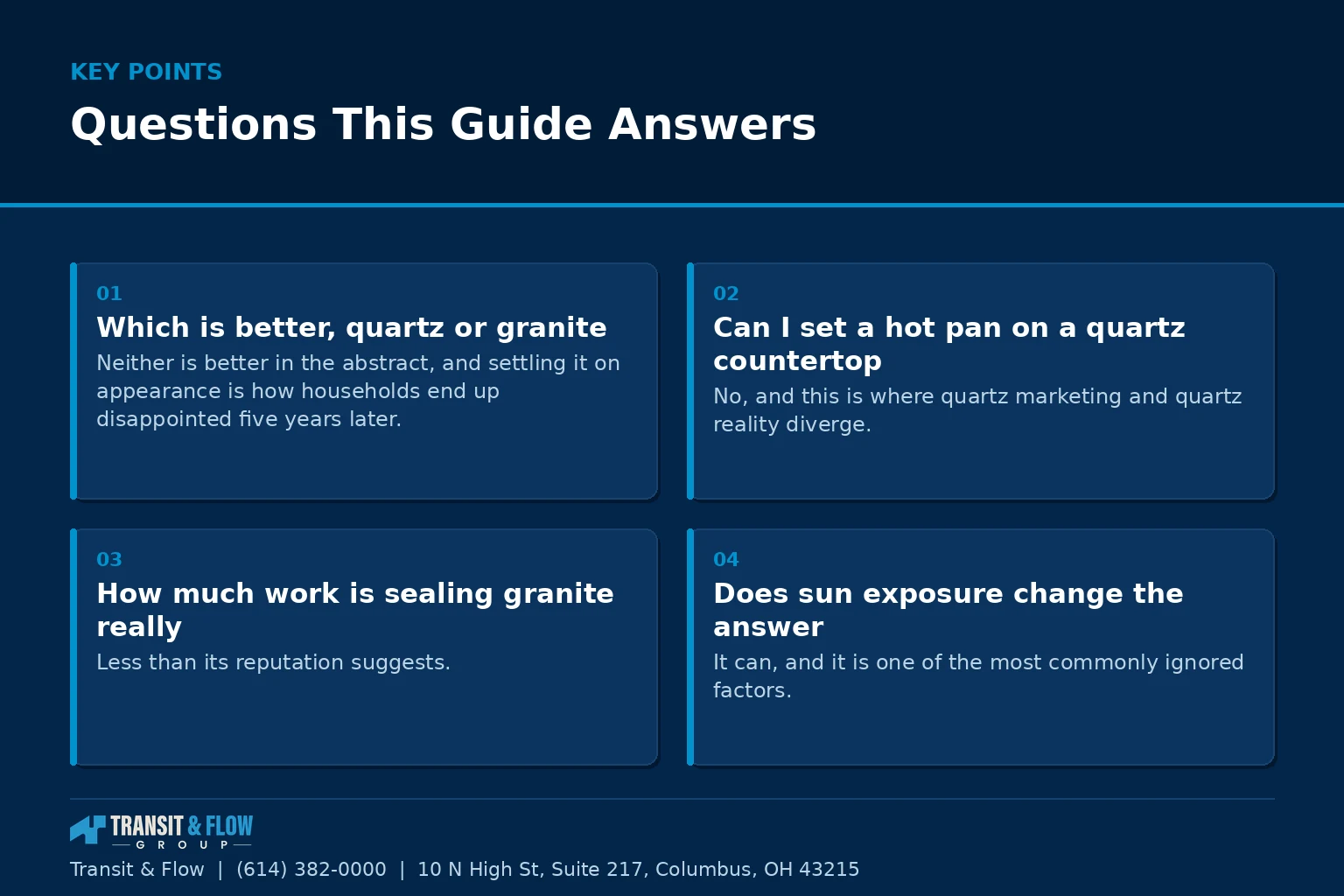
Which is better, quartz or granite?
Neither is better in the abstract, and settling it on appearance is how households end up disappointed five years later. They fail differently and they are maintained differently. Engineered quartz is non-porous, so nothing ever needs sealing, but the polymer binder is vulnerable to heat. Granite is a quarried natural stone that handles high heat without damage, but it is porous and sealing is part of ownership. The better question is which weakness suits your household.
Can I set a hot pan on a quartz countertop?
No, and this is where quartz marketing and quartz reality diverge. Engineered quartz is not damaged by warm, it is damaged by hot, and the threshold is lower than most households assume. A pan straight off a burner or out of the oven, set directly on the surface, can leave a discolored mark or a fine crack from thermal shock, and that mark is permanent in practical terms. Trivets near the range, used every time, and the problem does not exist. Follow the manufacturer’s published care instructions for the specific product line you buy.
How much work is sealing granite really?
Less than its reputation suggests. The test is simple: put a small amount of water on the surface and leave it for several minutes. If the stone darkens where the water sat, the seal has worn and it is time to reseal, and if it beads without darkening, nothing needs doing. Resealing is wiping a product across a clean dry surface, letting it sit, and buffing off the excess, which takes a fraction of an evening for a whole kitchen. The failure mode is not difficulty, it is forgetting, and the consequence of forgetting is a stain from oil or wine that had time to soak in.
Does sun exposure change the answer?
It can, and it is one of the most commonly ignored factors. Some engineered quartz products discolor under direct sustained sunlight, so a kitchen with a large south facing window or a sunroom adjacency needs the product specification checked before selection. Granite is stable in that condition and is commonly used outdoors, while engineered quartz generally is not recommended outdoors by its manufacturers. Ask for the published specification on the exact product line rather than relying on a general statement about the category.
Is quartzite the same thing as engineered quartz?
No, and the naming causes real confusion. Quartzite is a natural stone quarried like granite, not manufactured. True quartzite is often harder than granite and carries the soft veining people associate with marble, but it is porous, so it seals like granite rather than needing nothing like quartz. The complication is that material sold under the quartzite name is sometimes a softer stone that looks similar and will etch from ordinary kitchen acids. Ask what the stone is by name rather than by category and ask how that was verified, because a supplier who deals seriously in natural stone will answer both directly.
What do households most often get wrong when choosing?
Choosing granite from a sample the size of a phone, which tells you the color family and nothing about movement across a slab. Choosing quartz expecting zero maintenance, when it still needs trivets and care with certain cleaners. Assuming one material is categorically more expensive than the other, when both span wide overlapping ranges driven by the specific product, the slab, the fabrication complexity, and the layout. Treating the fabricator as interchangeable, when seam placement, edge quality, and slab layout differ more between fabricators than between these two materials. Seeing full slabs is close to mandatory for granite and still worth doing for quartz.
Sources
- Ohio Construction Industry Licensing Board, trade licensing verification
- City of Columbus, Get a Permit, permit and inspection process
- Ohio Attorney General, consumer protection guidance on home improvement contracts
- U.S. Consumer Product Safety Commission, household product and material safety resources
About This Guide
Written and edited by Micheal Parker, founder of Transit & Flow Group. Published January 13, 2027. This guide is checked against the agency and code sources listed above, and it is revised when those sources change.
General contractor of record. Micheal Parker holds City of Columbus General Contractor Registration G12064, issued by the Columbus Department of Building and Zoning Services under Transit & Flow LLC and valid through June 30, 2027. Trade work that falls outside the scope of that registration is performed by licensed trade partners, and the responsible license holder is identified before work begins.
Transit & Flow Group, home and commercial services for Columbus and the surrounding Central Ohio communities. Phone (614) 382-0000. Email solutions@transitflowgroup.com. 10 N High St, Suite 217, Columbus, OH 43215. Contact our team or review the communities we serve.
