


Countertops are the surface a kitchen is judged by and the surface a kitchen is used on, and those two roles pull in different directions. Almost every countertop disappointment traces back to a household choosing for one and living with the other. This guide compares the materials realistically available in Central Ohio, explains what each one is actually made of and how it behaves, and sets out the decision sequence that produces a surface you are still satisfied with a decade later. It supports our countertop work and our broader kitchen work.
In This Guide
- The Three Properties That Actually Decide This
- Engineered Quartz
- Granite
- Quartzite, Which Is Not Quartz
- Marble
- Butcher Block and Solid Wood
- Laminate, Reconsidered
- Solid Surface, Concrete, and Porcelain
- The Comparison, Side by Side
- What Countertop Quotes Do Not Say Out Loud
- How to Choose, in Order
- Sinks, and the Decision Made With Them
- Hard Water in Central Ohio and What It Does to a Surface
- How Counters and Cabinets Constrain Each Other
- Choosing the Fabricator, Not Only the Material
- Glossary
- The Recommendation
- Where Transit & Flow Group Fits
- Frequently Asked Questions
Transit & Flow Group coordinates projects and partners with properly licensed and insured specialty contractors when licensing is required.
The Three Properties That Actually Decide This
Countertop marketing describes a long list of attributes. In daily use, three of them determine whether you are happy, and everything else is preference.
- Porosity. Whether the surface absorbs liquid. This governs staining, whether sealing is required, and how forgiving the surface is about a spill nobody noticed until morning.
- Hardness and heat tolerance. Whether the surface scratches, chips, or is damaged by a hot pan set down without thought. These are separate properties and materials do not rank the same on both.
- Repairability. What happens after damage occurs, because on a long enough timeline something happens to every countertop. Some materials are refinished in place. Some are patched invisibly. Some cannot be repaired at all.
Appearance matters and it is real, but appearance is the one property you can evaluate perfectly in a showroom in ten minutes. The three above are the ones you cannot, and they are the ones that determine how the surface feels to own.
Engineered Quartz
Engineered quartz is ground natural quartz bound in a polymer resin with pigment, formed into slabs. It is not a natural stone slab and it is not a solid surface acrylic. It sits between them, which is why it dominates current kitchen selection.
The defining property is that it is non-porous. It does not require sealing, it does not absorb wine or oil, and it is uniform from slab to slab, which means what you see in a sample is what arrives. It is hard and resists scratching from ordinary kitchen use. The pattern is manufactured, which is either its greatest advantage or its principal limitation depending on what you want, since consistency and natural variation are the same trait viewed from two sides.
Its real weakness is heat. The binder is a polymer, and direct contact with a hot pan can scorch or discolor the surface permanently. This is the single most common quartz complaint and it is entirely preventable with a trivet. It is also more difficult to repair invisibly than natural stone, because the pattern is manufactured rather than geological, which makes a patch harder to disguise.
Granite
Granite is quarried natural stone. Every slab is different, which means the slab you approve is the slab you get and selecting it individually is not vanity, it is the only way to know what will be installed.
Granite is very hard, handles heat better than any engineered product, and takes daily kitchen use without complaint. It is porous to varying degrees depending on the specific stone, which is why sealing is part of ownership. Sealing is not difficult and it is not frequent, but it is a task, and a household that will never do it should account for that honestly when choosing. The routine itself is short, and knowing it before you choose the material is the point.
Granite repairs reasonably well. Chips at an edge can be filled, and the natural variation in the stone helps hide the repair rather than highlighting it. Its main practical drawback is that variation cuts both ways. A sample tells you the family the stone belongs to and very little about the slab you will receive.
Quartzite, Which Is Not Quartz
The naming is genuinely confusing and it costs households money. Quartzite is a natural metamorphic stone. Engineered quartz is a manufactured product. They are unrelated, they behave differently, and they are sometimes displayed adjacent to each other with similar labels.
True quartzite is extremely hard, often harder than granite, with the visual character of marble. It is natural stone and therefore porous, so sealing applies. The complication is that material sold as quartzite is sometimes a softer stone, and the difference matters enormously in a kitchen. Ask the supplier directly what the material is and how it tested, and treat a confident answer with documentation differently from a confident answer without one.
Marble
Marble is the most beautiful common countertop material and the least suited to an ordinary kitchen, and both of those statements are true at the same time.
It is softer than granite, so it scratches. It is calcium based, so acids etch it, meaning lemon juice, vinegar, wine, and many cleaners leave dull marks that are chemical rather than dirt. It is porous, so it stains. None of this is a defect. It is what marble is, and it has been used in kitchens for a very long time by people who accepted it.
The honest guidance is this. Choose marble only if you find the developing patina attractive rather than distressing, and be certain everyone in the household agrees, because a marble counter in a home that wanted a pristine surface becomes a daily irritation within a year. If you want the look with fewer consequences, engineered quartz in a marble pattern and honed quartzite both exist and both are reasonable choices.
Butcher Block and Solid Wood
Wood is the one material on this list that improves with maintenance rather than merely surviving it, and the one that punishes neglect most visibly.
It is warm, comparatively inexpensive to install, and completely repairable. A wood counter with a decade of use can be sanded and refinished to look new, which is something no stone or engineered product offers. It is also the only surface here you can cut on directly, though doing so routinely means committing to the maintenance that follows.
The requirements are real. Oiled finishes need regular reapplication. Water standing at a sink cutout is the primary failure point, and wood immediately beside a sink is where most butcher block regret originates. Wood also moves with humidity, which matters in Central Ohio where indoor conditions swing meaningfully between a humid August and a dry January.
The strongest use of wood is as a secondary surface. An island top or a baking section in wood, with stone or quartz at the sink and range, gives you the warmth and the repairability where it helps and avoids the exposure where it hurts.
Laminate, Reconsidered
Laminate deserves a fair hearing rather than a reflexive dismissal. Modern laminate is substantially better than the material most people remember, with convincing patterns and edge treatments that no longer announce themselves from across the room.
It is non-porous on the surface, easy to clean, and the least expensive option by a wide margin. Its limitations are genuine. It is damaged by heat, it cannot be repaired once the surface layer is compromised, and water reaching the substrate at a seam or a sink cutout causes swelling that cannot be undone.
Laminate is the right answer more often than its reputation suggests. A rental property, a secondary kitchen, a laundry or utility surface, or a household that intends to remodel again within a few years are all situations where paying for stone is paying for something you will not keep.
Solid Surface, Concrete, and Porcelain
- Solid surface. An acrylic or polyester composite, non-porous, and uniquely repairable because it is the same material all the way through. Scratches and even burns sand out. It supports integrated seamless sinks, which is a real advantage for cleaning. It is softer than stone and less heat tolerant, and its appearance reads as manufactured rather than natural.
- Concrete. Made to order, formed to any shape, and capable of results nothing else can match. It is porous and requires sealing, it develops hairline cracks as a normal characteristic rather than a failure, and outcomes depend enormously on the specific fabricator. Choose the fabricator before choosing the material.
- Porcelain and sintered stone. The newest category in common availability. Very hard, non-porous, highly heat and ultraviolet resistant, and available in large format sheets with few seams. Fabrication requires specific tooling and experience, edges are more vulnerable during installation than the finished surface suggests, and the fabricator’s capability matters more here than in any other category.
The Comparison, Side by Side
| Material | Porosity and sealing | Heat and scratch behavior | Repairability | Best suited to |
|---|---|---|---|---|
| Engineered quartz | Non-porous, no sealing | Scratch resistant, vulnerable to direct heat | Difficult to patch invisibly | Busy households wanting consistency and low maintenance |
| Granite | Porous, periodic sealing | Excellent heat tolerance, very hard | Chips fill well, variation hides repairs | Households that cook heavily and will maintain the surface |
| Quartzite | Porous, periodic sealing | Very hard, good heat tolerance | Similar to granite | Marble appearance with stone durability, if verified |
| Marble | Porous, frequent sealing | Etches with acids, scratches readily | Honing and polishing possible | Households that welcome patina rather than fight it |
| Butcher block | Porous, oil or sealed finish | Marks and dents, tolerates warmth poorly | Fully refinishable by sanding | Islands and secondary surfaces away from the sink |
| Laminate | Non-porous surface, vulnerable substrate | Damaged by heat, scratches show | Not repairable | Rentals, secondary spaces, short remodel horizons |
| Solid surface | Non-porous, no sealing | Soft, low heat tolerance | Fully repairable, sands out | Integrated sinks and seamless runs |
| Concrete | Porous, sealing required | Good heat tolerance, hairline cracking normal | Patchable, fabricator dependent | Custom shapes and a specific aesthetic |
| Porcelain | Non-porous, no sealing | Very hard, excellent heat and light resistance | Limited, edge chips difficult | Large format runs with minimal seams |

What Countertop Quotes Do Not Say Out Loud
Material is only part of a countertop price, and the rest of it is fabrication. Two quotes for the same stone can differ substantially without either party misrepresenting anything, and the difference is in these items.
- Slab yield. A layout that needs a small additional piece consumes a whole slab. Ask how many slabs your layout requires and why.
- Seam count and placement. Seams are a design decision. Ask where they will fall and see it drawn before fabrication, because a seam through the middle of a visible run is a permanent outcome of a decision nobody discussed.
- Edge profile. A standard eased edge and a built-up or ogee edge are different operations with different costs.
- Cutouts. Undermount, drop-in, and farmhouse sinks are three different fabrication problems. Cooktop cutouts and faucet holes each carry their own charge.
- Backsplash. A short stone backsplash and a full height one are separate quantities entirely.
- Slab selection. Whether you select a specific slab or accept what is in stock is a legitimate cost difference and a legitimate quality difference.
- Removal and disposal of the existing counter, which is commonly excluded.
- Plumbing disconnect and reconnect, which is licensed trade work and is sometimes assumed to be included when it is not.
- Support requirements. Overhangs beyond a certain dimension need brackets or corbels, and this is discovered late when it is not designed early.
On cost: this article contains no dollar figures on purpose. Countertop pricing varies with material category, specific stone or product line, square footage, slab yield, edge profile, cutout count and complexity, seam plan, whether slabs are individually selected, removal of the existing surface, and current material markets which move independently of anything a contractor controls. A published range would misprice most readers substantially. Get a written quote itemizing the fabrication items listed above against your actual layout.
How to Choose, in Order
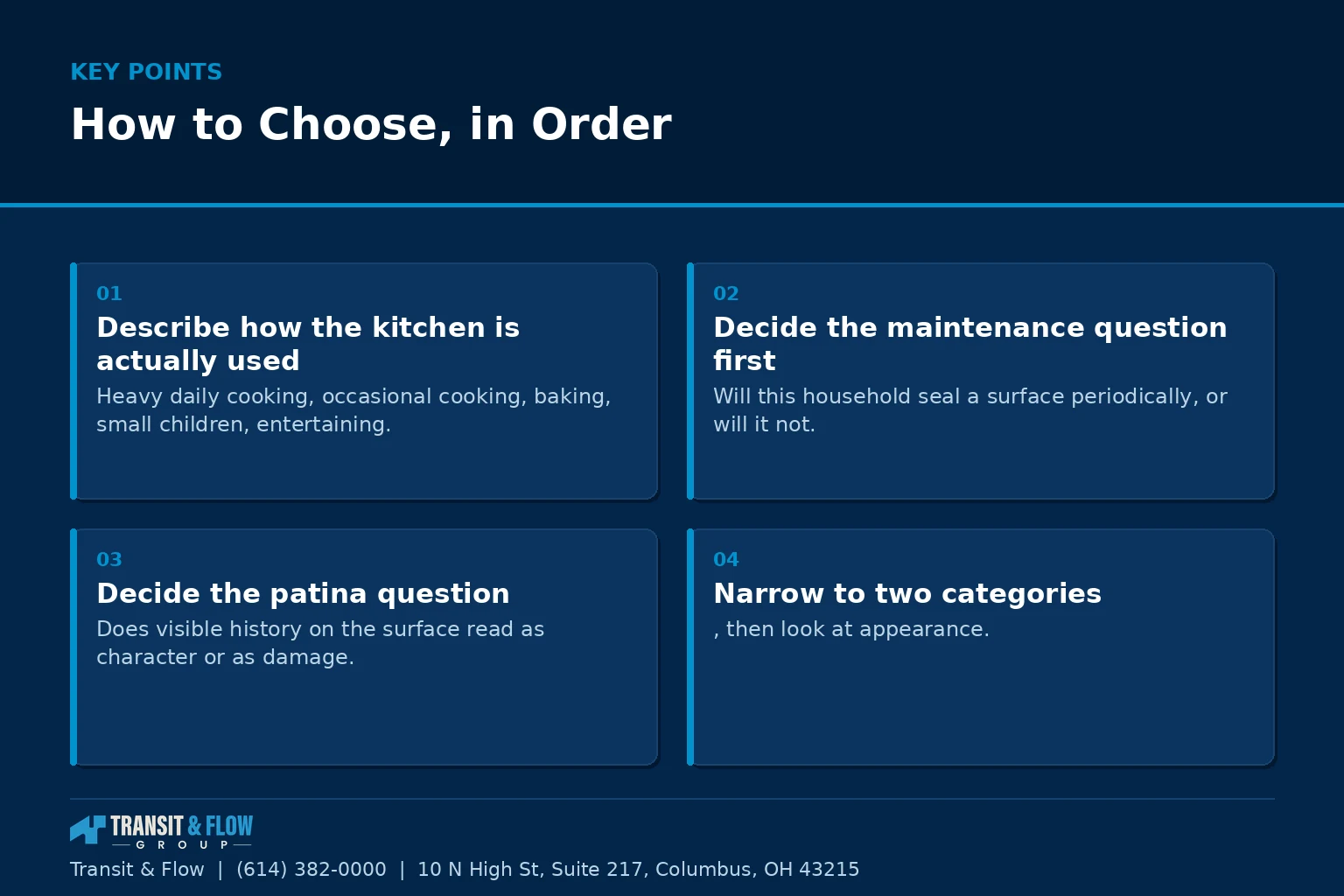
- Describe how the kitchen is actually used. Heavy daily cooking, occasional cooking, baking, small children, entertaining. Be honest rather than aspirational, because you will live with the honest version.
- Decide the maintenance question first. Will this household seal a surface periodically, or will it not. There is no wrong answer and there is a wrong material for each answer.
- Decide the patina question. Does visible history on the surface read as character or as damage. This single question eliminates or selects marble, wood, and concrete outright.
- Narrow to two categories, then look at appearance. Appearance evaluated inside a set of materials that already suit you is a pleasure. Appearance evaluated first is how households talk themselves into a surface that does not fit.
- See full slabs, not samples, for any natural material. A sample is a fragment of a pattern that may run very differently across a full slab.
- Take a sample home and abuse it. Lemon juice, oil, a red sauce, a coffee ring, a hot pan on a corner. Leave them overnight. An hour of testing outranks any amount of reading, including this article.
- Confirm the fabricator, not only the material. For concrete and porcelain especially, the fabricator determines the outcome more than the product does.
Sinks, and the Decision Made With Them
The sink is not a separate purchase from the countertop. It is a hole cut in the countertop, and the way that hole is cut is determined by the material and by the mounting style, which means the sink has to be selected and often physically delivered to the fabricator before the counter is cut. Households that treat the sink as an appliance to pick later are the ones who discover a delay they created themselves.
- Undermount. The sink hangs below the counter and the stone edge is polished around the opening. Crumbs sweep directly into the basin with nothing to catch on, which is the practical reason most households prefer it. It requires a material that can carry a finished exposed edge, which rules out laminate in nearly every case and makes the substrate question decisive.
- Drop-in. The sink rim sits on top of the counter. It is more forgiving of a substrate that cannot take a polished edge, it is easier to replace later, and the rim collects debris along its perimeter for the life of the installation. That trade is the whole decision.
- Integrated. The basin and the surface are one continuous piece with no joint at all. Solid surface makes this possible in a way stone does not, and it is the single strongest argument for solid surface in a kitchen where cleanliness at the sink is the governing priority.
- Farmhouse or apron front. The sink face is exposed and the cabinet beneath it is modified to carry it. This is a cabinetry decision as much as a countertop decision, and it must be settled before cabinets are ordered rather than after.
Reveal style matters more than it sounds. A positive reveal leaves a strip of counter visible inside the basin edge, a negative reveal tucks the counter slightly inside the basin, and a zero reveal aligns the two. Each cleans differently and each is a fabrication instruction, not a preference expressed on site. Name it in writing.
Hard Water in Central Ohio and What It Does to a Surface
Much of Central Ohio runs hard water, and hardness shows up on countertops long before anyone thinks to connect the two. The mineral content that leaves scale inside a water heater also leaves a film at the sink perimeter, around the faucet base, and anywhere standing water evaporates rather than being wiped away. On a dark honed surface it reads as a persistent cloudy ring that no amount of ordinary cleaning removes, because the deposit is mineral rather than dirt.
Two consequences follow. First, the products used to remove mineral deposit are usually acidic, and acids etch calcium based stone, which means the standard household fix for hard water is the exact thing that damages marble and some limestones permanently. On those materials the deposit has to be managed by drying the surface rather than by dissolving the deposit. Second, a honed or textured finish holds deposit more visibly than a polished one, so the finish choice and the water condition interact. If your water is hard and you want a honed dark surface, you are accepting a wiping habit as part of ownership. That is a fair trade if it is made knowingly.
This is the same underlying condition described in our article on hard water and water heaters in Central Ohio, and households that treat it once at the supply side rather than repeatedly at every fixture generally come out ahead across the whole house.
How Counters and Cabinets Constrain Each Other
Countertops are templated from installed cabinets, which means every cabinet decision is upstream of every countertop decision. That order is fixed by physics and it produces a set of constraints most households meet by surprise.
- Overhangs need support. An unsupported overhang past a modest dimension requires brackets or corbels sized for the material, and heavier materials reach that threshold sooner. A seating overhang designed on paper without support hardware specified is a change order waiting to happen.
- Cabinet run length drives seam count. Slabs come in finite sizes. A long uninterrupted run will have a seam somewhere, and the only question is whether it lands where you chose it or where the fabricator found it convenient.
- Sink base width limits sink choice. A large single basin will not fit a narrow sink base, and discovering that after cabinets are installed means either a smaller sink than planned or cabinet rework.
- Cooktop cutouts interact with drawers. The depth a cooktop drops into the cabinet below determines what drawer can live there. Some combinations do not coexist.
- Cabinet levelness sets counter quality. A template taken across cabinets that are not level produces a counter that follows the error. Shimming and leveling is not a finishing detail, it is the foundation the counter is measured from.
Our guidance on cabinet tiers and construction covers the box side of this. The point worth carrying here is that the counter conversation should begin during cabinet selection rather than after cabinet installation, when every option still exists.
Choosing the Fabricator, Not Only the Material
Two households can buy the same material and receive visibly different results, because the material is a commodity and the fabrication is a craft. These are short points with short answers, and the answers tell you what you are actually buying.
- Who fabricates the material, and whether they are the same company that installs it. A single accountable party is worth a great deal when something is wrong at installation.
- Where the seams will fall, shown on a drawing before anything is cut. Seam placement is a design decision, and a fabricator who will commit to it in advance has planned the layout rather than improvised it.
- Whether you select your own slab, and at what point in the schedule. On natural stone this matters enormously, because variation within a single material category is larger than most people expect from a sample.
- How the template is taken. Digital templating from installed cabinets is the standard worth asking for, and the answer should reference installed cabinets rather than drawings.
- What is included beyond the surface itself. Removal and disposal of the old counter, plumbing disconnect and reconnect, support hardware for overhangs, and the backsplash treatment are all separate line items that go missing from low quotes.
- The process if a piece breaks in transit or during installation. The answer should be a stated process rather than a reassurance.
- The warranty, and who honors it, the material manufacturer or the fabricator. Those are different warranties covering different failures, and knowing which one applies before there is a problem is the point of asking.
A fabricator who covers all seven without hesitation has done this work in an organized way many times. Hesitation on seams, on templating, or on what is included is the finding, and it is available to you for the cost of one conversation before you sign anything.
Glossary
- Porosity. The degree to which a surface absorbs liquid, which governs staining and sealing.
- Etching. Chemical dulling of a calcium based stone by acid, distinct from staining and not removed by cleaning.
- Honed. A matte rather than polished finish, which hides etching better and shows oils more.
- Engineered quartz. Ground quartz bound in resin, a manufactured slab product.
- Quartzite. A natural metamorphic stone, unrelated to engineered quartz despite the name.
- Slab yield. The usable counter area obtained from one slab after cutouts and seam planning.
- Seam. A joint between two pieces of material, placed by design rather than by accident.
- Template. Precise field measurement taken from installed cabinets, used to fabricate the counters.
- Overhang. Counter extending past the cabinet base, which requires support beyond a certain dimension.
- Sintered stone. A surface produced by fusing mineral particles under heat and pressure, closely related to porcelain in behavior.
The Recommendation
Option A is choosing one material for the entire kitchen. Option B is mixing materials by zone, meaning a durable non-porous surface at the sink and range and a different material on the island or a baking section.
My recommendation is Option A for most households and Option B for households that genuinely want wood or marble. The reason is that mixing is not a compromise, it is a way of putting each material where its weakness does not matter. Wood beside a sink is a maintenance problem. Wood on an island where people sit and where you occasionally chop is a pleasure. Marble across a whole kitchen is a source of daily friction. Marble on a baking section is exactly right.
For a single material across a busy Central Ohio kitchen, engineered quartz remains the most defensible default, because it removes the maintenance question entirely and its one real weakness, direct heat, is fully controlled by a habit rather than by a chore. For households that cook seriously, set hot pans down without thinking, and will maintain a surface, granite is the better answer and it is the one that will still be intact long after the current design cycle has moved on. Whatever you choose, choose it after the maintenance and patina questions rather than before them. Almost every countertop regret in a kitchen is a household discovering it answered those two questions differently in practice than it did in a showroom.
For the project this decision sits inside, see our kitchen planning guide, our article on where kitchen budgets actually go, and our guidance on choosing cabinets, since counters are templated from installed cabinets and the two decisions constrain each other.
Where Transit & Flow Group Fits
Transit & Flow Group coordinates countertop and kitchen projects across Columbus and Central Ohio and partners with properly licensed and insured specialty contractors when licensing is required. Our standard is that the maintenance and patina questions are answered before material selection begins, that full slabs are viewed rather than samples for any natural material, that the seam plan is drawn and approved before fabrication, that edge profile, cutout count, and support requirements are itemized in the quote, and that removal, disposal, and plumbing reconnection are addressed explicitly rather than assumed. To choose a countertop against how your household actually cooks, contact us.
Frequently Asked Questions
Which countertop properties actually matter in daily use?
Three of them: porosity, which governs staining and whether sealing is part of ownership; hardness and heat tolerance, which are separate properties that materials do not rank the same on; and repairability, which decides what happens after damage, because on a long enough timeline something happens to every countertop. Appearance is real, but it is the one property you can evaluate perfectly in a showroom in ten minutes. The other three are the ones you cannot evaluate there, and they determine how the surface feels to own.
Is engineered quartz the same thing as quartzite?
No, and the naming confusion costs households money. Engineered quartz is ground natural quartz bound in a polymer resin with pigment and formed into slabs, so it is non-porous, needs no sealing, and is uniform from slab to slab. Quartzite is a natural metamorphic stone, often harder than granite, with the visual character of marble, and because it is natural stone it is porous and sealing applies. They are sometimes displayed adjacent to each other with similar labels, and material sold as quartzite is sometimes a softer stone, so ask the supplier directly what the material is and how it tested.
What is the most common complaint about quartz countertops?
Heat damage. The binder in engineered quartz is a polymer, and direct contact with a hot pan can scorch or discolor the surface permanently. It is the single most common quartz complaint and it is entirely preventable with a trivet. Quartz is also harder to patch invisibly than natural stone, because the pattern is manufactured rather than geological, so a repair is more difficult to disguise.
Is marble a realistic choice for a working kitchen?
Only for a household that finds the developing patina attractive rather than distressing. Marble is softer than granite so it scratches, it is calcium based so acids etch it, meaning lemon juice, vinegar, wine, and many cleaners leave dull chemical marks, and it is porous so it stains. None of that is a defect; it is what marble is. Make sure everyone in the household agrees before choosing it, and if you want the look with fewer consequences, engineered quartz in a marble pattern and honed quartzite are both reasonable alternatives.
Why do two quotes for the same countertop material differ so much?
Because material is only part of the price and the rest is fabrication. Slab yield, seam count and placement, edge profile, cutout type and count, backsplash height, whether you select specific slabs, removal and disposal of the existing counter, plumbing disconnect and reconnect, and support hardware for overhangs are all separate items. Two honest quotes can diverge substantially on those alone. Ask for a written quote that itemizes each of them against your actual layout rather than comparing bottom-line totals.
Does Central Ohio hard water affect countertops?
Yes, and most households do not connect the two. The same mineral content that leaves scale in a water heater leaves a film at the sink perimeter, around the faucet base, and anywhere standing water evaporates instead of being wiped away, reading on a dark honed surface as a cloudy ring ordinary cleaning will not remove. The products sold to dissolve mineral deposit are usually acidic, and acids etch calcium based stone, so on marble and some limestones the deposit has to be managed by drying the surface rather than dissolving it. A honed or textured finish holds deposit more visibly than a polished one, so finish choice and water condition interact.
Sources
- Ohio Attorney General, consumer protection guidance on home improvement contracts and estimates
- Ohio Construction Industry Licensing Board, trade licensing verification
- Ohio Revised Code 3781.25, residential construction standards
- City of Columbus, Get a Permit, permit requirements for residential alteration
About This Guide
Written and edited by Micheal Parker, founder of Transit & Flow Group. Published January 10, 2027. This guide is checked against the agency and code sources listed above, and it is revised when those sources change.
General contractor of record. Micheal Parker holds City of Columbus General Contractor Registration G12064, issued by the Columbus Department of Building and Zoning Services under Transit & Flow LLC and valid through June 30, 2027. Trade work that falls outside the scope of that registration is performed by licensed trade partners, and the responsible license holder is identified before work begins.
Transit & Flow Group, home and commercial services for Columbus and the surrounding Central Ohio communities. Phone (614) 382-0000. Email solutions@transitflowgroup.com. 10 N High St, Suite 217, Columbus, OH 43215. Contact our team or review the communities we serve.
