


Replacing a concrete driveway in Central Ohio is mostly a soil and water project that happens to be finished in concrete. The slab you see is the last few inches of a system that starts with what is under it. If the subgrade over our clay is not prepared and compacted correctly, if water is not moved away from the slab and the house, and if the mix and joints are not specified for freeze and thaw service, the new driveway fails the same way the old one did, only on a slower clock. This guide covers the full replacement decision: repairable distress versus end of service life, what governs performance here, why the same job gets quoted at wildly different numbers, and how to verify a contractor before you sign.
In This Guide
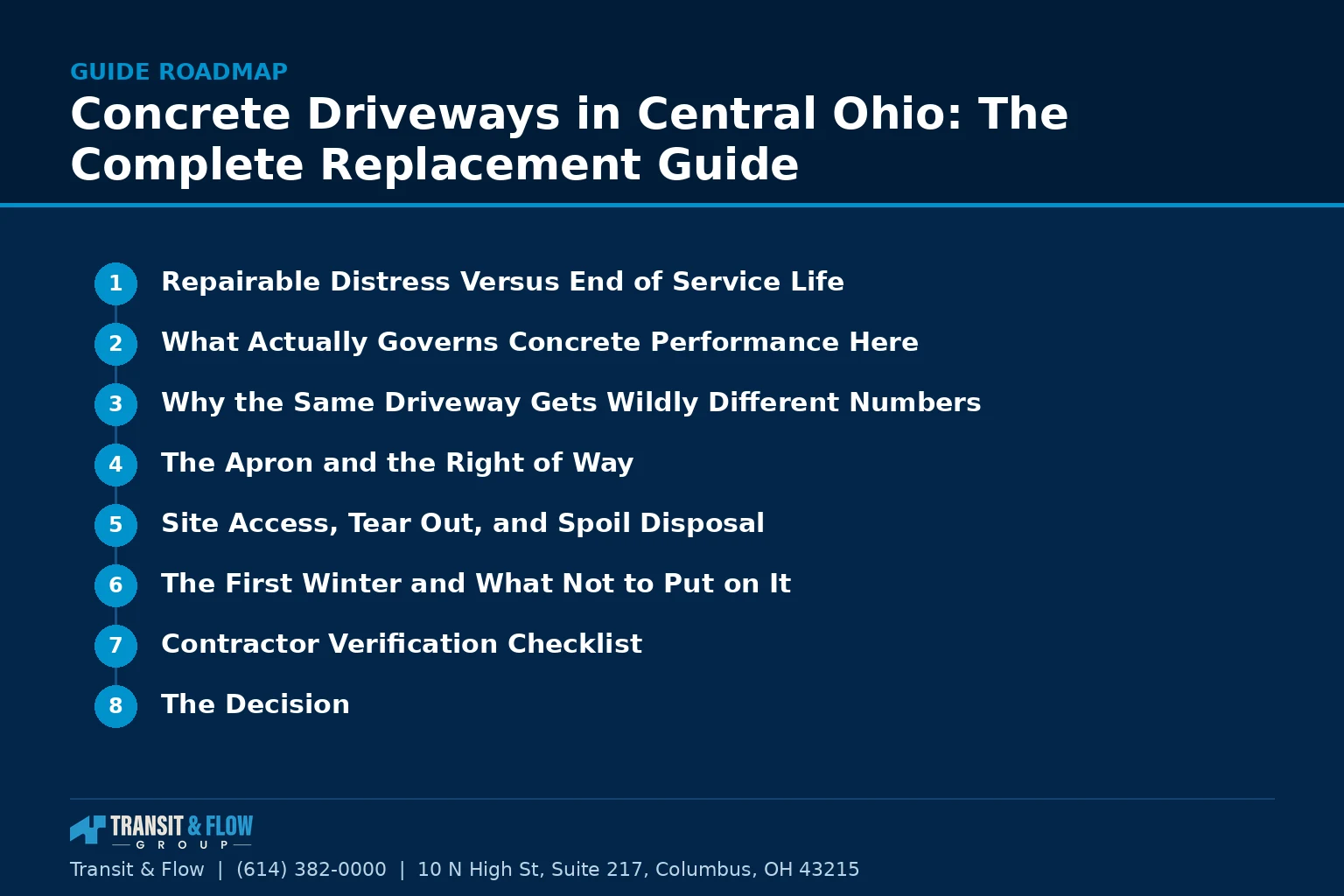
- Repairable Distress Versus End of Service Life
- What Actually Governs Concrete Performance Here
- Why the Same Driveway Gets Wildly Different Numbers
- The Apron and the Right of Way
- Site Access, Tear Out, and Spoil Disposal
- The First Winter and What Not to Put on It
- Contractor Verification Checklist
- The Decision
- Where Transit & Flow Group Fits
- Frequently Asked Questions
Here is what most Central Ohio property owners get wrong. They shop the driveway as a surface, comparing square footage and price per square foot, and treat everything under the surface as identical across bidders. It is not identical, it is the largest variable in whether the slab lasts, and it is exactly where a low bid does its cutting.
Repairable Distress Versus End of Service Life
Not every cracked driveway needs replacing, and not every intact looking driveway has service life left. The useful distinction is not how bad it looks. It is whether the distress is a surface condition or evidence that the support under the slab has failed. Surface conditions can often be repaired. Support failures cannot, because the repair sits on the same failed support.
Signs That Point Toward Repair
- Fine surface cracking with no vertical movement. Hairline shrinkage cracking you can see but not feel is a cosmetic concern, not a structural one.
- Isolated cracks that stay tight. One crack through one panel, both sides at the same elevation, no widening over several seasons.
- Failed joint sealant over sound joints. Sealant has a far shorter life than the slab, and replacing it is inexpensive relative to what it prevents.
- A single settled panel with the rest stable. One panel dropping usually traces to a local cause such as a utility trench or a downspout discharge, and that cause can be corrected.
- Edge spalling limited to one small area. Damage clustered around a known event is about that event, not about the slab.
Signs That Point Toward Replacement
- Panels rocking under vehicle weight. Movement you can feel means the slab has lost bearing contact with the material beneath it, and that void will keep growing.
- Vertical offset at cracks and joints across the drive. When one side sits higher than the other in several places, the support is settling differentially.
- Widespread scaling and surface loss. Sheet loss of the top layer is the classic outcome of a slab that was not durable enough for freeze and thaw exposure.
- Map cracking with aggregate visible. Interconnected cracking exposing the stone indicates deterioration through the paste, not just at the surface.
- Standing water that never drains. Ponding means the grade has changed, and a slab whose grade has changed has moved.
- Panels broken into several pieces. A fragmented panel no longer behaves as a panel, and loads transfer unpredictably to its neighbors.
- Repairs that have themselves failed. A patch that cracked or settled again is telling you the underlying cause was never addressed.
One consideration sits outside the slab entirely. If your driveway drains toward the house, replacement is the only realistic chance to fix it, because regrading a driveway means removing it. A repairable drive that sends water at the foundation is a stronger replacement candidate than its condition suggests, for reasons covered in our guide to grading, downspouts, and basement water.
What Actually Governs Concrete Performance Here
Performance is set by a short list of decisions, most made before any concrete arrives. The numbers attached to these items, thicknesses, spacings, contents, and dimensions, are set by the adopted code, the jurisdiction, and the mix supplier. This guide explains what governs each number and who states it, not the numbers themselves.
Subgrade Preparation and Compaction
This is the most consequential item and the one most often skipped. Much of Central Ohio sits on glacial till soils with high clay content, which behave in two inconvenient ways. They hold water, and they change volume as their moisture content changes. A slab placed on soft, wet, or uncompacted clay is supported unevenly from the day it cures.
Proper preparation means removing soft and organic material, verifying the exposed subgrade is firm, correcting soft spots by undercutting rather than bridging over them, and compacting in controlled lifts rather than one pass over a deep fill. It also means not placing on saturated subgrade, a real scheduling constraint in a region with a wet spring. Mapped soil series and drainage class for your parcel are public information, which makes you a better listener when someone tells you the ground is fine.
Base Material
A compacted granular base does three jobs. It spreads vehicle load over a wider area of soil, it gives the crew a uniform working platform so slab thickness stays consistent, and it provides a drainage path so water does not sit under the concrete. On clay that last function matters most, because water trapped under a slab through a freeze cycle is a heaving mechanism.
In a proposal, the base should be named, its depth stated, its compaction described, and its material type specified rather than left as generic gravel. Crushed angular material interlocks and stays put. Rounded material does not. Depth is driven by soil and loading, and your jurisdiction or engineer states the minimum.
Slab Thickness and Reinforcement
Thickness is governed by the adopted code and by expected loading, and a normal residential drive and one carrying a loaded truck or an RV are not the same project. Ask what thickness is proposed and what it is based on, then verify the requirement with your building department rather than accepting a bidder’s number.
Reinforcement is a separate question. Steel does not prevent concrete from cracking. It holds the two sides of a crack together and in the same plane once cracking occurs, which is exactly the failure mode that makes an old driveway unusable. Welded wire and bar do that only when positioned correctly within the slab depth, so the proposal should say how they are supported during placement. Steel dragged up with a hook after the pour is not reliably positioned. Fiber reinforcement addresses early plastic shrinkage cracking, a different tool for a different problem, not a substitute for structural steel where it is specified. What is required, in what size and spacing, is a design and code question for your engineer and jurisdiction.
Air Entrainment and Mix Specification
This is the most important durability decision for exterior concrete in our climate, and it is invisible in the finished product. Central Ohio runs through many freeze and thaw cycles each winter, and the region’s habit of thawing in the middle of cold stretches means slabs cycle more than the January average would suggest. Water inside hardened concrete expands as it freezes, and air entrainment builds microscopic voids into the paste that give that expansion somewhere to go.
Concrete without an appropriate entrained air system, placed outdoors here and exposed to deicing salts, scales. That is the sheet surface loss described earlier, and it is not repairable in any durable way. The required air content for a given exposure class is set by the adopted code and the project specification and verified at delivery, not asserted afterward. Get the mix design, specified strength, exposure class, air content requirement, and a commitment that delivery tickets are retained. That documentation costs nothing and is the only record of what arrived on your site. Related: water added at the site to make concrete easier to place reduces strength, so a crew that resists adding water is protecting your slab.
Jointing Layout and Timing
Concrete shrinks as it cures and it will crack. Joints decide where. A control joint is a deliberate weakened plane that concentrates shrinkage stress and produces a straight crack at the bottom of a groove instead of a ragged one across a panel. Spacing is a function of thickness and mix, governed by the adopted code and industry standards rather than by preference.
Two execution details matter as much as the layout. Joints must be cut deep enough to create the weakened plane, and cut within the window when the concrete is hard enough to saw cleanly but has not yet cracked on its own. Miss that window on a hot afternoon and the slab picks its own crack pattern before the saw arrives.
Isolation joints are the other half. Where the new slab meets the garage foundation, a sidewalk, or any fixed structure, a compressible joint lets the slab move independently. Without one, the slab pushes against the structure through every thermal cycle.
Curing and Drainage
Concrete does not dry, it hydrates, and hydration needs moisture and moderate temperature. Curing is the deliberate maintenance of those conditions after finishing, by compound, water, or covering. Concrete that loses surface moisture too quickly gains far less strength in the top layer, precisely the layer facing salt, tires, and freezing water. Curing is easy to omit because nothing visible happens when you skip it. The difference shows up in year three as a surface that scales. A proposal should state the curing method and the seasonal protection measures.
Drainage is the other item that outlives the pour. A driveway is a large impervious surface usually attached to the building, and the slope of the finished slab decides where every inch of rain goes. In the flat to gently rolling terrain typical of Central Ohio there is often little natural fall, so positive drainage away from the garage takes deliberate design rather than luck. Replacement is the moment to solve it. Establish where water goes now, where it should go, and what finished elevations get it there. That may bring in a trench drain, a swale, downspout changes, or a different crown, and it should happen before the price is set.
Why the Same Driveway Gets Wildly Different Numbers
Homeowners routinely collect three proposals on one driveway and find a spread that seems impossible. It is almost never arbitrary. It is the sum of line items one bidder included and another did not, plus real differences in how each bidder read the site.
- Subgrade work and undercutting. The largest hidden variable. A bid assuming the subgrade is adequate and a bid including removal of soft material are different projects.
- Base depth and material. Depth, material type, and whether compaction is done in verified lifts change material cost and labor hours.
- Slab thickness. Thickness drives concrete volume directly and is the easiest place to quietly shave a bid.
- Reinforcement approach. Steel plus the chairs and labor to position it correctly costs real money. Fiber alone costs less. Both can be described as reinforced.
- Mix specification. Specified strength, air entrainment, and seasonal admixtures all sit in the concrete unit price, and a lower unit price usually means a different mix.
- Tear out and disposal. Priced by volume and disposal weight, and reinforced or unusually thick old slabs cost more to remove.
- Site access. Whether trucks discharge directly or concrete moves by buggy or pump is among the largest labor drivers on a residential job.
- Drainage and grading work. Trench drains, swales, downspout changes, and elevation work are separate scope that some bidders include and some omit.
- The apron and right of way portion. Frequently a different permit, specification, and inspection, and frequently missing from bids that priced only the private portion.
- Permits, inspections, and utility location. Real cost and real schedule, worth seeing named rather than assumed.
- Restoration. Topsoil and seed at the edges, landscaping damaged by access, and lawn repair where trucks staged.
- Season and schedule. Cold and hot weather placement carry protection requirements, and a compressed peak season schedule prices differently than a flexible one.
Normalize the bids before comparing them. Take the most detailed proposal, list every line item, and ask the other bidders to confirm in writing whether each item is in their number. What comes back usually explains the entire spread. That habit transfers across trades, and we walk through it in our article on reading an estimate line by line.
The Apron and the Right of Way
The portion of your driveway between the sidewalk and the street, and often the sidewalk itself, commonly sits within the public right of way rather than on your private property. Your deed line and the edge of the pavement are usually not the same line, and that surprises people every season.
Work in the right of way typically requires its own permit from a different office than the one handling private site work, frequently service or engineering rather than building. The specification for that portion is often set by the jurisdiction, covering thickness, mix, and jointing for that segment. The contractor may need to be separately approved or bonded, and inspection runs on the jurisdiction’s timeline, not yours.
Franklin County makes this harder than it needs to be, because a Columbus mailing address does not establish which authority governs your street. Dublin, Westerville, Upper Arlington, Grove City, and the surrounding townships each administer their own right of way work with their own permit process and specification. Confirm your actual jurisdiction before anyone quotes the apron.
The failure mode is straightforward. A bid prices the private driveway only, work proceeds, and the apron turns out mid project to need a separate permit the contractor cannot pull, or a specification the mix already ordered does not meet. That is a change order on a job already torn out. Establish before signing whether the apron is included, who pulls the permit, what specification applies, and who is responsible if the jurisdiction rejects the work.
Site Access, Tear Out, and Spoil Disposal
These three are invisible in a finished driveway, among the largest real cost drivers, and where bidders most often differ in their assumptions.
Access determines the method. A driveway a ready mix truck can discharge into directly is the cheapest case. Moving concrete by wheelbarrow or buggy adds hours of labor per load, and a pump adds equipment and mobilization cost. Narrow lots, mature trees, and overhead lines all constrain what equipment can be used.
Tear out cost scales with volume, thickness, and whether the old slab was reinforced, since reinforced concrete has to be cut apart rather than broken. If the previous driveway was asphalt over concrete, or concrete over an older slab, both layers come out and the quantity doubles with no change in visible square footage.
Disposal is a per ton or per load cost that shows up whether or not anyone itemized it. Concrete is heavy, facilities charge by weight, and hauling distance is a real variable. Excavated clay is its own problem, since spoil from undercutting also leaves the site and is heavier when wet. Ask where material is going, whether disposal is in the number, and what happens if tear out reveals more depth than expected.
One item is not optional. Underground utility location is required by Ohio law before excavation, it is free to the homeowner, and it takes lead time. Gas, electric, water, communications, and irrigation lines all cross residential driveways somewhere, and a contractor who intends to start tomorrow with no locate tickets is telling you how they operate. We go through the process and its limits in our article on utility location before you dig in Ohio.
The First Winter and What Not to Put on It
New concrete is most vulnerable in its first winter, and the most common way a good driveway gets damaged is by the homeowner who paid for it. Concrete keeps gaining strength long after it is walkable, and its resistance to freeze and thaw damage is still developing through the first season. Deicing chemicals add cycles and drive salt into a surface that has not finished maturing.
The general guidance for new exterior slabs is to avoid deicing chemicals through the first winter and use them sparingly after that, favoring mechanical removal and abrasives such as sand. Your supplier and contractor should give written guidance for the mix placed on your site, and manufacturer documentation for any sealer states its own limits. Some chemistries, particularly those containing ammonium compounds, are more aggressive toward concrete than others.
- Keep vehicles off until the contractor releases the slab. Foot traffic, vehicle traffic, and heavy vehicle traffic each have their own waiting period.
- Plow and shovel rather than salt. Mechanical removal protects the surface during the season it is least able to resist chloride exposure.
- Use sand for traction. Abrasives provide grip without introducing chemistry or additional melt and refreeze cycles.
- Avoid parking where snow melts off a vehicle and refreezes. Repeated local melt and refreeze concentrates cycles in one spot, and that is where scaling starts.
- Keep street salt off the new slab. Plow spray and tracked slush carry chloride onto the apron, so rinse that area during thaws when you can.
- Watch the joints. Sealant keeps water and debris out, and it needs periodic replacement across the life of the slab.
- Recheck drainage after the first heavy rain. Look for ponding while the contractor is still on the hook, not the following spring.
Contractor Verification Checklist
Work through this before signing. Every item is verifiable in advance and cheaper to check now than to discover later.
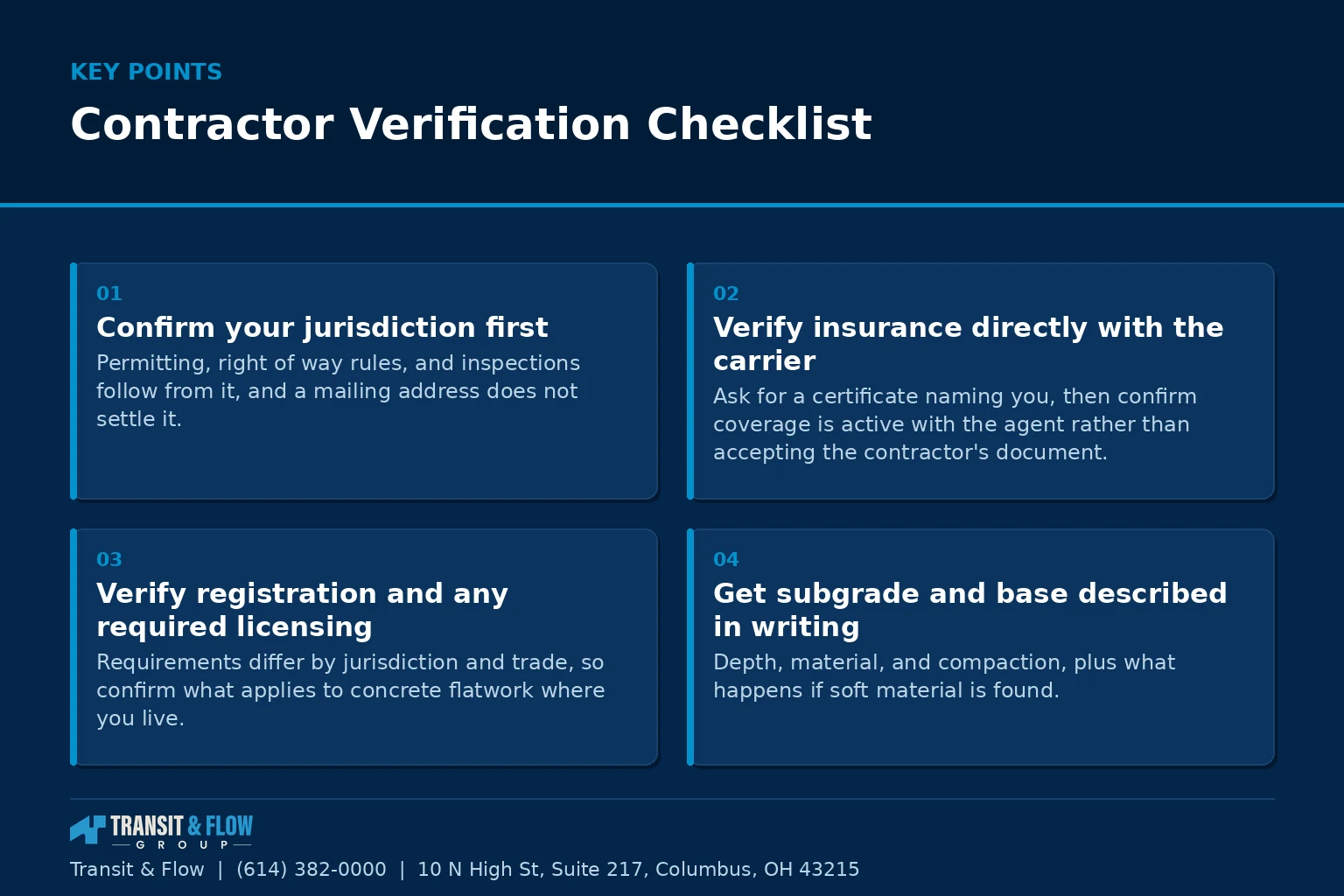
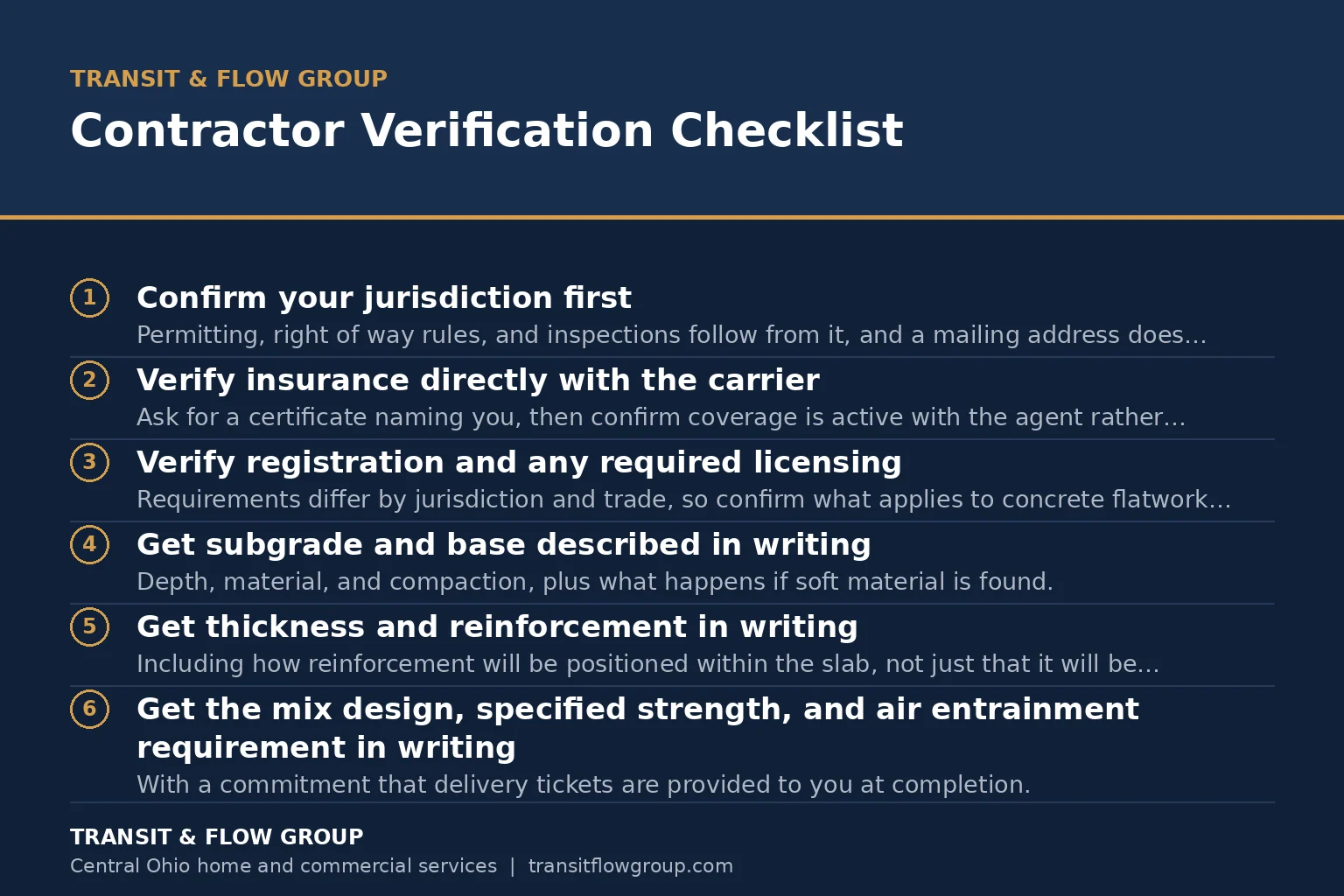
- Confirm your jurisdiction first. Permitting, right of way rules, and inspections follow from it, and a mailing address does not settle it.
- Verify insurance directly with the carrier. Ask for a certificate naming you, then confirm coverage is active with the agent rather than accepting the contractor’s document.
- Verify registration and any required licensing. Requirements differ by jurisdiction and trade, so confirm what applies to concrete flatwork where you live.
- Get subgrade and base described in writing. Depth, material, and compaction, plus what happens if soft material is found.
- Get thickness and reinforcement in writing. Including how reinforcement will be positioned within the slab, not just that it will be present.
- Get the mix design, specified strength, and air entrainment requirement in writing. With a commitment that delivery tickets are provided to you at completion.
- Get the jointing plan. Panel layout, joint depth, saw cut timing, and where isolation joints occur against the garage and other fixed structures.
- Get the curing method stated. Plus cold or hot weather protection measures if placement falls in a season that requires them.
- Get finished elevations and drainage direction confirmed. Establish in writing which way water will run and what happens to water that currently ponds.
- Settle the apron question explicitly. Whether the right of way portion is included, who pulls that permit, and what specification governs it.
- Confirm utility location will be requested and tickets held. With enough lead time to satisfy the required notice period.
- Confirm disposal is included and where material is going. Both the old concrete and the excavated soil.
- Understand the payment schedule. A deposit proportional to mobilization and material, progress tied to completed work, final payment after inspection and acceptance.
- Read the warranty for what it excludes. Nearly all concrete warranties exclude shrinkage cracking and color variation. What matters is what it says about settlement, scaling, and joint performance.
- Get the change order process in writing before work starts. Settle it while nothing is torn out and you still have leverage.
Two of these have their own guides: verifying a contractor in Ohio and payment schedules, deposits, and draws.
The Decision
Option A. Collect three proposals, compare bottom line numbers and stated square footage, choose the bidder whose price and availability work best, and rely on their representation that the work will be done correctly.
Option B. Establish the scope yourself first, including subgrade treatment, base, thickness, reinforcement, mix, jointing, curing, drainage, and the apron. Confirm your jurisdiction and its right of way requirements independently. Issue that scope to every bidder so all three price the same project, then verify insurance, registration, and references before signing.
Recommendation: Option B, and the scoping work takes one afternoon. The asymmetry drives it. A driveway fails slowly and expensively, and every mechanism that shortens its life is buried under the surface where no later inspection can evaluate it. Once concrete is placed, subgrade preparation, base depth, reinforcement position, air content, and curing are permanently unverifiable. You are not buying a driveway, you are buying a set of decisions that get covered up on the day of the pour. Writing the scope yourself converts three incomparable numbers into three comparable ones, and it usually reveals that the low bid was low because it was a smaller project. If you do nothing else from this guide, confirm your jurisdiction before anyone quotes the apron, and get the mix specification and delivery tickets in writing.
Where Transit & Flow Group Fits
We coordinate driveway replacement projects across Central Ohio, and the scope is written before bids rather than assembled from them. Jurisdiction and right of way requirements are established up front, subgrade conditions are assessed rather than assumed, the mix and jointing plan are specified in writing, drainage is designed as part of the project rather than treated as a consequence of it, and delivery tickets and permit records are turned over at completion. If you are weighing repair against replacement, or trying to reconcile proposals that do not agree, start a conversation with our team.
Transit & Flow Group coordinates projects and partners with properly licensed and insured specialty contractors when licensing is required, and work is performed under the appropriate permits.
Frequently Asked Questions
Why do concrete driveways fail early in Central Ohio
Most early failures trace back to what is under the slab rather than the concrete itself. Soft or uncompacted subgrade, a thin or dirty base, and water that has no place to go all load the slab unevenly. Add freeze and thaw cycling and the slab cracks where it was never supported.
How thick should a residential concrete driveway be
Thickness is a design decision that depends on soil, base, and the vehicles the surface will carry, so it belongs in writing on the estimate rather than in a rule of thumb. Ask the contractor to state the specified thickness, how it was chosen, and how it will be verified during the pour.
Does reinforcement stop cracking
No. Reinforcement does not prevent concrete from cracking, it controls what happens after a crack forms by holding the pieces in alignment and transferring load. Joint layout is what determines where cracks appear. Treat reinforcement and jointing as two separate line items with two separate jobs.
Can a new driveway be poured over the old one
Sometimes, but it changes the problem. An overlay inherits every movement and every drainage issue in the slab beneath it, and it raises the finished surface, which can affect garage thresholds, door clearance, and how water leaves the property. Replacement resets the base and the drainage.
Do I need a permit to replace a driveway
It depends on the jurisdiction and on whether the work touches the public right of way, including the apron or drive approach. Municipalities in Franklin County and the surrounding area do not treat this identically. Confirm with the authority having jurisdiction over your address before work begins.
When is the best time of year to pour concrete in Ohio
Concrete can be placed across most of the Ohio calendar with the right precautions, but the precautions change with the weather. Cold placement requires protection so the mix gains strength, hot and windy placement requires moisture control at the surface. Schedule matters less than whether the crew is prepared for the conditions.
Sources
- International Code Council, the code editions adopted in Ohio
- Ohio Department of Commerce, Division of Industrial Compliance, adopted building codes and contractor licensing
- Federal Highway Administration, concrete pavement materials, jointing, and durability research
- USDA Natural Resources Conservation Service Web Soil Survey, mapped soil series and drainage characteristics by parcel
- Ohio Utilities Protection Service, underground utility location requirements before excavation
About This Guide
Written and edited by Micheal Parker, founder of Transit & Flow Group. Published May 9, 2027. This guide is checked against the agency and code sources listed above, and it is revised when those sources change.
General contractor of record. Micheal Parker holds City of Columbus General Contractor Registration G12064, issued by the Columbus Department of Building and Zoning Services under Transit & Flow LLC and valid through June 30, 2027. Trade work that falls outside the scope of that registration is performed by licensed trade partners, and the responsible license holder is identified before work begins.
Transit & Flow Group, home and commercial services for Columbus and the surrounding Central Ohio communities. Phone (614) 382-0000. Email solutions@transitflowgroup.com. 10 N High St, Suite 217, Columbus, OH 43215. Contact our team or review the communities we serve.
