


Permits are the part of a kitchen project that homeowners most often try to avoid and most often regret avoiding. The avoidance is usually based on two beliefs, that permits cost a lot and that they slow everything down. Neither survives contact with an actual project. What permits do is put a third party with no financial stake into the middle of the work you are least able to evaluate. This article explains what triggers a permit on a kitchen remodel, what the process looks like, and what happens later when the work was never permitted. It supports our kitchen work.
In This Guide
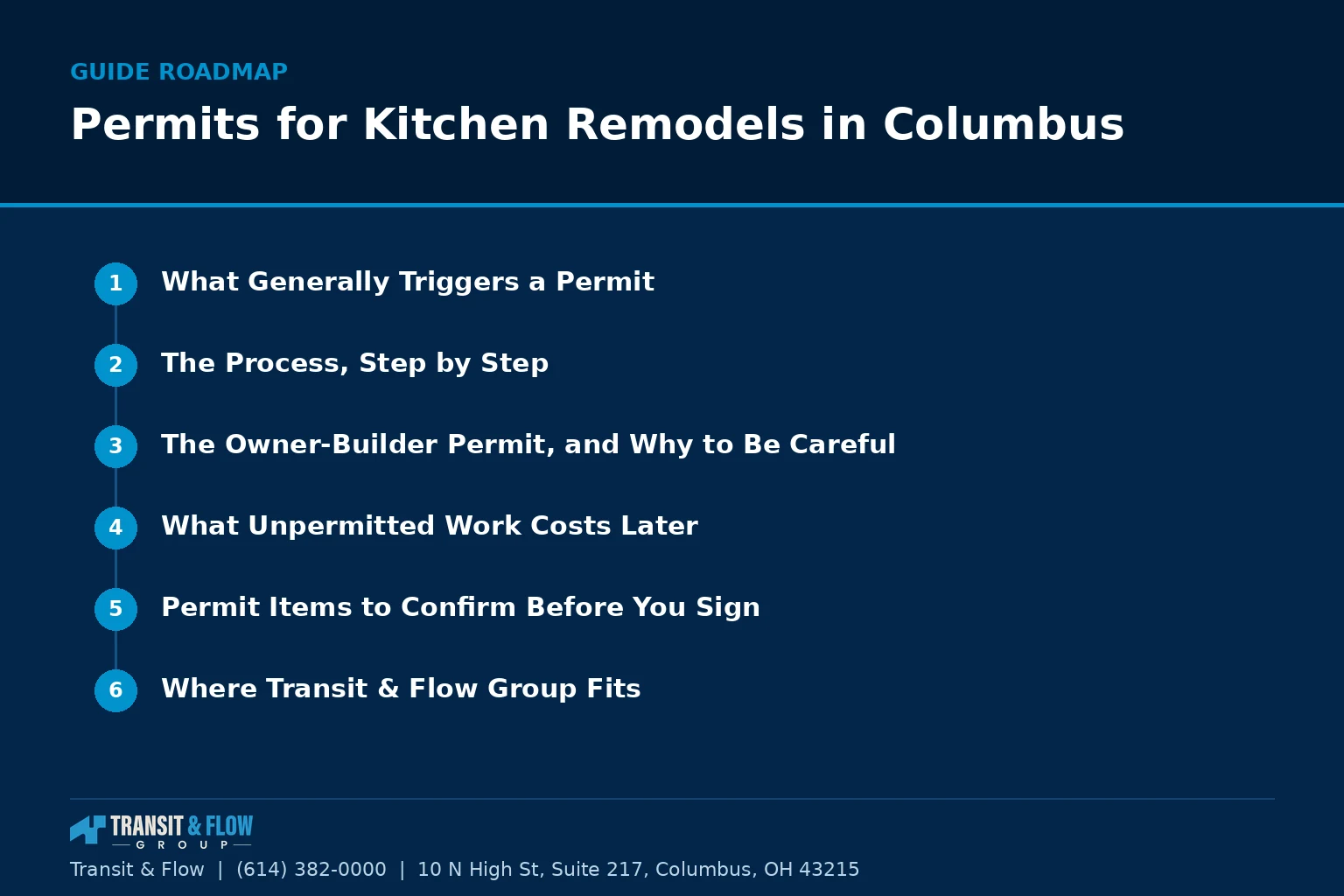
- What Generally Triggers a Permit
- The Process, Step by Step
- The Owner-Builder Permit, and Why to Be Careful
- What Unpermitted Work Costs Later
- Permit Items to Confirm Before You Sign
- Glossary
- Where Transit & Flow Group Fits
- Frequently Asked Questions
Transit & Flow Group coordinates projects and partners with properly licensed and insured specialty contractors when licensing is required.
Read this first. Permit requirements are set by the jurisdiction your property sits in, and Central Ohio contains many of them. Columbus, the surrounding municipalities, and unincorporated township areas served by county departments do not all apply the same thresholds or the same process. Nothing here substitutes for confirming requirements with the authority that actually has jurisdiction over your address, and your contractor should be doing that as a matter of course. Treat this as a map of the questions rather than as a determination about your project.
What Generally Triggers a Permit
The pattern across jurisdictions is consistent even where the details differ. Permits attach to work that affects structure, life safety, or the licensed trade systems. They generally do not attach to finishes.
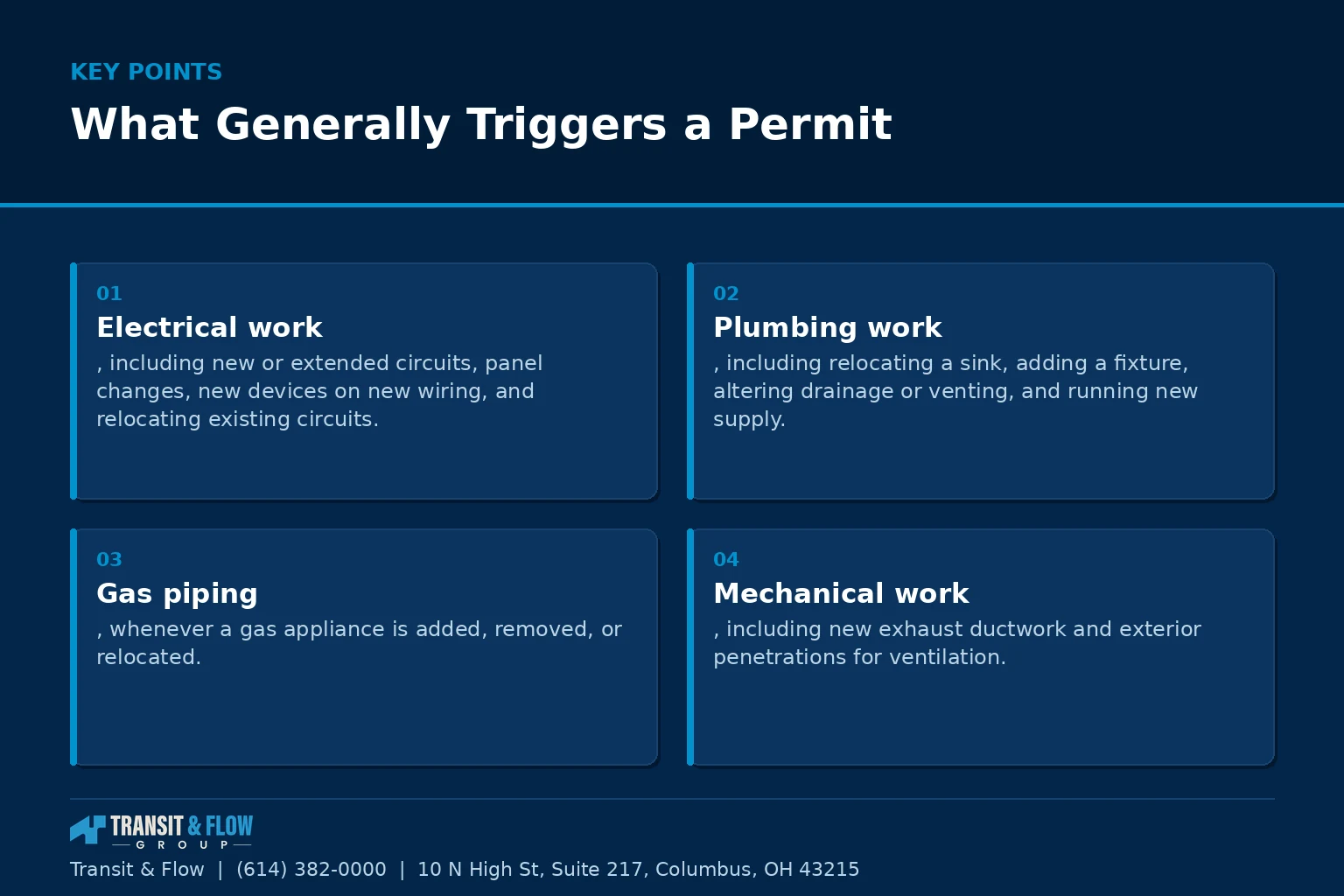
- Electrical work, including new or extended circuits, panel changes, new devices on new wiring, and relocating existing circuits. This is the most commonly triggered permit in a kitchen and the most commonly skipped.
- Plumbing work, including relocating a sink, adding a fixture, altering drainage or venting, and running new supply. Replacing a faucet is not the same category as moving a drain.
- Gas piping, whenever a gas appliance is added, removed, or relocated.
- Mechanical work, including new exhaust ductwork and exterior penetrations for ventilation.
- Structural work, including removing or altering a wall, changing an opening, adding or resizing a window or door, and altering floor structure.
- Changes to the building envelope, meaning anything that penetrates or modifies an exterior wall or roof.
Work that generally does not trigger a permit includes painting, replacing cabinets in the same locations with no trade work, installing countertops, replacing flooring, installing a backsplash, and swapping a fixture or appliance in place with no new wiring or piping. That list maps almost exactly onto the class one and class two projects described in our article on what changes the project class, which is not a coincidence. The class boundary and the permit boundary are the same line viewed from two directions.
The Process, Step by Step
- Scope determination. The contractor identifies which trades are in scope and therefore which permits apply. This should happen before the contract is signed, not after demolition.
- Application. The licensed contractor performing each trade applies for that trade’s permit, with the property address, the scope, and the license credentials attached.
- Plan review where applicable. Simple trade permits often issue without review. Structural work and larger alterations may require drawings.
- Issuance. The permit is posted at the property and the work may begin.
- Rough inspection. Performed with walls and floors open, before anything is covered. This is the substantive inspection.
- Cover and finish. Insulation, drywall, cabinetry, and finishes proceed only after the rough inspection passes.
- Final inspection. Devices are in, fixtures are connected, and the work is verified complete.
- Permit closure. The record closes and attaches to the property’s file, which is the part that matters years later.
The schedule impact of this sequence is smaller than people expect and it is almost entirely concentrated at the rough inspection, which is a scheduling dependency rather than a delay. A contractor who runs an organized job builds it into the schedule and it costs nothing. A contractor who treats it as an interruption was going to have schedule problems regardless.
The Owner-Builder Permit, and Why to Be Careful
Many jurisdictions allow a homeowner to pull a permit for work on their own residence. There are legitimate reasons a homeowner does this, and there is one very common illegitimate reason someone else suggests it.
When you pull the permit, you become the responsible party. You are the one the jurisdiction looks to for compliance, you are the one who has to be present for inspections, and you have removed the requirement that a licensed contractor put their credentials behind the work. If a contractor asks you to pull the permit for work they are performing, understand what has just happened. That request should prompt a direct inquiry into whether they hold the license for the trade in question, and the answer should be verifiable. Our article on verifying a contractor in Ohio covers the check, which takes a few minutes.
What Unpermitted Work Costs Later
The cost of skipping a permit is never paid during the project. It is paid later, by someone, and often by you.
- At sale. Unpermitted work surfaces during inspection or through public records, and it becomes a negotiation item at the worst possible moment. Buyers routinely ask for permits on visible recent work.
- At an insurance claim. A loss originating in unpermitted work invites questions you would rather not be answering while you are also dealing with the loss itself.
- At the next project. A later permit application can surface earlier unpermitted work, and the resolution is retroactive permitting, which sometimes means opening finished walls so the work can be inspected.
- In safety terms. This is the one that matters most and gets discussed least. The rough inspection exists because concealed trade work cannot be evaluated by the person paying for it. Skipping it means nobody independent ever looked.
- In enforcement terms. Jurisdictions can require correction, and the cost of correction after finishes are installed is not comparable to the cost of doing it correctly the first time.
On cost: this article contains no dollar figures on purpose. Permit fees vary by jurisdiction, by trade, and often by the valuation of the work, and they are set by public schedules that change. What is consistent across Central Ohio is that permit fees are a small fraction of a kitchen project, small enough that they are never the real reason a permit was skipped. Check the fee schedule published by the authority with jurisdiction over your address rather than relying on any figure from an article.
Permit Items to Confirm Before You Sign
These are short items with short answers. A contractor who runs permitted work addresses all of them without hesitation, because the answers are already part of how the job is planned. Hesitation on any one of them is the finding.
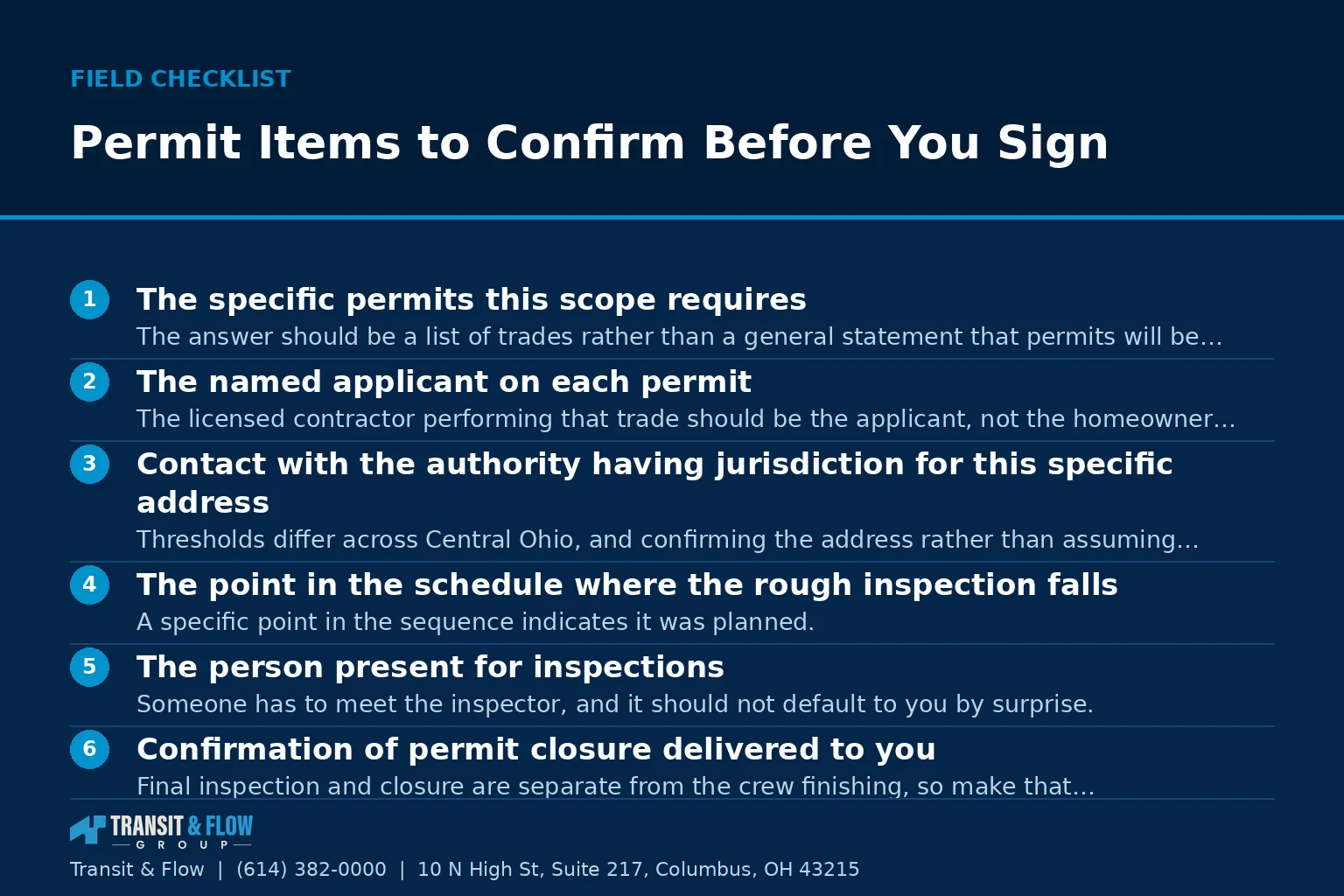
- The specific permits this scope requires. The answer should be a list of trades rather than a general statement that permits will be handled.
- The named applicant on each permit. The licensed contractor performing that trade should be the applicant, not the homeowner and not the general contractor for a trade they do not hold.
- Contact with the authority having jurisdiction for this specific address. Thresholds differ across Central Ohio, and confirming the address rather than assuming the municipality is the whole point.
- The point in the schedule where the rough inspection falls. A specific point in the sequence indicates it was planned. A vague answer indicates it was not.
- The person present for inspections. Someone has to meet the inspector, and it should not default to you by surprise.
- Confirmation of permit closure delivered to you. Final inspection and closure are separate from the crew finishing, so make that confirmation a stated deliverable at the end of the job.
Put the answers in the contract rather than in a conversation. A permit list written into the scope document does two things at once. It commits the contractor to the process, and it gives you an independent description of how much regulated trade work your project actually contains.
Glossary
- Authority having jurisdiction. The specific municipal or county department responsible for permits and inspections at your address.
- Trade permit. A permit for a single discipline, meaning electrical, plumbing, mechanical, or gas, issued to the licensed contractor performing it.
- Plan review. A pre-issuance review of drawings, required for structural and larger alterations.
- Rough inspection. Inspection of concealed work before it is covered.
- Final inspection. Inspection of completed work, which closes the permit.
- Owner-builder permit. A permit pulled by the property owner, transferring responsibility to them.
- Retroactive permitting. Permitting work after it was performed, which frequently requires exposing it for inspection.
- Permit record. The public file attached to a property showing what was permitted and closed.
Option A is permitting only what clearly requires it and moving quickly on the rest. Option B is having the contractor confirm the full permit set with the authority having jurisdiction before the contract is signed, and building the inspection points into the schedule from the start. My recommendation is Option B, and the reasoning is not primarily about compliance. It is that the permit set is a free, accurate description of how much real trade work is in your project. A proposal claiming a simple kitchen update while the permit set includes electrical, plumbing, and mechanical has told you the project class, in writing, from an independent source, before you have spent anything. Read the permit list as a scope document. It is the most honest one you will receive. For the work those permits cover, see our article on kitchen rough-in work, and for the full sequence, our kitchen planning guide.
Where Transit & Flow Group Fits
Transit & Flow Group coordinates kitchen projects across Columbus and Central Ohio and partners with properly licensed and insured specialty contractors when licensing is required. Our standard is that the permit set is confirmed with the authority having jurisdiction before a contract is signed, that permits are pulled by the licensed contractor performing each trade rather than by the homeowner, that inspection points are scheduled rather than treated as interruptions, and that final inspection and permit closure are completed rather than left open after the crew leaves. To have a kitchen scope checked against the permits it actually requires, contact us.
Frequently Asked Questions
What kind of kitchen work actually requires a permit?
The pattern is consistent across jurisdictions even where the details differ. Permits attach to work that affects structure, life safety, or the licensed trade systems, and generally not to finishes. That means electrical work including new or extended circuits and panel changes, plumbing work including relocating a sink or altering drainage and venting, gas piping whenever a gas appliance is added, removed, or relocated, mechanical work including new exhaust ductwork and exterior penetrations, structural work such as removing or altering a wall, and any change to the building envelope. Requirements are set by the jurisdiction your property sits in, so confirm them with the authority that actually has jurisdiction over your address.
What kitchen work usually does not need a permit?
Painting, replacing cabinets in the same locations with no trade work, installing countertops, replacing flooring, installing a backsplash, and swapping a fixture or appliance in place with no new wiring or piping generally fall outside the permit line. Replacing a faucet is not the same category as moving a drain, and that distinction is the whole boundary. Central Ohio contains many jurisdictions that do not all apply identical thresholds, so treat this as a map of the questions rather than a determination about your project and have your contractor confirm with the building department for your address.
Will permits slow my kitchen project down?
Less than most people expect. The schedule impact is almost entirely concentrated at the rough inspection, which is a scheduling dependency rather than a delay. A contractor who runs an organized job builds it into the schedule and it costs nothing in calendar time. A contractor who treats it as an interruption was going to have schedule problems regardless. The sequence is scope determination, application, plan review where applicable, issuance, rough inspection with walls open, cover and finish, final inspection, and permit closure.
My contractor asked me to pull the permit. Should I?
Understand what that request does before you agree. When you pull the permit you become the responsible party, you are the one the jurisdiction looks to for compliance, you have to be present for inspections, and you have removed the requirement that a licensed contractor put their credentials behind the work. Many jurisdictions do allow a homeowner to pull a permit on their own residence, and there are legitimate reasons to do so. But when the request comes from a contractor performing the work, it should prompt a direct and verifiable inquiry into whether they hold the license for the trade in question.
What happens later if kitchen work was never permitted?
The cost of skipping a permit is never paid during the project, it is paid later. Unpermitted work surfaces at sale through inspection or public records and becomes a negotiation item at the worst moment. A loss originating in unpermitted work invites questions during an insurance claim you would rather not be answering. A later permit application can expose the earlier work, and the resolution is retroactive permitting, which sometimes means opening finished walls. Jurisdictions can also require correction, and correcting concealed work after finishes are installed is not comparable in cost to doing it right the first time.
Why is the permit list useful beyond compliance?
Because the permit set is a free, accurate description of how much real trade work is in your project, written by an independent source before you have spent anything. A proposal describing a simple kitchen update while the permit set includes electrical, plumbing, and mechanical has told you the actual project class in writing. Have the contractor confirm the full permit set with the authority having jurisdiction before the contract is signed, and put the permit list into the scope document rather than leaving it in a conversation. Read it as a scope document, because it is the most honest one you will receive.
Sources
- City of Columbus, Get a Permit, permit application and inspection process
- Ohio Revised Code 3781.25, residential construction standards
- Ohio Construction Industry Licensing Board, trade licensing verification
- Ohio Attorney General, consumer protection guidance on home improvement contracts
About This Guide
Written and edited by Micheal Parker, founder of Transit & Flow Group. Published January 3, 2027. This guide is checked against the agency and code sources listed above, and it is revised when those sources change.
General contractor of record. Micheal Parker holds City of Columbus General Contractor Registration G12064, issued by the Columbus Department of Building and Zoning Services under Transit & Flow LLC and valid through June 30, 2027. Trade work that falls outside the scope of that registration is performed by licensed trade partners, and the responsible license holder is identified before work begins.
Transit & Flow Group, home and commercial services for Columbus and the surrounding Central Ohio communities. Phone (614) 382-0000. Email solutions@transitflowgroup.com. 10 N High St, Suite 217, Columbus, OH 43215. Contact our team or review the communities we serve.
