

Nearly every failed garage floor coating in Central Ohio failed for one of two reasons, and neither is the product. Either moisture moved up through the slab and pushed the coating off, or the surface was never prepared well enough to bond. Product selection matters, but it matters third. A premium system over an untested, unprepared slab peels on roughly the same schedule as a bargain kit.
In This Guide
- What Is Actually Under Your Garage Slab
- Vapor Drive and Why It Decides the Outcome
- Evaluating a Slab Before You Spend Anything
- Surface Preparation Is the Product
- The Coating Families in Plain Terms
- Hot Tire Pickup
- Salt, Chloride, and February
- Cracks, Joints, and What a Coating Cannot Do
- Slope, Drainage, and the Door Edge
- Pre-Purchase Evaluation Checklist
- Realistic Maintenance Expectations
- The Decision
- Where Transit & Flow Group Fits
- Frequently Asked Questions
Here is what most property owners get wrong. They treat the garage floor as a surface to be cleaned and painted, when it is the top face of a slab sitting on wet Central Ohio clay and exchanging moisture with it continuously. The coating is not decorating a floor. It is placing a barrier on a system that is already moving water, and whether it survives depends on what the slab underneath is doing.
What Is Actually Under Your Garage Slab
A garage floor here is a slab on grade, poured on compacted fill over native soil, which across Franklin County and surrounding counties is a dense glacial till with high clay content. Clay does not drain. It holds water, releases it slowly, and stays damp most of the year.
That matters because concrete is porous. It is a network of capillaries moving water and vapor from the wet side to the dry side, driven by differences in humidity and temperature. The slab is not a barrier. It is a wick with a hard surface.
The other half of the story is the vapor retarder, the sheet membrane placed under the slab before the pour. When present, correctly lapped, and not punctured during placement, it interrupts that path and the slab dries from the top. When absent or torn, the slab has a permanent moisture supply beneath it. Two slabs that look identical can behave completely differently for this reason, and you cannot tell which you have by looking.

Vapor Drive and Why It Decides the Outcome
Vapor drive is the movement of moisture through the slab toward the drier side, and in an unconditioned Central Ohio garage its intensity changes with the season. In spring, with the soil saturated and the garage air warming, it is strongest. In a dry August it may be negligible. This is why a coating applied in late summer can look perfect for eight months and blister the following April.
Place a low permeability coating over a slab with active vapor drive and the moisture arriving under that film has nowhere to go. It accumulates at the bond line, carrying alkaline salts that attack it in a process called osmotic blistering. The result is bubbles, then delamination in sheets, then a floor worse than bare concrete.
This is why moisture testing exists. The test methods, acceptable results, and mitigation options are defined by the manufacturer in the technical data sheet for the system being installed, and those thresholds differ between products. There is no universal number, and a contractor who quotes one without naming the product it belongs to is telling you something about their process.
Evaluating a Slab Before You Spend Anything
An owner can learn a great deal before a contractor arrives. None of these replace instrumented testing, but they tell you whether you have a straightforward job or a problem slab.
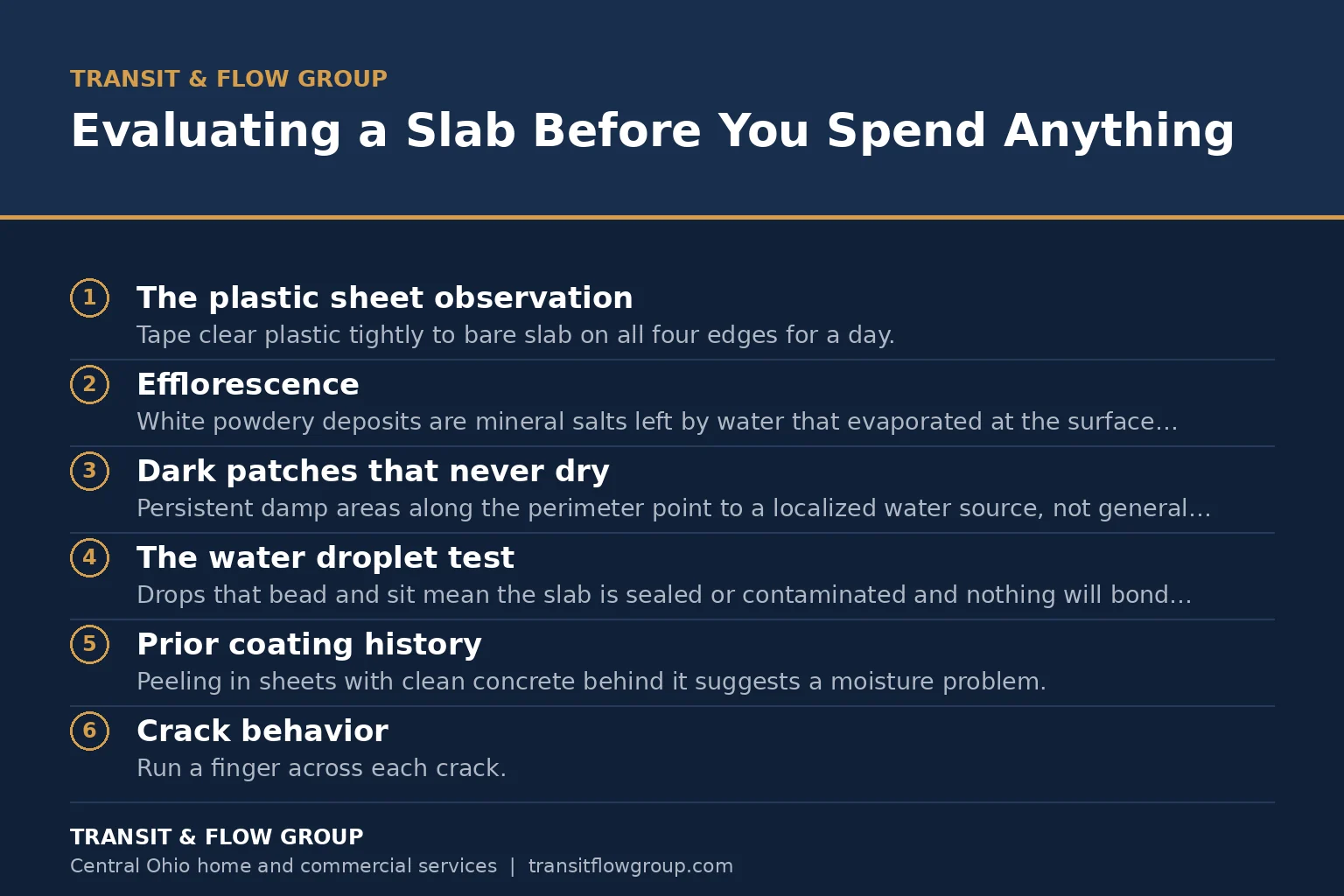
- The plastic sheet observation. Tape clear plastic tightly to bare slab on all four edges for a day. Condensation underneath or darkened concrete indicates moisture from below.
- Efflorescence. White powdery deposits are mineral salts left by water that evaporated at the surface, proof that water has moved through the concrete.
- Dark patches that never dry. Persistent damp areas along the perimeter point to a localized water source, not general vapor drive.
- The water droplet test. Drops that bead and sit mean the slab is sealed or contaminated and nothing will bond until that is removed. Drops that absorb mean the surface is open.
- Prior coating history. Peeling in sheets with clean concrete behind it suggests a moisture problem. Coating that pulls concrete off suggests a weak surface layer.
- Crack behavior. Run a finger across each crack. A vertical step means the two sides are moving independently.
- Where water goes. Pour a bucket at the back of the garage. Water that pools rather than running toward the door means the slope is inadequate or reversed.
A professional applicator adds instrumented testing, typically in situ relative humidity probes drilled into the slab, calcium chloride emission testing, or both, performed as the manufacturer specifies. They should tell you which system they intend to install, which test it requires, and what the results were. A mitigation primer is a normal outcome, not a failure.
Surface Preparation Is the Product
Concrete cures with a thin, weak top layer called laitance, fine cement particles and water that rose during finishing. Power troweling makes it denser and smoother. It has to come off, because a coating bonded to laitance is bonded to something poorly attached to the slab below.
Mechanical profiling removes it. Diamond grinding and shot blasting cut into sound concrete and leave a measurable texture the coating keys into. Acid etching, included with most consumer kits, dissolves the surface unevenly, leaves residue that must be neutralized, does not touch oil, and cannot produce the profile thicker systems require.
Preparation also includes decontamination. Years of oil, transmission fluid, and road salt have soaked into the pores of a garage slab, and grinding alone can smear them rather than remove them. Degreasing before profiling is part of the sequence. The required profile is stated in the manufacturer’s technical data sheet.
The Coating Families in Plain Terms
Every coating family trades something away. What each one gives up is more useful than any product comparison, because the trade determines whether it fits your slab and your use.
| System | What it is | Strengths | What it trades away |
|---|---|---|---|
| One part water based | Single component acrylic or water based blend, roller applied | Lowest cost, easiest application, low odor | Thin build, limited chemical and abrasion resistance, most vulnerable to hot tire pickup |
| Two part epoxy | Resin and hardener mixed on site, cures by reaction | Strong adhesion, real film build, good chemical resistance | Slower cure, sensitive to temperature and moisture, ultraviolet ambering |
| Polyaspartic | Fast curing aliphatic polyurea variant, usually a top coat | Fast cure, excellent abrasion and ultraviolet stability | Short working time, higher cost, needs a base beneath it |
| Polyurea | Rapid curing elastomeric, often the base in hybrids | Flexible and impact resistant, tolerates minor slab movement | Cost, and it still cannot bridge a moving joint |
| Full broadcast flake | Base coat, vinyl flake broadcast to refusal, clear top coats | Greatest thickness, hides imperfection, slip resistant, longest life | Highest cost, longest install, most preparation dependent |
The layered hybrid, an epoxy or polyurea base with broadcast flake and a polyaspartic top coat, is the common residential specification because it puts each material where its strength is. None of it helps if the moisture question went unanswered.
Hot Tire Pickup
A tire that has been on the highway comes home hot and soft. Parked, it flattens against the floor and the plasticizers in the rubber stay aggressive while the contact patch cools and grips. The next morning it lifts the coating away, leaving bare concrete in the shape of the tread.
Two things decide whether this happens. The first is bond strength, which is preparation. A coating keyed into profiled concrete resists the pull. One sitting on laitance does not. The second is the coating’s own resistance to tire chemistry, where thin one part systems are weakest. Hot tire pickup is read as a product failure and is almost always a preparation failure.
Salt, Chloride, and February
A Central Ohio garage floor in February takes abuse a milder climate never delivers. Vehicles arrive coated in road brine and deicing salt that melts into puddles sitting on the slab for hours. Chlorides penetrate uncoated concrete, and where reinforcing steel is present they promote corrosion that expands and cracks the slab from within.
Freeze and thaw compounds it. The National Weather Service office serving this region records repeated crossings of the freezing point through winter, and each cycle expands water held in the concrete’s pores. On a bare slab that produces scaling and spalling. A sound, continuous coating is genuinely protective here, which is the strongest argument for coating a garage floor in this climate. A failing coating is worse than none, because water gets under the film, freezes, and drives delamination outward from every edge.
Cracks, Joints, and What a Coating Cannot Do
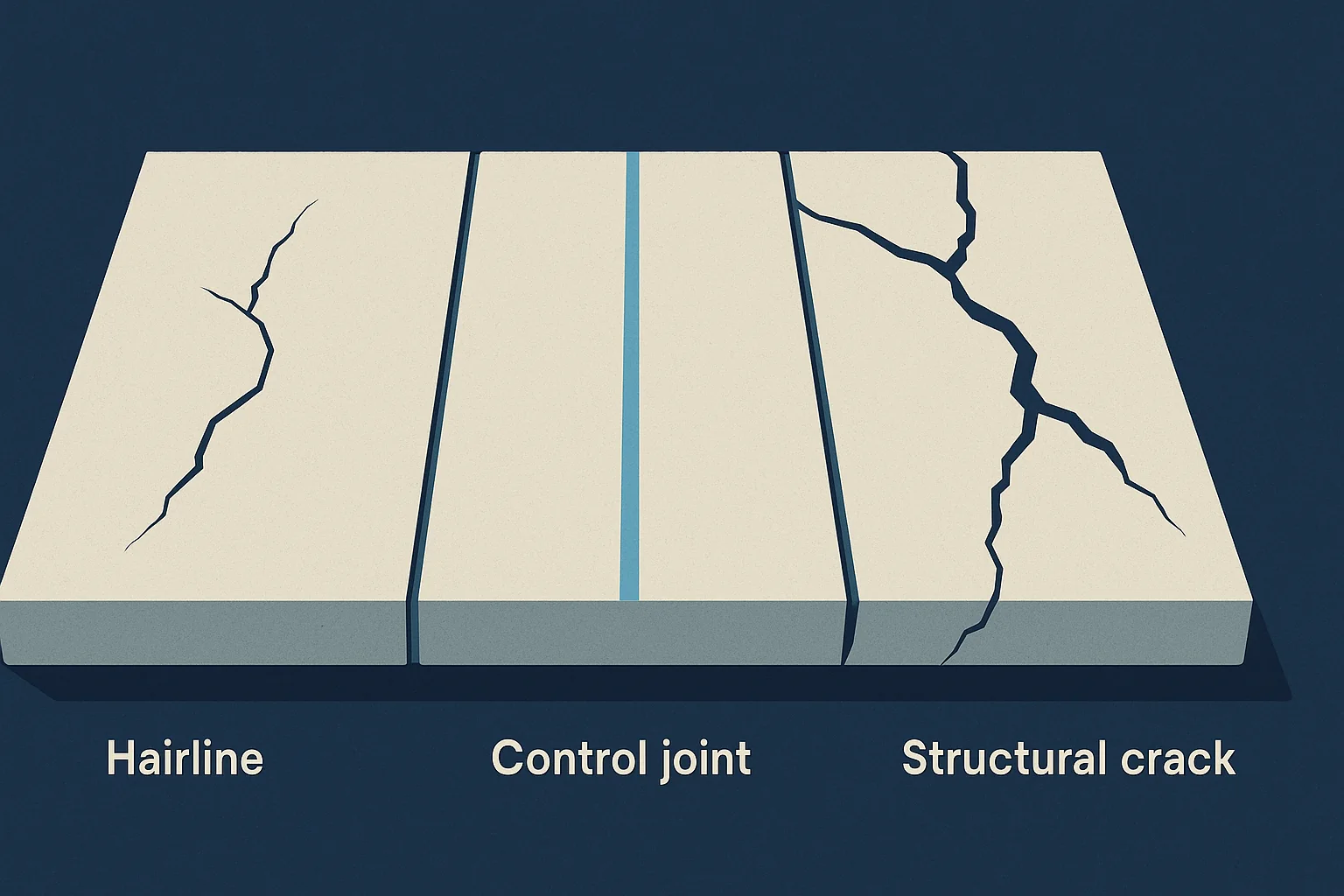
Control joints, the saw cuts in the slab, force shrinkage cracking into a straight, planned line. They are working joints, opening and closing seasonally as the slab and soil move. No coating film bridges one permanently. It will either telegraph the joint as a visible line or split along it.
Treat joints as features rather than defects. They can be filled with a semi rigid filler and coated over, accepting that a line will likely reappear, or honored deliberately as a clean detail. Static cracks can be routed, filled, and made largely invisible under a flake system. Cracks with vertical displacement mean part of the slab is moving independently, which is a question about the fill and soil beneath. Coating over active movement buys you a season.
Slope, Drainage, and the Door Edge
Garage slabs slope toward the overhead door so meltwater leaves the building. When that slope is flat, reversed, or interrupted by settlement, water pools, works into any pinhole or edge defect, and freezes there in winter. Pooling at the back wall of an attached garage is worse, because that is where the slab meets the foundation. Water management at the foundation is covered in our discussion of interior and exterior waterproofing approaches.
The slab edge at the door opening is the most exposed detail on the floor, taking direct weather, freeze and thaw, plow spray, and the door itself. Coating should be terminated there deliberately, with the edge wrapped or cut into a clean saw kerf, so the film has an anchored end rather than a feathered one water can lift.
Pre-Purchase Evaluation Checklist
Work through this before signing anything. Each item separates applicators who have a process from those who have a price.
- Named product system. The proposal identifies the manufacturer and the specific system, not a generic phrase like industrial epoxy.
- Technical data sheet provided. You receive it, and the scope of work matches what it requires.
- Moisture testing specified. The proposal names the required test method and describes what follows if the result exceeds the manufacturer’s limit.
- Mechanical preparation stated. Diamond grinding or shot blasting is named explicitly, not left to the crew.
- Crack and joint treatment described. The proposal says how cracks will be handled and states in writing that working joints may telegraph.
- Cure and return to service. Times for foot and vehicle traffic come from the data sheet and vary with conditions, so ask for the manufacturer’s figures rather than a flat promise.
- Written warranty with exclusions. Moisture related failure is a common exclusion, which is precisely why the testing question matters.
- Insurance and licensing verified. Confirm coverage independently rather than at face value. Our guidance on verifying a contractor in Ohio covers the mechanics.
- References from three winters ago. A Central Ohio floor that survived three freeze and thaw seasons tells you what a photograph of a fresh installation cannot.
Realistic Maintenance Expectations
A layered system on a sound, tested slab is long lived, but not permanent and not maintenance free. The top coat is sacrificial, absorbing abrasion from grit tracked in on tires, and grit is the primary wear mechanism in a garage. Sweeping and periodic wet cleaning extend service life directly.
Winter salt should be rinsed off in spring rather than left to sit, and spills wiped rather than allowed to dwell. Eventually the top coat wears in the traffic lanes, and a recoat over a sound base restores the floor at a fraction of the original cost. That interval depends on use and vehicle count, and the manufacturer’s maintenance guidance is the document to follow.
The Decision
Option A. Select a coating on appearance and price, prepare the slab with whatever method the lowest bid includes, and find out what the slab was doing after the coating is down.
Option B. Establish the slab’s moisture condition first using the test the chosen manufacturer requires, let that result drive system selection and any mitigation primer, specify mechanical profiling, and treat the technical data sheet as the governing document.
Recommendation: Option B, because the failure modes are not symmetric. A coating chosen on price over a properly prepared and tested slab underperforms gracefully. It wears sooner and gets recoated. A premium coating over an unprepared slab with active vapor drive fails catastrophically, and the remedy is full removal by grinding, which costs more than the original installation. You are not choosing between a good floor and a better one. You are choosing between a floor that wears and a floor that has to be demolished. Spend on testing and preparation first, then buy whatever the remaining budget supports.
Where Transit & Flow Group Fits
We coordinate slab, coating, and moisture management work across Columbus and Central Ohio, sequenced in the order the building physics requires rather than the order that gets a crew on site fastest. That means slab evaluation and manufacturer specified moisture testing before product selection, mechanical profiling as a line item, and joint treatment agreed in writing before anyone mixes material. If you want the slab question answered before you commit, start a conversation with our team. The same moisture principles govern work below grade, which we cover in our guides to finishing a basement in Ohio and controlling basement humidity and preventing mold.
Transit & Flow Group coordinates projects and partners with properly licensed and insured specialty contractors when licensing is required, and work is performed under the appropriate permits.
Frequently Asked Questions
Why do garage floor coatings peel
The most common reason is moisture moving up through the slab, which breaks the bond from underneath no matter how good the coating is. The second most common reason is inadequate surface preparation. Both are diagnosable before the coating is purchased.
How do I know if my slab has a moisture problem
Moisture testing is the reliable answer, and it is a standard step in any serious coating proposal. Visual signs worth noting include persistent dark patches, efflorescence deposits, and areas that stay damp when the rest of the floor is dry, but signs alone are not a substitute for testing.
Does the slab need to be ground before coating
Mechanical profiling is what creates the surface the coating can actually grip. Acid based preparation and cleaning alone generally do not produce an equivalent profile. If a proposal does not describe how the surface will be profiled, that is the line item to question first.
Can a garage slab be coated in winter
Temperature and humidity affect how coatings cure, and every product publishes conditions in its technical data. In an unconditioned Ohio garage, meeting those conditions in winter takes deliberate control of the space. Confirm the plan for temperature control before scheduling.
What causes a garage slab to crack near the door
That zone sees the most water, the most freeze and thaw cycling, the most deicer arriving on vehicles, and the most edge loading. Cracking there frequently reflects the combination rather than a single defect, and drainage at the apron is usually part of the picture.
Is a coating worth it if the slab is already cracked
A coating is a surface treatment, so it does not resolve movement or support problems underneath. Address whether the cracks are stable first. Coating over active movement produces a finish that fails along the same lines within a short time.
Sources
- NIST Engineering Laboratory, building materials and concrete durability research
- USDA NRCS Web Soil Survey, soil composition and drainage characteristics by location
- National Weather Service, Wilmington Ohio, regional temperature and freeze and thaw cycle data
- U.S. Environmental Protection Agency, moisture control and mold prevention guidance
- International Code Council, Ohio codes, adopted building code text applicable in Ohio jurisdictions
About This Guide
Written and edited by Micheal Parker, founder of Transit & Flow Group. Published May 23, 2027. This guide is checked against the agency and code sources listed above, and it is revised when those sources change.
General contractor of record. Micheal Parker holds City of Columbus General Contractor Registration G12064, issued by the Columbus Department of Building and Zoning Services under Transit & Flow LLC and valid through June 30, 2027. Trade work that falls outside the scope of that registration is performed by licensed trade partners, and the responsible license holder is identified before work begins.
Transit & Flow Group, home and commercial services for Columbus and the surrounding Central Ohio communities. Phone (614) 382-0000. Email solutions@transitflowgroup.com. 10 N High St, Suite 217, Columbus, OH 43215. Contact our team or review the communities we serve.
