
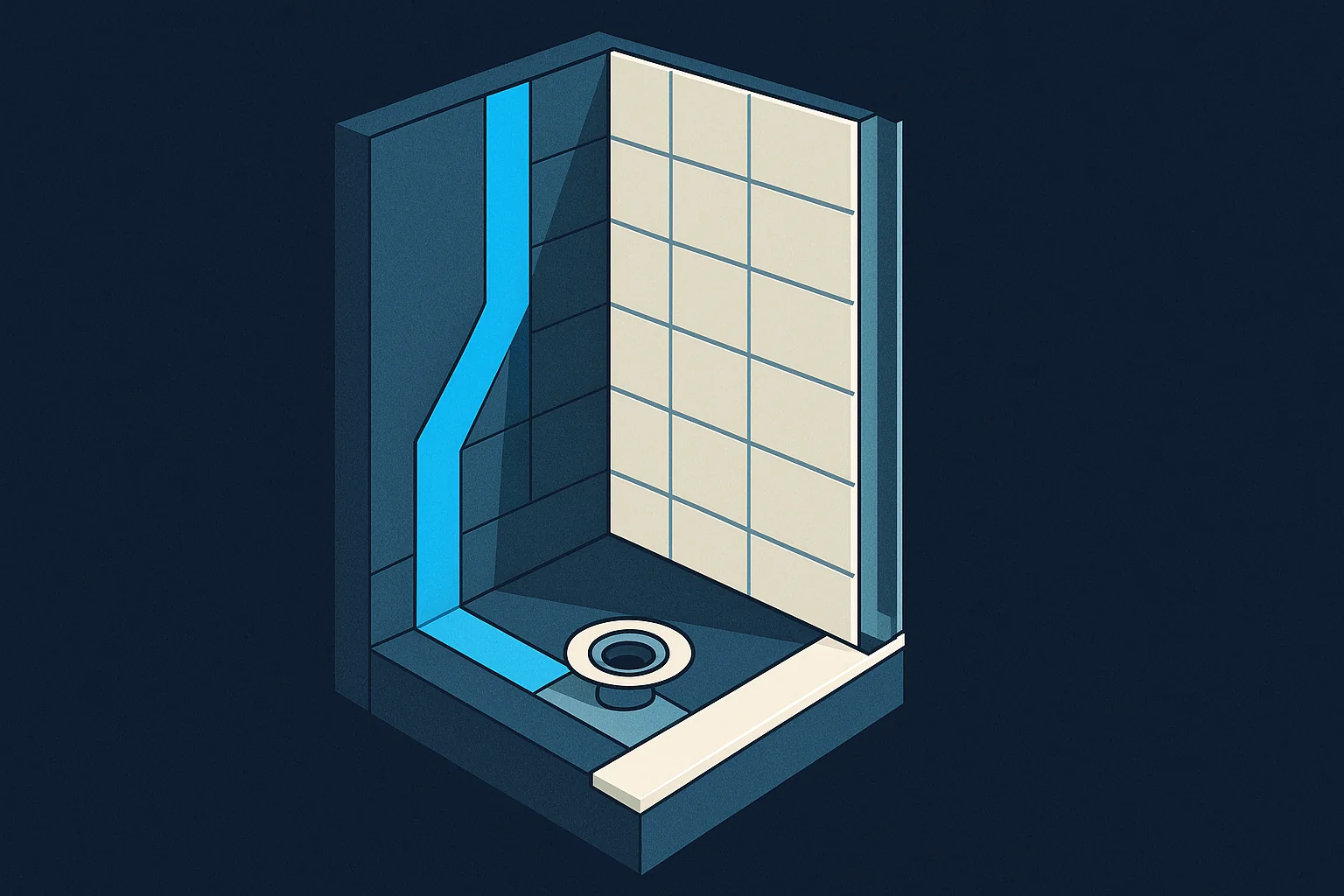

Read this first. This article is written to help a household evaluate shower waterproofing work, not to instruct anyone in performing it. Waterproofing is a manufacturer specified system installed by trained applicators, and the written instructions that accompany a given system govern the installation in every respect, including where a warranty applies. What follows describes what the assembly consists of and what questions distinguish a properly built shower from one that will fail, so the household can read a proposal and watch a job with informed eyes. It supports our plumbing work and sits under our bathroom planning guide.
In This Guide
- The Premise Everyone Gets Wrong
- Waterproofing Is a System, Not a Product
- Sheet Applied Versus Liquid Applied
- The Pan, the Slope, and the Drain That Matches
- Where Showers Actually Leak
- The Flood Test, and Why It Is the Whole Argument
- Glossary
- Where Transit & Flow Group Fits
- Frequently Asked Questions
Transit & Flow Group coordinates projects and partners with properly licensed and insured specialty contractors when licensing is required.
The Premise Everyone Gets Wrong
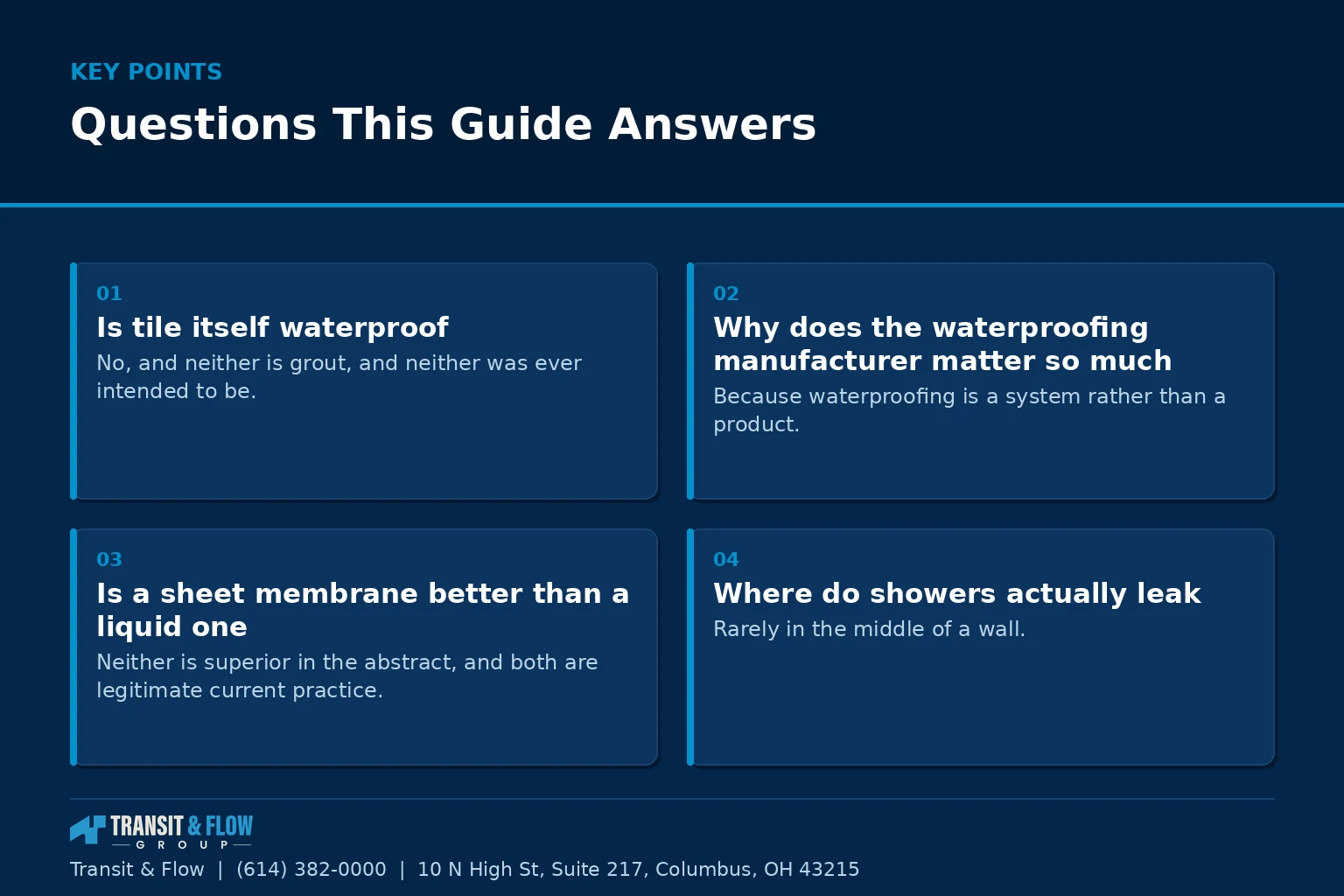
Tile is not waterproof. Grout is not waterproof. Neither was ever intended to be. Water passes through a tiled surface continuously and in normal quantities, and it always has. That is not a defect and it is not evidence of poor workmanship. It is how the assembly works.
What keeps the water out of the house is a continuous barrier behind and beneath the tile, and the tile is a wear surface applied over it. Everything that matters about a shower is decided in that hidden layer, which means the shower a household evaluates on appearance is the one component that carries no information about whether the shower will last. A flawless tile job over a compromised membrane looks identical to a flawless tile job over a correct one, for about five years.
This is why waterproofing is the item to interrogate in a proposal and the item most proposals describe in three words. A line reading waterproofing included conveys nothing. The system has a manufacturer and a name, and both belong in writing.
Waterproofing Is a System, Not a Product
Every major manufacturer sells a complete family of components designed and tested to work together: the membrane, the corner and seam treatments, the bonding material, the drain assembly, the pipe seals, the pan or sloped substrate, and the sealants. Those components are engineered as a set, and the warranty that stands behind them covers the set.
The most common way a technically competent installation still fails is component mixing, meaning one manufacturer’s membrane with another manufacturer’s corners, a third company’s drain, and whatever bonding material was on the truck. Each individual piece may be a good product. The assembly is untested, the chemistry at the bonded interfaces is unverified, and no manufacturer warrants any of it. When that shower leaks, and the household goes looking for recourse, there is none.
The evaluation question is therefore singular and it should be asked plainly. Which system is being installed, and is every component in the wet area from that same system. The answer should be immediate and specific. Hesitation is informative.
Sheet Applied Versus Liquid Applied
Two membrane approaches dominate current practice and both are legitimate. The distinction is worth understanding because it changes what a household should be watching for.
Sheet applied membranes are manufactured to a known thickness and bonded to the substrate. Because the material arrives at full thickness, the thickness variable is removed from the job site, and the remaining craft question is the quality of the seams, corners, and terminations where sheets meet each other and meet penetrations. A sheet system is straightforward to inspect visually while it is exposed.
Liquid applied membranes are rolled or troweled on, usually in multiple coats, often with reinforcing fabric embedded at corners and changes of plane. They handle complicated geometry gracefully, which is their real advantage. Their vulnerability is film thickness, because a coat applied thinner than specification looks essentially identical to a correct one once cured. Reputable applicators address this by working to a stated wet film thickness and by applying the specified number of coats in the specified colors, so coverage can be confirmed by eye.
Neither approach is superior in the abstract. What matters is that the system is complete, that it is installed to the manufacturer’s written instructions, and that the person installing it has done many of them.
The Pan, the Slope, and the Drain That Matches
The shower floor is where the two families of assembly genuinely diverge, and the drain type is not interchangeable between them.
A bonded system uses a single continuous membrane at the floor, bonded to a pre sloped substrate, paired with a bonding flange drain designed to accept that membrane and clamp or adhere it at the drain. Water reaching the membrane runs across it to the drain and leaves. There is one drainage plane.
A traditional mortar bed assembly is older and works differently. A flexible pan liner sits within the floor build up and a two part clamping drain with weep holes admits water that has reached liner level, so the assembly drains at two planes rather than one. This method is entirely valid when built correctly and is increasingly uncommon, largely because it is unforgiving.
The point at which traditional assemblies most often go wrong is the pre-slope, and it is worth understanding because the mistake is invisible afterward. The slope has to exist beneath the liner as well as above it. Where a liner is laid flat on a level floor and the slope is built only in the mortar above it, any water that reaches liner level has nowhere to go, so it stands there permanently against the framing. That standing water is the origin of a large share of the failures that get discovered years later when the ceiling below shows a stain. In a bonded system the equivalent question is simply whether the substrate was sloped correctly before the membrane went down, since the membrane follows whatever it is bonded to.
Either way, the drain and the method have to be a matched pair. A bonding flange drain in a traditional assembly, or a clamping drain under a bonded membrane, is a mismatch, and it is one of the more common findings when a failed shower is opened up.
Where Showers Actually Leak
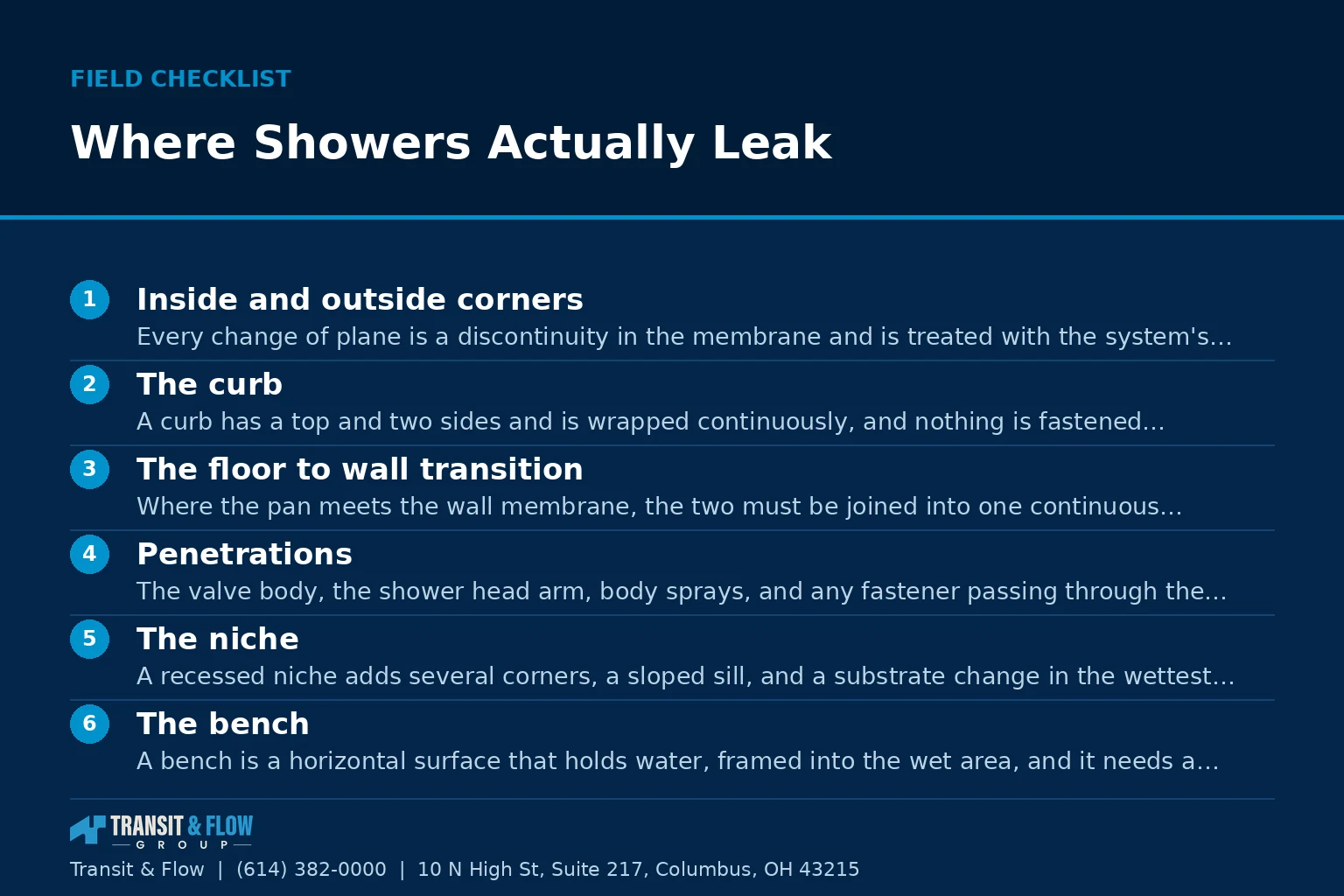
Failures are rarely in the middle of a wall. They cluster at a small number of predictable locations, and those locations are the ones to ask about.
- Inside and outside corners. Every change of plane is a discontinuity in the membrane and is treated with the system’s dedicated corner components rather than by folding material and hoping.
- The curb. A curb has a top and two sides and is wrapped continuously, and nothing is fastened through it from above, because a fastener through a curb is a hole in the barrier at the lowest point where water collects.
- The floor to wall transition. Where the pan meets the wall membrane, the two must be joined into one continuous barrier rather than merely brought close together.
- Penetrations. The valve body, the shower head arm, body sprays, and any fastener passing through the membrane each get the system’s specified seal.
- The niche. A recessed niche adds several corners, a sloped sill, and a substrate change in the wettest wall in the room, which is why it is a detail rather than a decoration and should be waterproofed as an assembly.
- The bench. A bench is a horizontal surface that holds water, framed into the wet area, and it needs a slight slope and full membrane coverage on all faces including underneath the front edge.
- The threshold at a curbless entry. Without a curb the membrane must extend well beyond the shower footprint into the bathroom floor, and how far is a specification rather than a judgment call.
A useful way to read a proposal is to look for these seven items by name. A scope that mentions the niche, the bench, the curb, and the penetrations individually was written by someone who has built showers. A scope that says waterproof shower was not.
The Flood Test, and Why It Is the Whole Argument
Once the waterproofing is complete and before any tile is set, the drain is plugged and the pan is filled with water to just below the curb, then left for a period of hours while the level is observed and the space below is checked. A membrane that holds is confirmed. A membrane that does not is repaired at that moment for the cost of an afternoon.
The same defect discovered after tile costs the tile, the glass, the fixtures, the labor to remove all of it, and frequently the ceiling and the flooring of the room below. The ratio between those two numbers is the largest in residential construction, and it is why the flood test is the single most valuable question a household can ask about a shower. Whether it is scheduled, and whether the household may be present for it, tells you a great deal about how the rest of the job is run. Our article on tub to shower conversions places this step in the wider sequence, and our article on bathroom ventilation addresses the moisture that never reaches the membrane at all.
On cost: this article contains no dollar figures on purpose. Waterproofing scope varies with shower size, geometry, the number of niches and benches, curb or curbless design, the drain treatment, and the system specified. What is consistent is that the waterproofing line is a small fraction of a shower’s total and effectively all of its risk.
Glossary
- Membrane. The continuous barrier behind and beneath the tile that keeps water within the shower assembly.
- Sheet applied membrane. A manufactured sheet of known thickness bonded to the substrate.
- Liquid applied membrane. A coating rolled or troweled on in multiple coats, often with reinforcing fabric at corners.
- Pre-slope. Slope built into the substrate beneath the liner or membrane so water at that level drains rather than stands.
- Bonding flange drain. A drain designed to bond directly to a single continuous membrane.
- Clamping drain. A two part drain with weep holes used with a traditional mortar bed and pan liner.
- Weep holes. Openings admitting water that has reached liner level into the drain in a traditional assembly.
- Termination. The point where a membrane ends or meets another surface, which is where most failures occur.
- Flood test. Filling the completed pan with water before tiling to confirm the assembly holds.
Option A is selecting a tile installer on portfolio and price and accepting whatever waterproofing method they prefer. Option B is selecting a named manufacturer system first, requiring every wet area component to come from it, and treating the installer’s familiarity with that specific system as a selection criterion. My recommendation is Option B, and it inverts how most households shop for a shower. Tile photographs well and every installer’s portfolio looks similar, because setting tile attractively is a common skill. Building a continuous membrane through seven termination points that will hold for twenty years is not a common skill, and it does not photograph at all. Ask for the system name, ask whether every component comes from it, ask how many of that system the installer has built, ask for the flood test to be on the schedule, and ask to see the waterproofing before it is covered. Four questions, asked before signing, that address effectively all of the downside risk in the room. For the full project context, see our bathroom planning guide.
Where Transit & Flow Group Fits
Transit & Flow Group coordinates plumbing and bathroom projects across Columbus and Central Ohio and partners with properly licensed and insured specialty contractors when licensing is required. Our standard is that the waterproofing system is named by manufacturer in the written scope, that every wet area component comes from that single system, that the drain type is matched to the pan method, that curb, corner, niche, bench, and penetration details are called out individually rather than bundled, and that a flood test is scheduled before tile with the household invited to observe it. To have a shower scope reviewed before work begins, contact us.
Frequently Asked Questions
Is tile itself waterproof?
No, and neither is grout, and neither was ever intended to be. Water passes through a tiled surface continuously and in normal quantities, which is not a defect or evidence of poor workmanship. What keeps water out of the house is a continuous barrier behind and beneath the tile, with the tile serving as a wear surface over it. That means the part of a shower a household can see carries no information about whether the shower will last.
Why does the waterproofing manufacturer matter so much?
Because waterproofing is a system rather than a product. Each major manufacturer sells a family of components designed and tested together, including the membrane, the corner and seam treatments, the bonding material, the drain assembly, the pipe seals, the pan or sloped substrate, and the sealants, and the warranty stands behind the set. The most common way a technically competent installation still fails is component mixing, where one manufacturer’s membrane meets another’s corners and a third company’s drain. Each piece may be a good product, but the assembly is untested, and no manufacturer warrants it, so a household that later goes looking for recourse finds none.
Is a sheet membrane better than a liquid one?
Neither is superior in the abstract, and both are legitimate current practice. Sheet applied membranes arrive at a known thickness, which removes the thickness variable from the job site and leaves seams, corners, and terminations as the craft question, and they are straightforward to inspect visually while exposed. Liquid applied membranes are rolled or troweled on and handle complicated geometry gracefully, but their vulnerability is film thickness, because a thin coat looks essentially identical to a correct one once cured. What matters is that the system is complete, that it is installed to the manufacturer’s written instructions, and that the installer has built many of them.
Where do showers actually leak?
Rarely in the middle of a wall. Failures cluster at a predictable short list: inside and outside corners, the curb, the floor to wall transition, penetrations such as the valve body and shower head arm, the niche, the bench, and the threshold at a curbless entry. Each of those is a discontinuity that the manufacturer’s system addresses with dedicated components and specified details rather than improvisation. A useful way to read a proposal is to look for those items by name, because a scope that mentions the niche, the bench, the curb, and the penetrations individually was written by someone who has built showers.
What is a flood test and why should I insist on one?
Once the waterproofing is complete and before any tile is set, the drain is plugged and the pan is filled with water to just below the curb, then left for a period of hours while the level is observed and the space below is checked. A membrane that holds is confirmed, and one that does not is repaired at that moment for the cost of an afternoon. The same defect discovered after tile costs the tile, the glass, the fixtures, the labor to remove all of it, and often the ceiling and flooring of the room below. Whether the test is on the schedule, and whether you may be present for it, tells you a great deal about how the rest of the job is run.
What should I ask before signing a shower proposal?
Four questions cover most of the downside risk in the room. Ask which manufacturer’s system is being installed, ask whether every component in the wet area comes from that same system, ask how many showers the installer has built with that specific system, and ask for the flood test to be scheduled before tile with permission to see the waterproofing before it is covered. A proposal line reading waterproofing included conveys nothing, since the system has a manufacturer and a name and both belong in writing. The answers should be immediate and specific, and hesitation is informative.
Sources
- Ohio Construction Industry Licensing Board, trade licensing verification
- City of Columbus, Get a Permit, permit and inspection process
- Ohio Revised Code 3781.25, residential construction standards
- Ohio Attorney General, consumer protection guidance on home improvement contracts
About This Guide
Written and edited by Micheal Parker, founder of Transit & Flow Group. Published January 29, 2027. This guide is checked against the agency and code sources listed above, and it is revised when those sources change.
General contractor of record. Micheal Parker holds City of Columbus General Contractor Registration G12064, issued by the Columbus Department of Building and Zoning Services under Transit & Flow LLC and valid through June 30, 2027. Trade work that falls outside the scope of that registration is performed by licensed trade partners, and the responsible license holder is identified before work begins.
Transit & Flow Group, home and commercial services for Columbus and the surrounding Central Ohio communities. Phone (614) 382-0000. Email solutions@transitflowgroup.com. 10 N High St, Suite 217, Columbus, OH 43215. Contact our team or review the communities we serve.
