
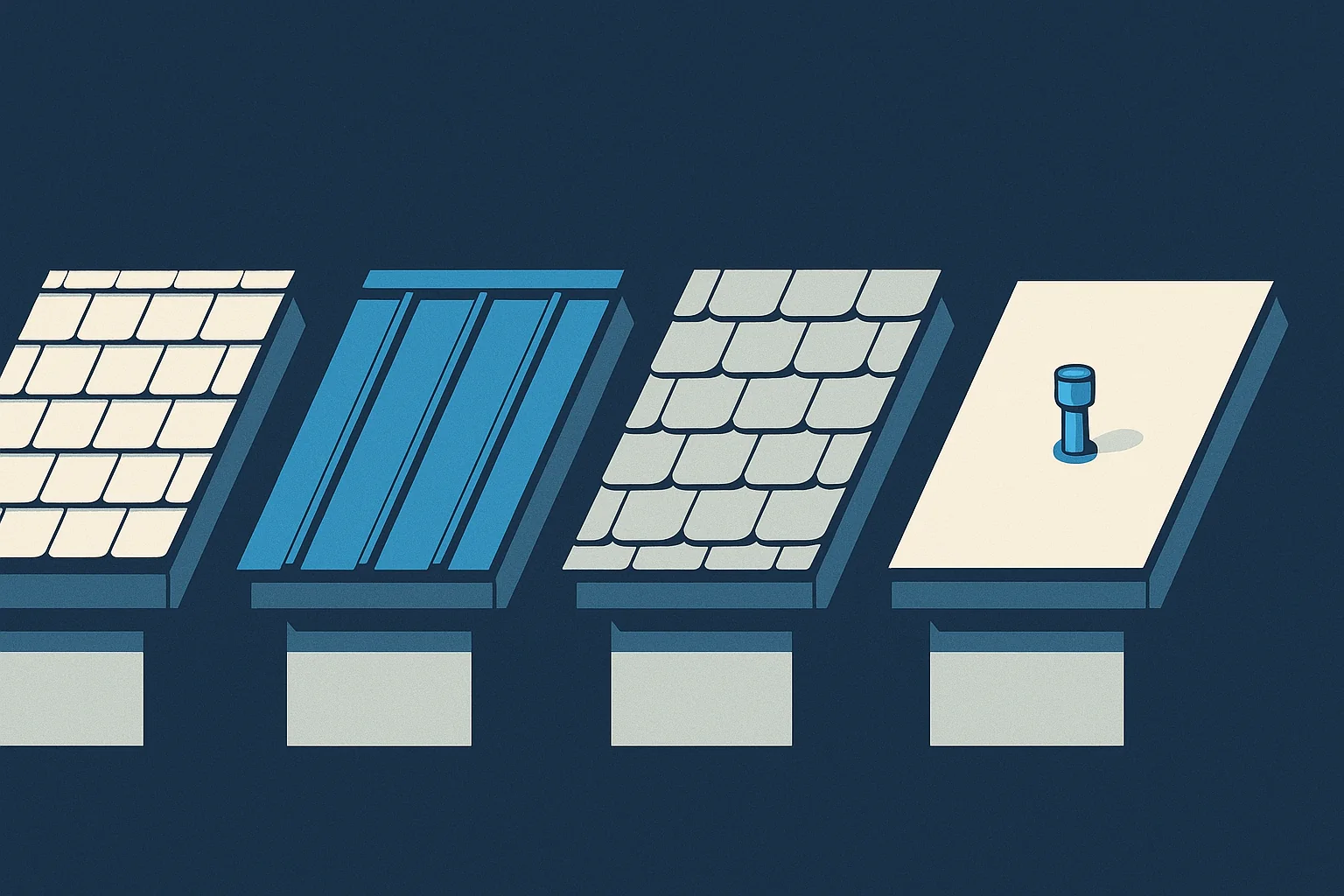

Roofing material is the single largest lever in a replacement project: it sets the budget class, the look of the house, and the date of the next replacement. This comparison covers the materials that make practical sense in Central Ohio, judged against the weather this region actually delivers: freeze-thaw winters, hail-capable springs, and hot, humid summers. It is part of our roofing series anchored by the complete roof replacement guide.
In This Guide
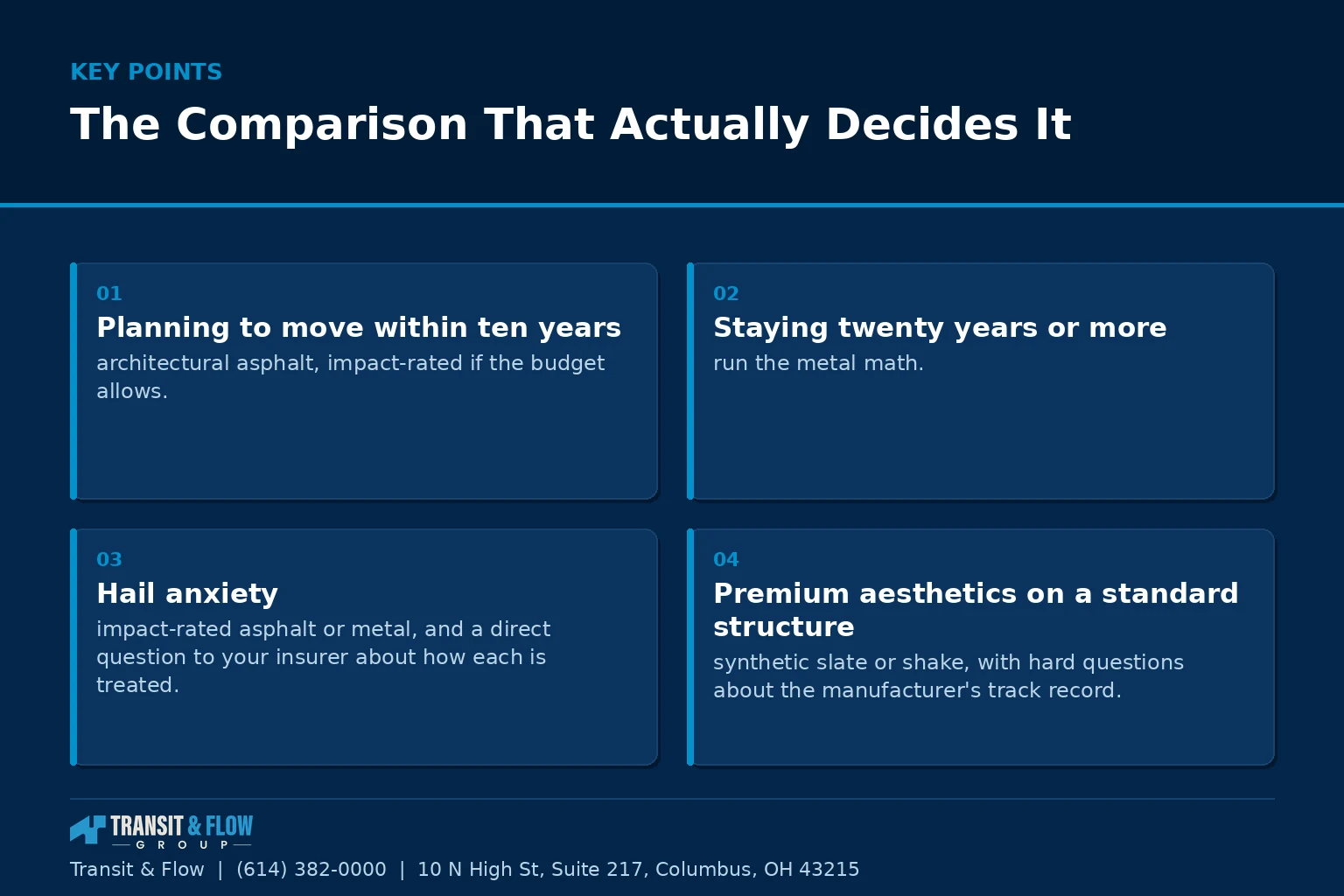
- What Ohio Weather Demands From a Roof
- Architectural Asphalt Shingles: The Central Ohio Default
- Impact-Rated Asphalt: The Hail Hedge
- Standing Seam Metal: Buy Once, Cry Once
- Synthetic Slate and Shake: The Premium Middle
- Natural Slate, Tile, and Cedar: The Special Cases
- The Comparison That Actually Decides It
- The Materials Side by Side
- What Goes Wrong and Why
- Glossary of Roofing Material Terms
- Choosing With a Coordinator Instead of a Salesperson
- Frequently Asked Questions
Transit & Flow Group coordinates projects and partners with properly licensed and insured specialty contractors when licensing is required. We have no allegiance to any manufacturer, and this comparison reflects that.
What Ohio Weather Demands From a Roof
Judge every material against four local stresses. Freeze-thaw cycling, dozens of times a winter, which pries at any seam or crack where water can sit. Hail, which tests impact resistance in a way gentle climates never do. Wind events, spring and summer, which test fastening and edge detail. And summer attic heat, which ages asphalt from below when ventilation is poor. The Insurance Institute for Business and Home Safety researches exactly these failure modes, and its findings shape the comparisons below. The National Weather Service office covering Central Ohio documents the storm side of this profile every season.
Architectural Asphalt Shingles: The Central Ohio Default
Architectural, also called dimensional or laminate, shingles dominate this market for defensible reasons. They cost the least of any serious option, install quickly by crews that work with them daily, and carry meaningful wind ratings and impact-rated variants for hail-prone areas. Their weaknesses are the flip side: the shortest lifespan of the serious options, vulnerability to poor attic ventilation, and sensitivity to installation quality, since the wind rating on the wrapper assumes the nailing pattern in the manual. Choose architectural asphalt when budget discipline matters, when you may sell within fifteen years, or when the neighborhood aesthetic calls for it. Skip the bottom-tier three-tab version; the savings are small and the performance gap is not.
Impact-Rated Asphalt: The Hail Hedge
Within asphalt, impact-rated shingles are built to resist hail strikes that crack or bruise standard shingles. UL 2218 Class 4 is the designation to ask about, the highest impact class in the common test standard. In a hail-capable region, the premium over standard architectural shingles is modest, and some insurers recognize the class in their pricing, a question worth asking your carrier directly rather than assuming. If you are already buying asphalt in Central Ohio, the impact-rated tier is usually the smartest small upgrade on the menu.
Standing Seam Metal: Buy Once, Cry Once
Standing seam metal costs a class more than asphalt and typically outlasts two asphalt roofs. It sheds snow well, handles freeze-thaw indifferently, resists wind strongly when installed to specification, and its concealed-fastener design removes the failure point that plagues cheaper exposed-fastener metal panels. Hail dents metal cosmetically more readily than it functionally damages it, which is a conversation to have honestly before buying: a metal roof after a hailstorm may look textured up close while still performing perfectly. Choose standing seam when you intend to stay long enough to harvest the lifespan, when you value the low-maintenance profile, or when the architecture suits it. Avoid bargain exposed-fastener panel systems on a primary residence; the thousands of gasketed screws through the surface become the maintenance program.
Synthetic Slate and Shake: The Premium Middle
Composite materials molded to mimic slate and cedar have matured into a genuine category: lighter than real slate, impact-rated variants available, and lifespans between asphalt and metal. They suit homes where the premium look matters and real slate’s weight or cost does not pencil. The category is younger than its competitors, so manufacturer track record and warranty substance deserve extra scrutiny; a fifty-year warranty from a company founded recently is an underwriting question, not a fact about the product.
Natural Slate, Tile, and Cedar: The Special Cases
Real slate and clay tile last generations and demand structural capacity most Central Ohio homes were not framed for, plus specialty installation and repair trades. Cedar shakes offer beauty with a maintenance commitment that our humid summers make real. These are the right answers for specific houses, usually historic or architect-driven, and the wrong default for everyone else. If your home is one of them, the decision deserves a structural evaluation before a materials conversation.
The Comparison That Actually Decides It
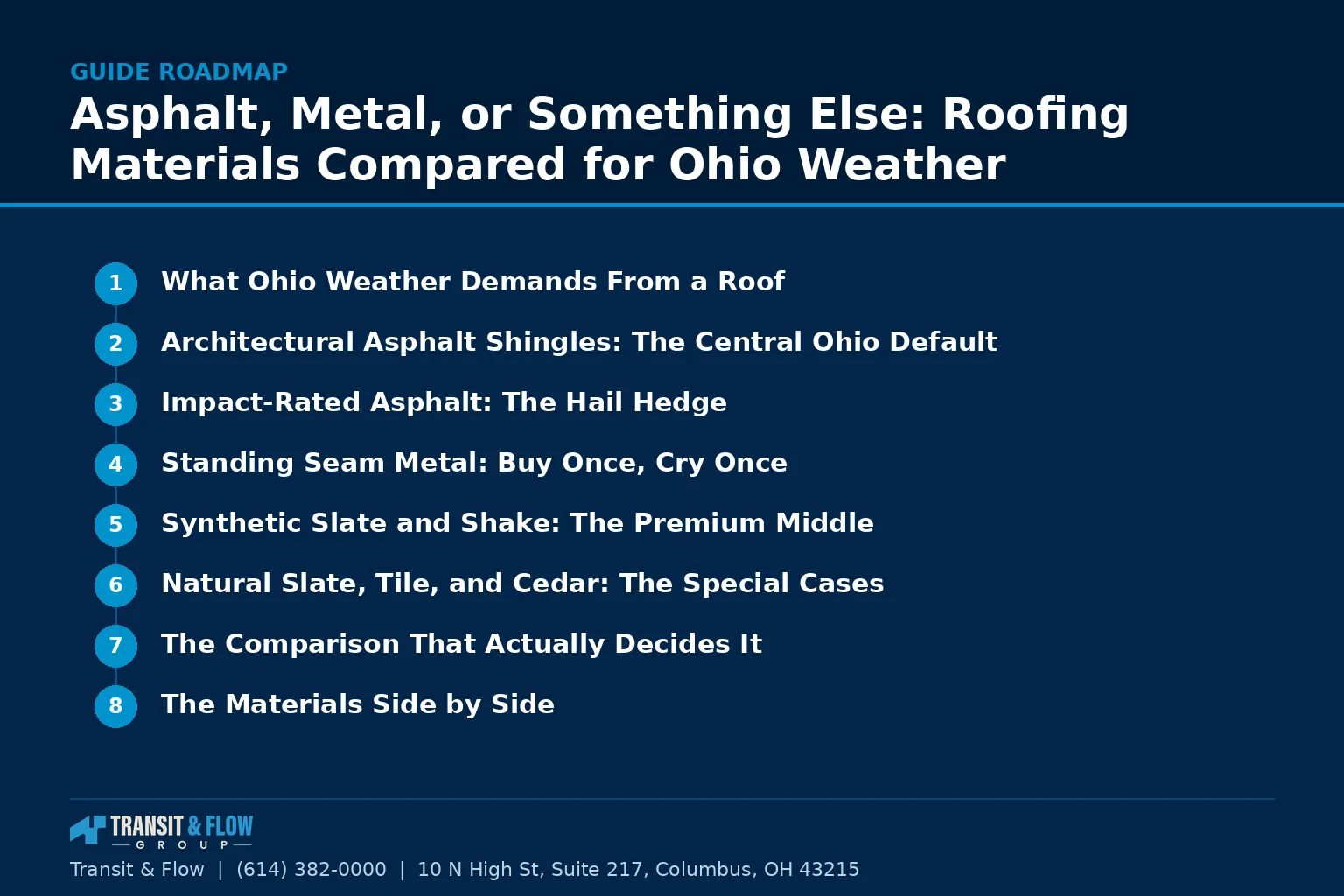
- Planning to move within ten years: architectural asphalt, impact-rated if the budget allows. The next owner buys the remaining life.
- Staying twenty years or more: run the metal math. Two asphalt roofs against one metal roof, with maintenance included, is closer than the sticker prices suggest.
- Hail anxiety: impact-rated asphalt or metal, and a direct question to your insurer about how each is treated.
- Premium aesthetics on a standard structure: synthetic slate or shake, with hard questions about the manufacturer’s track record.
- Historic or architect-designed home: match the original material class, and start with a structural evaluation.
Every one of these paths lives or dies on installation quality. The U.S. Department of Energy’s roofing guidance is a reminder that the system under the surface, ventilation included, drives performance regardless of the material on top. A mid-grade shingle installed precisely will outperform a premium product installed carelessly, which is why the materials decision and the contractor decision are really one decision. Our guide to reading a roofing estimate shows how to verify the system behind the shingle, and if your roof’s age is what started this conversation, the Ohio lifespan guide covers what shortens every material’s clock.
The Materials Side by Side
Read the table across a row rather than down a column. No material wins every category, and the right row is the one whose weakness you can live with.
| Material | Budget Class | Service Life | Hail Behavior | Main Weakness Here |
|---|---|---|---|---|
| Architectural asphalt | Lowest of the serious options | Shortest of the serious options | Bruises and cracks under larger stones | Sensitive to ventilation and installation quality |
| Impact-rated asphalt | Modest step above architectural | Comparable to architectural | Built to the highest common impact class | Still governed by attic ventilation |
| Standing seam metal | A class above asphalt | Typically two asphalt roofs | Dents cosmetically more than functionally | Detailing at penetrations must be right |
| Synthetic slate or shake | Premium middle | Between asphalt and metal | Impact-rated variants available | Younger category, warranty substance varies |
| Natural slate or clay tile | Highest | Generations | Excellent, though breakage repairs are specialized | Structural capacity and scarce repair trades |
What Goes Wrong and Why
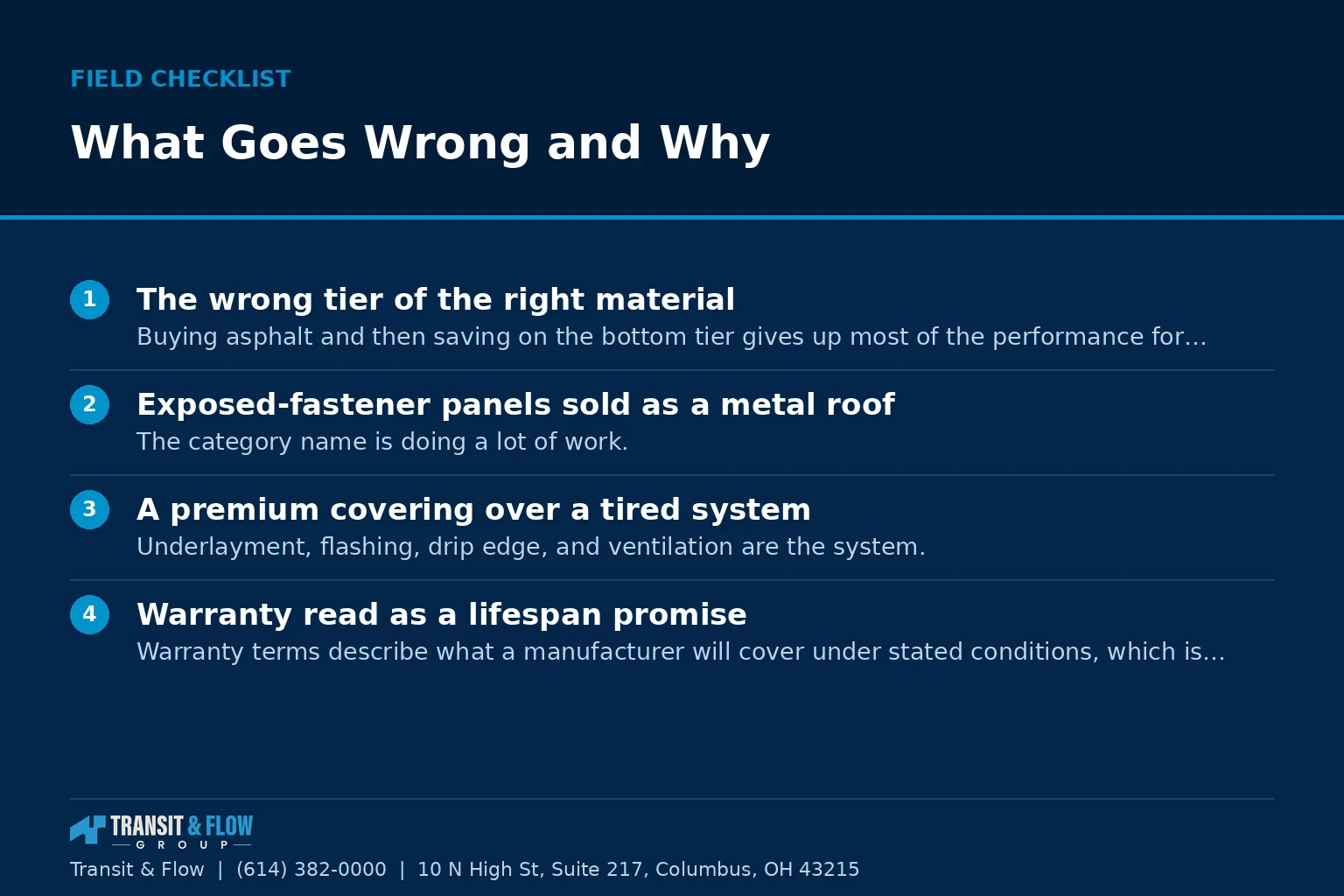
- The wrong tier of the right material. Buying asphalt and then saving on the bottom tier gives up most of the performance for very little. The tier decision matters more than the brand decision.
- Exposed-fastener panels sold as a metal roof. The category name is doing a lot of work. Concealed-fastener standing seam and screw-through panel are different products with different failure modes.
- A premium covering over a tired system. Underlayment, flashing, drip edge, and ventilation are the system. Upgrading the visible layer while reusing the rest is how a premium roof underperforms a mid-grade one.
- Warranty read as a lifespan promise. Warranty terms describe what a manufacturer will cover under stated conditions, which is a different subject from how long the product will serve on your house.
Glossary of Roofing Material Terms
- Architectural shingle. A laminated asphalt shingle built from bonded layers, also sold as dimensional or laminate.
- Three-tab shingle. The older single-layer asphalt shingle, now the bottom tier of the asphalt category.
- UL 2218 Class 4. The highest impact class in the common test standard, and the designation to ask for by name when hail is the concern.
- Standing seam. A metal panel system whose fasteners are concealed within the raised seam rather than driven through the surface.
- Exposed-fastener panel. A metal system with gasketed screws driven through the face of the panel, which makes those gaskets the long-term maintenance item.
- Underlayment. The water-resisting layer between the deck and the covering, and the last line of defense once the surface is breached.
- Flashing. The metal that bridges the roof plane to walls, chimneys, and penetrations, and the origin of most leaks.
- Wind rating. The manufacturer’s stated wind performance, which assumes the installation described in the published instructions.
- Composite or synthetic slate. A molded polymer product engineered to imitate slate or cedar at a fraction of the weight.
- Deck. The structural sheathing everything else fastens to, and the item most likely to change a project’s scope once the old roof comes off.
Choosing With a Coordinator Instead of a Salesperson
Because Transit & Flow Group coordinates roofing projects through vetted specialty contractors rather than selling one manufacturer’s line, the materials conversation starts with your house, your timeline, and your budget class. Request an assessment and we will bring samples, the honest trade-offs, and numbers measured from your actual roof.
Frequently Asked Questions
What should a Central Ohio roofing material be judged against?
Four local stresses, not general reputation. Freeze-thaw cycling, dozens of times a winter, pries at any seam or crack where water can sit. Hail tests impact resistance in a way gentle climates never do, wind events in spring and summer test fastening and edge detail, and summer attic heat ages asphalt from below when ventilation is poor. Judge every candidate material against those four, because a product that performs well elsewhere may be answering a different set of questions.
Why are architectural asphalt shingles the default here?
They cost the least of any serious option, install quickly by crews that work with them daily, and carry meaningful wind ratings with impact-rated variants available for hail-prone areas. The weaknesses are the flip side, namely the shortest lifespan of the serious options, vulnerability to poor attic ventilation, and sensitivity to installation quality, since the wind rating on the wrapper assumes the nailing pattern in the manufacturer’s manual. They make sense when budget discipline matters, when a sale within fifteen years is likely, or when the neighborhood aesthetic calls for it. The bottom-tier three-tab version is worth skipping, because the savings are small and the performance gap is not.
Is an impact-rated shingle worth it in a hail region?
In a hail-capable region it is usually the smartest small upgrade on the menu if you are already buying asphalt. UL 2218 Class 4 is the designation to ask about, the highest impact class in the common test standard, and impact-rated shingles are built to resist strikes that crack or bruise standard shingles. The step up from standard architectural is modest. Some insurers recognize the class in their pricing, which is a question to put to your carrier directly rather than assume.
How does standing seam metal actually behave in Ohio weather?
It sheds snow well, handles freeze-thaw indifferently, and resists wind strongly when installed to specification, and its concealed-fastener design removes the failure point that plagues cheaper exposed-fastener panels. It typically outlasts two asphalt roofs, which is the honest way to compare it rather than looking at the initial figure alone. Hail dents metal cosmetically more readily than it damages it functionally, so a metal roof after a hailstorm may look textured up close while still performing. Bargain exposed-fastener panel systems are the version to avoid on a primary residence, because the thousands of gasketed screws through the surface become the maintenance program.
Where do synthetic slate and shake fit?
They have matured into a genuine category, lighter than real slate, available in impact-rated variants, and with lifespans between asphalt and metal. They suit homes where the premium look matters and real slate’s weight or cost does not pencil out. The category is younger than its competitors, so manufacturer track record and warranty substance deserve extra scrutiny. A fifty-year warranty from a recently founded company is an underwriting question, not a fact about the product.
How should the choice be narrowed for a specific house?
Start from how long you intend to stay. Planning to move within ten years points to architectural asphalt, impact-rated if the budget allows, because the next owner buys the remaining life, while staying twenty years or more justifies running the metal comparison with maintenance included. Hail concern points to impact-rated asphalt or metal plus a direct conversation with your insurer, and premium aesthetics on a standard structure points to synthetic slate or shake. A historic or architect-designed home is its own case and should begin with a structural evaluation before any materials conversation.
Sources
- Insurance Institute for Business and Home Safety, impact and wind performance research
- National Roofing Contractors Association, material and installation standards
- U.S. Department of Energy, Energy Saver, roof system and energy guidance
- National Weather Service, Wilmington Ohio office, regional storm climatology
About This Guide
Written and edited by Micheal Parker, founder of Transit & Flow Group. Published September 4, 2026. This guide is checked against the agency and code sources listed above, and it is revised when those sources change.
General contractor of record. Micheal Parker holds City of Columbus General Contractor Registration G12064, issued by the Columbus Department of Building and Zoning Services under Transit & Flow LLC and valid through June 30, 2027. Trade work that falls outside the scope of that registration is performed by licensed trade partners, and the responsible license holder is identified before work begins.
Transit & Flow Group, home and commercial services for Columbus and the surrounding Central Ohio communities. Phone (614) 382-0000. Email solutions@transitflowgroup.com. 10 N. High St., Suite 217, Columbus, OH 43215. Contact our team or review the communities we serve.
