


Read this first. This is an observation guide, not a repair guide. Everything described below is something you can see from the ground on a dry day with reasonable footing. It does not ask you to climb a ladder, walk a roof, enter a crawl space, or open anything up, and it does not describe how to correct any of the conditions it names. The purpose is narrower and more useful than that. It is to give you a record of what your house looked like coming out of winter, so that when something does need attention you are describing a change rather than guessing.
In This Guide
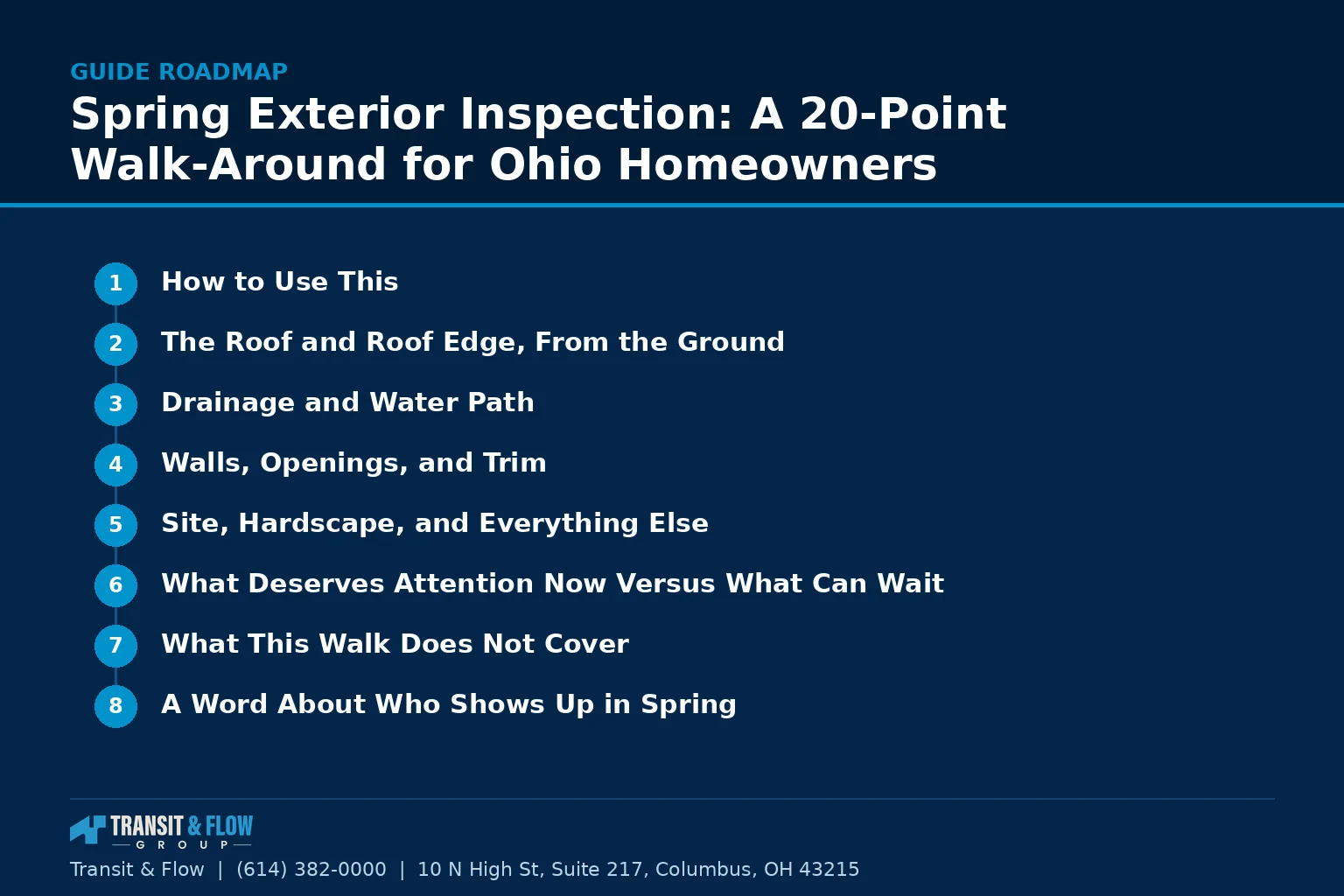
- How to Use This
- The Roof and Roof Edge, From the Ground
- Drainage and Water Path
- Walls, Openings, and Trim
- Site, Hardscape, and Everything Else
- What Deserves Attention Now Versus What Can Wait
- What This Walk Does Not Cover
- A Word About Who Shows Up in Spring
- On Cost
- Glossary
- The Decision
- Where Transit & Flow Group Fits
- Frequently Asked Questions
Central Ohio winters are hard on exteriors in a specific way. It is not the cold, it is the cycling. Repeated freeze and thaw passes across the same joints, the same mortar, the same caulk lines, and the same saturated soil, dozens of times between December and March. Materials that were fine in November are frequently loosened by April, and the evidence is visible for a few weeks before spring growth covers it. Late March into April is the window.
How to Use This
Walk the full perimeter once, slowly, with a phone camera. Photograph each elevation as a whole from far enough back to see the roofline and the grade in one frame, then photograph anything that looks different from last year up close. Do the whole loop in one session so that lighting is consistent, and note the date. Photographs taken the same way each spring are worth more than any single observation, because they turn a subjective impression into a comparison.
Two rules make this safe. Stay on the ground. And treat anything you cannot see from the ground as a subject to have looked at by someone equipped for it, rather than a reason to get a ladder out.
The Roof and Roof Edge, From the Ground
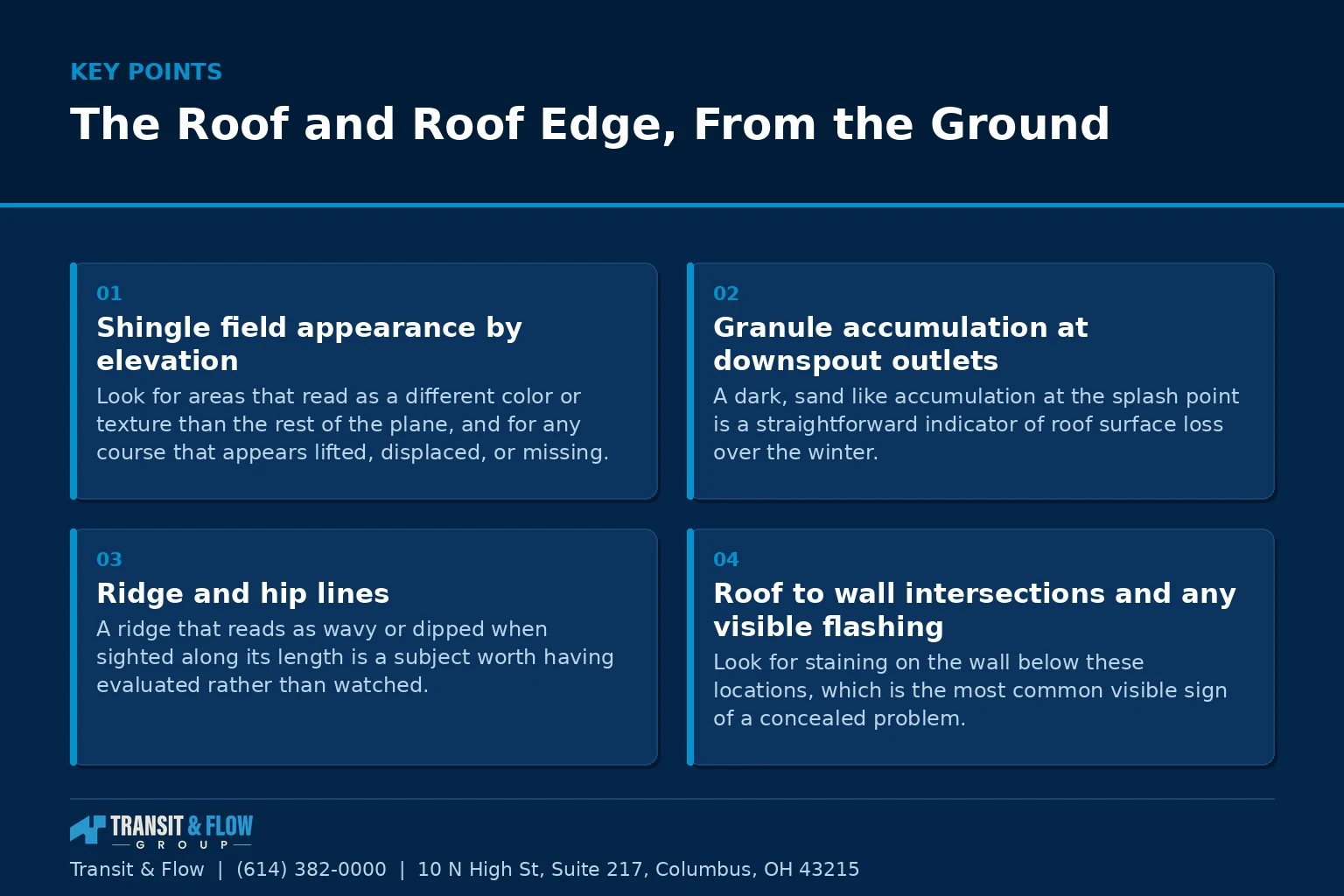
- Shingle field appearance by elevation. Look for areas that read as a different color or texture than the rest of the plane, and for any course that appears lifted, displaced, or missing.
- Granule accumulation at downspout outlets. A dark, sand like accumulation at the splash point is a straightforward indicator of roof surface loss over the winter.
- Ridge and hip lines. A ridge that reads as wavy or dipped when sighted along its length is a subject worth having evaluated rather than watched.
- Roof to wall intersections and any visible flashing. Look for staining on the wall below these locations, which is the most common visible sign of a concealed problem.
- Gutter line, sighted along its length. Sagging between hangers, separation at seams and corners, and any section pulled away from the fascia.
Drainage and Water Path
- Vegetation growing out of the gutter. If something is growing up there, the trough has held soil and moisture through a full season.
- Downspout connections and elbows. Separations at the top elbow are common after ice loading and are easy to see.
- Where each downspout discharges. Follow every one to its termination and note whether water is being carried away from the foundation or delivered next to it.
- Splash zone erosion. A scoured depression, exposed soil, or displaced mulch at a discharge point shows you where the volume actually goes.
- Grade at the foundation. Look for soil that slopes toward the house, settled areas along the wall, and mulch or soil piled against siding or above the foundation top. This subject is covered in detail in our article on grading and downspouts.
Walls, Openings, and Trim
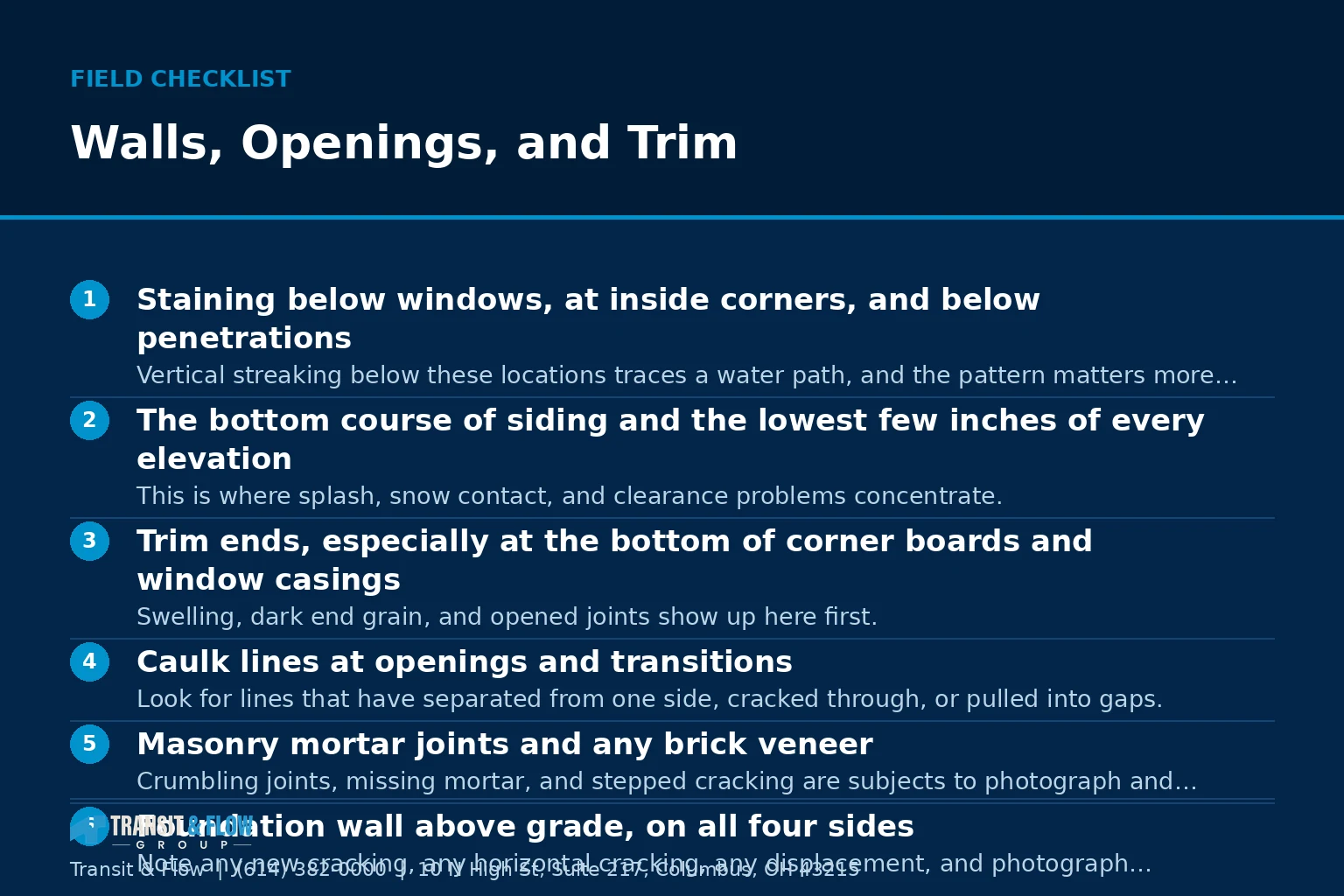
- Staining below windows, at inside corners, and below penetrations. Vertical streaking below these locations traces a water path, and the pattern matters more than the severity. Reading those patterns is the subject of reading siding damage.
- The bottom course of siding and the lowest few inches of every elevation. This is where splash, snow contact, and clearance problems concentrate.
- Trim ends, especially at the bottom of corner boards and window casings. Swelling, dark end grain, and opened joints show up here first.
- Caulk lines at openings and transitions. Look for lines that have separated from one side, cracked through, or pulled into gaps.
- Masonry mortar joints and any brick veneer. Crumbling joints, missing mortar, and stepped cracking are subjects to photograph and monitor.
- Foundation wall above grade, on all four sides. Note any new cracking, any horizontal cracking, any displacement, and photograph anything you find with something for scale. Interpretation of foundation cracking belongs to a qualified professional, and the thresholds are discussed in our article on when foundation cracks warrant an engineer.
Site, Hardscape, and Everything Else
- Driveway, walks, and patio surfaces. Heaving, new cracking, settled sections, and any slab now pitched toward the house rather than away from it.
- Decks, porches, and steps. Look at where the structure meets the house, at guard and handrail firmness, and at the base of any post in contact with soil or a slab.
- Tree limbs over the roof and near the service drop. Note anything overhanging the roof plane and anything that has grown into contact with the structure.
- Exterior mechanical equipment and its surroundings. Condensing units, vents, and terminations, along with whether anything has grown into or settled against them over the winter.
What Deserves Attention Now Versus What Can Wait
Not everything on the list carries the same urgency, and treating them as equal is how homeowners end up doing the cosmetic items and deferring the consequential ones.
| Observation | What it usually indicates | Urgency |
|---|---|---|
| Water discharging at the foundation | An active, ongoing load on the foundation and the soil around it | Address this season, it compounds |
| Grade sloping toward the house | Surface water being directed to the wall on every rainfall | Address this season |
| Staining below a roof to wall intersection | Possible concealed water entry at flashing | Have evaluated promptly |
| New or widening foundation cracking | A condition requiring qualified interpretation | Have evaluated promptly |
| Gutter separated or sagging | Drainage not reaching the intended discharge point | Address this season |
| Displaced or missing shingles | An interruption in the roof covering | Have evaluated promptly |
| Granule accumulation at a downspout | Normal wear if modest, meaningful if heavy on an older roof | Photograph and compare next year |
| Failed caulk at openings | A maintenance item, unless staining accompanies it | Plan for this year |
| Peeling coating on a sun exposed elevation | Coating cycle reaching its end | Plan, the timing question is covered separately |
| Trim end swelling and opened joints | Absorption at end grain | Plan for this year |
What This Walk Does Not Cover
A ground level walk is a screening tool and it should be understood as one. It does not evaluate the roof covering, which requires being on or above it. It does not assess the condition of the water resistive barrier or the sheathing, which are concealed by definition and only visible when cladding is removed, a subject covered in house wrap, flashing, and trim. It does not evaluate structural conditions, which belong to a qualified professional. And it does not address anything inside the building envelope.
What it does exceptionally well is establish a baseline. The homeowner who has four springs of photographs is in a materially stronger position than the one who does not, whether the conversation is with a contractor, an insurer, or a buyer’s inspector.
A Word About Who Shows Up in Spring
Spring in Central Ohio brings door to door exterior solicitation, and it intensifies after any significant storm. A few patterns are worth recognizing. An offer to inspect your roof for free, immediately, from someone who arrived unannounced is a sales call. A claim that damage was observed from the street is not an inspection. A price available only if the contract is signed during the visit is a pressure device. And any suggestion of handling an insurance matter in a way that involves misrepresenting the cause or timing of damage is a proposal to commit fraud, regardless of how it is phrased.
The Ohio Attorney General publishes current guidance on home solicitation sales and consumer rights, and the Ohio Department of Insurance publishes guidance on claims. Both are worth reading before spring rather than during a conversation on your porch.
On Cost
This article contains no dollar figures on purpose. The walk itself costs nothing but an hour. What follows from it varies so widely by finding, by house, and by scope that any figure printed here would mislead more than it informed. The useful economic point is a different one. Nearly every expensive exterior repair in this region began as an inexpensive drainage or flashing condition that was visible from the ground for several seasons before it became structural. The value of the walk is entirely in the interval between those two states.
Glossary
- Freeze and thaw cycling. Repeated crossing of the freezing point, which expands water in joints, mortar, and soil and loosens materials over a season.
- Granule loss. Shedding of the mineral surface from asphalt shingles as they age.
- Fascia. The board at the roof edge that gutters and hangers commonly attach to.
- Hanger. The bracket supporting a gutter and transferring its load to the fascia or roof edge.
- Discharge point. Where a downspout releases water, and the location that determines whether drainage helps or harms the foundation.
- Positive grade. Soil sloping away from the foundation so surface water moves away from the building.
- Efflorescence. White mineral deposit on masonry left behind by water moving through it.
- Step flashing. Individual flashing pieces installed with each shingle course where a roof meets a wall.
- Kick out flashing. The piece at the lower end of a roof to wall run that diverts water into the gutter rather than behind the cladding.
- Baseline. A dated record of condition used for comparison in later years.
The Decision
Option A. Walk it when something looks wrong. This is what most households do. It is not unreasonable, and it catches the obvious. What it misses is the class of condition that develops slowly and is only recognizable as a change, which unfortunately includes most of the conditions that become expensive.
Option B. Walk the same route, the same way, every spring, and keep the photographs. One hour, one folder per year, same elevations, same angles, same order. Then triage the findings into what gets addressed this season, what gets evaluated by someone qualified, and what gets photographed again next year.
Our recommendation is Option B, and specifically the photograph discipline rather than the walk itself. The walk finds obvious things either way. The archive is what converts a vague sense that something looks worse into a documented progression, and a documented progression is what allows a decision to be made at the right time rather than after the damage forces it. It also happens to be the single most valuable thing you can hand a contractor, an adjuster, or an engineer, and it costs an hour a year.
Where Transit & Flow Group Fits
We look at exteriors as one connected water path rather than as separate trades, which means the roof edge, the gutters, the wall assembly, the grade, and the discharge points get assessed together and reported together. Where a finding belongs to a qualified professional in another discipline, we say so and we say why. Our siding and gutters work and the broader framework in our siding replacement guide both start from the same premise, which is that the wall stays dry because the water path is right, not because the cladding is new. We do not solicit door to door.
Transit & Flow Group coordinates projects and partners with properly licensed and insured specialty contractors when licensing is required, and work is performed under the appropriate permits.
Frequently Asked Questions
When is the best time to do this walk in Central Ohio?
Late March into April is the window. Freeze and thaw cycling is what does the damage here, not the cold itself, and the evidence of a winter of that cycling is visible for a few weeks before spring growth starts covering it. Walking the perimeter on a dry day with reasonable footing, in one session so the lighting stays consistent, is what makes the record usable. Note the date, because the value of the walk comes from comparing one year to the next.
Do I need to get on a ladder or on the roof to do this?
No. Everything in this walk is observable from the ground, and staying on the ground is one of the two rules that make it safe. The other rule is that anything you cannot see from the ground becomes a subject to have looked at by someone equipped for it, rather than a reason to get a ladder out. A ground level walk is a screening tool, and it is not a substitute for evaluation of the roof covering, the concealed water resistive barrier, or any structural condition.
What should I photograph, and why do the photographs matter more than the observations?
Photograph each elevation as a whole, from far enough back to capture the roofline and the grade in one frame, then photograph anything that looks different from last year up close. Do the full loop in one session, and keep one dated folder per year with the same elevations, the same angles, and the same order. A single observation is a subjective impression, while several years of consistent photographs is a documented progression. That archive is the single most useful thing you can hand a contractor, an adjuster, or an engineer.
Which findings should I deal with this season and which ones can wait?
The conditions tied to water reaching or sitting against the building are the ones that compound, so a downspout discharging at the foundation, grade sloping toward the house, and a gutter that has sagged or separated belong in this season’s plan. Staining below a roof to wall intersection, displaced or missing shingles, and new or widening foundation cracking are items to have evaluated promptly rather than watched. Failed caulk at openings and swelling at trim ends are ordinary maintenance to plan for during the year, unless staining accompanies them. Modest granule accumulation at a downspout is usually something to photograph and compare against next spring.
I found a crack in the foundation wall above grade. What should I do about it?
Photograph it with something in the frame for scale, note the date, and record where it is on which elevation. Interpretation of foundation cracking belongs to a qualified professional, and horizontal cracking, displacement, and anything that appears new or wider than last year are the observations worth reporting rather than assessing yourself. This walk is an observation guide, so it does not describe how to correct anything it names. A structural engineer or a licensed contractor working from your photographs and a site visit is the right route to a determination.
Someone knocked on my door after a storm and offered a free roof inspection. How should I handle that?
Treat it as a sales call, because that is what an unannounced offer to inspect immediately and at no charge is. A claim that damage was observed from the street is not an inspection, and a price that is only available if the contract is signed during the visit is a pressure device. Any suggestion of handling an insurance matter in a way that misrepresents the cause or the timing of damage is a proposal to commit fraud, however it is phrased. The Ohio Attorney General publishes guidance on home solicitation sales and the Ohio Department of Insurance publishes guidance on claims, and both are better read before spring than during a conversation on your porch.
Sources
- Ohio Attorney General, consumer protection guidance
- Ohio Department of Insurance
- Ohio Construction Industry Licensing Board
- U.S. Department of Energy, moisture control
About This Guide
Written and edited by Micheal Parker, founder of Transit & Flow Group. Published March 21, 2027. This guide is checked against the agency and code sources listed above, and it is revised when those sources change.
General contractor of record. Micheal Parker holds City of Columbus General Contractor Registration G12064, issued by the Columbus Department of Building and Zoning Services under Transit & Flow LLC and valid through June 30, 2027. Trade work that falls outside the scope of that registration is performed by licensed trade partners, and the responsible license holder is identified before work begins.
Transit & Flow Group, home and commercial services for Columbus and the surrounding Central Ohio communities. Phone (614) 382-0000. Email solutions@transitflowgroup.com. 10 N High St, Suite 217, Columbus, OH 43215. Contact our team or review the communities we serve.
