


A certificate of insurance is a one page summary, issued for information only, describing policies that were in force on the day it was printed. It is not an insurance policy, it is not a contract, and it does not obligate the insurer to anything. It tells you coverage existed. It does not tell you that coverage still exists, that it applies to your project, or that it would respond to a loss on your property. That gap between what the document appears to promise and what it actually establishes is the entire subject of this article.
In This Guide
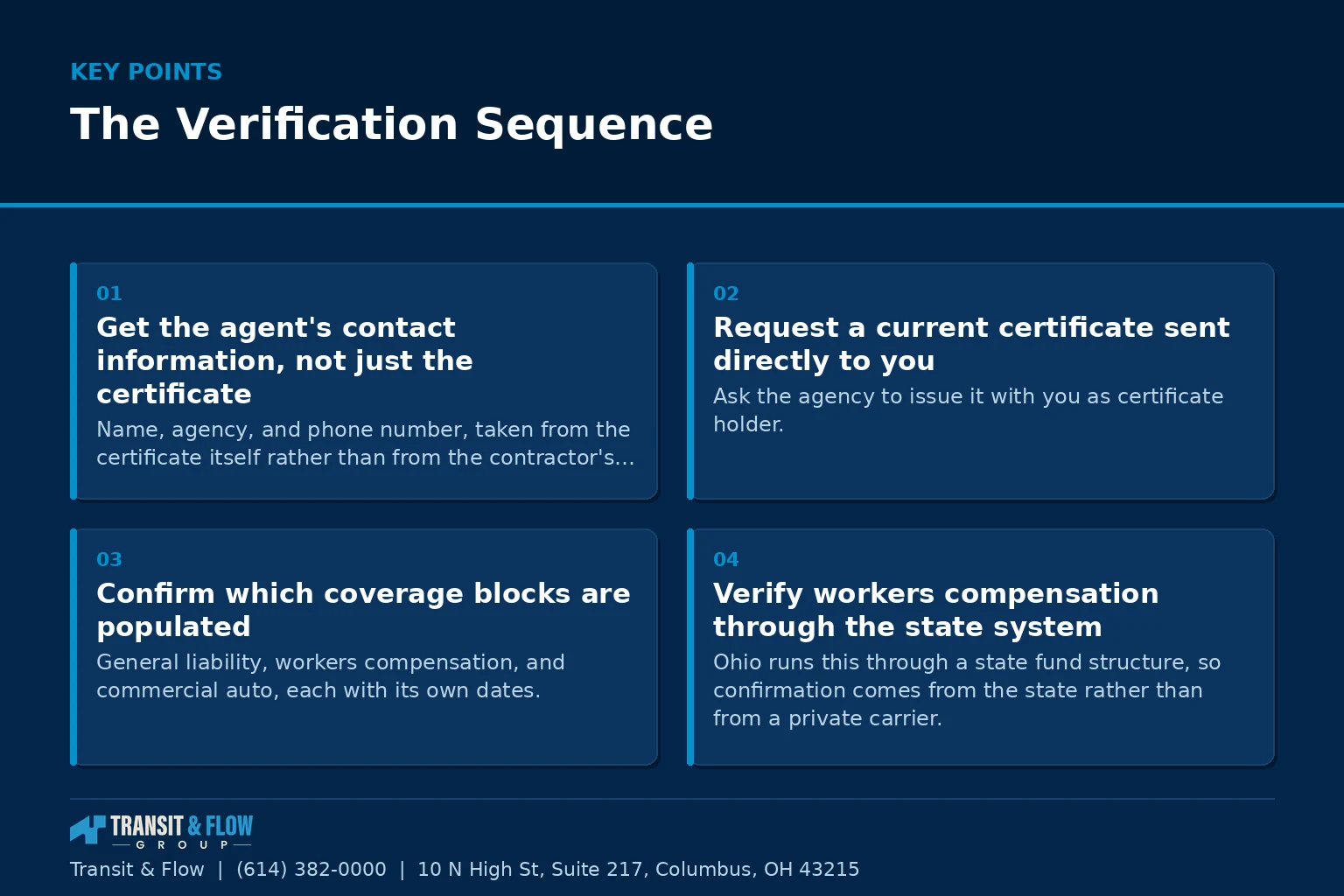
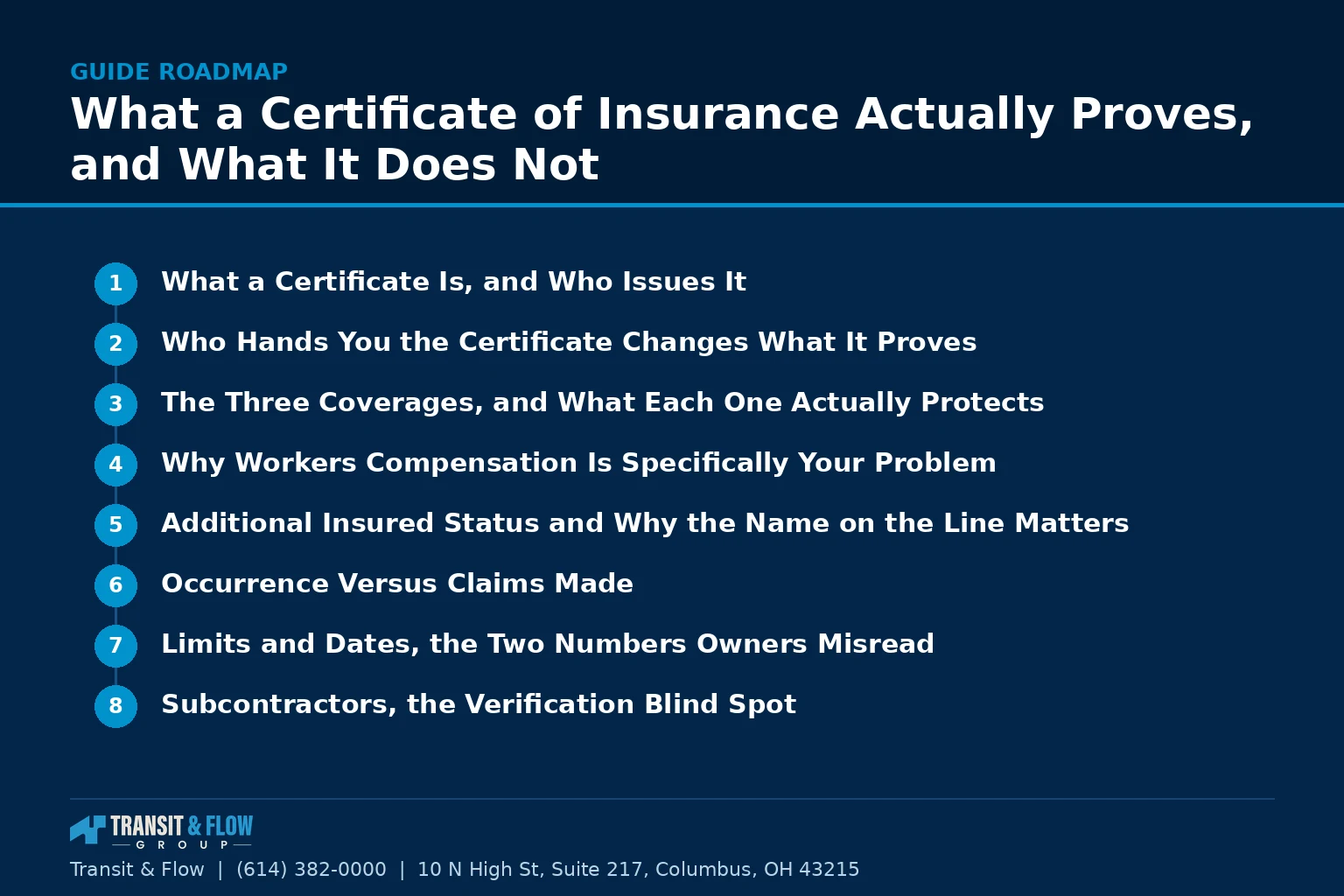
- What a Certificate Is, and Who Issues It
- Who Hands You the Certificate Changes What It Proves
- The Three Coverages, and What Each One Actually Protects
- Why Workers Compensation Is Specifically Your Problem
- Additional Insured Status and Why the Name on the Line Matters
- Occurrence Versus Claims Made
- Limits and Dates, the Two Numbers Owners Misread
- Subcontractors, the Verification Blind Spot
- Licensing Verification Is a Separate Step
- The Verification Sequence
- The Decision
- Where Transit & Flow Group Fits
- Frequently Asked Questions
Here is the thing most Central Ohio property owners get wrong. They treat the certificate as the end of the insurance conversation, when it is the beginning of one. A contractor hands over a folded page, the owner glances at the limits, sees numbers with commas in them, and considers the matter closed. The document was never designed to carry that weight.
This is general information, not legal or insurance advice. Coverage questions about your specific project belong with a licensed insurance professional or an attorney.
What a Certificate Is, and Who Issues It
The certificate is produced by the contractor’s insurance agent or broker, not by the contractor and generally not by the insurer. The agent pulls policy data into a standardized form and provides it to the contractor, who forwards it to whoever asked. The form itself carries language stating that it is issued as a matter of information only and confers no rights on the holder.
Read that language, because it is doing real work. The certificate does not amend, extend, or alter the underlying policy. If the policy excludes coverage for the exact work being done on your property, the certificate will not show it, because it summarizes coverage types and limits, not exclusions. Policies are long documents full of conditions. The certificate is a cover sheet.
Who Hands You the Certificate Changes What It Proves
A certificate that arrives as a PDF attached to an email from the contractor, or as a paper copy pulled from a truck, proves less than the same certificate sent to you directly by the agency that issued it. The difference is not about suspicion of any individual. It is about the chain of custody.
A certificate held by the contractor is a static file. It may be current. It may also have been issued eleven months ago, before a policy lapsed for nonpayment, before a carrier cancelled mid term, or before coverage was reduced at renewal. The document does not update itself. Digital files are also trivially editable, a problem with no honest solution other than removing the contractor from the delivery path.
The correction costs nothing. Ask for the agent’s name, agency, and phone number, then contact the agency yourself and request a current certificate sent directly to you. A legitimate contractor treats this as routine, because it is routine on every commercial project in Columbus. Reluctance at this step is itself information.
The Three Coverages, and What Each One Actually Protects
Certificates typically list several coverage types in separate blocks. Three of them carry most of the weight for a property owner hiring a contractor. They protect against different things, and having one does not imply having another.
- Commercial general liability. Responds to third party bodily injury and property damage arising from the contractor’s operations. This is the coverage that matters when a crew damages your structure, your neighbor’s fence, or a visitor to the site.
- Workers compensation. Covers injury to the contractor’s own employees. It is a separate system with separate rules, and it is the coverage most likely to become your problem if it is missing.
- Commercial auto. Covers vehicles used in the business. Relevant because trucks and trailers arrive at your property repeatedly, back into driveways, and park on streets in dense neighborhoods.
- Umbrella or excess liability. Sits above the underlying policies and extends limits once those are exhausted. It follows the terms of what it sits over, so it does not fix a gap in the underlying coverage.
- Builder’s risk. Covers the work in progress itself against damage before completion, a different exposure than liability to third parties.
These are separate purchases. A contractor can carry robust general liability and no workers compensation at all. The certificate shows both blocks either way, one filled in and one blank, and blank blocks are easy to skim past.
Why Workers Compensation Is Specifically Your Problem
General liability protects you from damage the contractor causes. Workers compensation protects you from a claim by an injured worker who has no other route to recovery. When a worker is hurt on a job site and there is no coverage behind them, the search for a responsible party does not stop at the contractor. It extends toward the property owner.
Ohio operates workers compensation through a state fund system rather than through the open insurance market that handles general liability. That structural difference matters when you verify, because the verification path runs through the state system rather than through a private carrier. What an active status does and does not mean for a particular worker on a particular day is a question for the state and for a licensed professional, not for a contractor’s own summary of it.
Two situations complicate this. Sole proprietors may be permitted to operate outside the standard employee coverage requirement, so a legitimate one person contractor may genuinely have no employee coverage. That can be fine, until the day they bring a helper. The second is subcontractors, because a general contractor’s coverage does not automatically extend to the crews they hire.
Additional Insured Status and Why the Name on the Line Matters
A certificate names a certificate holder. That means you received a copy of the summary. It gives you no standing under the policy. It is a mailing label.
Additional insured status is different in kind. It means the policy has been endorsed to extend certain protections to you, generally for liability arising out of the named insured’s work. If a claim arises and you are pulled into it, that status determines whether the contractor’s policy has any obligation toward you rather than only toward the contractor.
The status is created by an endorsement to the policy, not by a checkbox on the certificate. A certificate can display additional insured language while the underlying endorsement is absent, narrower than implied, or written to apply only to ongoing operations and not to completed work. The verification step is asking for the endorsement itself. Whether you need the status, and in what form, is a question for an insurance professional or an attorney before you sign.
Occurrence Versus Claims Made
Liability policies are written on one of two triggers, and the certificate indicates which. The distinction is simple to state and has consequences that surface years later.
An occurrence policy responds based on when the incident happened. If the damage occurred during the policy period, the policy is generally the one that responds, even if the claim surfaces later and even if that policy is long expired. A claims made policy responds based on when the claim is reported. Coverage depends on a policy being active at the time the claim is made, which means a lapse, a nonrenewal, or a contractor going out of business can leave nothing standing behind a problem that traces back to work already performed.
This matters more in construction because defects reveal themselves on a delay. Water intrusion and settlement in Central Ohio clay soils frequently take a freeze and thaw cycle or two before anyone notices. The trigger tells you whether the coverage you verified today relates at all to a problem discovered three winters from now.
Limits and Dates, the Two Numbers Owners Misread
The limits block draws the eye first and gets read wrong most often. A limit is a ceiling, not a guarantee, and a single figure rarely describes what is available for your loss.
- Per occurrence versus aggregate. The aggregate is the total available across the policy year for all claims from all customers. It is a pool, not an allocation, and a claim from another project in March reduces what remains for yours in October.
- Deductibles and retentions. Amounts the contractor absorbs before coverage engages. A contractor who cannot fund the retention creates a practical gap regardless of the stated limit.
- Exclusions the certificate does not show. Policies commonly exclude specific operations, materials, or conditions. The certificate summarizes what is covered, never what is carved out.
- Scope proportionality. A limit adequate for routine interior work is a different question than the same limit on structural work, excavation, or anything involving occupied commercial space.
- The effective and expiration dates. Each coverage block carries its own dates, and they do not always align with each other.
On dates, the gap risk is routinely missed. Policies are usually annual, and projects in Columbus regularly run past a policy expiration, particularly anything that stalls through a wet Central Ohio spring. Nothing notifies you when a policy lapses mid project. Where your schedule extends beyond a date shown on the certificate, make an updated certificate from the agency a contract obligation rather than a thing you intend to remember.
Subcontractors, the Verification Blind Spot
The certificate you were handed covers one business entity. It says nothing about the electrician, the excavator, or the concrete crew that entity hires. On most projects in Franklin County, a meaningful share of the labor on your property belongs to companies whose names never appeared on any document you saw.
Ask directly whether subcontractors will be used, which trades, and whether the general contractor collects certificates from each before they set foot on site. A disciplined operation has a file and describes the process without hesitation. A contractor who has never thought about it will say the subs are covered under their policy, which is generally not how it works.
This is also where the jurisdiction fragmentation of Central Ohio compounds the problem. A project touching Columbus, Dublin, Westerville, or an unincorporated township may pull in trade contractors registered in one place and not another, with insurance and licensing status that varies by company. Coordination failures across trades are their own category of risk, covered in our article on how responsibility gaps cost homeowners.
Licensing Verification Is a Separate Step
Insurance and licensing are unrelated systems, verified through different channels. A fully insured contractor may be unlicensed for the trade they are performing, and a licensed contractor may have let coverage lapse. Neither document speaks for the other.
Ohio licenses certain specialty trades at the state level, including electrical, plumbing, HVAC, hydronics, and refrigeration, through the state licensing board. General construction and most remodeling is not licensed at the state level, so the relevant requirement is local registration, which varies by municipality and township. Confirm specialty licensure with the state board and registration with the jurisdiction governing the property address.
The Verification Sequence
This is the order that works, because each step depends on the one before it. Run it before signing.
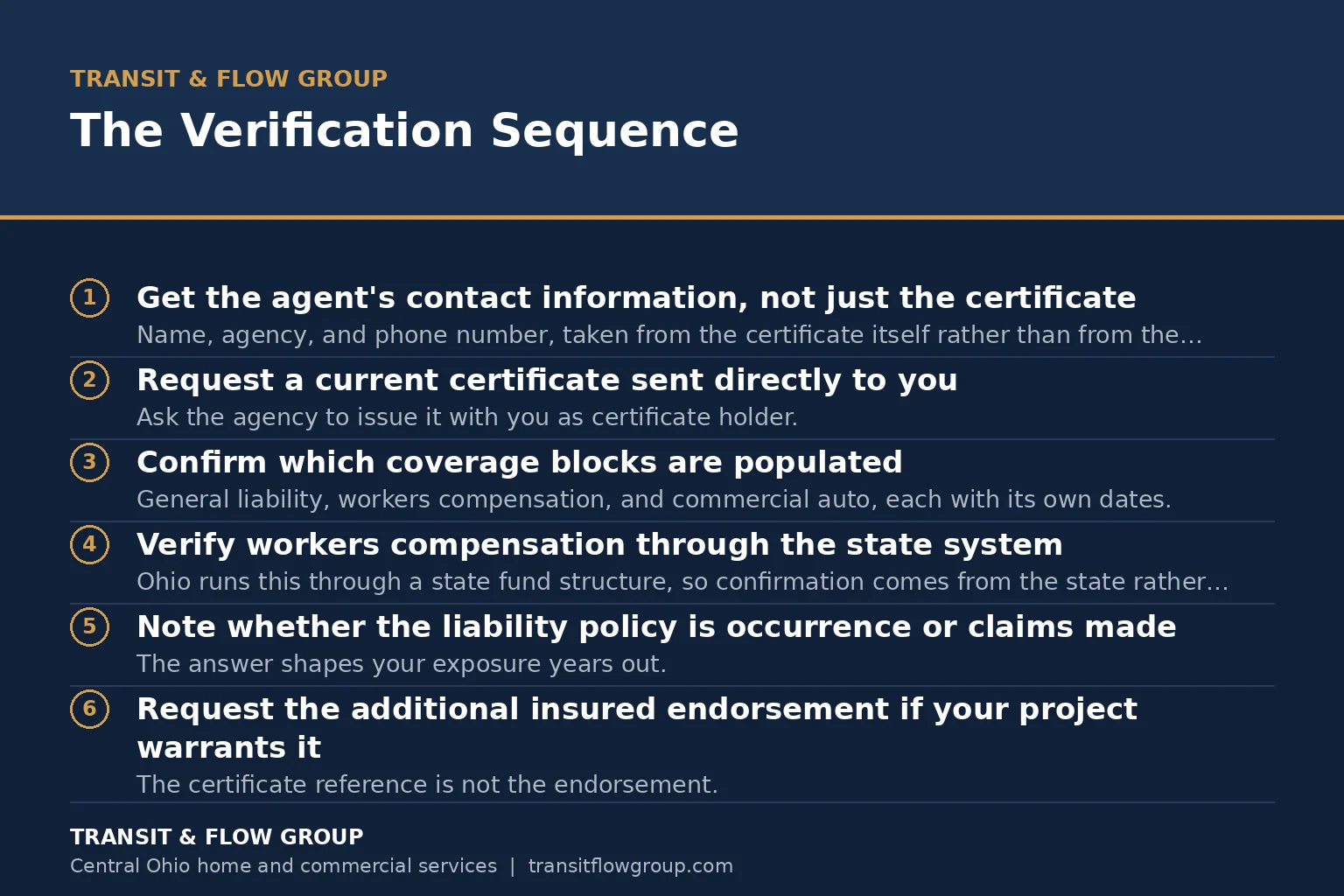
- Get the agent’s contact information, not just the certificate. Name, agency, and phone number, taken from the certificate itself rather than from the contractor’s word.
- Request a current certificate sent directly to you. Ask the agency to issue it with you as certificate holder. This single step resolves currency and authenticity at once.
- Confirm which coverage blocks are populated. General liability, workers compensation, and commercial auto, each with its own dates.
- Verify workers compensation through the state system. Ohio runs this through a state fund structure, so confirmation comes from the state rather than from a private carrier.
- Note whether the liability policy is occurrence or claims made. The answer shapes your exposure years out.
- Request the additional insured endorsement if your project warrants it. The certificate reference is not the endorsement.
- Compare expiration dates against your project schedule. Any overlap requires a contractual obligation to furnish updated certificates at renewal.
- Ask about subcontractors by trade and how their coverage is verified. Get the answer before the crews change.
- Verify licensing separately. State board for the specialty trades, local jurisdiction for registration.
- Keep the file. Certificates, endorsements, licensing confirmations, and dated notes, retained for the life of your ownership of the property.
The Decision
Option A. Accept the certificate the contractor hands you, confirm the limits look substantial, and proceed on the reasonable assumption that a document on a standardized form means what it appears to mean.
Option B. Treat the handed certificate as a lead rather than as proof. Obtain a current one directly from the issuing agency, verify workers compensation through the state system, verify licensing through a separate channel, ask the subcontractor question explicitly, and match expiration dates against the project schedule.
Recommendation: Option B, and the whole sequence costs a couple of phone calls. The asymmetry decides it. Option A works fine on the large majority of projects, because most contractors carry what they say they carry. Option B protects you on the small fraction where that is not true, and those are precisely the projects where an uninsured injury or an uncovered loss lands on the property owner. You cannot tell in advance which category you are in, which is why verification exists as a discipline. If you do only two things, have the certificate sent to you by the agency rather than by the contractor, and verify workers compensation and licensing as separate steps.
Where Transit & Flow Group Fits
We coordinate projects across Central Ohio, and insurance and licensing verification is a defined phase of project setup rather than paperwork collected at the end. Certificates come from issuing agencies directly, subcontractor coverage is verified before mobilization, and expiration dates are tracked against the schedule. If you have been handed a certificate and want a second read before you sign,start a conversation with our team. You can also review our deck and outdoor living services, our Central Ohio project planning guide, our guidance on evaluating existing structures, and our explanation of why footing work is inspected when it is.
Transit & Flow Group coordinates projects and partners with properly licensed and insured specialty contractors when licensing is required, and work is performed under the appropriate permits.
Frequently Asked Questions
What is a certificate of insurance
It is a summary document issued by an agent or broker describing policies in effect as of the date it was produced. It is informational. It does not itself grant coverage, amend the policy, or guarantee that coverage is still in force today.
Why should the certificate come from the agent rather than the contractor
Because a document handed to you can be outdated or altered, while one sent directly by the agent or insurer confirms the coverage as the issuer sees it. Requesting it directly is a small step that materially improves the evidence.
Why does workers compensation coverage matter to a property owner
Because it addresses what happens when someone is injured working on your property. Ohio operates workers compensation through a state system, and verifying a contractor’s standing there is a separate check from verifying liability coverage.
What does additional insured status mean
It means you have been added to the contractor’s policy for the specific exposure described, which can give you rights under that policy rather than merely knowledge of it. Whether it applies to your situation depends on the endorsement language, not the certificate.
Do higher coverage limits always mean better protection
Not by themselves. The limit is one variable alongside what the policy actually covers, the exclusions, whether the coverage responds on an occurrence or claims made basis, and whether the work you are contracting for falls inside the described operations.
Is verifying insurance enough on its own
No. Insurance verification and licensing verification are separate steps confirming different things, and both should be done through the issuing authority. This article is general information, and specific coverage questions belong with a licensed insurance professional or an attorney.
Sources
- Ohio Department of Insurance, insurance regulation and company licensing in Ohio
- Ohio Department of Insurance, Consumer Services, consumer guidance and complaint resources
- Ohio Construction Industry Licensing Board, state licensing for specialty trades
- Occupational Safety and Health Administration, construction site safety obligations
- Internal Revenue Service, employee and independent contractor classification
About This Guide
Written and edited by Micheal Parker, founder of Transit & Flow Group. Published July 10, 2027. This guide is checked against the agency and code sources listed above, and it is revised when those sources change.
General contractor of record. Micheal Parker holds City of Columbus General Contractor Registration G12064, issued by the Columbus Department of Building and Zoning Services under Transit & Flow LLC and valid through June 30, 2027. Trade work that falls outside the scope of that registration is performed by licensed trade partners, and the responsible license holder is identified before work begins.
Reviewed by Micheal Parker, City of Columbus registered general contractor, registration G12064. This guide covers a permit, structural, or life safety subject. It is written as evaluation guidance only. Every determination in it routes to the authority having jurisdiction and to a professional licensed in the applicable trade, and no statement here substitutes for that review.
Transit & Flow Group, home and commercial services for Columbus and the surrounding Central Ohio communities. Phone (614) 382-0000. Email solutions@transitflowgroup.com. 10 N High St, Suite 217, Columbus, OH 43215. Contact our team or review the communities we serve.
